Election Commissioners Immunity: Section 16 CEC Act 2023, Article 324 and the Supreme Court Challenge
Can a Chief Election Commissioner never be sued or prosecuted for official acts, even after retirement? On 13 October 2026 the Supreme Court agreed to examine this question. Here is what Section 16 says, how it compares with the protection given to judges and the President, and why it is being challenged under Articles 14 and 21.
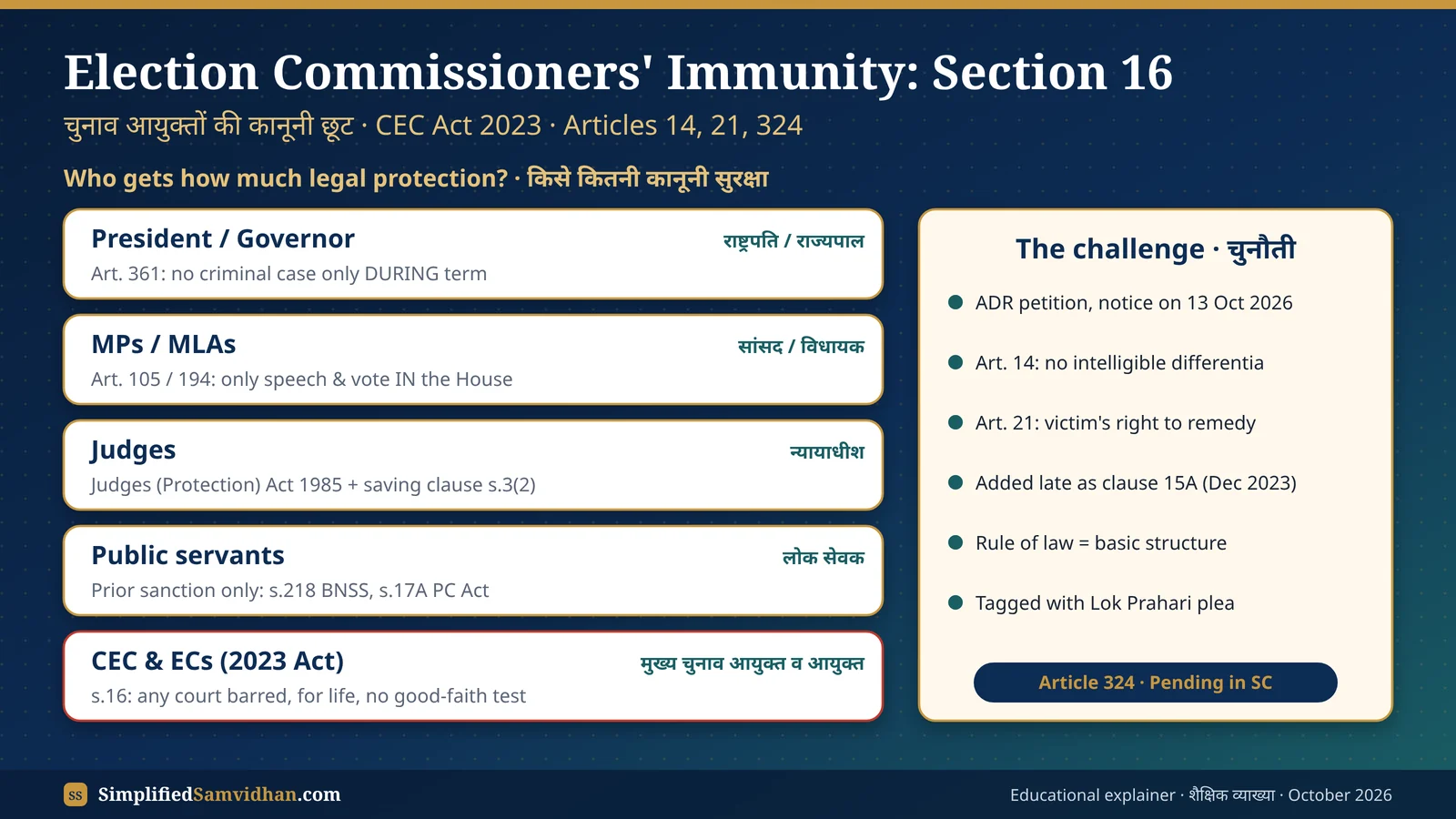
What happened on 13 October 2026
A Supreme Court bench of CJI Surya Kant, Justice Joymalya Bagchi and Justice V. Mohana issued notice to the Union of India and the Election Commission on a petition filed by the Association for Democratic Reforms (ADR), argued by Senior Advocate Gopal Sankaranarayanan. The petition challenges Section 16 of the Chief Election Commissioner and Other Election Commissioners (Appointment, Conditions of Service and Term of Office) Act, 2023, which bars courts from hearing any civil or criminal case against a serving or former CEC or Election Commissioner for acts done in official duty.
The petition was tagged with a pending petition by the NGO Lok Prahari on the same issue. ADR says the immunity is blanket, lifelong, not limited to good-faith acts and has no sanction mechanism, and so violates Articles 14 and 21 and the basic structure. It also asks that proceedings which ended when Section 16 came into force be revived. LiveLaw had earlier reported the Court remarking that the CEC and ECs enjoy greater legal immunity than even judges. No next date of hearing has been reported. The case is pending and Section 16 remains in force.
BackgroundSection 16 CEC Act 2023: How the Immunity Clause Was Added
| Date | What happened |
|---|---|
| 1950 | Article 324 creates the Election Commission; Parliament may make a law on appointments and service conditions. |
| 1991 | The Election Commission (Conditions of Service of Election Commissioners and Transaction of Business) Act, 1991 governs service conditions. It contains no immunity clause. |
| 1995 | T.N. Seshan v. Union of India: the Supreme Court upholds the multi-member Election Commission. |
| 2 Mar 2023 | Anoop Baranwal v. Union of India (Constitution Bench): until Parliament makes a law, the CEC and ECs are to be appointed on the advice of a committee of the PM, the Leader of Opposition (or leader of the largest opposition party) and the CJI. |
| Aug 2023 | The CEC Bill is introduced. Neither the original Bill nor its Statement of Objects and Reasons has any immunity clause. |
| 11 Dec 2023 | An official amendment adding a new clause 15A (the immunity clause) is circulated. |
| 12 Dec 2023 | Rajya Sabha passes the Bill with clause 15A on the same day it is moved; there is no debate on the clause and motions to refer the Bill to a select committee are negatived. |
| 21 Dec 2023 | Lok Sabha passes the Bill without amendment while many Opposition MPs are under suspension. Clause 15A becomes Section 16 of the Act. |
| 13 Oct 2026 | Supreme Court issues notice on ADR's petition, tagged with Lok Prahari's pending petition. Pending. |
Note: the appointment provisions of the 2023 Act (the Selection Committee without the CJI) are a separate challenge also pending in the Supreme Court. This page is about the immunity clause.
Official TextSection 16 CEC Act 2023: The Lifelong Immunity CEC Clause
16. Protection of Chief Election Commissioner and other Election Commissioners.
Notwithstanding anything contained in any other law for the time being in force, no Court shall entertain or continue any civil or criminal proceedings against any person who is or was a Chief Election Commissioner or an Election Commissioner for any act, thing or word, committed, done or spoken by him when, or in the course of acting or purporting to act in the discharge of his official duty or function.
Section 16 tells every court in India: do not hear any civil suit or criminal case against a person who is or was the CEC or an Election Commissioner, if the complaint is about something he did, or said, while performing (or claiming to perform) his official duty. Four features make it unusual:
- Lifelong: the words "is or was" mean the shield continues even after retirement.
- Blanket: it covers both civil and criminal cases.
- No good-faith test: the act need not be honest; "purporting to act" can cover acts merely claimed to be official.
- No sanction route or saving clause: nobody, not even the Government or a High Court, is given the power to allow a case to go ahead.
🏠 Everyday analogy
A school gives its exam controller a badge saying: "No complaint can ever be filed against me for anything I did as controller, even after I leave the school." Even if marks were wrongly changed, parents would have no forum to complain.
🇮🇳 Real Indian example
If a voter claims her name was wrongly deleted from the electoral roll due to an official decision, Section 16 would block a suit for damages against the CEC or EC personally. She could still challenge the decision itself through a writ petition, but not hold the officer personally liable.
What Section 16 does not bar: it bars civil and criminal proceedings against the person. It does not touch the constitutional writ jurisdiction of the High Courts (Article 226) and the Supreme Court (Article 32) to review the Election Commission's decisions, nor removal of the CEC under Article 324(5).
Constitutional BaseArticle 324: Why Election Commissioners Need Independence
324. Superintendence, direction and control of elections to be vested in an Election Commission.
(1) The superintendence, direction and control of the preparation of the electoral rolls for, and the conduct of, all elections to Parliament and to the Legislature of every State and of elections to the offices of President and Vice-President held under this Constitution shall be vested in a Commission (referred to in this Constitution as the Election Commission).
(2) The Election Commission shall consist of the Chief Election Commissioner and such number of other Election Commissioners, if any, as the President may from time to time fix and the appointment of the Chief Election Commissioner and other Election Commissioners shall, subject to the provisions of any law made in that behalf by Parliament, be made by the President.
(5) Subject to the provisions of any law made by Parliament, the conditions of service and tenure of office of the Election Commissioners and the Regional Commissioners shall be such as the President may by rule determine:
Provided that the Chief Election Commissioner shall not be removed from his office except in like manner and on the like grounds as a Judge of the Supreme Court and the conditions of service of the Chief Election Commissioner shall not be varied to his disadvantage after his appointment:
Provided further that any other Election Commissioner or a Regional Commissioner shall not be removed from office except on the recommendation of the Chief Election Commissioner.
Article 324 hands the whole election machinery (preparing voter lists and conducting elections to Parliament, State Legislatures, and the offices of President and Vice-President) to the Election Commission. The Constitution protects the CEC's independence in two ways: he can be removed only like a Supreme Court judge (by impeachment-style process for proved misbehaviour or incapacity), and his service conditions cannot be changed to his disadvantage after appointment. Other ECs can be removed only on the CEC's recommendation. Notice what the Constitution does not give: any immunity from courts. Section 16 adds that by an ordinary law.
🏠 Everyday analogy
A cricket umpire must be fearless, so the board says he cannot be sacked midway for an unpopular decision. That is job security. Section 16 goes further: it is like saying no one may ever take the umpire to any tribunal, even for taking a bribe disguised as a decision.
🇮🇳 Real Indian example
The 2023 Act sets up a Selection Committee of the Prime Minister, the Leader of Opposition and a Union Cabinet Minister nominated by the PM (the CJI recommended in Anoop Baranwal is replaced), with a Search Committee headed by the Law Minister. Earlier, the Dinesh Goswami Committee (1990) and the Law Commission's 255th Report (2015) had recommended a broader, collegium-style selection body including the CJI.
The Comparative SplitElection Commissioners Immunity vs Judges, President and Legislators
Why did the Court remark that ECs now enjoy more protection than judges? Compare Section 16 with other protections in Indian law:
| Office | Protection | Limits |
|---|---|---|
| President, Governors (Art. 361) | No criminal case during term; civil case only after two months' written notice. | Only during term of office; after it ends, ordinary law applies. |
| MPs, MLAs (Arts. 105, 194) | No court proceedings for anything said or any vote given in the House. | Only for speech and vote in the House, not for all official acts. |
| Judges (Judges (Protection) Act, 1985) | Section 3(1): courts shall not entertain civil or criminal proceedings for official or judicial acts. | Section 3(2) saves the power of the Government, the Supreme Court and High Courts to take civil, criminal or departmental action. |
| Public servants (Sec. 218 BNSS, earlier Sec. 197 CrPC; Sec. 17A PC Act) | Prior sanction or approval needed before prosecution or inquiry for official acts. | A filter, not immunity: cases proceed once sanction is given. |
| CAG, PSC members, Lokpal, Lokayuktas, Information Commissioners | No comparable blanket statutory immunity. | Ordinary law, with sanction rules where applicable. |
| CEC and ECs (Sec. 16, CEC Act 2023) | No civil or criminal proceedings for any official act, word or thing. | Lifelong, no good-faith test, no sanction route, no saving clause. |
🧑⚖️ Judges (Protection) Act, 1985
- Similar wording in Section 3(1): "is or was a Judge".
- Section 3(1) is expressly subject to sub-section (2).
- Section 3(2) keeps open civil, criminal or departmental action by the Government, the Supreme Court or a High Court.
- So a judge can still face action through the proper authority.
🗳️ Section 16, CEC Act 2023
- Same "is or was" wording, covering former office-holders.
- Begins with "Notwithstanding anything contained in any other law".
- No saving clause and no authority empowered to permit proceedings.
- Result: a wider shield than the one given to judges, which is why critics call it lifelong immunity.
361. Protection of President and Governors and Rajpramukhs.
(2) No criminal proceedings whatsoever shall be instituted or continued against the President, or the Governor of a State, in any court during his term of office.
(3) No process for the arrest or imprisonment of the President, or the Governor of a State, shall issue from any court during his term of office.
Even the President, the highest office in the Republic, is protected from criminal cases only while in office. The protection for legislators is limited to what they say or how they vote inside the House. Section 16 gives the CEC and ECs protection that is wider in time (lifelong) than the President's and wider in scope (no saving clause) than a judge's.
🏠 Everyday analogy
A school principal cannot be summoned to the police station while running the morning assembly, but once the term ends, he answers like anyone else. Section 16 is like giving the exam controller a pass that never expires.
🇮🇳 Real Indian example
A government doctor accused of negligence in a public hospital can be prosecuted once the competent authority grants sanction. A former Election Commissioner, under Section 16, cannot be prosecuted at all for official acts, as no authority can grant sanction.
Grounds of ChallengeIs Section 16 Valid? Article 14, Article 21 and Basic Structure
14. Equality before law.
The State shall not deny to any person equality before the law or the equal protection of the laws within the territory of India.
21. Protection of life and personal liberty.
No person shall be deprived of his life or personal liberty except according to procedure established by law.
- 1Reasonable classification (Article 14)
A law can treat a group differently only if there is an intelligible differentia and a rational nexus with the law's object (State of West Bengal v. Anwar Ali Sarkar, 1952). ADR argues that being a CEC is not a valid basis to place a person beyond all courts, and lifelong immunity has no nexus to independence while in office.
- 2Status-based protection struck down before
In Subramanian Swamy v. Director, CBI (2014), a Constitution Bench struck down Section 6A of the DSPE Act, which required prior Government approval to investigate officers of Joint Secretary rank and above. Classifying people by rank or status for protection from investigation was held to violate Article 14. ADR relies on this.
- 3Manifest arbitrariness (Article 14)
A law that is capricious, irrational or without an adequate determining principle can be struck down (Shayara Bano v. Union of India, 2017). The petition argues a blanket shield without a good-faith test or sanction route is manifestly arbitrary.
- 4Access to justice (Article 21)
Victims of wrongful acts have a right to a remedy. Closing every court door, civil and criminal, leaves a person harmed by an illegal official act with no remedy against the wrongdoer.
- 5Rule of law and basic structure
Equality before law (A.V. Dicey's idea that no one is above the law) and judicial review are part of the basic structure (Kesavananda Bharati, 1973). Indira Gandhi v. Raj Narain (1975) held free and fair elections to be part of the basic structure. ADR argues that unaccountable election officials weaken both.
The Court will ask two simple questions. First, is there a good reason to treat the CEC and ECs differently from every other public servant? Second, does a lifelong, unconditional shield actually serve that reason, or does it go far beyond it? If the answer to the second is "far beyond", the clause may be struck down or read down (for example, by reading in a good-faith requirement).
🏠 Everyday analogy
A shop gives its cashier insurance against false complaints from angry customers. That is fair. But a rule saying the cashier can never be questioned, even for stealing from the till, protects the wrong thing.
🇮🇳 Real Indian example
The petition notes that proceedings pending when Section 16 came into force came to an end because of it, and asks the Court to revive them. Whether the Court will do so is not known yet.
ArgumentsLifelong Immunity CEC: Arguments For and Against
✅ For the immunity
- Election Commissioners take tough calls during heated elections (model code action, poll schedules, roll revisions) and face many politically motivated complaints.
- Protection from vexatious, harassing suits helps them decide without fear of personal litigation.
- Article 324 aims at an independent Commission; personal immunity can be seen as supporting that independence.
- Their decisions still remain open to challenge by writ petitions and election petitions.
- Judges have a broadly similar statutory protection under the Judges (Protection) Act, 1985.
❌ Against the immunity
- Lifelong: protection after retirement has no link to independence while in office.
- No good-faith condition: covers even acts done with malice or corruption if they are "purported" official acts.
- No sanction mechanism or saving clause, unlike Sec. 218 BNSS or Sec. 3(2) of the Judges (Protection) Act.
- Wider than the President's own protection under Article 361, and wider than legislators' under Articles 105 and 194.
- Added late through an official amendment, without debate on the clause, and absent from the Bill's Statement of Objects and Reasons.
- Independence and accountability go together; trust in elections depends on the referee also being answerable.
Both sides agree that the CEC needs freedom from harassment. The disagreement is about how much protection is enough. A filter (like sanction) blocks frivolous cases while letting genuine ones through. A wall (like Section 16) blocks everything.
🏠 Everyday analogy
A mosquito net keeps out mosquitoes but lets air in. A sealed room keeps out mosquitoes too, but you cannot breathe. The debate is whether Section 16 is a net or a sealed room.
🇮🇳 Real Indian example
The general case made for such protection is to shield office-holders from suits arising from election-time decisions. Petitioners ADR and Lok Prahari argue that a narrower protection would achieve the same goal.
ReformsWay Forward: Balancing Independence and Accountability of Election Commissioners
- 1Good-faith qualifier
Limit protection to acts done in good faith in the discharge of official duty, a common pattern in Indian statutes.
- 2Sanction filter instead of a bar
Allow prosecution with prior sanction of a named authority, on the lines of Section 218 BNSS (earlier Section 197 CrPC), so frivolous cases are screened out.
- 3Limit to tenure
Like Article 361, any special shield could last only while the person holds office.
- 4Saving clause
Add a clause like Section 3(2) of the Judges (Protection) Act, 1985, keeping the power of the Government, Supreme Court and High Courts to act.
- 5Fix the appointment process
Independence comes mainly from how ECs are chosen. The Dinesh Goswami Committee (1990), the Law Commission's 255th Report (2015) and Anoop Baranwal (2023) all pointed to a broader selection body including the CJI. That challenge is pending.
- 6Transparent law-making
Major changes such as immunity clauses benefit from committee scrutiny and debate, rather than late official amendments.
The aim is a calibrated shield: strong enough to stop harassment, but not so wide that it puts anyone above the law. Whatever the Supreme Court decides will shape how much protection other constitutional and statutory bodies can claim in future.
🏠 Everyday analogy
A helmet protects a rider from serious injury, but it does not make him immune from traffic rules. Protection and responsibility can coexist.
🇮🇳 Real Indian example
Public servants across India, from district collectors to police officers, work with sanction protection, not total immunity, and still take difficult decisions every day.
UPSC CornerElection Commissioners Immunity for UPSC Prelims and Mains
- Prelims fact: Article 324(5): the CEC can be removed only in like manner and on like grounds as a Supreme Court judge; other ECs only on the CEC's recommendation.
- Prelims fact: Section 16 of the CEC Act, 2023 was added as clause 15A by an official amendment in December 2023; it was not in the original Bill.
- Prelims fact: Article 361 protects the President and Governors from criminal proceedings only during their term of office.
- Prelims fact: The 2023 Act's Selection Committee: PM, Leader of Opposition, and a Union Cabinet Minister nominated by the PM.
- Prelims fact: Subramanian Swamy v. Director, CBI (2014) struck down Section 6A of the DSPE Act under Article 14.
- Mains (250 words): "Independence of the Election Commission requires protection, not impunity." Critically examine Section 16 of the Chief Election Commissioner and Other Election Commissioners Act, 2023 in the light of Articles 14, 21 and 324.
- Essay angle: Who guards the guardians? Accountability of constitutional referees in a democracy.
- Ethics angle: Accountability versus fear of harassment in public office; integrity cannot depend only on legal immunity.
Election Commission seriesRead More: Election Commission of India Series
This page covers Section 16 immunity. For the full picture of the Commission, its history and every CEC, read the series below.
Practice MCQTest Yourself: Election Commissioners Immunity
With reference to the Chief Election Commissioner and Other Election Commissioners (Appointment, Conditions of Service and Term of Office) Act, 2023, consider the following statements: (1) Section 16 of the Act protects only serving, and not former, Election Commissioners from civil and criminal proceedings. (2) The immunity clause was not part of the Bill as originally introduced. (3) Under Article 324(5), an Election Commissioner other than the CEC can be removed only on the recommendation of the Chief Election Commissioner. Which of the statements given above is/are correct?
Doubts ClearedFrequently Asked Questions
What is Section 16 of the CEC Act 2023?
Section 16 of the Chief Election Commissioner and Other Election Commissioners (Appointment, Conditions of Service and Term of Office) Act, 2023 bars every court from entertaining or continuing any civil or criminal proceedings against a serving or former CEC or Election Commissioner for any act, thing or word done or spoken in the course of official duty.
Why is the immunity for Election Commissioners being challenged?
The Association for Democratic Reforms says the immunity is blanket and lifelong, is not limited to acts done in good faith, has no sanction mechanism or saving clause, and therefore violates Articles 14 and 21 and the basic structure. The Supreme Court issued notice on 13 October 2026; the case is pending.
Do judges have the same immunity as Election Commissioners?
No. The Judges (Protection) Act, 1985 has similar wording in Section 3(1), but Section 3(2) saves the power of the Government, the Supreme Court and High Courts to take civil, criminal or departmental action against a judge. Section 16 of the CEC Act has no such saving clause, so it is wider.
How can the Chief Election Commissioner be removed?
Under Article 324(5), the CEC can be removed only in the same manner and on the same grounds as a Supreme Court judge, that is, for proved misbehaviour or incapacity through a process in Parliament. Other Election Commissioners can be removed only on the recommendation of the CEC.
Can decisions of the Election Commission still be challenged in court?
Yes. Section 16 bars civil and criminal proceedings against the CEC and ECs personally. Decisions of the Election Commission can still be challenged through writ petitions under Articles 32 and 226, subject to the limits on interfering in an ongoing election process.
Sources and further readingSources We Checked
News facts on this page were checked against the reports below on 16 October 2026. The case is pending in the Supreme Court and the position may change.
- LiveLaw, 13 Oct 2026: Supreme Court issues notice on ADR's plea challenging lifelong immunity to CEC, Election Commissioners
- Legacy IAS: The Hindu News Analysis, 16 October 2026 (The debate over immunity to CEC, ECs)
- LawChakra: Supreme Court issues notice on plea challenging lifelong immunity for CEC and ECs
- Legislative Department, Government of India: The Constitution of India