Model Code of Conduct: The Rules of Fair Play in Indian Elections
Why ministers stop announcing new schemes the day elections are declared, what parties and candidates may not do, how a 1960 Kerala idea became national practice, and how you can report a violation.
What it isWhat Is the Model Code of Conduct? In Simple Words
Model Code of Conduct, Part I: General Conduct
(1) No party or candidate shall include in any activity which may aggravate existing differences or create mutual hatred or cause tension between different castes and communities, religious or linguistic.
(3) There shall be no appeal to caste or communal feelings for securing votes. Mosques, Churches, Temples or other places of worship shall not be used as forum for election propaganda.
Part VII: Party in Power
(i) The Ministers shall not combine their official visit with electioneering work and shall also not make use of official machinery or personnel during the electioneering work.
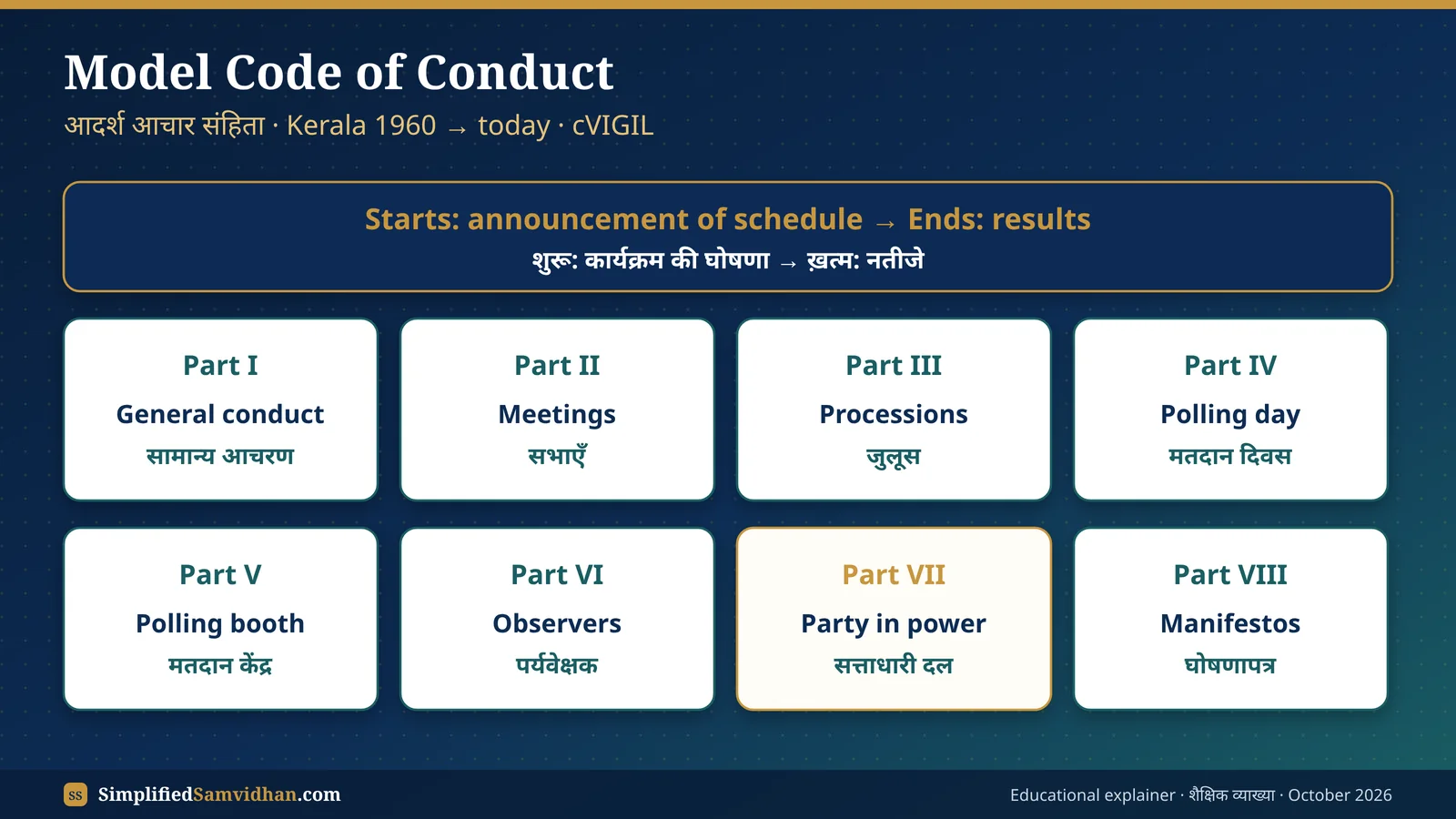
The Model Code of Conduct is a set of rules of fair play that parties, candidates and the government must follow from the day the Commission announces an election until the results are out. It is not a law passed by Parliament: it grew out of an agreement among parties and is enforced by the Election Commission under Article 324. Its main aim is simple: the party in power must not use the government's money, staff or announcements to win votes.
🏠 Everyday analogy
During a school sports day, the games teacher's own house team should not get the best ground, extra practice time or new shoes from the school budget. The MCC puts the same rule on the government during elections.
🇮🇳 Real Indian example
In April 2019 the Commission barred Uttar Pradesh Chief Minister Yogi Adityanath from campaigning for 72 hours and BSP chief Mayawati for 48 hours for remarks that appealed to religion.
The rulesModel Code of Conduct Rules: The Eight Parts and When It Applies
| Part | Covers | Example rule |
|---|---|---|
| I | General conduct | Criticise policies, not private lives; no caste or religious appeals; no bribing or intimidating voters |
| II | Meetings | Tell the police in advance; get permission for loudspeakers |
| III | Processions | Fix time and route in advance; do not burn effigies of rivals |
| IV | Polling day | No liquor distribution; identity badges for party workers; no crowding near booths |
| V | Polling booth | Only voters and those with a valid pass from the Commission may enter |
| VI | Observers | Complaints can be given to the Commission's observers |
| VII | Party in power | No new schemes, grants, foundation stones or project announcements; no official vehicles for campaigning; no government-paid ads |
| VIII | Election manifestos | Promises must not go against the Constitution; parties should explain how freebies will be funded |
HistoryHistory of the Model Code of Conduct: Kerala 1960 to cVIGIL
- 11960
Kerala's Assembly election: the administration and parties agree on a short code of conduct, the first of its kind.
- 21962
The Election Commission circulates a code to all recognised parties for the general election.
- 31979
A section on the 'party in power' is added to stop misuse of official position.
- 41991
Under T. N. Seshan the Code is enforced strictly, even postponing polls when needed.
- 52013
After the Supreme Court's freebies ruling (S. Subramaniam Balaji), guidelines on manifestos are added.
- 62018
The cVIGIL app lets any citizen send a photo or video of a violation; the target is action within 100 minutes.
EnforcementHow the Model Code Is Enforced, and Should It Be a Law?
Without a law, how is it enforced?
- Notice to the leader or party, with a short deadline to reply
- Censure, warning or a ban on campaigning for hours or days
- Transfer of officers, stopping of schemes and ads
- FIRs where the act is also a crime under the RP Act 1951 or the Bharatiya Nyaya Sanhita (bribery, undue influence)
- Under the Symbols Order, even suspension or withdrawal of a party's recognition
Should it become a law?
- For: legal backing, clear penalties (a Parliamentary Standing Committee suggested this in 2015)
- Against: court cases would take years and the election would be over (the Commission's view)
- Against: its moral force comes from all-party consent
Connect the dotsRead Next: Related Notes
- The power behind the Code: Powers of the Election Commission (Article 324).
- Where the Code fits in the calendar: Election process step by step.
- Money, freebies and donations: NOTA, electoral bonds and election funding.
- When a corrupt practice can unseat a winner: Election petition.
- Hate speech limits on free speech: Article 19.
Quick revisionOne-Line Revision Points (Exam Ready)
- MCC is not a statute; ECI enforces it under Article 324.
- First code: Kerala Assembly election, 1960.
- Applies from the announcement of the schedule to the result (Harbans Singh Jalal, 2001).
- Part VII binds the party in power; Part VIII covers manifestos.
- Strict enforcement began under T. N. Seshan (1990s).
- Citizen complaints: cVIGIL app (2018).
- Manifesto guidelines followed S. Subramaniam Balaji (2013).
Practice MCQPractice MCQs (with Answers): Model Code of Conduct
In which State was a Model Code of Conduct first used, in 1960?
The Model Code of Conduct comes into force:
Consider: 1. The Model Code of Conduct is part of the RP Act, 1951. 2. It bars ministers from combining official visits with campaigning. Which is/are correct?
Which app lets citizens report Model Code violations with photos or videos?
Guidelines on election manifestos were added to the MCC after which case?
Doubts ClearedFrequently Asked Questions
What is the Model Code of Conduct?
A set of guidelines from the Election Commission for parties, candidates and governments, in force from the announcement of an election to the result, to keep the contest fair.
Is the Model Code of Conduct legally binding?
It is not a law, but the Commission enforces it under Article 324, and many violations are also offences under the RP Act, 1951 and the Bharatiya Nyaya Sanhita.
Can the government start new schemes during the Model Code?
No new schemes, grants, foundation stones or promises of roads and water supply may be announced. Ongoing schemes may continue, and emergencies such as relief work are allowed.
How can I complain about a Model Code violation?
Use the cVIGIL app to upload a photo or video with location, call the voter helpline 1950, or write to the Returning Officer or the Commission's observer.
Sources and further readingSources We Checked
Facts checked on 21 October 2026. The quoted lines are from the Model Code as published by the Election Commission; the Hindi lines are a simple rendering.