Disqualification of MPs and MLAs: Article 102 and the Representation of the People Act, 1951
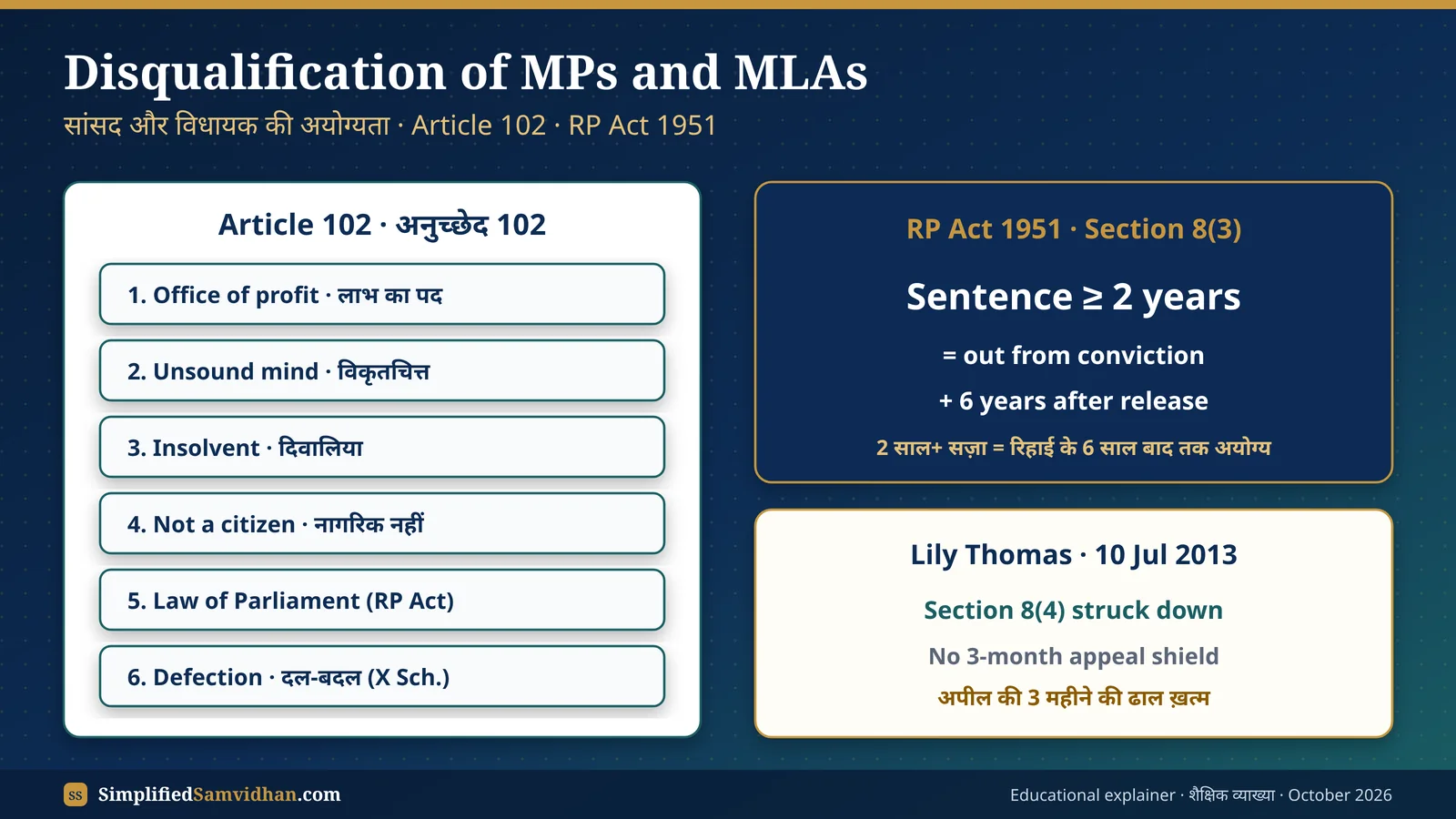
Who cannot become or stay an MP or MLA, how a two-year sentence ends a career, who decides each kind of disqualification, and the rules on candidates with criminal cases.
The ConstitutionDisqualification of MPs and MLAs: Articles 102 and 191 Explained
102. Disqualifications for membership.— (1) A person shall be disqualified for being chosen as, and for being, a member of either House of Parliament—
(a) if he holds any office of profit under the Government of India or the Government of any State, other than an office declared by Parliament by law not to disqualify its holder;
(b) if he is of unsound mind and stands so declared by a competent court;
(c) if he is an undischarged insolvent;
(d) if he is not a citizen of India, or has voluntarily acquired the citizenship of a foreign State, or is under any acknowledgment of allegiance or adherence to a foreign State;
(e) if he is so disqualified by or under any law made by Parliament.
(2) A person shall be disqualified for being a member of either House of Parliament if he is so disqualified under the Tenth Schedule.
To sit in Parliament or an Assembly you must pass two tests. First, the qualifications (Article 84 and 173): be a citizen, take the oath, be at least 25 (Lok Sabha, Assembly) or 30 (Rajya Sabha, Council), and be a registered voter. Second, you must not be disqualified: no paid post under the government ('office of profit'), no declared unsoundness of mind, no undischarged insolvency, no foreign citizenship, no defection, and no disqualification under the RP Act, 1951, mainly for criminal convictions.
🏠 Everyday analogy
A cricket selector cannot also be a player in the team: that is the logic of 'office of profit'. And a player banned for match-fixing cannot walk back into the team just by filing an appeal: that is the logic of Lily Thomas.
🇮🇳 Real Indian example
On 23 March 2023 a Surat court sentenced Rahul Gandhi to two years in a defamation case; the Lok Sabha notified his disqualification the next day. The Supreme Court stayed the conviction on 4 August 2023 and his membership was restored on 7 August.
RP Act 1951Disqualification Under the Representation of the People Act 1951: Section 8 and Lily Thomas
| Section (RP Act 1951) | Ground | Period |
|---|---|---|
| 8(1) | Conviction for listed offences (promoting enmity, bribery, rape, untouchability, terrorism, dowry, and others) | Fine only: 6 years from conviction. Prison: from conviction + 6 years after release |
| 8(3) | Conviction for any offence with a sentence of 2 years or more | From conviction + 6 years after release |
| 8A | Found guilty of a corrupt practice (decided by the President on the Commission's opinion) | Up to 6 years |
| 9 | Dismissed from government service for corruption or disloyalty | 5 years |
| 9A | Holding a government contract for supply or works | While the contract lasts |
| 10A | Not filing the election expense account (Election Commission's order) | 3 years |
| 11 | The Commission may remove or reduce a disqualification for recorded reasons (except under Section 8A) | — |
Who decidesWho Decides Disqualification: President, Speaker or Election Commission?
| Type | Who decides | Article / law |
|---|---|---|
| Office of profit, insolvency, citizenship, unsound mind (sitting member) | President (MPs) or Governor (MLAs), bound by the Election Commission's opinion | Arts. 103, 192 |
| Criminal conviction | Automatic on conviction; the House secretariat notifies the vacancy | Sec. 8, RP Act 1951 |
| Defection | Speaker or Chairman, subject to judicial review (Kihoto Hollohan, 1992); should decide in about three months (Keisham Meghachandra Singh, 2020) | Tenth Schedule (52nd Amendment, 1985) |
| Not filing expense account | Election Commission | Sec. 10A |
Criminal casesCriminal Candidates: Disclosure Rules and the Debate on a Ban
- 1Affidavit with nomination
Every candidate declares pending criminal cases, convictions, assets, liabilities and education (Union of India v. ADR, 2002; Form 26).
- 2Publicity in newspapers and TV
Candidates and parties must publish criminal cases at least three times (Public Interest Foundation, 2018).
- 3Parties must explain
Parties must post on their website why they chose a candidate with criminal cases, within 48 hours of selection (Rambabu Singh Thakur, 13 February 2020).
Should charge-sheeted persons be barred?
- Yes: cleaner politics; many winners face serious cases
- Law Commission (244th Report, 2014) suggested a bar after charges are framed for serious offences
No
- Innocent until proven guilty
- False cases against rivals would rise
- Only Parliament can add new disqualifications (Art. 102(1)(e))
Connect the dotsRead Next: Related Notes
- The Commission's advisory role: Powers of the Election Commission.
- Unseating a winner through the courts: Election petition and Article 329.
- Spending accounts and Section 10A: Election funding rules.
- Anti-defection and the Tenth Schedule: 12 Schedules of the Constitution.
- The 52nd Amendment in context: Important Amendments.
Quick revisionOne-Line Revision Points (Exam Ready)
- MPs: Article 102; MLAs: Article 191.
- Grounds: office of profit, unsound mind, insolvency, foreign citizenship, any law of Parliament, defection.
- Section 8(3): sentence of 2 years or more → disqualified till 6 years after release.
- Lily Thomas (10 July 2013) struck down Section 8(4).
- Election Commission's opinion binds the President: Article 103.
- Defection: Tenth Schedule (52nd Amendment, 1985), decided by the Speaker.
- Not filing expenses: 3 years (Section 10A).
- Criminal record disclosure: Public Interest Foundation (2018), Rambabu Singh Thakur (2020).
Practice MCQPractice MCQs (with Answers): Disqualification of MPs and MLAs
Which case struck down Section 8(4) of the RP Act, 1951?
A sitting MP is sentenced to two years in prison. When does the disqualification begin?
Who decides a question of disqualification of an MP for holding an office of profit?
Which Amendment added the Tenth Schedule (anti-defection law)?
For how long can the Election Commission disqualify a person for failing to lodge an account of election expenses?
Doubts ClearedFrequently Asked Questions
When is an MP disqualified after conviction?
If sentenced to two years or more for any offence (or convicted of listed offences), from the date of conviction until six years after release.
What is an office of profit?
A post under the Union or State government that can give pay or benefits. Holding one disqualifies a legislator unless Parliament or the State Legislature has exempted that post by law.
Can a disqualified MP get the seat back?
Yes, if a higher court stays or sets aside the conviction, as happened with Rahul Gandhi in August 2023.
Who decides anti-defection cases?
The Speaker or Chairman of the House under the Tenth Schedule; the decision can be challenged in court.
Sources and further readingSources We Checked
Facts checked on 21 October 2026. Article 102 is quoted from the Constitution; RP Act sections are summarised.