NOTA, Electoral Bonds and Election Funding in India
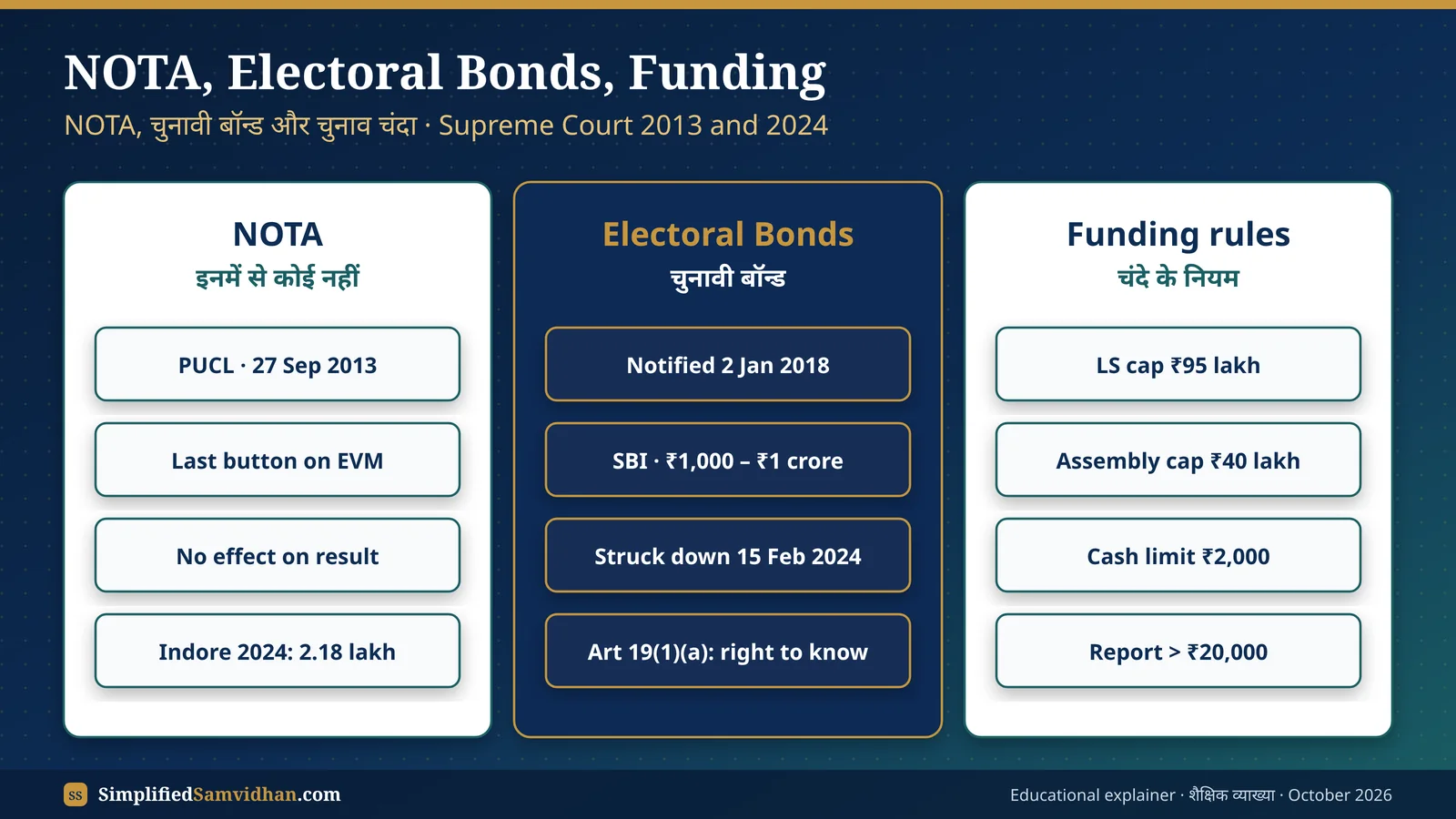
Your right to reject every candidate, your right to know who funds the parties, and the rules on how much candidates may spend: three Supreme Court-shaped parts of Indian elections.
NOTAWhat Is NOTA? None of the Above Explained
NOTA (None of the Above) is the last button on every EVM. It lets you say officially, and secretly, that you reject every candidate. In PUCL v. Union of India (27 September 2013) the Supreme Court held that the right to reject is part of the freedom of expression and must be secret, so the Commission added the button. But NOTA cannot defeat anyone: even if NOTA gets the most votes, the candidate with the most votes among the rest wins.
🏠 Everyday analogy
It is like giving 'zero stars' in a restaurant review: the restaurant still stays open, but everyone can see how many customers were unhappy.
🇮🇳 Real Indian example
In Indore in 2024, after the main opposition candidate withdrew, about 2.18 lakh voters pressed NOTA, the highest ever in a Lok Sabha seat, yet the leading candidate won by a record margin.
Electoral bondsElectoral Bonds Case: Scheme, Supreme Court Verdict (2024) and After
Article 19. (1) All citizens shall have the right— (a) to freedom of speech and expression;
RP Act, 1951, Section 29C (as it stands after the 2024 judgment): the treasurer of every political party shall, each financial year, prepare a report of contributions in excess of twenty thousand rupees received from any person or company, and submit it to the Election Commission.
Supreme Court, ADR v. Union of India (15 February 2024), in substance: the Electoral Bond Scheme and the 2017 amendments to the RP Act, the Companies Act and the Income-tax Act that made donations anonymous are violative of Article 19(1)(a) (the voter's right to information) and unconstitutional.
- 1
💼 2017-18: the scheme
The Finance Act 2017 changed four laws, and the Electoral Bond Scheme was notified on 2 January 2018: bonds of Rs 1,000 to Rs 1 crore, sold only by SBI, given to a party without the donor's name being public. The cap on company donations (7.5% of profits) was removed.
- 2
⚖️ 15 February 2024: struck down
A five-judge Bench led by CJI D. Y. Chandrachud unanimously struck down the scheme and the related amendments: voters have a right to know who funds parties, and unlimited anonymous company money risks quid pro quo.
- 3
📊 March 2024: data out
On the Court's order SBI gave the details, and the Election Commission put them on its website on 14 March 2024, later with the bond numbers that link donors to parties.
Funding rulesElection Funding in India: Spending Limits and Donation Rules
| Rule | What it says |
|---|---|
| Candidate spending cap (Rule 90, Conduct of Election Rules, revised 2022) | Lok Sabha: Rs 95 lakh in larger States, Rs 75 lakh in smaller ones. Assembly: Rs 40 lakh / Rs 28 lakh |
| Party spending | No upper limit; parties file expenditure statements after elections |
| Cash donations | Not more than Rs 2,000 from one person in cash |
| Reporting donations | Donations above Rs 20,000 must be reported to the Commission (Section 29C) |
| Expense account | Every candidate files it within 30 days of the result; failure can bring a 3-year disqualification (Section 10A) |
| Electoral trusts | Companies can give through registered electoral trusts that disclose donors and recipients |
Ideas for cleaner funding
- Partial State funding of elections (Indrajit Gupta Committee, 1998)
- A cap on party spending, not just candidate spending
- All donations through banks with public disclosure
Why it is hard
- Real spending is far above the caps
- Donors fear being targeted by rivals
- Freebies promised from public money blur the line
Connect the dotsRead Next: Related Notes
- The button on the machine: EVM and VVPAT.
- Freebie promises and manifesto rules: Model Code of Conduct.
- Disqualification for not filing expenses: Disqualification of MPs and MLAs.
- Freedom of expression behind NOTA and the bonds case: Article 19.
Quick revisionOne-Line Revision Points (Exam Ready)
- NOTA: PUCL v. Union of India, 27 September 2013.
- NOTA has no electoral effect: the top candidate still wins.
- First used: Assembly elections of Nov-Dec 2013.
- Record NOTA: Indore, 2024 (about 2.18 lakh votes).
- Electoral Bond Scheme notified 2 January 2018; sold only by SBI.
- Struck down unanimously on 15 February 2024 (Art. 19(1)(a), right to information).
- Donations above Rs 20,000 must be reported (Sec. 29C); cash limit Rs 2,000.
- Lok Sabha candidate cap: Rs 95 lakh (larger States).
Practice MCQPractice MCQs (with Answers): NOTA and election funding
Which judgment introduced the NOTA option?
If NOTA gets the highest number of votes in a constituency, then:
On what ground did the Supreme Court strike down the Electoral Bond Scheme?
Which bank was the only seller of electoral bonds?
Consider: 1. There is a legal limit on how much a political party may spend in an election. 2. Donations above Rs 20,000 to a party must be reported to the Election Commission. Which is/are correct?
Doubts ClearedFrequently Asked Questions
What is NOTA in elections?
NOTA means 'None of the Above'. It is the last option on the EVM for voters who want to reject all candidates secretly.
Is the electoral bond scheme still running?
No. The Supreme Court struck it down on 15 February 2024 and the sale of bonds stopped.
What is the election expenditure limit for a Lok Sabha candidate?
Rs 95 lakh in larger States and Rs 75 lakh in smaller States and some UTs, as revised in January 2022.
Can NOTA lead to re-election?
Not in Lok Sabha or Assembly elections under current law. A few State Election Commissions have experimented with such rules for local body polls.
Sources and further readingSources We Checked
Facts checked on 21 October 2026. The quotation is from the operative conclusion of the 2024 judgment; Section 29C is given in substance.
- Constitution of India, Part XV (Legislative Department)
- Representation of the People Act, 1951 (India Code)
- Election Commission of India (official website)
- Supreme Court of India: Association for Democratic Reforms v. Union of India (electoral bonds), 15 February 2024
- Supreme Court Observer: Electoral Bonds case