Special Summary Revision of Voter List 2027: What the SSR Means Under Articles 324, 325 and 326
The Election Commission has ordered the yearly clean-up of voter lists in 17 States and UTs, and for the first time parties will get text-readable rolls. What is a Special Summary Revision, how is it different from the SIR, which Articles of the Constitution govern your vote, and how do you make sure your own name is on the list?
What happened in October 2026
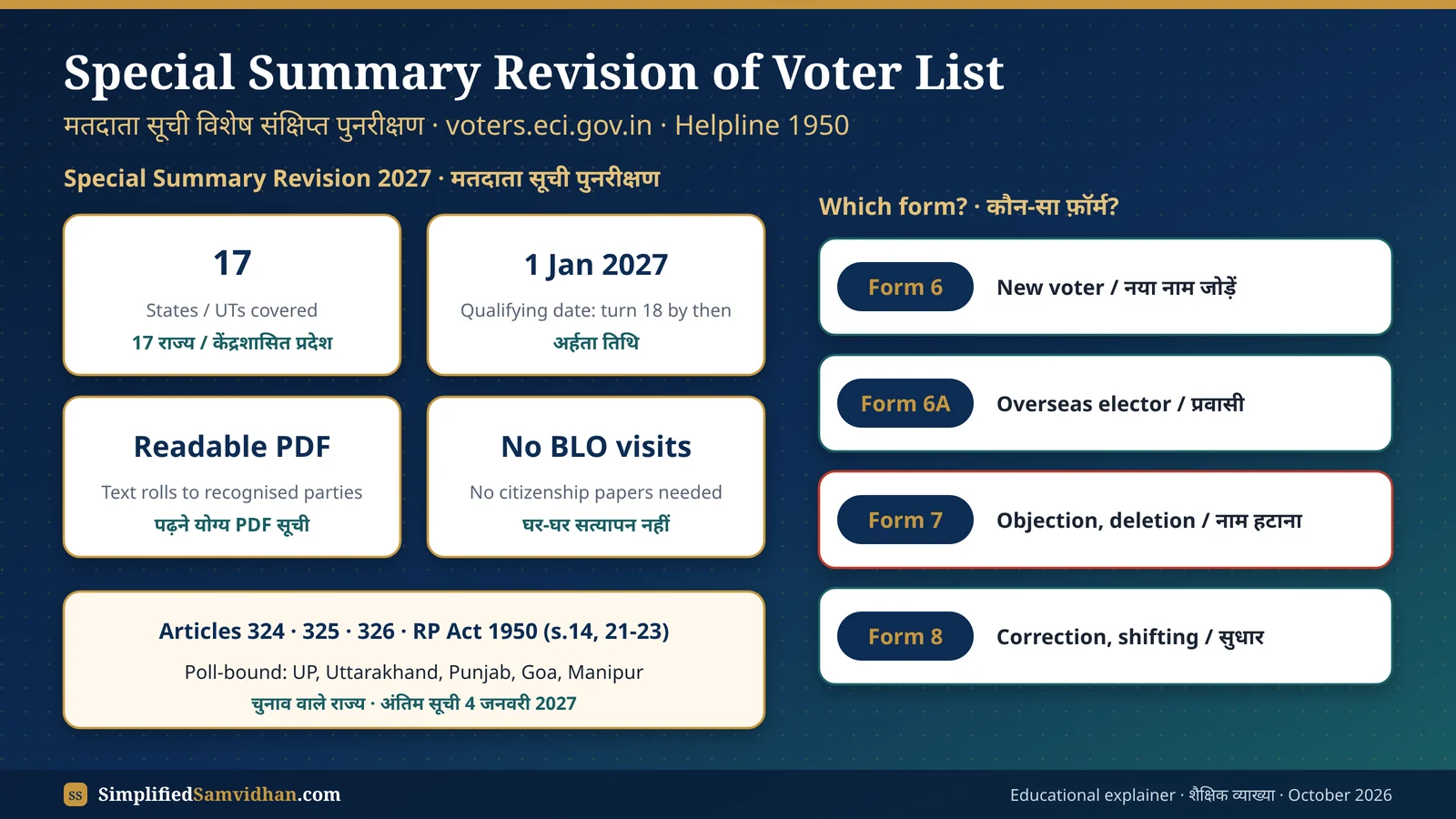
On Thursday, 15 October 2026, the Election Commission of India (ECI) ordered the annual Special Summary Revision (SSR) of electoral rolls, with 1 January 2027 as the qualifying date, in 17 States and Union Territories: Andaman and Nicobar Islands, Assam, Bihar, Chhattisgarh, Goa, Gujarat, Kerala, Lakshadweep, Madhya Pradesh, Manipur, Puducherry, Punjab, Rajasthan, Tamil Nadu, Uttar Pradesh, Uttarakhand and West Bengal. Assembly elections are due early next year in Uttar Pradesh, Uttarakhand, Goa, Punjab and Manipur (UP's Assembly term ends on 22 May 2027; the others in March 2027). Reports say the final rolls in the poll-bound States will be published on 4 January 2027.
Three things are new or different this time:
- Readable PDF rolls: for the first time, recognised political parties (and candidates in poll-bound States) will get draft and final rolls, without photos, as text-searchable PDFs instead of scanned image PDFs, along with supplements listing every addition, deletion and modification. EROs will also share weekly lists of claims and objections.
- No house-to-house visits: these States have already gone through the Special Intensive Revision (SIR). In the SSR, Booth Level Officers do not go door to door, applicants need no citizenship documents and no mapping to older rolls, and draft lists are displayed at polling booths.
- A cap on mass objections: a Booth Level Agent of a party may file up to 10 forms a day; if a BLA files more than 30 in the revision period, the ERO or AERO must cross-verify them personally.
Why it matters: the SSR was skipped last year because the SIR was under way. A special drive since 29 September 2026 is trying to re-enrol eligible voters left out after SIR deletions, which The Hindu's analysis puts at about 13 crore (a reported figure). The Opposition welcomed the readable-roll decision; the ECI had earlier refused it citing tampering and privacy risks.
The BasicsWhat Is the Special Summary Revision of Voter List?
An electoral roll (voter list) is the official list of people entitled to vote in a constituency. Every year people turn 18, move house, get married, or pass away, so the list must be updated. The Special Summary Revision (SSR) is the ECI's regular, usually yearly, update of this list with reference to a qualifying date, here 1 January 2027.
In a summary revision, the existing roll is published as a draft; citizens and parties file claims (to add names) and objections (to remove wrong names) within a fixed window; the Electoral Registration Officer (ERO) decides them; and the final roll is published. In an intensive revision, the roll is prepared afresh through door-to-door enumeration.
| Term | Meaning |
|---|---|
| ECI | Election Commission of India, a constitutional body under Article 324. |
| CEO | Chief Electoral Officer of a State or UT. |
| ERO / AERO | Electoral Registration Officer and Assistant ERO, who decide claims and objections for a constituency. |
| BLO | Booth Level Officer, a government official who looks after the roll of one polling booth. |
| BLA | Booth Level Agent appointed by a recognised political party for a booth. |
| Qualifying date | The date on which you must be 18 to be enrolled in that revision (1 January 2027 here). |
| EPIC | Electors Photo Identity Card, the voter ID card. |
Official TextArticle 324: Election Commission Controls the Voter List
324. Superintendence, direction and control of elections to be vested in an Election Commission.
(1) The superintendence, direction and control of the preparation of the electoral rolls for, and the conduct of, all elections to Parliament and to the Legislature of every State and of elections to the offices of President and Vice-President held under this Constitution shall be vested in a Commission (referred to in this Constitution as the Election Commission).
The Constitution does not leave the voter list to the government of the day. Article 324 hands the preparation of electoral rolls, and the conduct of elections, to an independent Election Commission. That is why the ECI, not a ministry, orders an SSR or an SIR, issues the forms, and fixes the schedule. The Supreme Court has called Article 324 a "reservoir of power" that the ECI can use where the law is silent, but always fairly and within the law (Mohinder Singh Gill v. Chief Election Commissioner, 1978).
🏠 Everyday analogy
In a school exam, the board, not the school whose students are writing, prepares the roll-number list. A neutral referee keeps the list so that no team can quietly drop the other side's players.
🇮🇳 Real Indian example
When the ECI decided on 15 October 2026 to give readable PDF rolls to parties, it was using this superintendence power over the preparation of rolls.
Official TextArticles 325 and 326: One Roll, Adult Suffrage at 18
325. No person to be ineligible for inclusion in, or to claim to be included in a special, electoral roll on grounds of religion, race, caste or sex.
There shall be one general electoral roll for every territorial constituency for election to either House of Parliament or to the House or either House of the Legislature of a State and no person shall be ineligible for inclusion in any such roll or claim to be included in any special electoral roll for any such constituency on grounds only of religion, race, caste, sex or any of them.
326. Elections to the House of the People and to the Legislative Assemblies of States to be on the basis of adult suffrage.
The elections to the House of the People and to the Legislative Assembly of every State shall be on the basis of adult suffrage; that is to say, every person who is a citizen of India and who is not less than eighteen years of age on such date as may be fixed in that behalf by or under any law made by the appropriate Legislature and is not otherwise disqualified under this Constitution or any law made by the appropriate Legislature on the ground of non-residence, unsoundness of mind, crime or corrupt or illegal practice, shall be entitled to be registered as a voter at any such election.
Article 325 says there is one common voter list for each constituency. Nobody can be kept off it, or put on a separate list, only because of religion, race, caste or sex. India rejected the colonial system of separate electorates.
Article 326 gives the vote to every citizen aged 18 or above on the qualifying date, unless a law disqualifies them for non-residence, unsoundness of mind, crime, or corrupt or illegal practice. The age was 21 until the 61st Amendment Act, 1988 lowered it to 18 (in force from 28 March 1989).
🏠 Everyday analogy
One school, one attendance register for every class. You cannot be removed from it because of your surname, and you do not need anyone's favour to be on it: being a student of that class is enough.
🇮🇳 Real Indian example
A college student in Lucknow who turns 18 on or before 1 January 2027 can file Form 6 in this SSR and vote in the 2027 UP Assembly election.
The Law Behind the FormsRepresentation of the People Act, 1950: Rules for Electoral Roll Revision
Representation of the People Act, 1950 (key sections, summarised)
Section 14(b): "qualifying date" means the 1st day of January, the 1st day of April, the 1st day of July and the 1st day of October of the year in which the roll is prepared or revised (four dates since the Election Laws (Amendment) Act, 2021).
Section 16: a person is disqualified for registration if he is not a citizen of India, or is of unsound mind and stands so declared by a competent court, or is disqualified from voting under any law relating to corrupt practices and other offences in connection with elections.
Section 19: every person who is not less than eighteen years of age on the qualifying date and is ordinarily resident in a constituency shall be entitled to be registered in the electoral roll for that constituency.
Section 21: the roll shall be revised before each general election and, unless the Election Commission otherwise directs, annually in the prescribed manner; under sub-section (3) the Commission may at any time, for reasons to be recorded, direct a special revision.
Sections 22 and 23: correction of entries and inclusion of names by the Electoral Registration Officer; Section 24: appeals to the District Magistrate and then to the Chief Electoral Officer.
Articles 327 and 328 let Parliament and State Legislatures make laws on preparing electoral rolls. Parliament did this in the Representation of the People Act, 1950 and the Registration of Electors Rules, 1960. The Act says who can be enrolled (a citizen, 18 on the qualifying date, ordinarily resident), who cannot, when rolls are revised, and how you appeal if your claim is rejected. Since 2021 there are four qualifying dates a year, so a young voter does not have to wait a full year after turning 18.
🏠 Everyday analogy
Think of the Constitution as the rule that every child gets a seat in class, and the RP Act as the school diary that explains which form to fill, by when, and whom to approach if the teacher says no.
🇮🇳 Real Indian example
If the ERO rejects your Form 6, Section 24 lets you appeal to the District Magistrate, and then to the Chief Electoral Officer of the State.
The Comparative SplitSSR vs SIR: Special Summary Revision vs Special Intensive Revision
📝 Special Summary Revision (SSR)
- Usually annual; Section 21 RP Act.
- Starts from the existing roll, published as a draft.
- Citizens file claims and objections (Forms 6, 7, 8).
- No house-to-house enumeration this time; no citizenship documents asked.
- Lists displayed at polling booths; parties get supplements of changes.
🔍 Special Intensive Revision (SIR)
- Ordered for special reasons (Section 21(3) and Article 324).
- Roll prepared afresh through door-to-door enumeration by BLOs.
- Electors fill enumeration forms; documents may be asked to establish eligibility.
- Can lead to large deletions (deaths, shifted, duplicate or untraced electors).
- Done in phases from 2025; challenges were heard by the Supreme Court.
Continuous updation: apart from SSR and SIR, you can apply to add, correct or shift your entry at any time on the Voters' Service Portal. Applications received during the revision are decided before the final roll; those received later go into the next update.
Transparency vs PrivacyReadable PDF Voter List: Transparency, Privacy and the Kamal Nath Case
Until now parties got rolls as scanned images. You could read them, but a computer could not search them, so checking lakhs of names for duplicates or sudden deletions was very hard. In 2018 the Supreme Court rejected Kamal Nath's plea for text-format rolls (Kamal Nath v. Election Commission of India, 2018), accepting the ECI's view that it could decide the format. The ECI has now changed its own policy.
✅ For readable rolls
- Parties and citizens can detect duplicate or ghost entries quickly.
- Sudden mass deletions in a booth can be spotted and challenged in time.
- Builds trust in the ECI at a time of disputes over the SIR.
- Photos are removed, limiting misuse.
⚠️ Concerns
- Names, ages, addresses of crores of people become easy to copy and profile.
- Right to privacy is a fundamental right (K.S. Puttaswamy v. Union of India, 2017).
- Risk of targeted campaigning or harassment of communities.
- Text files can be altered and circulated as "official" lists.
A readable roll is like moving from a photocopy of the class register to an Excel sheet: much easier to check, but also much easier to copy. The fair balance is to share it with accountable users (recognised parties and candidates) for a clear purpose, without photos, and with rules against misuse.
Your RightsWrongful Deletion from Voter List: Safeguards and Supreme Court Rulings
- No deletion without notice: in Lal Babu Hussein v. Electoral Registration Officer (1995) the Supreme Court held that a person already on the roll cannot be removed as a suspected non-citizen without notice and a fair hearing.
- Form 7 cap: a party's BLA can file at most 10 objections a day; more than 30 in the revision period triggers personal cross-verification by the ERO or AERO.
- Supplements to parties: lists of every addition, deletion and modification go to recognised parties at the draft stage, so wrong deletions can be challenged before the final roll.
- Appeal: Section 24 RP Act gives an appeal to the District Magistrate and then to the CEO.
- Aadhaar: in the Bihar SIR, the Supreme Court in September 2025 allowed Aadhaar to be accepted as a document of identity. Linking Aadhaar with your voter entry (Form 6B) is voluntary under the 2021 amendment.
- Courts and elections: Article 329 bars courts from interfering once the election process starts, so roll mistakes must be fixed during the revision itself.
Your vote is protected by the Constitution, but the voter list is where it can quietly disappear. The law therefore insists on notice, hearing and appeal before a name is removed, and the SSR is the time to check.
🏠 Everyday analogy
A bank cannot close your account just because someone complains that you have moved; it must ask you first. The same fairness applies to your name on the voter list.
🇮🇳 Real Indian example
A migrant worker from Bihar working in Surat should check whether he is enrolled at one place only, and use Form 8 to shift his entry if he has moved for good.
Legal AwarenessHow to Add Your Name in Voter List: Form 6, 7, 8 Step by Step
- 1Check the list
Search your name on voters.eci.gov.in, the Voter Helpline App, or the draft roll displayed at your polling booth. Helpline: 1950.
- 2New voter: Form 6
If you are a citizen, ordinarily resident, and 18 on or before 1 January 2027, fill Form 6 online or give it to your BLO or ERO office with a photo, age proof and address proof.
- 3NRI voter: Form 6A
Indian citizens living abroad who hold an Indian passport and have not taken another citizenship use Form 6A.
- 4Wrong or dead entry: Form 7
To object to an entry (death, shifted, duplicate) or to remove your own old entry, file Form 7. False objections are an offence.
- 5Correction or shifting: Form 8
To correct name, age or photo, shift within or outside the constituency, get a replacement EPIC, or mark yourself as a person with disability, use Form 8.
- 6Track and appeal
Track your application with the reference number. If it is rejected, appeal to the District Magistrate and then the CEO under Section 24.
Tip: claims filed after the claims-and-objections window are still accepted under continuous updation, but they may miss the final roll that is used for the next election. Do it early.
UPSC DimensionsElectoral Roll Revision: Inclusion vs Accuracy Debate
➕ Inclusion (no eligible voter left out)
- Universal adult franchise is the base of democracy (Article 326).
- Migrants, women after marriage, the homeless and the poor often lack papers.
- Burden of proof should not fall on the citizen without due process.
- Large deletions can disenfranchise whole communities.
🎯 Accuracy (no ineligible or duplicate voter in)
- Duplicate, dead and shifted entries can enable bogus voting.
- Only citizens may vote (Section 16 RP Act).
- Clean rolls raise trust in results.
- Technology can help find duplicates across States.
- Way forward 1: notice and hearing before every deletion, with public deletion lists that give reasons.
- Way forward 2: time-bound disposal of claims and objections, with SMS updates to the applicant.
- Way forward 3: special camps for first-time voters, women, migrants, transgender persons and persons with disabilities.
- Way forward 4: share machine-readable rolls only with accountable users and with clear anti-misuse rules, respecting Puttaswamy.
- Way forward 5: protect ECI's neutrality so that every revision is seen as fair by all parties.
UPSC CornerVoter List Revision for UPSC Prelims and Mains
- Prelims fact: Article 324(1) vests superintendence, direction and control of preparation of electoral rolls in the ECI.
- Prelims fact: Article 325: one general electoral roll per territorial constituency; no exclusion on grounds only of religion, race, caste or sex.
- Prelims fact: 61st Amendment Act, 1988 lowered the voting age from 21 to 18 (Article 326).
- Prelims fact: Four qualifying dates (1 Jan, 1 Apr, 1 Jul, 1 Oct) since the Election Laws (Amendment) Act, 2021.
- Prelims fact: Form 6 new elector; 6A overseas elector; 6B Aadhaar; 7 objection or deletion; 8 correction or shifting.
- Mains (250 words): "A clean electoral roll and an inclusive electoral roll are not opposing goals." Discuss with reference to the Special Intensive Revision and the 2027 Special Summary Revision.
- Mains (150 words): Examine the transparency and privacy concerns in providing machine-readable electoral rolls to political parties.
- Essay angle: "The voter list is the first ballot."
Election Commission seriesRead More: Election Commission of India Series
This page covers the 2026 revision. For how voter lists, SSR and SIR work in general, and how the Commission runs elections, read the series below.
Practice MCQTest Yourself: Voter List Revision (SSR 2027)
With reference to electoral rolls in India, consider the following statements: (1) Article 325 provides for one general electoral roll for every territorial constituency. (2) Under the Representation of the People Act, 1950, there is only one qualifying date in a year, 1 January. (3) The voting age was lowered from 21 to 18 years by the 61st Constitutional Amendment Act. Which of the statements given above is/are correct?
Doubts ClearedFrequently Asked Questions
What is Special Summary Revision of voter list?
It is the Election Commission's regular, usually annual, update of the electoral roll. The existing roll is published as a draft, people file claims and objections using Forms 6, 7 and 8, and a final roll is published. In October 2026 the ECI ordered an SSR with qualifying date 1 January 2027 in 17 States and UTs.
What is the difference between SSR and SIR?
In an SSR the existing roll is updated through claims and objections, without door-to-door enumeration. In a Special Intensive Revision (SIR) the roll is prepared afresh with Booth Level Officers visiting every house and electors filling enumeration forms.
How can I add my name in the voter list?
If you are an Indian citizen, ordinarily resident in the constituency and 18 years old on the qualifying date, fill Form 6 on voters.eci.gov.in or the Voter Helpline App, or submit it to your Booth Level Officer or ERO office. Track it with the reference number.
Which Article of the Constitution gives the right to vote?
Article 326 provides for elections on the basis of adult suffrage: every citizen aged 18 or above on the qualifying date, not disqualified by law, is entitled to be registered as a voter. The right to vote itself is treated as a statutory right under the Representation of the People Act.
Can my name be deleted from the voter list without notice?
No. Under the Registration of Electors Rules and the Supreme Court's ruling in Lal Babu Hussein (1995), an entry should not be deleted without notice and an opportunity of hearing. If you are wrongly deleted, file Form 6 again and appeal under Section 24 of the RP Act, 1950.
Sources and further readingSources We Checked
News facts on this page were checked against the reports below on 16 October 2026. Only the qualifying date and the final-roll date were reported; check your State CEO's website for the full schedule.
- Legacy IAS: The Hindu News Analysis, 16 October 2026 (Special summary revision of voter lists to begin soon)
- Muslim Mirror / agencies, 15 Oct 2026: EC orders special summary revision of electoral rolls in 17 states with readable PDFs
- Daily Jagran English: SSR exercise and readable PDF version of voters' list: what's behind EC's two moves
- Election Commission of India: Voters' Service Portal
- Legislative Department, Government of India: The Constitution of India (official text)