How Many Times Can You Vote in India? The Full Voting Hierarchy, Told as a Story
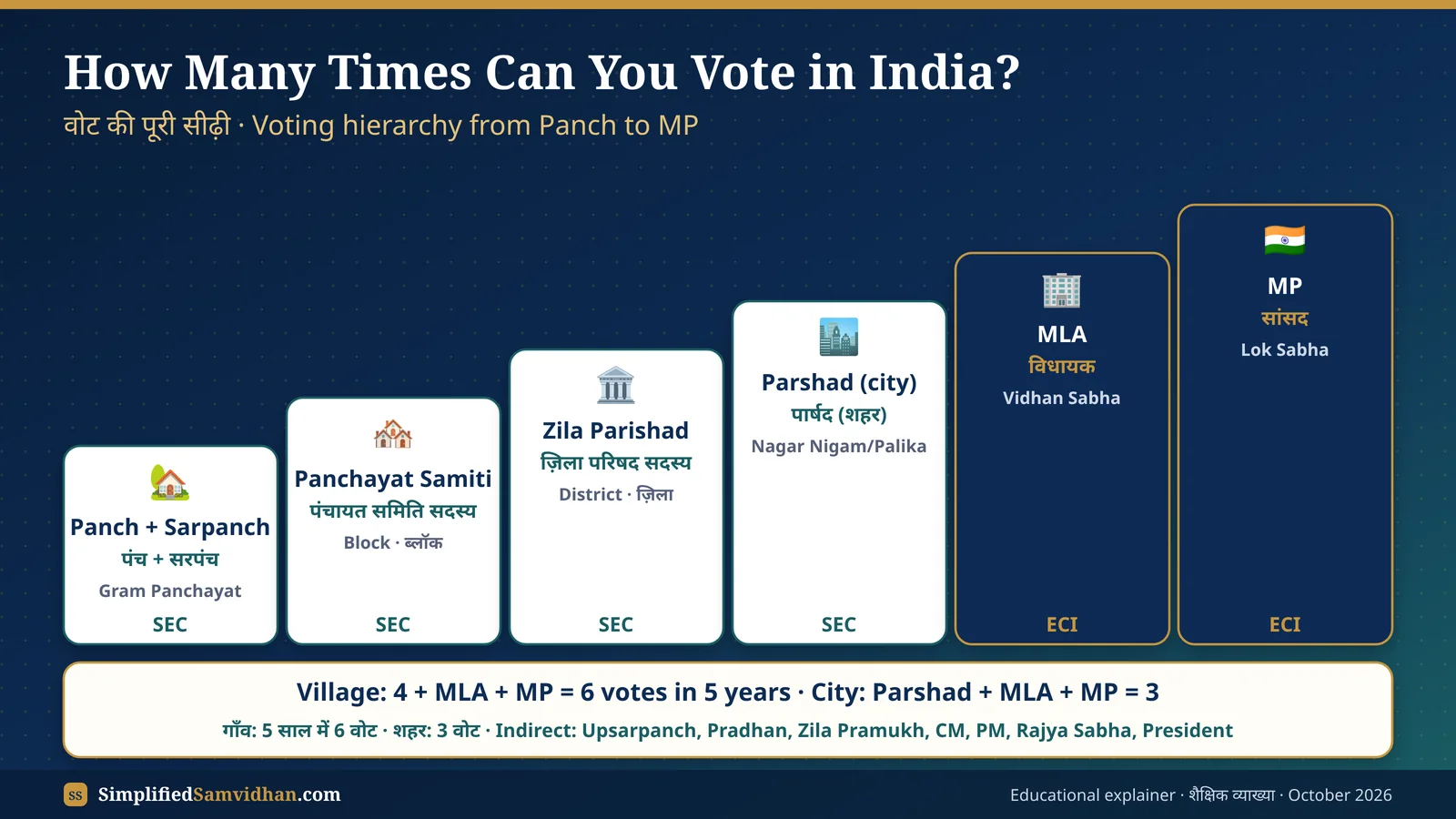
Most Indians know they vote for an MLA and an MP. Few know that a village voter actually casts six votes in five years, from ward panch to MP, and through them helps choose even the President. Here is the whole ladder, one simple story at a time.
The storyHow Many Times Can You Vote in India? One Voter's 5-Year Story
Meet Arjun. He lives in a village near Bhilwara in Rajasthan, and he turned 18 in 2023. His great-grandmother Kamla Devi laughs when he says he is excited about his first vote: "In my time you had to be 21!" Let us follow Arjun for five years and count every time he presses a button or stamps a ballot paper.
- 1
📝 2023: his name goes on the voter list
Arjun fills Form 6 on the Voter Helpline app. Since 2021 there are four qualifying dates a year (1 January, 1 April, 1 July, 1 October), so he did not have to wait for the next January. His BLO checks his address and his EPIC card arrives.
- 2
🏢 25 November 2023: Vote 1, his MLA
The Rajasthan Vidhan Sabha election. Arjun chooses one MLA for his Assembly constituency. The party with a majority of the 200 MLAs forms the government, and its leader becomes Chief Minister.
- 3
🇮🇳 April 2024: Vote 2, his MP
The Lok Sabha election (Rajasthan voted on 19 and 26 April 2024). Arjun chooses one MP out of Rajasthan's 25. All 543 MPs together decide who becomes Prime Minister.
- 4
🏡 October 2026: Votes 3 and 4, ward panch and sarpanch
The gram panchayat election. At the village school Arjun gets two ballot papers: one for the ward panch of his ward and one for the sarpanch of the whole panchayat. Counting happens the same evening at the panchayat. Next day the panchs elect the upsarpanch.
- 5
🏘️ October-November 2026: Votes 5 and 6, panchayat samiti and zila parishad
On a separate polling day Arjun votes for a panchayat samiti member (block level) and a zila parishad member (district level). These members later elect the Pradhan and the Zila Pramukh.
- 6
🧮 Total: 6 votes in about 5 years
Arjun cast six direct votes for six different representatives, and through them he indirectly helped choose the upsarpanch, Pradhan, Zila Pramukh, Chief Minister, Prime Minister, Rajya Sabha members and even the President. Then the cycle starts again: Assembly due in late 2028, Lok Sabha in 2029.
India has three levels of government: the Centre, the State and the local body (panchayat in villages, municipality in towns). You vote at every level. A village voter usually casts 6 votes in 5 years; a city voter usually casts 3 (or 4 where the mayor is directly elected). The votes do not all come in the same year, because each body's five-year term started on a different date.
🏠 Everyday analogy
Think of a school. You elect your class monitor (panchayat), the house captain (Assembly) and the school captain (Lok Sabha). Three different jobs, three different votes, and the captains then pick their own deputies.
🇮🇳 Real Indian example
Arjun's cousin Pooja lives in Jaipur city. In the same five years she voted only three times: MLA (2023), MP (2024) and her ward's parshad (September 2026). The mayor of Jaipur was then chosen by the parshads, not by her directly.
The ladderVoting Hierarchy in India: From Ward Panch to MP
| Level | Body | You elect | Then they elect | Conducted by | Article |
|---|---|---|---|---|---|
| Village | Gram Panchayat | Ward Panch + Sarpanch (2 votes) | Upsarpanch | State Election Commission | 243B, 243C, 243K |
| Block | Panchayat Samiti | Panchayat Samiti member (1 vote) | Pradhan, Up-Pradhan | State Election Commission | 243C(5)(b) |
| District | Zila Parishad | Zila Parishad member (1 vote) | Zila Pramukh, Up-Pramukh | State Election Commission | 243C(5)(b) |
| Town / City | Nagar Palika, Nagar Parishad, Nagar Nigam | Parshad (ward councillor), 1 vote; in some States also the mayor | Chairperson or Mayor (Rajasthan: by parshads) | State Election Commission | 243Q, 243R, 243ZA |
| State | Vidhan Sabha | MLA (1 vote) | Chief Minister (majority leader), Rajya Sabha MPs, votes for President | Election Commission of India | 170, 172, 324 |
| Country | Lok Sabha | MP (1 vote) | Prime Minister (majority leader), President and Vice-President | Election Commission of India | 81, 83, 324, 326 |
Read the table from the bottom of the ladder to the top. The lower three rows (village, block, district) and the town row are local self-government, created by the 73rd and 74th Amendments in 1992. The top two rows are the State and Union governments. Every row has a five-year term, but each starts on its own date.
🏠 Everyday analogy
Like a family's bills: electricity every month, school fees every quarter, house tax every year. All are regular, but they never all fall on the same day.
Count your votesVillage Voter vs City Voter: How Many Votes in 5 Years
Village voter (Arjun)
- Ward Panch
- Sarpanch
- Panchayat Samiti member
- Zila Parishad member
- MLA
- MP
- = 6 votes in 5 years
City voter (Pooja)
- Parshad (ward councillor)
- Mayor, only in States with direct election (for example Uttar Pradesh, Madhya Pradesh)
- MLA
- MP
- = 3 votes in 5 years (4 with a direct mayor)
| Extra votes some people get | Who | When |
|---|---|---|
| By-election (upchunav) | Voters of a seat that fell vacant (death, resignation, disqualification) | Usually within 6 months of the vacancy |
| Graduates' and Teachers' seats of a Legislative Council | Registered graduates and teachers in the 6 States with a Council (UP, Bihar, Maharashtra, Karnataka, Andhra Pradesh, Telangana) | Every 6 years per seat (one-third retire every 2 years) |
| Cooperative society elections | Members of a dairy, credit or housing cooperative | Every 5 years (Art. 243ZK); not a public election |
Indirect electionsWho Your Representatives Elect for You: Sarpanch to President
| Post | Chosen by | Your link |
|---|---|---|
| Upsarpanch | Elected ward panchs (and sarpanch) | You elected your ward panch |
| Pradhan (Panchayat Samiti head) | Elected Panchayat Samiti members, Art. 243C(5)(b) | You elected your PS member |
| Zila Pramukh (Zila Parishad head) | Elected Zila Parishad members, Art. 243C(5)(b) | You elected your ZP member |
| Mayor / Sabhapati / Adhyaksh (Rajasthan) | Elected parshads (indirect in Rajasthan; direct in some States) | You elected your parshad |
| Chief Minister | Appointed by the Governor: the leader who has the support of a majority of MLAs (Art. 164) | You elected your MLA |
| Prime Minister | Appointed by the President: the leader with majority support in the Lok Sabha (Art. 75) | You elected your MP |
| Rajya Sabha member | Elected MLAs of the State (Art. 80(4)) | Through your MLA |
| President of India | Elected MPs + elected MLAs (Art. 54) | Through your MP and MLA |
| Vice-President | All MPs of both Houses (Art. 66) | Through your MP |
Your one vote travels upward like a relay baton. You hand it to your panch, parshad, MLA or MP, and they carry it into the next election that you do not see on your ballot paper.
🇮🇳 Real Indian example
In July 2022, when Droupadi Murmu was elected President, Arjun's MP and MLA both voted in that election. So Arjun was part of it without ever going to a booth.
The refereesWho Conducts Which Election: ECI vs State Election Commission
326. Elections to the House of the People and to the Legislative Assemblies of States to be on the basis of adult suffrage.
The elections to the House of the People and to the Legislative Assembly of every State shall be on the basis of adult suffrage; that is to say, every person who is a citizen of India and who is not less than eighteen years of age on such date as may be fixed in that behalf by or under any law made by the appropriate Legislature and is not otherwise disqualified under this Constitution or any law made by the appropriate Legislature on the ground of non-residence, unsoundness of mind, crime or corrupt or illegal practice, shall be entitled to be registered as a voter at any such election.
243K. (1) The superintendence, direction and control of the preparation of electoral rolls for, and the conduct of, all elections to the Panchayats shall be vested in a State Election Commission consisting of a State Election Commissioner to be appointed by the Governor.
243ZA. (1) The superintendence, direction and control of the preparation of electoral rolls for, and the conduct of, all elections to the Municipalities shall be vested in the State Election Commission referred to in article 243K.
Election Commission of India (Art. 324)
- Lok Sabha (MP)
- Vidhan Sabha (MLA)
- Rajya Sabha and Legislative Councils
- President and Vice-President
State Election Commission (Arts. 243K, 243ZA)
- Gram Panchayat (panch, sarpanch)
- Panchayat Samiti and Zila Parishad
- Nagar Palika, Nagar Parishad, Nagar Nigam (parshad)
- Their by-elections
Two different referees run Indian elections. The Election Commission of India in Delhi runs the big ones (MP, MLA, President). Each State has its own State Election Commission that runs the local ones (panchayat and municipality). They are separate bodies: the State Commission does not work under the ECI. Full comparison: State Election Commission vs Election Commission of India.
🏠 Everyday analogy
Like the BCCI running India's international matches while each State association runs its own Ranji and district matches.
Voting ageVoting Age 18 in India: From 21 to 18 by the 61st Amendment
| Year | What happened |
|---|---|
| 1950 | Constitution starts with universal adult suffrage at 21, for every citizen, rich or poor, man or woman. |
| 1951-52 | First general election, conducted by Sukumar Sen. |
| Dec 1988 | Parliament passes the 61st Amendment (Lok Sabha on 15 December, Rajya Sabha on 20 December). |
| 28 Mar 1989 | Act comes into force: Article 326 now says 18 years. |
| Nov 1989 | First Lok Sabha election in which 18-to-20-year-olds voted. |
| 2011 | 25 January (ECI's founding day) celebrated as National Voters' Day. |
| 2021 | Four qualifying dates a year; 17-year-olds can apply in advance. |
Real exampleRajasthan 2023-2029: Every Level of Voting in Real Dates
| When | Election | Who voted | Conducted by |
|---|---|---|---|
| 25 Nov 2023 | Vidhan Sabha (200 seats) | All voters | ECI |
| 19 and 26 Apr 2024 | Lok Sabha (25 seats from Rajasthan) | All voters | ECI |
| 9 and 11 Sep 2026 | Urban bodies: 309 Nagar Nigam, Nagar Parishad, Nagar Palika (parshads) | Town and city voters | Rajasthan SEC |
| 22 Oct to 14 Nov 2026 | Panchayat Samiti and Zila Parishad members (4 phases) | Village voters | Rajasthan SEC |
| 24 Oct to 16 Nov 2026 | Ward panch and sarpanch, 14,403 gram panchayats (4 phases) | Village voters | Rajasthan SEC |
| Late 2028 (due) | Next Vidhan Sabha | All voters | ECI |
| 2029 (due) | Next Lok Sabha | All voters | ECI |
Rajasthan is a perfect example of the full ladder: in just three years (2023 to 2026) a village voter there has voted at every single level. Dates of the 2026 panchayat polls are from State Election Commission announcements as reported in the news (revised once for Dhanteras).
Connect the dotsRead Next: Panchayat, Municipal and Election Notes
- How a sarpanch is elected, who can contest, deposit and spending limit: Sarpanch election process and eligibility.
- Town elections: Nagar Nigam vs Nagar Parishad vs Nagar Palika, and parshad election.
- Who runs local polls: State Election Commission vs ECI.
- Voting age story: 61st Amendment, voting age 18.
- Getting on the voter list: Voter list and SIR.
- Lok Sabha, Rajya Sabha and President's elections in detail: Types of elections and process.
- After the election, hold your sarpanch to account: Gram Sabha powers and check panchayat spending.
Quick revisionOne-Line Revision Points (Exam Ready)
- A village voter usually casts 6 direct votes in 5 years: ward panch, sarpanch, panchayat samiti, zila parishad, MLA, MP.
- A city voter usually casts 3: parshad, MLA, MP (plus mayor where directly elected).
- Panchayat and municipal polls: State Election Commission (Arts. 243K, 243ZA).
- MP, MLA, Rajya Sabha, President, VP: Election Commission of India (Art. 324).
- Pradhan and Zila Pramukh are elected by members, Art. 243C(5)(b).
- Voting age 21 to 18: 61st Amendment, 1988, in force 28 March 1989 (Art. 326).
- Every elected body has a 5-year term: Arts. 83(2), 172(1), 243E, 243U.
- You never vote directly for the PM, CM, President or Rajya Sabha.
Practice MCQPractice MCQs (with Answers): Voting hierarchy in India
Who conducts the election of a sarpanch?
In Rajasthan, how many direct votes does a village voter usually cast in one 5-year cycle?
Who elects the Pradhan of a Panchayat Samiti?
Which Constitutional Amendment reduced the voting age from 21 to 18?
Which of these is NOT directly elected by the people?
Doubts ClearedFrequently Asked Questions
How many times can a person vote in India in 5 years?
A village voter usually votes 6 times (ward panch, sarpanch, panchayat samiti, zila parishad, MLA, MP). A city voter usually votes 3 times (parshad, MLA, MP), or 4 where the mayor is directly elected. By-elections can add more.
How many times can I vote in one year?
It depends on the calendar. In most years you vote zero or one time; in a year with panchayat polls a village voter may vote four times (two ballot papers on one day and two on another). There is no fixed yearly number.
Do we vote directly for the Prime Minister or Chief Minister?
No. You elect MPs and MLAs. The President appoints as PM the leader with majority support in the Lok Sabha, and the Governor appoints the CM the same way in the State.
Who conducts panchayat and municipal elections?
The State Election Commission of each State, under Articles 243K and 243ZA. The Election Commission of India has no role in them.
What is the minimum age to vote in panchayat elections?
18 years, the same as for Lok Sabha and Assembly elections. To contest a panchayat or municipal seat you must be 21.
Sources and further readingSources We Checked
Facts checked on 25 October 2026. Rajasthan 2026 dates are from State Election Commission announcements as reported in the news; check sec.rajasthan.gov.in for the final notice. Hindi text of the Articles is a simple rendering; the English text is authoritative.
- Constitution of India, Part XV (Legislative Department)
- Constitution of India, Part IX (Panchayats) and Part IXA (Municipalities)
- Election Commission of India (official website)
- State Election Commission, Rajasthan (official website)
- The Constitution (Sixty-first Amendment) Act, 1988 (Legislative Department)
- ETV Bharat: Rajasthan panchayat elections in four phases (3 Oct 2026)