Types of Elections in India and the Election Process, Step by Step
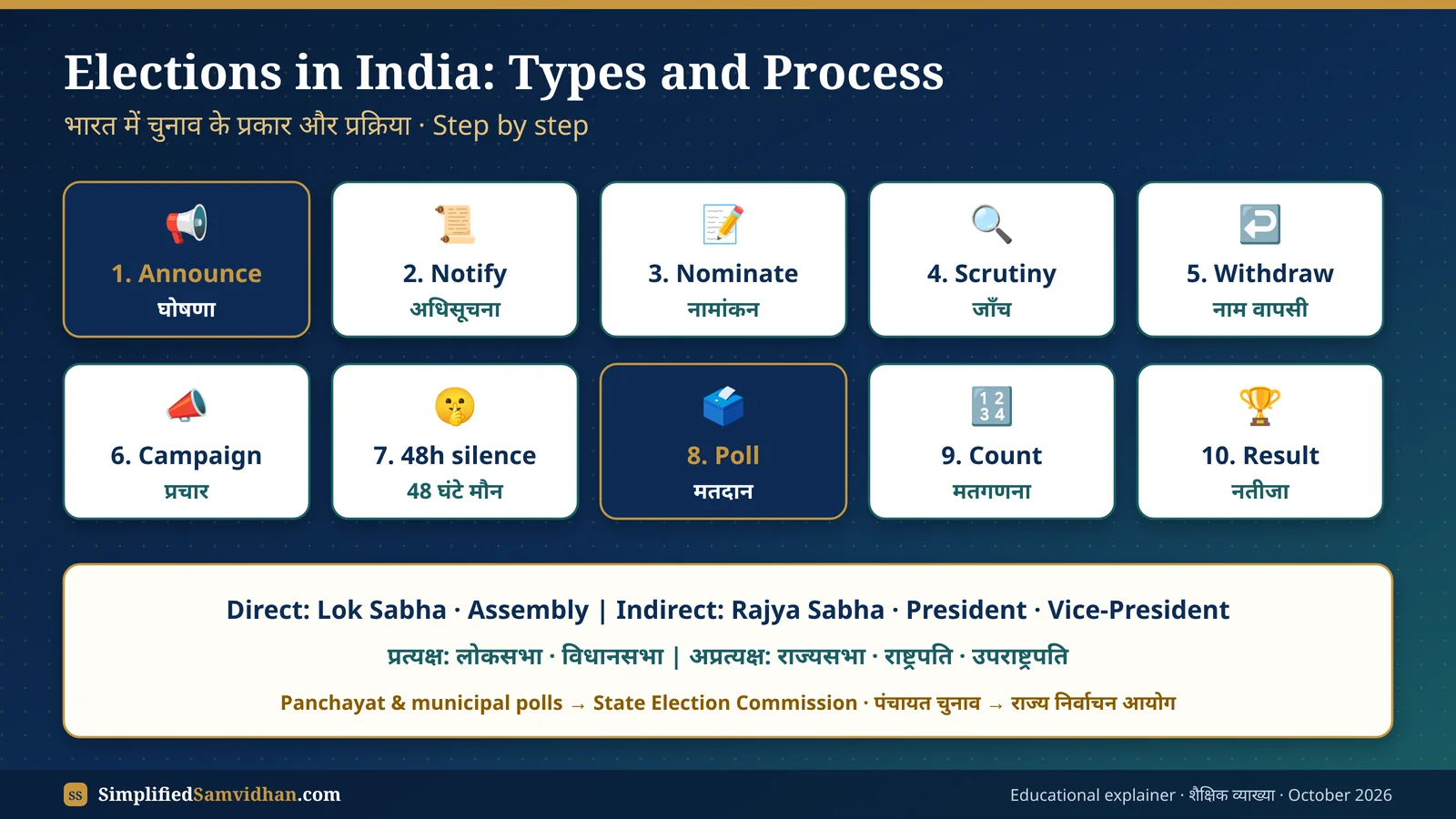
From the Lok Sabha to the President's election, and from the day the schedule is announced to the day the winner gets a certificate: the whole journey of an Indian election.
The frameElections in the Constitution: Who Makes the Rules
327. Power of Parliament to make provision with respect to elections to Legislatures.— Subject to the provisions of this Constitution, Parliament may from time to time by law make provision with respect to all matters relating to, or in connection with, elections to either House of Parliament or to the House or either House of the Legislature of a State including the preparation of electoral rolls, the delimitation of constituencies and all other matters necessary for securing the due constitution of such House or Houses.
243K. (1) The superintendence, direction and control of the preparation of electoral rolls for, and the conduct of, all elections to the Panchayats shall be vested in a State Election Commission consisting of a State Election Commissioner to be appointed by the Governor.
India has many kinds of elections. In some, you vote directly (Lok Sabha, State Assembly, panchayat). In others, your representatives vote for you (Rajya Sabha, President, Vice-President). The Constitution sets the frame, Parliament fills in the details through the Representation of the People Acts, and the Election Commission runs the show. Panchayat and municipal polls are a separate track run by each State's own Election Commission.
🏠 Everyday analogy
A housing society elects its committee directly, and the committee then elects its secretary. Lok Sabha is the first kind; the Rajya Sabha and the President's election are the second kind.
🇮🇳 Real Indian example
In the 2024 Lok Sabha election, a candidate with the most votes in each of the 543 seats won, even without 50 per cent: that is first-past-the-post. In the July 2022 presidential election, MPs and MLAs ranked candidates and their votes carried different values.
TypesTypes of Elections in India: Lok Sabha to Panchayat
| Election | Who votes | System | Article | Min. age |
|---|---|---|---|---|
| Lok Sabha (543 seats) | All registered voters, 18+ | Direct, first-past-the-post | 81 | 25 |
| State Legislative Assembly | All registered voters of the State | Direct, first-past-the-post | 170 | 25 |
| Rajya Sabha | Elected MLAs of each State | Proportional representation, single transferable vote; open ballot for party MLAs (since 2003) | 80 | 30 |
| Legislative Council (6 States) | MLAs, local bodies, graduates, teachers; some nominated | Single transferable vote | 171 | 30 |
| President | Elected MPs + elected MLAs of States, Delhi and Puducherry | Single transferable vote, secret ballot, weighted votes | 54, 55 | 35 |
| Vice-President | All MPs of both Houses, including nominated | Single transferable vote, secret ballot | 66 | 35 |
| By-election | Voters of the vacant seat | Same as the House; within 6 months of the vacancy (Sec. 151A) | — | — |
| Panchayat / Municipality | Local voters | Run by the State Election Commission, not ECI | 243K, 243ZA | 21 |
ProcessElection Process in India Step by Step: Announcement to Result
- 1Announcement
The Commission announces the schedule at a press conference. The Model Code of Conduct starts that very moment.
- 2Notification
The President (Lok Sabha) or Governor (Assembly) issues the notification calling on the constituency to elect; nominations open.
- 3Nomination
Last date: the 7th day after notification. The candidate files the form, an affidavit on criminal cases, assets and education, and the deposit (Rs 25,000 for Lok Sabha, Rs 10,000 for Assembly; half for SC/ST).
- 4Scrutiny
The Returning Officer checks the papers the next day and may reject defective ones.
- 5Withdrawal
Candidates may withdraw up to the second day after scrutiny. Then the final list and symbols are fixed.
- 6Campaign
Rallies, ads and door-to-door visits under the Model Code and spending limits. Campaigning stops 48 hours before polling ends (Section 126, the 'silence period').
- 7Polling day
Not earlier than the 14th day after withdrawal. Voters show ID, get indelible ink on the left forefinger and vote on the EVM; the VVPAT shows a slip for 7 seconds.
- 8Counting and result
Postal ballots first, then EVMs round by round, then VVPAT slips of 5 random booths per Assembly segment. The Returning Officer declares the winner and gives the certificate.
- 9After the result
The Commission notifies the names of members; expense accounts are due within 30 days; any challenge goes to the High Court by election petition within 45 days.
Voting systemsFirst-Past-the-Post vs Proportional Representation in India
| Point | First-past-the-post (FPTP) | Proportional representation (STV) |
|---|---|---|
| Used for | Lok Sabha, Assemblies | Rajya Sabha, Councils, President, Vice-President |
| You mark | One candidate | Preferences 1, 2, 3 ... |
| Winner | Most votes, even below 50% | Must reach a quota; surplus and lowest votes transfer |
| Strength | Simple, quick, stable governments | Seats closer to vote share |
| Weakness | Seat share can differ a lot from vote share | Complex counting |
Connect the dotsRead Next: Related Notes
- Before you can vote: Voter list and SIR.
- Rules during the campaign: Model Code of Conduct.
- The machine you vote on: EVM and VVPAT.
- Who cannot contest: Disqualification of MPs and MLAs.
- How seats are drawn: Delimitation Commission.
Quick revisionOne-Line Revision Points (Exam Ready)
- Parliament makes election laws under Article 327; States under Article 328.
- Lok Sabha and Assemblies: first-past-the-post.
- Rajya Sabha, President, VP: single transferable vote.
- Rajya Sabha voting is an open ballot for party MLAs since 2003.
- Minimum age: 25 (LS, Assembly), 30 (RS, Council), 35 (President, VP).
- Deposit: Rs 25,000 (LS), Rs 10,000 (Assembly); half for SC/ST.
- Campaign silence: 48 hours before close of poll (Sec. 126).
- By-election within 6 months of a vacancy (Sec. 151A).
- Panchayat and municipal polls: State Election Commission (Art. 243K, 243ZA).
Practice MCQPractice MCQs (with Answers): Types of elections and process
Which system is used to elect members of the Lok Sabha?
Who conducts panchayat elections?
Campaigning must stop how many hours before the close of polling?
Who does NOT vote in the election of the President of India?
Within what time must a by-election normally be held after a vacancy?
Doubts ClearedFrequently Asked Questions
What are the types of elections in India?
Lok Sabha, State Assembly, Rajya Sabha, Legislative Council, President, Vice-President, by-elections, and local body elections (panchayat and municipality).
What is the election process in India?
Announcement and Model Code, notification, nominations, scrutiny, withdrawal, campaign, 48-hour silence, polling, counting and declaration of result.
What is a direct and an indirect election?
In a direct election voters choose the representative themselves (Lok Sabha). In an indirect election elected representatives choose (Rajya Sabha, President).
What is the security deposit for a Lok Sabha election?
Rs 25,000, or Rs 12,500 for SC/ST candidates. It is forfeited if the candidate gets less than one-sixth of the valid votes.
Sources and further readingSources We Checked
Facts checked on 21 October 2026. Hindi text of Articles 327 and 243K is a simple rendering; the English text is authoritative.