Children in Election Campaigns: What the ECI Rules and the Madras High Court Say
Should a political party put a five-year-old in a campaign reel, or hand a child a flag at a rally? The Election Commission says no, the Madras High Court has called the practice undignified, and yet an election cannot be set aside for it under today's law. Here is the gap, explained simply.
Why it is in the news
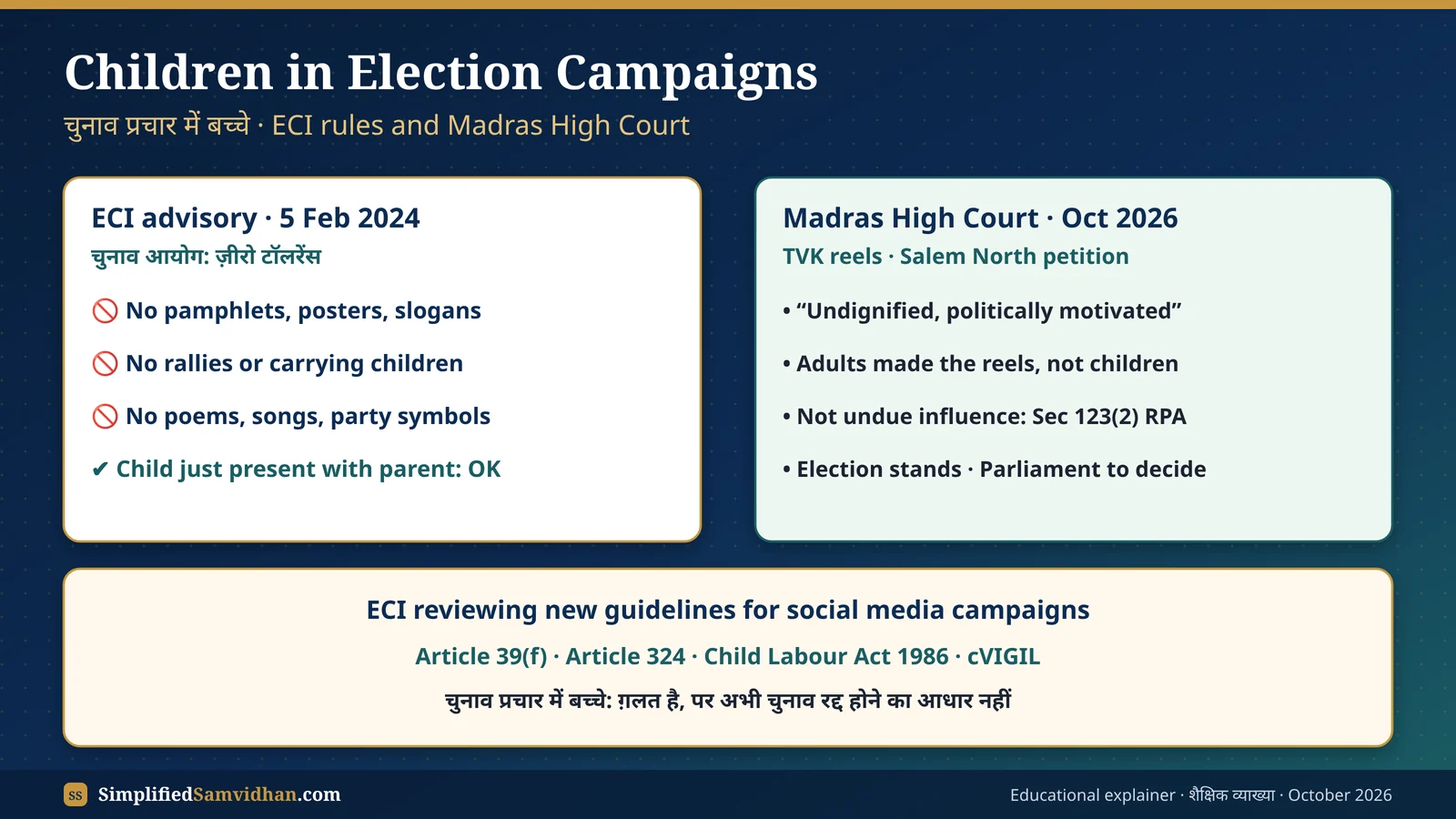
In mid-October 2026, Justice D. Bharatha Chakravarthy of the Madras High Court rejected a DMK candidate's election petition against the TVK candidate who won Salem North in the 2026 Tamil Nadu Assembly election. The petition said TVK used reels of children and an appeal by TVK chief Vijay to children, so that children would push their parents to vote for TVK. The judge called such reels "undignified and politically motivated" and in bad taste, but held there was no cause of action: children do not make reels on their own, adults at home made them, so this was not undue influence overriding the voters' free choice. Whether such acts should be a ground to cancel an election, he said, is for Parliament to decide.
In a separate public interest case, the Election Commission of India told the same High Court that it is reviewing whether more guidelines are needed, especially for social media campaigns aimed at children to reach their parents. On 23 October 2026 The Hindu ran an editorial on the issue. No new ECI rule had been issued when we checked.
ECI RulesUse of Children in Election Campaigns: What the ECI Advisory Says
| The ECI's 5 February 2024 advisory | What it means |
|---|---|
| Zero tolerance | Parties and candidates must not use children in any form of election campaign |
| No posters, pamphlets or rallies | Children cannot distribute pamphlets, stick posters, shout slogans or join rallies |
| No carrying children | Leaders should not hold or carry children in vehicles or rallies as part of campaigning |
| Poems, songs, symbols | Using children to recite poems or songs, or to show a party symbol or logo, is barred |
| Exception | A child simply standing near a parent or guardian, not part of any campaign activity, is not a breach |
| Legal base cited | Child Labour (Prohibition and Regulation) Act, 1986 (amended 2016) and a 2014 Bombay High Court order |
The Election Commission's message is simple: children are not campaign tools. They cannot vote, they cannot judge a manifesto, and they should not be used to pull at their parents' emotions. But an advisory is a guideline. Breaking it can bring a notice or a warning from the ECI, not automatic cancellation of an election.
🏠 Everyday analogy
It is like a school rule that says "no mobile phones in class". The teacher can take the phone and warn you, but you do not fail the exam for it. Only the board's exam law can decide that.
🇮🇳 Real Indian example
A party video shows a girl in school uniform singing a song with the party symbol, shared 2 lakh times on Instagram. Under the 2024 advisory this is a clear breach. A complaint can go to the District Election Officer or on the cVIGIL app.
Official TextArticle 39(f) and Section 123(2) RPA: The Law on Children and Undue Influence
Constitution of India, Article 39. Certain principles of policy to be followed by the State.
The State shall, in particular, direct its policy towards securing ... (e) that the health and strength of workers, men and women, and the tender age of children are not abused and that citizens are not forced by economic necessity to enter avocations unsuited to their age or strength; (f) that children are given opportunities and facilities to develop in a healthy manner and in conditions of freedom and dignity and that childhood and youth are protected against exploitation and against moral and material abandonment.
Representation of the People Act, 1951 · Section 123(2). Corrupt practices: undue influence.
Undue influence, that is to say, any direct or indirect interference or attempt to interfere on the part of the candidate or his agent, or of any other person with the consent of the candidate or his election agent, with the free exercise of any electoral right.
- Article 324 gives the ECI superintendence, direction and control of elections; its advisories and the Model Code of Conduct flow from this.
- Section 100(1)(b) RPA: a High Court can declare an election void if a corrupt practice was committed by the winner or with their agent's consent.
- Article 39(f) is a Directive Principle. It guides law-making but cannot be enforced directly in court.
The RulingMadras High Court on Children in TVK Campaign Reels: What Was Decided
What the Court criticised
- Reels with children are undignified and politically motivated
- Parties and candidates should not involve children in any election activity
- Using children to sway parents is in bad taste
Why the election stands
- Children did not make the reels; adults did
- No proof it overrode voters' free will (Section 123(2))
- Making it a ground to void an election is for Parliament
The judge drew a line between wrong and illegal enough to cancel an election. Cancelling a people's verdict is a very serious step, so the law asks for a clear corrupt practice. Using children was wrong, but under the law as it stands it was not proved to be "undue influence".
The DebateShould Using Children in Campaigns Be a Corrupt Practice?
For a stricter law
- Children cannot consent to their image being used
- Emotional pressure on parents distorts free choice
- Social media reels spread far beyond the ECI's reach
- Fits Article 39(f) and child rights duties
Against
- Hard to define: is a child at a family rally campaigning?
- Risk of election petitions on small grounds
- Better handled by ECI penalties and platform takedowns
UPSC CornerChildren in Election Campaigns for UPSC Prelims and Mains
- Prelims: corrupt practices are listed in Section 123 of the Representation of the People Act, 1951; undue influence is Section 123(2).
- Prelims: election petitions are heard by the High Court (Section 80A RPA), with appeal to the Supreme Court.
- Mains (GS II): "Advisories without teeth." Examine the ECI's power to regulate campaign conduct in the age of social media.
- Ethics (GS IV): using children for political gain as an issue of dignity and consent.
Practice MCQTest Yourself: Children in Election Campaigns: Rules and Gaps
Consider the following statements: (1) Undue influence is a corrupt practice under Section 123 of the Representation of the People Act, 1951. (2) An election petition in India is first heard by the Supreme Court. (3) Article 39(f) protects childhood and youth against exploitation. Which of the statements given above is/are correct?
Doubts ClearedFrequently Asked Questions
Is it legal to use children in election campaigns in India?
The ECI's advisory of 5 February 2024 bans the use of children in any form of campaigning, except a child simply present with a parent. Breaking it can bring ECI action, but it is not by itself a ground to cancel an election.
What did the Madras High Court say about TVK's campaign reels?
In October 2026 it called reels with children undignified and politically motivated, but rejected the election petition because adults, not children, made them and no undue influence was shown.
Is the ECI making new rules?
The ECI told the Madras High Court it is reviewing whether more guidelines are needed, especially for social media. No new rule had been issued when we checked on 24 October 2026.
What is undue influence in elections?
Under Section 123(2) RPA it is any direct or indirect interference, by the candidate or with their consent, with the free exercise of an electoral right.
Where can I complain about children in a campaign?
To the Returning Officer or District Election Officer, or through the ECI's cVIGIL app during the Model Code of Conduct.
Sources and further readingSources We Checked
Facts checked against the reports below on 24 October 2026. The Madras High Court's reasoning is taken from news reports of the order; the ECI's review was pending.
- LawChakra: Madras High Court says children's campaign videos in bad taste but not ground to void election (Oct 2026)
- Free Press Journal: Using children in election campaigns reflects poor parenting, is a 'cheap act', says Madras High Court
- Indian Masterminds: ECI to review use of children in election campaigns, tells Madras High Court
- Bar and Bench: Mooting guidelines to bar use of children in election campaigns, ECI to Madras High Court
- Election Commission of India: advisory to political parties on use of children in election campaigns (5 Feb 2024)
- Representation of the People Act, 1951 (India Code)