Bare ActOfficial Text of Article 16
16. Equality of opportunity in matters of public employment.—
(1) There shall be equality of opportunity for all citizens in matters relating to employment or appointment to any office under the State.
(2) No citizen shall, on grounds only of religion, race, caste, sex, descent, place of birth, residence or any of them, be ineligible for, or discriminated against in respect of, any employment or office under the State.
(3) Nothing in this article shall prevent Parliament from making any law prescribing, in regard to a class or classes of employment or appointment to an office under the Government of, or any local or other authority within, a State or Union territory, any requirement as to residence within that State or Union territory prior to such employment or appointment.
(4) Nothing in this article shall prevent the State from making any provision for the reservation of appointments or posts in favour of any backward class of citizens which, in the opinion of the State, is not adequately represented in the services under the State.
(4A) Nothing in this article shall prevent the State from making any provision for reservation in matters of promotion, with consequential seniority, to any class or classes of posts in the services under the State in favour of the Scheduled Castes and the Scheduled Tribes which, in the opinion of the State, are not adequately represented in the services under the State.
(4B) Nothing in this article shall prevent the State from considering any unfilled vacancies of a year which are reserved for being filled up in that year in accordance with any provision for reservation made under clause (4) or clause (4A) as a separate class of vacancies to be filled up in any succeeding year or years and such class of vacancies shall not be considered together with the vacancies of the year in which they are being filled up for determining the ceiling of fifty per cent. reservation on total number of vacancies of that year.
(5) Nothing in this article shall affect the operation of any law which provides that the incumbent of an office in connection with the affairs of any religious or denominational institution or any member of the governing body thereof shall be a person professing a particular religion or belonging to a particular denomination.
(6) Nothing in this article shall prevent the State from making any provision for the reservation of appointments or posts in favour of any economically weaker sections of citizens other than the classes mentioned in clause (4), in addition to the existing reservation and subject to a maximum of ten per cent. of the posts in each category.
Clause (1) is the promise: every citizen gets an equal chance at government jobs, through the same exam, same age limit, same rules.
Clause (2) adds two grounds that Article 15 does not have: descent (whose family you come from) and residence (where you live). A State cannot keep its own jobs only for its domiciles; only Parliament can allow a residence rule (clause 3).
Clauses (4), (4A), (4B) and (6) allow reservation. The Supreme Court has said reservation is not against equality: it is a way to reach real (proportional) equality and distributive justice, that is, sharing resources on a priority basis with those left behind.
Reservation is an enabling power, not a duty. No one has a fundamental right to claim it, and the State must back it with data and keep it within limits that courts can review.
🏠 Everyday Analogy
Picture a 400-metre race where some runners were made to start 100 metres behind for generations. Making everyone run from today's line (formal equality) is not fair. Reservation is like giving those runners lanes of their own until the gap closes, but with checks: a runner whose family has already caught up (creamy layer) gives way to those still behind, and the special lanes cannot take over the whole track (50% rule).
🇮🇳 Real Indian Example
Pooja (OBC) and Arjun (general) both clear the UPSC Civil Services exam. Pooja's father is a farmer and her mother runs a small shop; family income from other sources is below ₹8 lakh a year, so she is "non-creamy layer" and competes in the 27% OBC seats. Her cousin, whose father is a Group A officer, is "creamy layer" by status and must compete in the open category. Arjun's family earns ₹6 lakh and owns no big property, so he can apply under the 10% EWS quota.
Clause by ClauseArticle 16 of Indian Constitution Clause by Clause: Equality of Opportunity in Public Employment
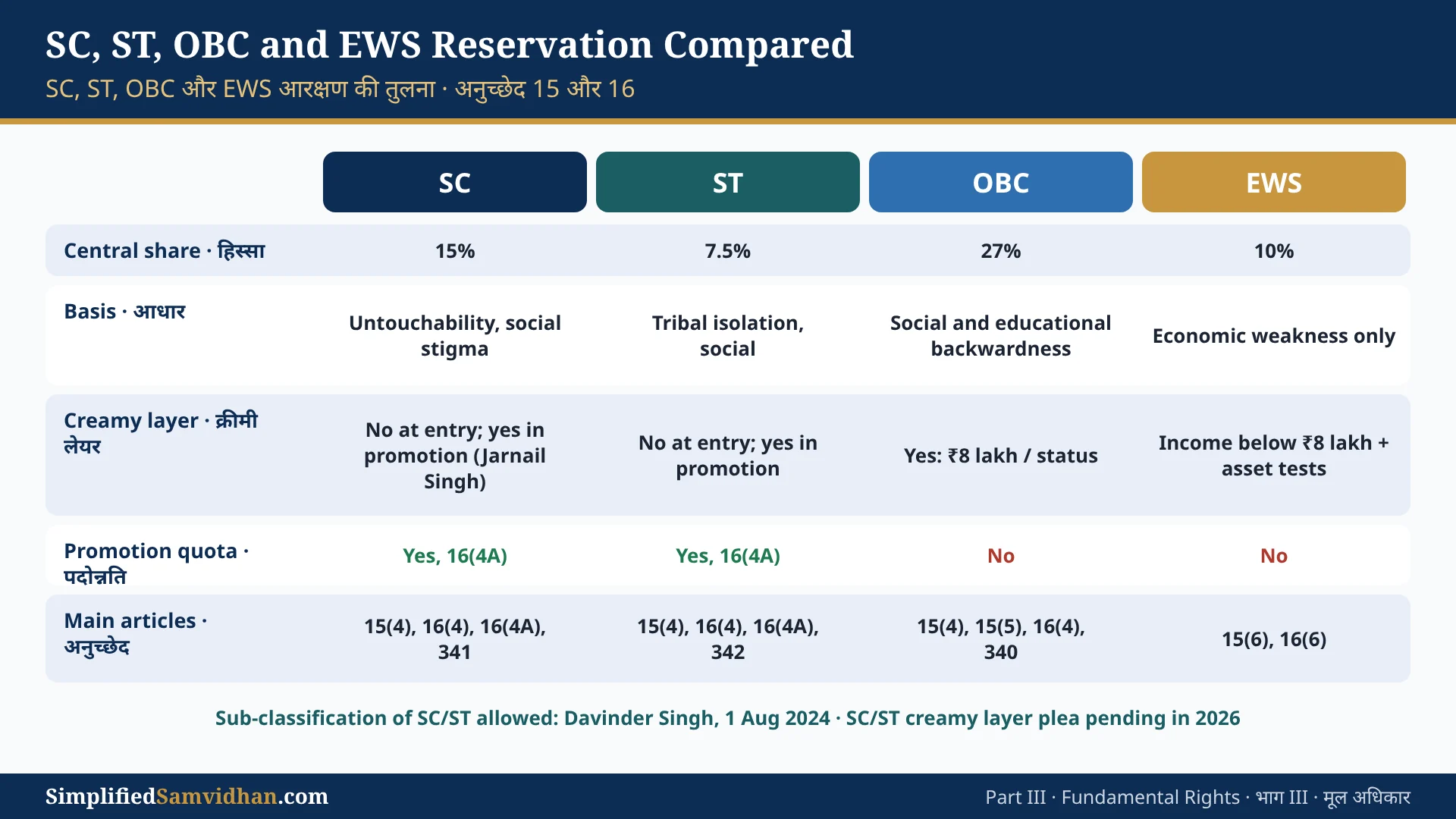
| Clause | Meaning in simple words | Source |
|---|---|---|
| 16(1) | Equal opportunity for all citizens in government jobs and appointments | Original |
| 16(2) | No discrimination on religion, race, caste, sex, descent (उद्भव), place of birth, residence | Original |
| 16(3) | Parliament (only Parliament) may prescribe a residence condition for jobs in a State or UT | Original |
| 16(4) | Reservation for any backward class not adequately represented in State services | Original |
| 16(4A) | Reservation in promotion for SC/ST, with consequential seniority | 77th (1995), 85th (2001) |
| 16(4B) | Unfilled reserved posts carried forward as a separate class; outside the 50% ceiling | 81st (2000) |
| 16(5) | Posts in a religious institution may be kept for members of that religion | Original |
| 16(6) | Up to 10% for EWS, in addition to existing reservation | 103rd (2019) |
Points to note
- Descent and residence are extra grounds in Article 16(2). Under 16(3) Parliament once passed the Public Employment (Requirement as to Residence) Act, 1957; today residence rules exist mainly through special provisions such as Article 371D (Andhra Pradesh and Telangana).
- A State law reserving its jobs for "sons of the soil" by domicile is generally invalid (Kailash Chand Sharma v. State of Rajasthan, 2002).
- Clause (5) example: the trustees of a Hindu temple board can be required to be Hindus.
- N.M. Thomas (1976) and Indra Sawhney (1992): Article 16(4) is not an exception to 16(1) but a facet of it.
The Issue of ReservationHistory of Reservation in India: Kalelkar, Mandal Commission and the 27% OBC Quota
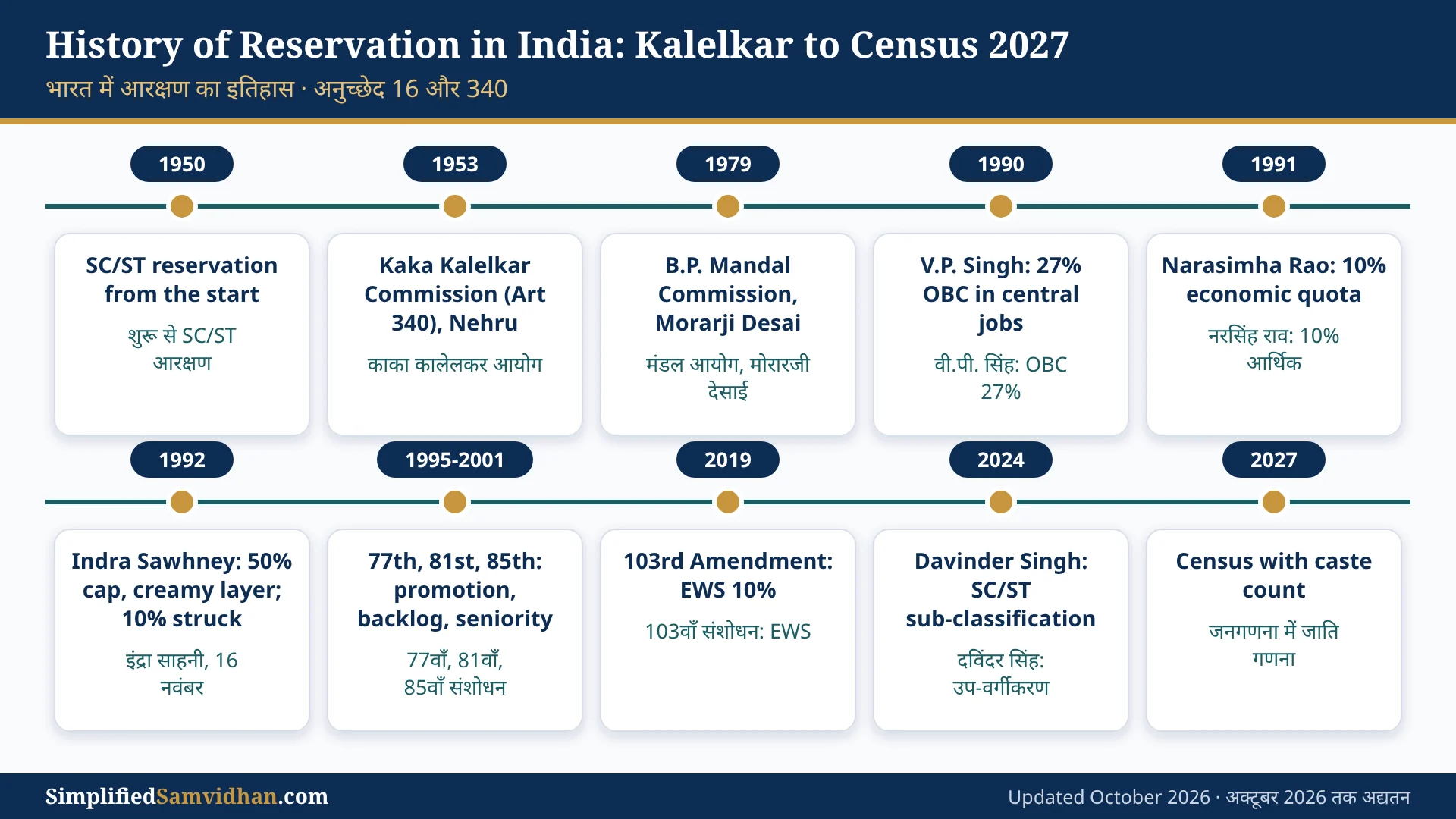
- From the first days of the Constitution SCs and STs got reservation, and this was never seriously disputed.
- For backward classes, Article 340 lets the President appoint a commission from time to time. Under it the Kaka Kalelkar Commission was set up in 1953 (Nehru government). Its 1955 report was not accepted.
- Drawing on Article 340, the Morarji Desai government set up the B.P. Mandal Commission in 1979 to suggest steps for the backward classes. Its 1980 report identified 3,743 castes and recommended 27% OBC reservation.
- After the V.P. Singh government came to power (December 1989), it formally implemented the Mandal recommendations in August 1990, giving 27% to OBCs in central jobs. Caste was chosen as the basis.
- In September 1991 the P.V. Narasimha Rao government added 10% for the economically backward among other classes. This 10% was struck down in Indra Sawhney (1992). (The EWS quota we have today is a different, later scheme from the 103rd Amendment, 2019.)
- Big questions arose: Does the Constitution allow caste-based reservation? Can there be reservation on an economic basis? What is the definition of backwardness? The Supreme Court answered them in Indra Sawhney v. Union of India, 16 November 1992.
The 59.5% MathReservation Percentage in India: SC 15%, ST 7.5%, OBC 27% and EWS 10%
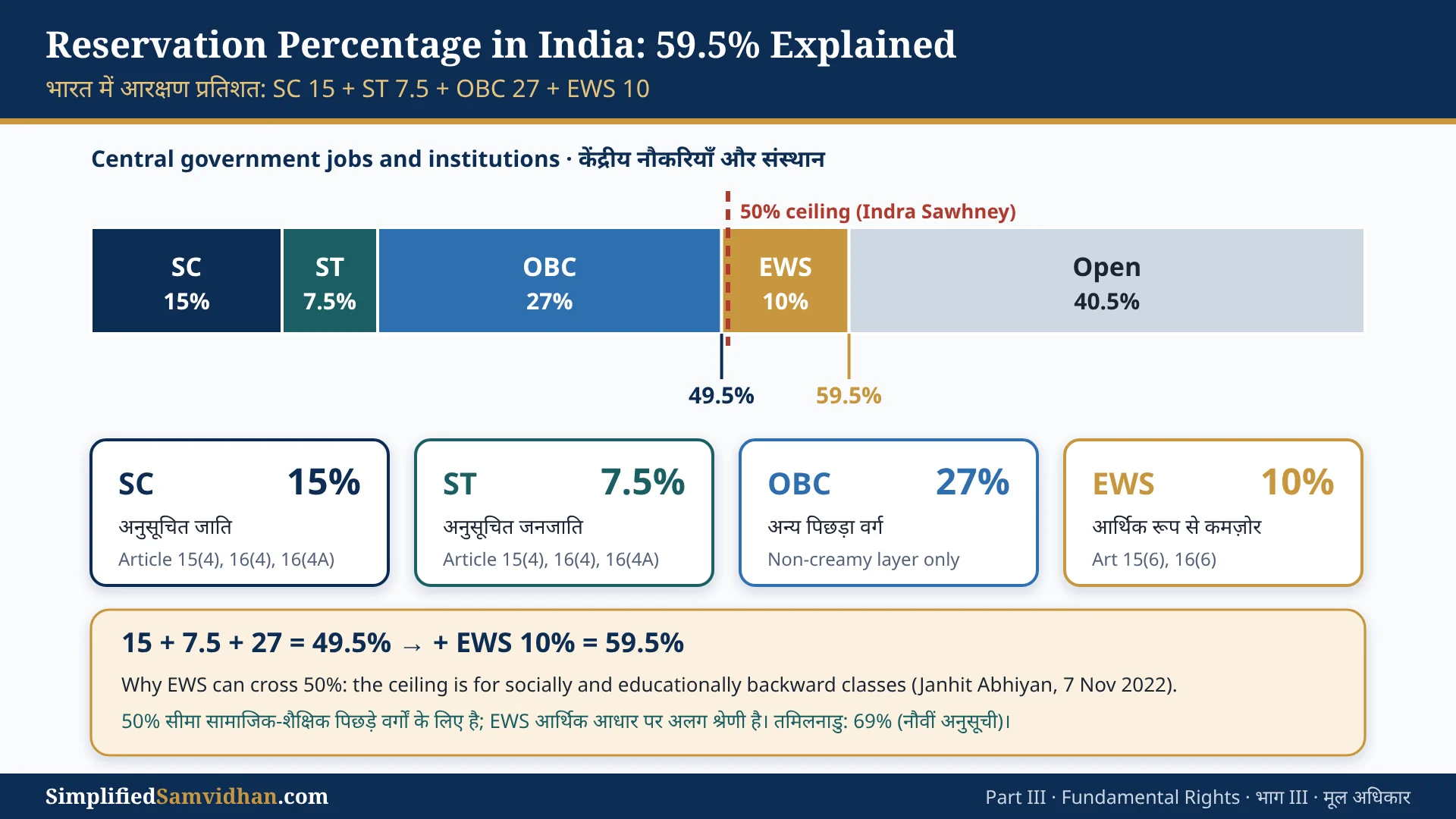
In central government jobs and central educational institutions the shares are:
- Scheduled Castes: 15%
- Scheduled Tribes: 7.5%
- Other Backward Classes: 27% (non-creamy layer only)
- Total for SC + ST + OBC = 49.5%, just under the 50% ceiling of Indra Sawhney.
- EWS: 10%, added in 2019 → total 59.5%.
16 November 1992Indra Sawhney Case (Mandal Case): What the Supreme Court Decided on Reservation
A nine-judge bench decided by 6:3:
- For establishing equality the State can make positive discrimination.
- Reservation is not against equality. The Constitution has proportional equality built into it, through which distributive justice can be achieved. (Distributive justice = distributing resources in a differentiated way, on the basis of priority.)
- Caste-based protection is valid, because in the majority Hindu community many castes are victims of backwardness. Caste is the first and main basis to identify backwardness; occupation, income, housing and other economic conditions can be seen as secondary factors.
- Creamy layer (the well-off) of the OBC will not get reservation. Today a person whose parents' income from other sources is ₹8 lakh a year or more (limit since 2017), or whose parents hold high constitutional posts or Group A / Class I posts, is in the creamy layer.
- There is no creamy layer for SC and ST (the Court did not apply it to them).
- Maximum limit of caste-based reservation is 50%, save extraordinary situations, and it is open to judicial review.
- No reservation in promotions (applied prospectively, with existing promotions saved for five years).
- The 10% economic quota of 1991 was struck down: income alone cannot identify a backward class under Article 16(4).
- A permanent body to examine inclusion and exclusion in the OBC list was ordered (the National Commission for Backward Classes, 1993; constitutional status by the 102nd Amendment, 2018, Article 338B).
After the judgment: what governments did
- The 10% EWS reservation of the Narasimha Rao government was withdrawn.
- Through the 76th Amendment (1994), Tamil Nadu's 69% reservation law was put in the Ninth Schedule. (The Ninth Schedule was added by the 1st Amendment, 1951; laws put in it were meant to be beyond judicial review. But under judicial activism the Supreme Court in I.R. Coelho (2007) brought post-1973 entries within judicial review on the basic structure test.)
- The 77th Amendment (1995) inserted Article 16(4A): SC and ST will get reservation in promotion.
- The 81st Amendment (2000) inserted 16(4B) (backlog, see below), the 82nd (2000) allowed relaxed qualifying marks in promotion (proviso to Article 335) and the 85th (2001) gave consequential seniority.
Reservation in PromotionReservation in Promotion: Catch-up Rule vs Consequential Seniority (Article 16(4A))
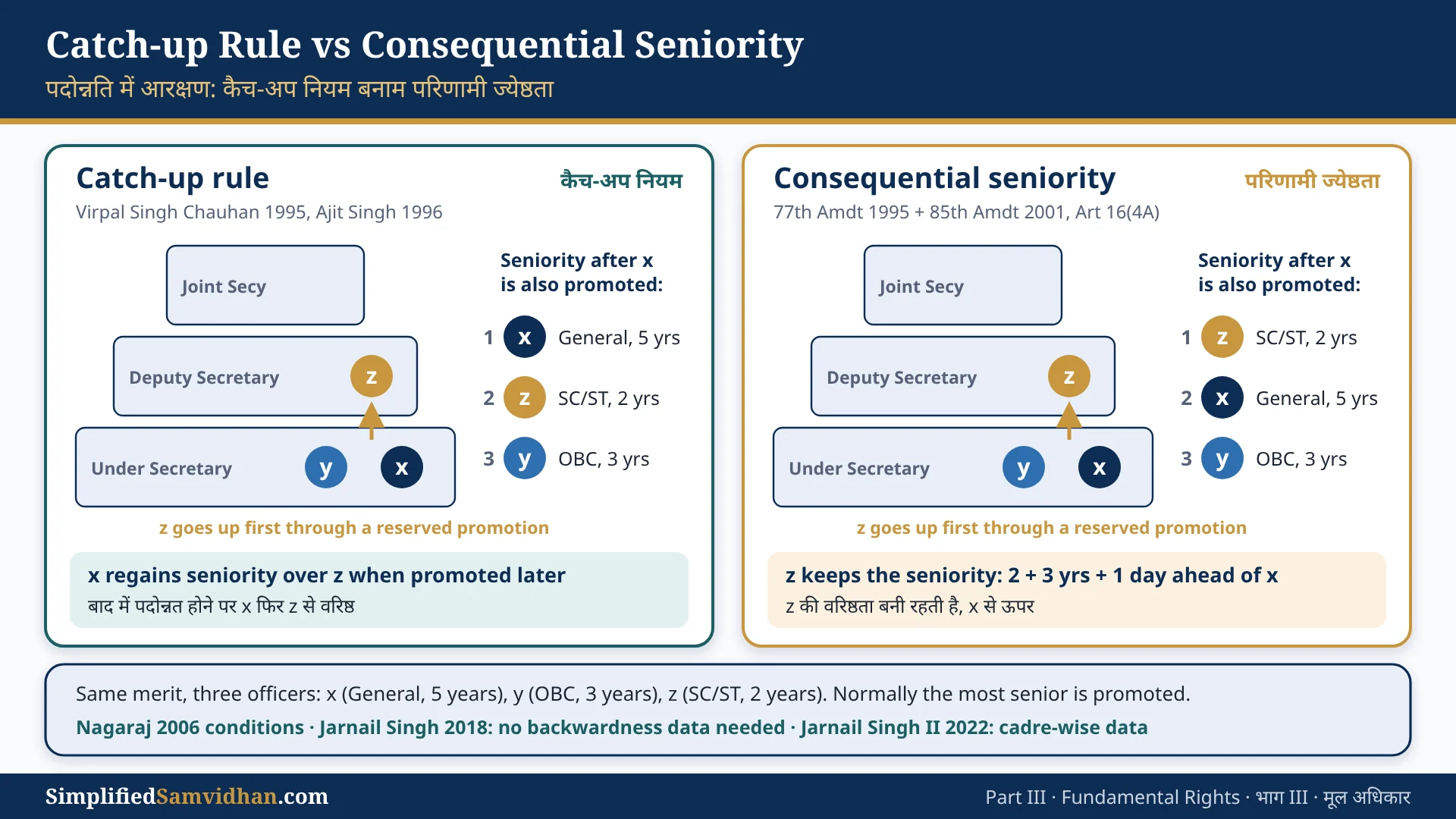
Through the 85th Amendment it was settled that for SC and ST reservation in promotion the principle of consequential seniority applies.
Take three officers of equal merit: x (general category, 5 years of service, the most senior), y (OBC, 3 years) and z (SC/ST, 2 years, the most junior).
- Catch-up rule (Virpal Singh Chauhan 1995, Ajit Singh 1996): z can go up first through a reserved promotion, but when x is promoted later, x regains seniority over z. z gets an early chair, not a permanent lead. Normally, when merit is equal, the most senior person is promoted.
- Consequential seniority (85th Amendment): z keeps the seniority that comes with the reserved promotion. Your class notes explain it as deliberately treating z as the most senior: the gap with the most senior person is added to z, that is 2 years + 3 years + 1 day, so z stands just above x and is promoted first.
Then came the debate
After these government efforts, the debate was: Is reservation in promotion right? Should there not be a creamy layer for SC and ST? The Court answered through these cases:
- M. Nagaraj v. Union of India (2006): (i) reservation in promotion for SC/ST is valid; (ii) SC/ST representation in many organisations did not happen because of backwardness; (iii) SC/ST people are still victims of backwardness; (iv) reservation in promotion should not come at the cost of efficiency of administration (Article 335). But the State must collect quantifiable data on backwardness and inadequate representation, the creamy layer rule applies to SC/ST at the promotion stage, and the 50% ceiling must be kept.
- Even after this, SC/ST representation at higher levels remained low, and governments neither researched the lack of representation nor gave the data to the judiciary.
- Jarnail Singh v. Lachhmi Narain Gupta (2018): (i) SC/ST reservation in promotion is valid; (ii) the State need not give data on the backwardness of SC/ST (that condition was removed); (iii) all other Nagaraj conditions continue, including creamy layer and data on inadequate representation.
- B.K. Pavitra II (2019): Karnataka's law on consequential seniority upheld.
- Mukesh Kumar v. State of Uttarakhand (2020): there is no fundamental right to reservation in promotion; the State is not bound to give it.
- Jarnail Singh II (28 January 2022): data on inadequate representation must be collected cadre-wise, not for the whole service; the Court refused to fix a yardstick.
81st Amendment, 2000Backlog Vacancies and the Carry Forward Rule under Article 16(4B)
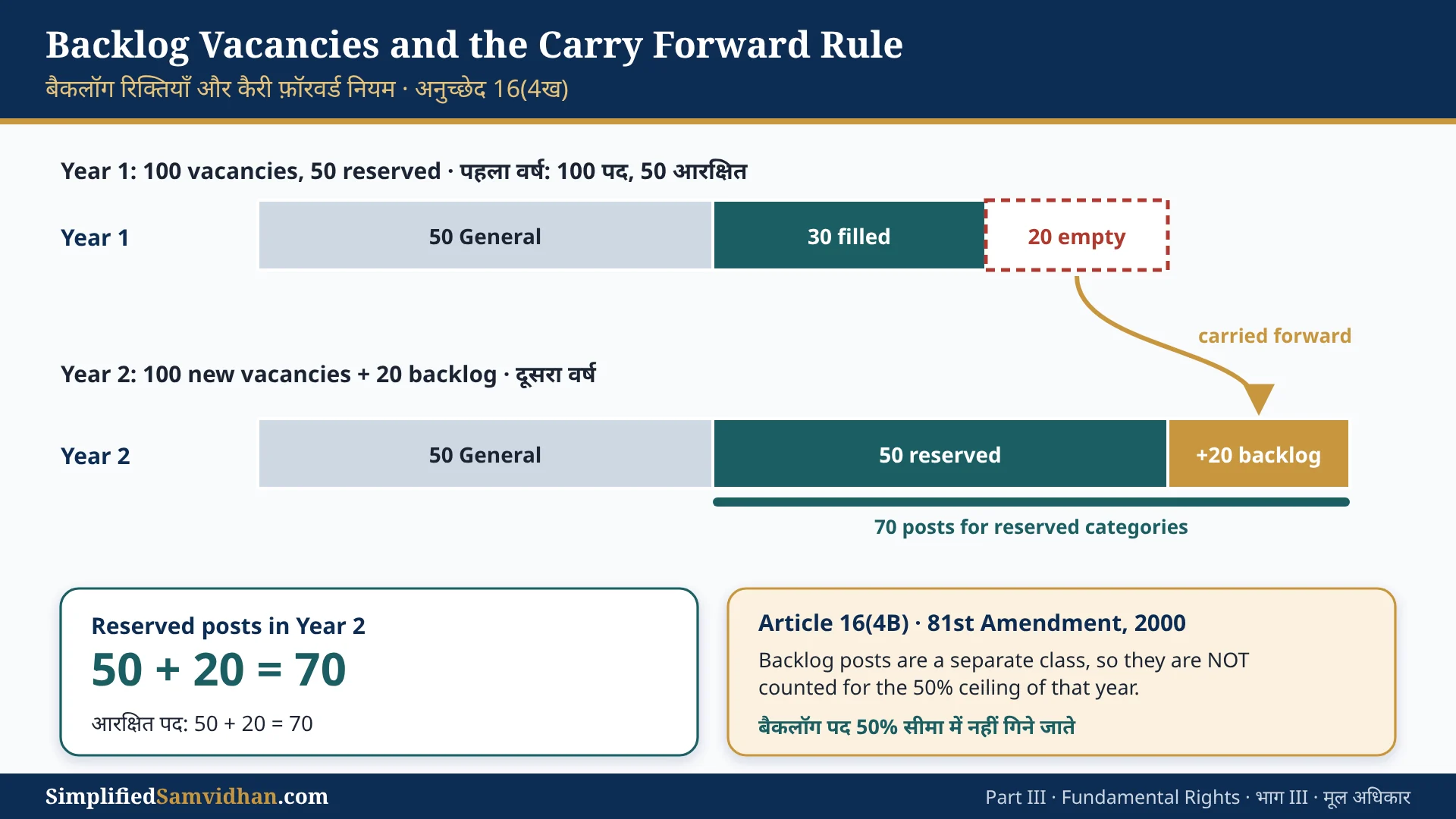
Through the 81st Amendment (2000) a new Article 16(4B) was inserted: reservation applies to vacancies lying empty, and for them the 50% rule does not apply. This adopted the principle of backlog and carry forward: if some of the reserved vacancies remain empty, they are added to the reserved posts of the next year.
Example: out of 100 vacancies, 50 are reserved. Only 30 are filled; 20 remain empty. Next year again 100 vacancies come: 50 for the general category, and 50 + the 20 left over from last year, that is 70 posts for the reserved categories. The 20 backlog posts are treated as a separate class, so the year's 50% ceiling is not breached.
103rd Amendment, 2019EWS Reservation: 103rd Amendment, Eligibility Criteria and the Janhit Abhiyan Judgment
In 2019 the 103rd Amendment gave reservation on an economic basis in two ways:
- Article 15(6): up to 10% EWS reservation in educational institutions, but minority educational institutions are not included.
- Article 16(6): up to 10% EWS reservation in employment under the State.
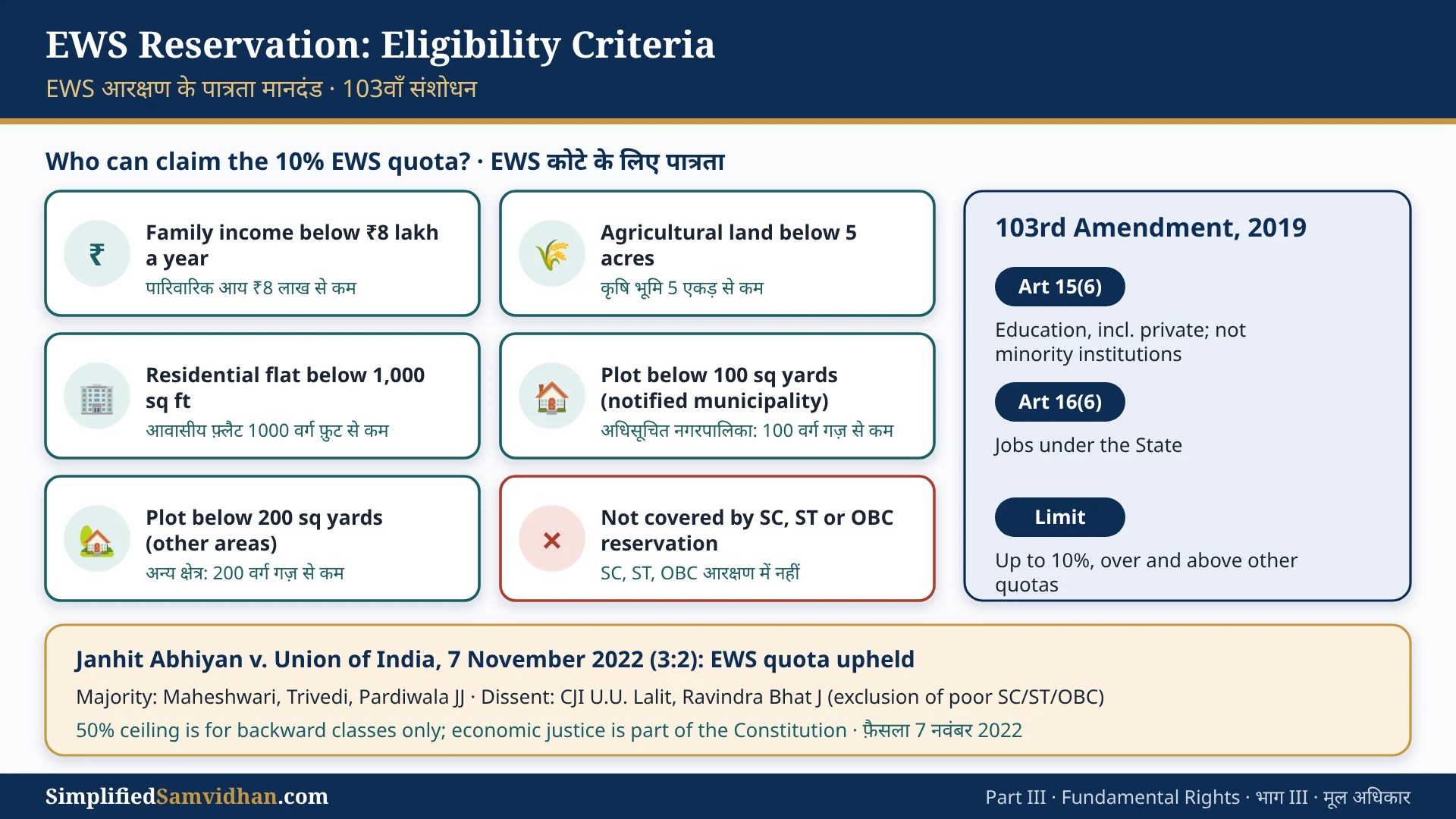
Who are EWS? (Government of India criteria, 2019)
- It does not apply to SC, ST and OBC; it applies to the general category.
- Family gross annual income (the candidate, parents, minor siblings, spouse and minor children, from all sources) must be below ₹8 lakh.
- Excluded if the family owns 5 acres or more of agricultural land,
- or a residential flat of 1,000 sq ft or more,
- or a residential plot of 100 sq yards or more in a notified municipal area,
- or a residential plot of 200 sq yards or more in other (non-notified) areas.
Supreme Court decision: Janhit Abhiyan v. Union of India (7 November 2022, 3:2)
(Your notes date this 26 May 2023; the correct date of the judgment is 7 November 2022.) The majority (Justices Dinesh Maheshwari, Bela M. Trivedi and J.B. Pardiwala) held:
- EWS reservation, that is reservation on an economic basis, is constitutionally valid, because the Constitution also recognises economic justice.
- The idea of distributive justice is built into the Constitution.
- The 50% ceiling was kept for socially and educationally backward classes; the State can give reservation on other grounds, that is on an economic basis.
- Economic reservation does not reduce SC, ST and OBC reservation.
- Reservation is an enabling factor, not an essential feature of the Constitution: a tool run for a fixed period to empower a community. Justice Trivedi and Justice Pardiwala said reservation should not go on forever.
- The 10% EWS reservation can be applied in private (unaided) educational institutions too.
- Dissent (CJI U.U. Lalit and Justice S. Ravindra Bhat): leaving out poor SC, ST and OBC families from EWS is exclusionary and violates the equality code.
Criticisms of economic reservation (from the notes)
- Such arrangements will keep raising the demand for reservation, and people will start treating reservation as a fundamental right.
- Because of corruption in India it can be misused; economic backwardness is hard to identify reliably.
- There is a lack of data to define economic backwardness in India.
- Regional imbalance: economic activity is strong in western India but weaker in eastern and north-eastern India, so a single all-India income line can be disputed.
In its favour: it reduces the resentment of the general category against caste-based reservation, fits the constitutional principle of economic justice, and eases the unemployment and frustration in the general category created by globalisation, liberalisation and privatisation.
Counter-view: under the Directive Principles the government already runs welfare programmes to remove economic backwardness, so reservation on an economic basis is not the right tool.
Two Ways to ReserveHorizontal vs Vertical Reservation in India
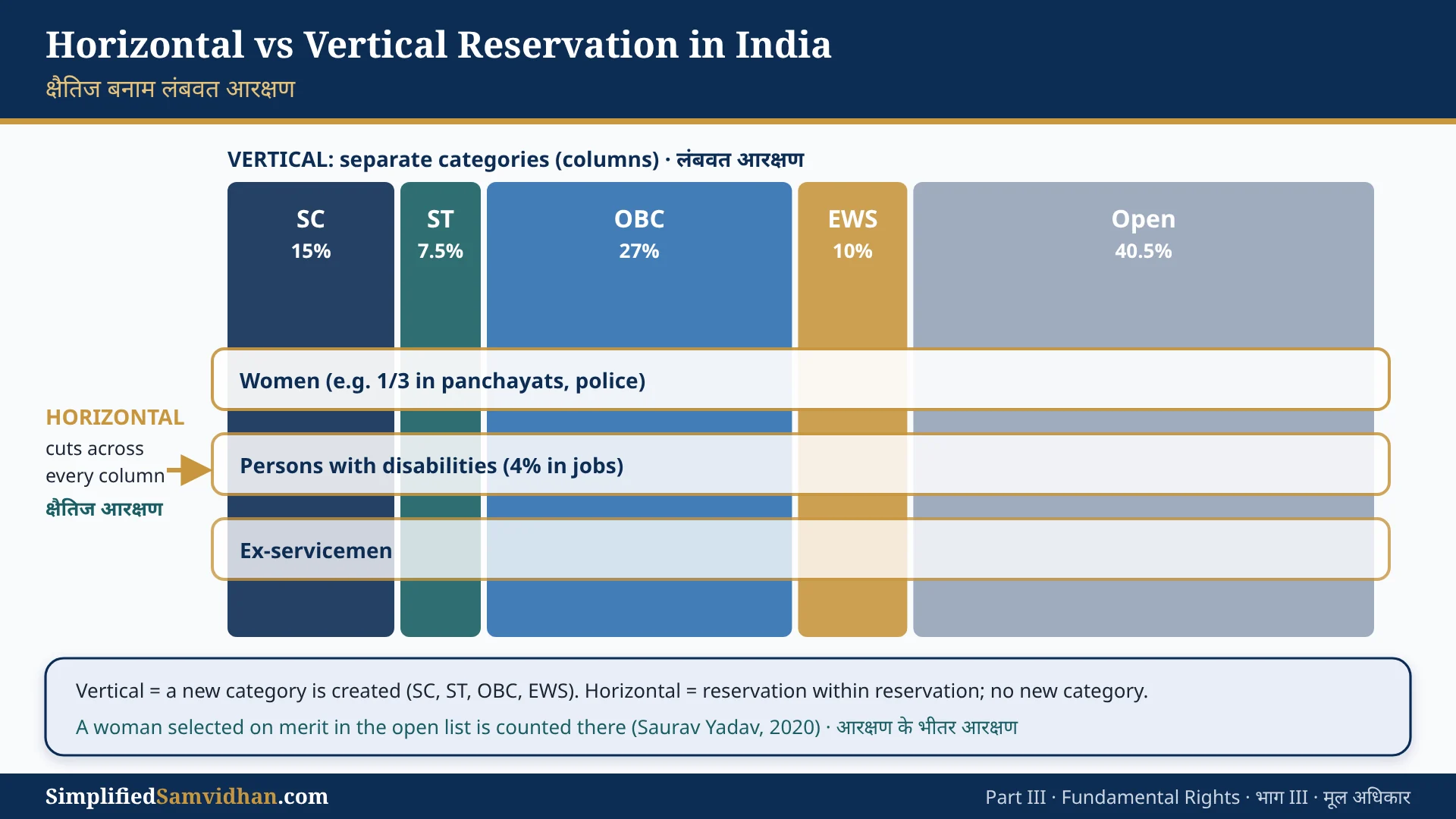
Reservation is generally classified on these two bases:
| Horizontal reservation (क्षैतिज) | Vertical reservation (लंबवत) |
|---|---|
| No new separate category; reservation inside every category | A new category is carved out |
| Example: one-third seats for women in panchayats and municipalities (Articles 243D, 243T); women of SC, ST, OBC and general categories all included | Example: SC 15%, ST 7.5%, OBC 27% (49.5%) and, by the 103rd Amendment, a new EWS category of 10% |
| Other examples: persons with disabilities (4% in jobs), ex-servicemen, women in police recruitment | Based on Articles 15(4), 16(4), 15(6), 16(6) |
| A woman selected on merit in the general list is counted there; the horizontal quota is adjusted category-wise (Saurav Yadav, 2020) | Subject to the 50% rule of Indra Sawhney (EWS sits outside it) |
Think of vertical reservation as the floors of a building (SC, ST, OBC, EWS, open) and horizontal reservation as a lift that runs through every floor (women, persons with disabilities, ex-servicemen).
For and AgainstIs Caste-Based Reservation Constitutionally Right? Principles, Criticisms and the Justice Argument
Settled principles on reservation
- For social justice, caste-based reservation is the first and main tool.
- Caste-based reservation is constitutionally valid.
- Reservation on an economic basis is also possible, but it is the second priority (Indra Sawhney 1992; now through the 103rd Amendment).
- The Constitution has no provision for reservation on the basis of religion.
- Reservation can be given by any "State" under Article 12: the Union, the States, Parliament or a State Legislature.
- The Constitution does not state a right to reservation; it is implicit for social and economic justice.
- No creamy layer for SC/ST at recruitment; creamy layer applies to OBC at recruitment and to SC/ST in promotion (Nagaraj, Jarnail Singh).
- Reservation is subject to judicial review.
- The equality code of Articles 14, 15 and 16 is part of the basic structure, so it cannot be amended in a negative (destructive) way.
Criticisms of reservation
- Caste-based reservation, in some way or other, promotes casteism.
- If the race to grant reservation continues, gradually almost all posts may become reserved.
- Merit gets second priority, and the morale of meritorious candidates falls.
- It promotes populist or vote-bank politics; demands for reservation on the basis of religion are being raised at the political level, though the Constitution has no clear provision for it and the Supreme Court has never approved it.
- Politics of giving reservation to dominant castes too (Jats, Patidars, Marathas); some States have even passed laws. If this continues, all castes may need reservation and the principle of socio-economic justice may be lost.
- In the age of globalisation, liberalisation and privatisation the government is shrinking, so reservation is not giving as much benefit as it should.
The justice argument
Despite these criticisms, social and economic justice are built into the Constitution, and the Supreme Court has accepted this from Indra Sawhney to Jarnail Singh. World thinker John Rawls, in his theory of justice, suggested arranging social and economic institutions so that the least advantaged get the greatest benefit (the difference principle); government cannot run on merit alone. So justice must get priority over bare merit. That is why affirmative action is recognised in America and reservation policy exists in India.
Updated October 2026Reservation in India: Latest Developments in 2024, 2025 and 2026
- Sub-classification of SCs and STs allowed (1 August 2024): in State of Punjab v. Davinder Singh a seven-judge bench (6:1) overruled E.V. Chinnaiah (2004). States may divide SCs/STs into sub-groups, on empirical data, so the most backward get a fair share (but not 100% to one sub-group). Four judges added that a creamy layer should be identified among SCs and STs too. On 9 August 2024 the Union Cabinet said it would not apply creamy layer to SC/ST reservation.
- Creamy layer for SC/ST still open (2026): on 15 January 2026 a bench of CJI Surya Kant and Justices Joymalya Bagchi and Vijay Bishnoi issued notice on Ashwini Kumar Upadhyay's petition seeking SC/ST creamy layer exclusion. In August 2026 the Union told the Supreme Court in written submissions that the creamy layer idea cannot apply to SCs and STs, because wealth does not remove the stigma of caste. The matter is pending.
- OBC creamy layer clarified (11 March 2026): in Union of India v. Rohith Nathan (Justices P.S. Narasimha and R. Mahadevan) the Supreme Court called creamy layer exclusion a constitutional requirement, held that a 2004 letter cannot override the status-based 1993 Office Memorandum, and said treating government and PSU employees' children differently violates Article 14. The ₹8 lakh income limit (since 2017) stays.
- Caste count in Census 2027: the Census notified on 16 June 2025 will record caste for the first time since 1931. Population enumeration runs in February 2027 with reference date 1 March 2027 (1 October 2026 for snow-bound Ladakh, J&K, Himachal Pradesh and Uttarakhand). SC/ST are coded from the notified lists; others write their caste in an open column. The data will shape future debates on the 50% ceiling and sub-categorisation.
- States crossing 50%: the Patna High Court struck down Bihar's increase from 50% to 65% on 20 June 2024; the Supreme Court refused a stay (29 July 2024) and the appeals are pending. Maharashtra's 10% Maratha quota (SEBC Act, 2024) is being heard by a special bench of the Bombay High Court, allowed meanwhile subject to the outcome.
- OBC sub-categorisation: the Justice G. Rohini Commission submitted its report on 31 July 2023; it has not been implemented so far.
- Other moves: the UPSC lateral-entry advertisement for 45 posts was withdrawn on 20 August 2024 after objections that it carried no reservation; in June 2025 the Supreme Court introduced SC/ST reservation in direct recruitment and promotion of its own staff.
Quick RevisionKey Points to Remember
- Article 16 = equal opportunity in public employment for citizens; 16(2) adds descent and residence.
- Only Parliament can prescribe a residence condition (16(3)).
- Central shares: SC 15%, ST 7.5%, OBC 27% (49.5%) + EWS 10% = 59.5%.
- Indra Sawhney (1992): caste valid basis, OBC creamy layer, 50% ceiling, no promotion quota.
- 16(4A) promotion (77th, 1995) + consequential seniority (85th, 2001); 16(4B) backlog (81st, 2000).
- Nagaraj (2006) conditions; Jarnail Singh (2018) drops backwardness data.
- Davinder Singh (2024): SC/ST sub-classification allowed.
- EWS: 103rd Amendment (2019), upheld in Janhit Abhiyan (7 Nov 2022).
Reservation TimelineReservation in India: Key Dates for UPSC
| Year | Event |
|---|---|
| 1951 | 1st Amendment adds 15(4) and the Ninth Schedule after Champakam Dorairajan. |
| 1953 | Kaka Kalelkar Commission (first Backward Classes Commission) under Article 340. |
| 1979 | B.P. Mandal Commission set up; report in 1980 recommends 27% for OBC. |
| 1990 | V.P. Singh government implements 27% OBC reservation in central jobs. |
| 1992 | Indra Sawhney (16 Nov): 27% upheld, creamy layer, 50% ceiling, no promotion quota, 10% economic quota struck down. |
| 1994-2001 | 76th (TN 69% in Ninth Schedule), 77th (16(4A)), 81st (16(4B)), 82nd (Article 335 proviso), 85th (consequential seniority). |
| 2006 | M. Nagaraj: amendments valid, with data, efficiency, creamy layer and 50% conditions. |
| 2018 | Jarnail Singh: no data on SC/ST backwardness needed; creamy layer in promotion stays. |
| 2019 | 103rd Amendment: up to 10% EWS reservation (15(6), 16(6)). |
| 2022 | Janhit Abhiyan (7 Nov): EWS upheld 3:2; 50% ceiling only for backward classes. |
| 2024 | Davinder Singh (1 Aug): sub-classification of SC/ST allowed; Patna HC strikes down Bihar's 65%. |
| 2026 | Rohith Nathan on OBC creamy layer (11 Mar); SC/ST creamy layer plea pending; caste data in Census 2027. |
UPSC · State PSC · JudiciaryArticle 16 and Reservation: UPSC Exam Corner
- Prelims trap: "State Legislatures can prescribe residence conditions for State jobs under Article 16(3)." False. Only Parliament can.
- Prelims trap: "Creamy layer applies to SC/ST in direct recruitment." False as of October 2026. It applies to OBC, and to SC/ST only at the promotion stage (Jarnail Singh).
- Mains (250 words): Is caste-based reservation constitutionally right? Give your view in the light of Supreme Court judgments.
- Mains (250 words): Explain the provisions of reservation on an economic basis and discuss the arguments for and against it given by the Supreme Court.
- Mains: Critically examine the 103rd Constitutional Amendment.
- Linked topics: Article 335 (efficiency), Article 338 / 338A / 338B (commissions), Article 340, Article 341 / 342 / 342A (lists), Ninth Schedule.
Practice MCQTest Yourself: Article 16 and Reservation
Consider the following: 1. Article 16(4B) allows unfilled reserved vacancies to be carried forward outside the 50% ceiling. 2. The 10% economic quota of 1991 was upheld in Indra Sawhney. 3. The EWS quota was upheld in Janhit Abhiyan in November 2022. Which are correct?
Doubts ClearedFrequently Asked Questions
What is Article 16 of Indian Constitution?
Article 16 guarantees equality of opportunity for all citizens in public employment, bans discrimination on religion, race, caste, sex, descent, place of birth or residence, and allows reservation for backward classes, SC/ST promotions and EWS.
What was decided in the Indra Sawhney case?
In 1992 a nine-judge bench upheld 27% OBC reservation, accepted caste as a basis of backwardness, excluded the OBC creamy layer, fixed a 50% ceiling, barred reservation in promotions and struck down the 10% economic quota.
What is the creamy layer limit for OBC in 2026?
₹8 lakh per year, unchanged since 2017. Salary and agricultural income are not added; children of parents in high constitutional posts or Group A posts are excluded by status.
What is the difference between catch-up rule and consequential seniority?
Under the catch-up rule a senior general candidate regains seniority once promoted later. Under consequential seniority (85th Amendment) an SC/ST employee keeps the seniority gained through reserved promotion.
Who is eligible for EWS reservation?
A person not covered by SC, ST or OBC reservation whose family income is below ₹8 lakh a year and whose family does not own 5 acres of farm land, a 1,000 sq ft flat, or a residential plot of 100 sq yards (notified municipality) or 200 sq yards (elsewhere).
Can reservation exceed 50 percent?
For backward classes the Indra Sawhney ceiling of 50% applies except in extraordinary situations. EWS sits outside it (Janhit Abhiyan, 2022), so the central total is 59.5%. Tamil Nadu's 69% is protected through the Ninth Schedule, but remains open to basic structure review.