Bare ActOfficial Text of Article 15
15. Prohibition of discrimination on grounds of religion, race, caste, sex or place of birth.—
(1) The State shall not discriminate against any citizen on grounds only of religion, race, caste, sex, place of birth or any of them.
(2) No citizen shall, on grounds only of religion, race, caste, sex, place of birth or any of them, be subject to any disability, liability, restriction or condition with regard to—(a) access to shops, public restaurants, hotels and places of public entertainment; or (b) the use of wells, tanks, bathing ghats, roads and places of public resort maintained wholly or partly out of State funds or dedicated to the use of the general public.
(3) Nothing in this article shall prevent the State from making any special provision for women and children.
(4) Nothing in this article or in clause (2) of article 29 shall prevent the State from making any special provision for the advancement of any socially and educationally backward classes of citizens or for the Scheduled Castes and the Scheduled Tribes.
(5) Nothing in this article or in sub-clause (g) of clause (1) of article 19 shall prevent the State from making any special provision, by law, for the advancement of any socially and educationally backward classes of citizens or for the Scheduled Castes or the Scheduled Tribes in so far as such special provisions relate to their admission to educational institutions including private educational institutions, whether aided or unaided by the State, other than the minority educational institutions referred to in clause (1) of article 30.
(6) Nothing in this article or sub-clause (g) of clause (1) of article 19 or clause (2) of article 29 shall prevent the State from making,—(a) any special provision for the advancement of any economically weaker sections of citizens other than the classes mentioned in clauses (4) and (5); and (b) any special provision for the advancement of any economically weaker sections of citizens other than the classes mentioned in clauses (4) and (5) in so far as such special provisions relate to their admission to educational institutions including private educational institutions, whether aided or unaided by the State, other than the minority educational institutions referred to in clause (1) of article 30, which in the case of reservation would be in addition to the existing reservations and subject to a maximum of ten per cent. of the total seats in each category.
Explanation.—For the purposes of this article and article 16, "economically weaker sections" shall be such as may be notified by the State from time to time on the basis of family income and other indicators of economic disadvantage.
The State (government, police, a government school, a municipal hospital) cannot treat you worse only because of your religion, race, caste, sex or where you were born.
The word "only" is key. If a rule uses one of these grounds together with a genuine reason, it may survive. Discrimination on other grounds, such as residence, is not barred by Article 15 (D.P. Joshi v. State of Madhya Bharat, 1955).
Clause (2) goes beyond the State: even a private shop, hotel or restaurant cannot refuse you entry on these grounds, and public wells, tanks, ghats and roads are open to all.
Clauses (3) to (6) are the "helping hand": the State may make special provisions for women, children, SCs, STs, backward classes and the economically weaker sections. This is called positive (protective) discrimination, and it is part of equality, not an exception to it.
🏠 Everyday Analogy
Think of a school sports day. The gate rule is: no child is turned away because of religion, caste or gender (clause 1 and 2). But the school also keeps a separate race for younger children and a girls' football team, and gives free shoes to children whose families cannot afford them (clauses 3 to 6). Helping the ones who start behind does not break fairness; it makes the race fair.
🇮🇳 Real Indian Example
Until 2024, jail manuals in several States made prisoners from "lower" castes clean toilets and sweep, while "higher" caste prisoners cooked. In Sukanya Shantha v. Union of India (3 October 2024) the Supreme Court struck these rules down under Articles 14, 15, 17, 21 and 23, and told States to remove the "caste" column from prison registers.
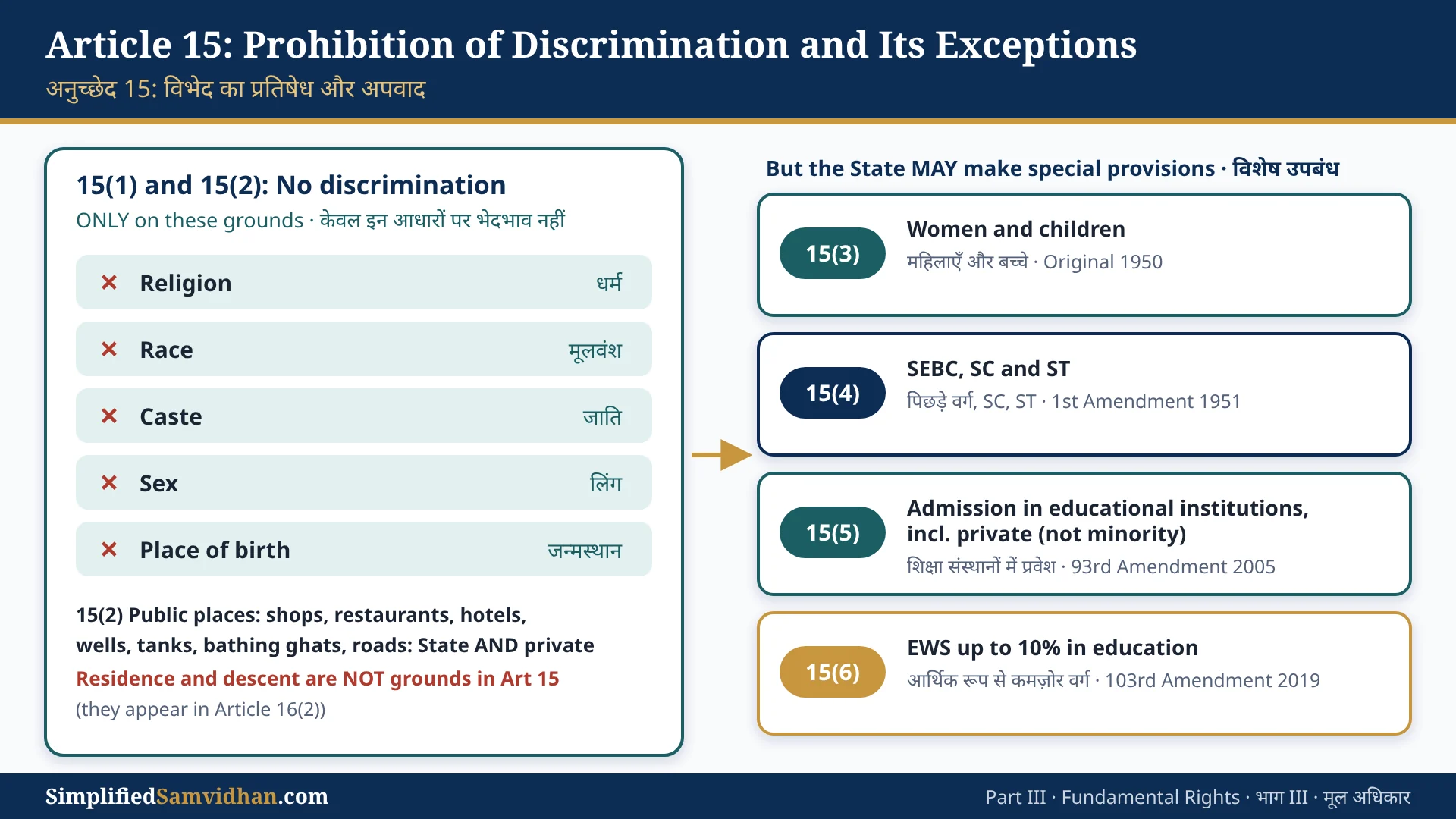
Clauses (1) and (2)Article 15 Prohibition of Discrimination: the Five Grounds and Public Places
Provisions of Article 15 in one look:
- The State shall not discriminate on caste, religion, sex, race (मूलवंश) and place of birth.
- Access to shops, hotels, restaurants, public places, places of entertainment, wells, tanks, bathing ghats and roads will not be restricted.
- In exceptional situations the State may discriminate in favour of women, children, SC/ST, OBC and economically weaker sections to empower them. This is positive discrimination.
| Clause | What it says | Added by |
|---|---|---|
| 15(1) | State shall not discriminate against a citizen only on religion, race, caste, sex, place of birth | Original |
| 15(2) | No citizen can be barred from shops, public restaurants, hotels, places of entertainment, or from wells, tanks, bathing ghats, roads and public resorts | Original |
| 15(3) | Special provisions for women and children | Original |
| 15(4) | Special provisions for socially and educationally backward classes (OBC), SCs and STs | 1st Amendment, 1951 |
| 15(5) | Reservation in admission to educational institutions, including private unaided ones (not minority institutions) | 93rd Amendment, 2005 |
| 15(6) | Up to 10% for EWS (economically weaker sections not covered by 15(4)/(5)), also in admissions | 103rd Amendment, 2019 |
How courts read "sex" and "only"
- NALSA v. Union of India (2014): "sex" includes gender identity; transgender persons are protected.
- Navtej Singh Johar (2018): "sex" also covers sexual orientation.
- Anuj Garg (2008): a law barring women from working in bars was struck down; "protective" rules based on stereotypes are not allowed.
- Indian Young Lawyers Association (Sabarimala, 2018): excluding women of a certain age from a temple was held discriminatory (a larger bench reference is pending).
Clauses (3) to (6)Article 15(3), 15(4), 15(5) and 15(6): Special Provisions and Reservation in Education
15(3): women and children
Separate bus seats and coaches for women, free education for girls, maternity benefits, 33% reservation for women in panchayats (Article 243D) and the Nari Shakti Vandan Adhiniyam (106th Amendment, 2023), which reserves one-third of Lok Sabha and Assembly seats for women after the next delimitation, all follow this idea.
15(4): why the 1st Amendment came
Madras reserved medical and engineering seats by community. In State of Madras v. Champakam Dorairajan (1951) the Supreme Court struck it down, because the original Article 15 had no clause for backward classes. Parliament quickly added Article 15(4) through the 1st Amendment, 1951.
15(5): reservation in private colleges too
After P.A. Inamdar (2005) said the State could not force reservation on private unaided colleges, the 93rd Amendment (2005) added 15(5). On this basis the Central Educational Institutions (Reservation in Admission) Act, 2006 gave 27% OBC seats in IITs, IIMs and central universities. Upheld in Ashoka Kumar Thakur (2008) (creamy layer excluded) and, for private unaided institutions, in Pramati Educational Trust (2014). Minority institutions (Article 30) are outside it.
15(6): EWS
The 103rd Amendment (2019) allows up to 10% reservation for economically weaker sections who are not SC, ST or OBC, in admissions as well, again except minority institutions. Upheld 3:2 in Janhit Abhiyan v. Union of India (7 November 2022). Full details and criteria are explained under Article 16.
Updated October 2026Article 15 in the News: Prison Caste Rules, Domicile Quota and the UGC Equity Rules 2026
- Caste in prisons (3 October 2024): in Sukanya Shantha the Supreme Court struck down jail-manual rules that assigned work by caste, and ordered the "caste" column removed from prison registers. Discrimination "only" on caste, even indirectly, is barred.
- Domicile quota in PG medical (29 January 2025): in Tanvi Behl v. Shrey Goel the Court held residence-based reservation in postgraduate medical seats invalid under Article 14; limited residence preference is still allowed at MBBS level.
- UGC Equity Regulations, 2026: notified on 13 January 2026 to fight caste discrimination on campuses. On 29 January 2026 a bench of CJI Surya Kant and Justice Joymalya Bagchi stayed them, saying the definition of caste discrimination (which protected only SC, ST and OBC students) looked vague and capable of misuse. The 2012 regulations apply until the case is decided.
- Women's reservation: the 106th Amendment (2023) is in force on paper, but its seats start only after the census and delimitation that follow it; the Census 2027 is now under way.
Quick RevisionKey Points to Remember
- Five banned grounds: religion, race, caste, sex, place of birth; the word "only" matters.
- Article 15 protects citizens only (Article 14 protects all persons).
- 15(2) applies against private persons too: shops, hotels, wells, ghats.
- 15(3) women and children (original); 15(4) SEBC/SC/ST (1st Amdt, 1951).
- 15(5) admissions incl. private unaided (93rd Amdt, 2005); minority institutions excluded.
- 15(6) EWS up to 10% (103rd Amdt, 2019), upheld in Janhit Abhiyan (2022).
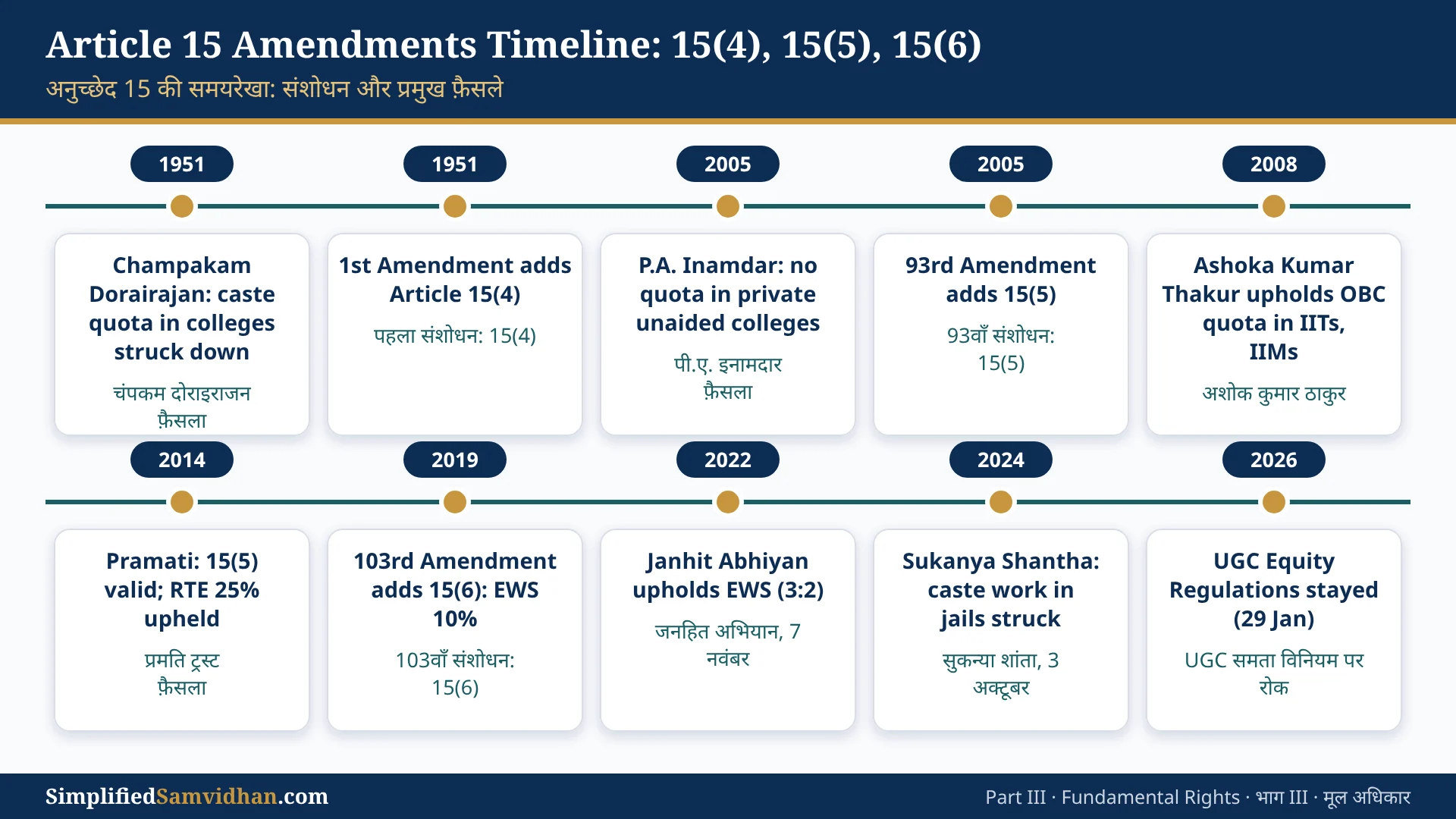
Case Law TimelineKey Judgments on Article 15
| Year | Judgment and holding |
|---|---|
| 1951 | State of Madras v. Champakam Dorairajan: communal seat quota struck down; led to Article 15(4). |
| 1955 | D.P. Joshi: residence is not "place of birth"; a residence-based fee rule upheld. |
| 1962 | M.R. Balaji v. State of Mysore: special provisions must be reasonable, generally below 50%. |
| 2008 | Ashoka Kumar Thakur: 27% OBC quota in central institutions upheld, creamy layer excluded. |
| 2014 | Pramati Educational Trust: Article 15(5) valid for private unaided institutions. |
| 2022 | Janhit Abhiyan: 103rd Amendment and 10% EWS quota upheld (3:2). |
| 2024 | Sukanya Shantha: caste-based work in prisons struck down. |
| 2026 | UGC Equity Regulations stayed by the Supreme Court (29 Jan); 2012 rules continue. |
UPSC · State PSC · JudiciaryArticle 15 of Indian Constitution: UPSC Exam Corner
- Prelims trap: "Descent" and "residence" are grounds in Article 15. False. They appear only in Article 16(2).
- Prelims trap: "Article 15(5) applies to minority educational institutions." False. They are expressly excluded.
- Mains: "Positive discrimination under Article 15 is a facet of equality, not an exception." Discuss with N.M. Thomas (1976) and Indra Sawhney (1992).
- Horizontal reach: Articles 15(2), 17, 23 and 24 can be enforced against private persons.
- Current: UGC Equity Regulations 2026 stay, Sukanya Shantha (2024), Tanvi Behl (2025).
Practice MCQTest Yourself: Article 15
Which constitutional amendment inserted Article 15(5), allowing reservation in private unaided educational institutions?
Doubts ClearedFrequently Asked Questions
What is Article 15 of Indian Constitution?
Article 15 prohibits the State from discriminating against any citizen only on grounds of religion, race, caste, sex or place of birth, guarantees access to public places, and allows special provisions for women, children, SCs, STs, backward classes and EWS.
Is Article 15 available to foreigners?
No. Article 15 uses the word "citizen", so only Indian citizens can claim it.
What is the difference between Article 15(4) and Article 16(4)?
Article 15(4) allows special provisions (including reservation) for SEBCs, SCs and STs in education and other fields. Article 16(4) allows reservation in government jobs for backward classes not adequately represented in services.
Can a private hotel refuse entry on the basis of caste?
No. Article 15(2) binds private persons for access to shops, public restaurants, hotels and places of public entertainment, and such refusal can also be an offence under the Protection of Civil Rights Act, 1955.