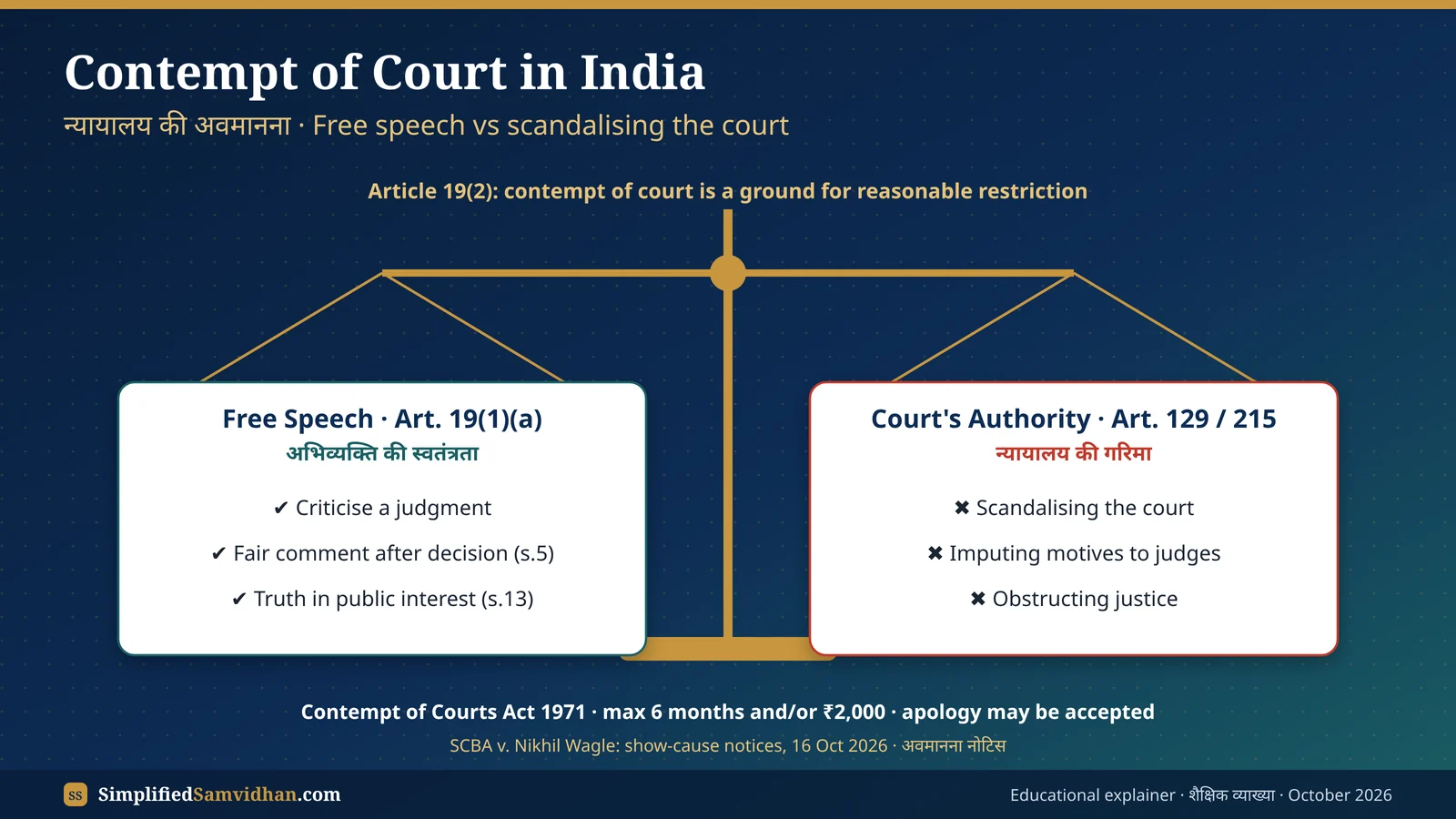
Contempt of Court in India: Article 129, Criminal Contempt and the Wagle-Raut Notice
On 16 October 2026 the Supreme Court asked journalist Nikhil Wagle and MP Sanjay Raut to show cause why criminal contempt proceedings should not be started over remarks targeting the Chief Justice and the judiciary. Where does fair criticism end and scandalising the court begin? Here is the law, in plain language.
Contempt of court: the line between fair criticism of a judgment and scandalising the institution.
📅 Last updated:
Live update
What happened on 16 October 2026
In Supreme Court Bar Association v. Nikhil Wagle and Anr., a bench of CJI Surya Kant and Justice Joymalya Bagchi on Friday, 16 October 2026, issued show-cause notices to journalist Nikhil Wagle and Shiv Sena (UBT) Rajya Sabha MP Sanjay Raut, asking why contempt proceedings should not be initiated against them. The Court declined the SCBA's request to summon them and exempted them from personal appearance for now: "We are giving a show cause ... as of now we are granting exemption for personal appearance. Let us see." The CJI remarked that such attacks on the institution were deeply unfortunate, since courts have always protected personal liberty and fundamental rights.
The allegations in the petition: Wagle is accused of posting a profane message on X directed at the CJI, in response to a report in The Hindu about the CJI declining a meeting with an Opposition delegation on the Election Commission; he later deleted the post and apologised. Raut is accused of claiming that 80 Supreme Court and High Court judges were seen playing badminton with political leaders in London, and that judges attend BJP programmes and BJP Chief Ministers host dinners for them. These are allegations; no finding has been made.
Procedure: the SCBA moved the petition under Section 15(1)(b) of the Contempt of Courts Act, 1971, which needs the written consent of the Attorney General. Attorney General R. Venkataramani gave consent on 15 October 2026, the same day the SCBA wrote to him, calling the posts "prima facie scandalous" and intended to lower the esteem of the Supreme Court, particularly the CJI. No next date has been reported. The matter is pending.
✔ Fact-checked · 16 October 2026⏳ Case pending
🏛️
BackgroundContempt of Court in India: The Wagle-Raut Case Timeline
Date
What happened
1926 and 1952
Earlier Contempt of Courts Acts govern the field; the law on what counts as contempt is largely judge-made.
1950
The Constitution makes the Supreme Court (Article 129) and High Courts (Article 215) courts of record with power to punish for contempt of themselves; Article 19(2) lists contempt of court as a ground for restricting free speech.
1963
The H.N. Sanyal Committee reviews contempt law; its report leads to a fresh statute.
1971
Contempt of Courts Act, 1971 enacted: defines civil and criminal contempt and sets the maximum punishment.
2006
Amendment substitutes Section 13: no punishment unless the contempt substantially interferes with justice; truth allowed as a defence if in public interest and bona fide.
2018
Law Commission's 274th Report recommends against amending the definition of criminal contempt.
Before 15 Oct 2026
Wagle's post on X (later deleted, with an apology) and Raut's public remarks about judges draw objection from the Supreme Court Bar Association.
15 Oct 2026
SCBA writes to the Attorney General; AG R. Venkataramani gives written consent the same day under Section 15(1)(b).
16 Oct 2026
Bench of CJI Surya Kant and Justice Joymalya Bagchi issues show-cause notices; refuses to summon; exempts personal appearance for now. Pending.
Why this matters for exams: this is a high-profile criminal contempt matter of the social-media era against a journalist and a sitting MP together. It brings Articles 129, 19(1)(a), 19(2), 105 and the 1971 Act into one story.
📜
Official TextArticle 129 and Article 215: Courts of Record and the Power to Punish Contempt
📜 Official text · Articles 129, 215 and 142(2), Constitution of India
129. Supreme Court to be a court of record.
The Supreme Court shall be a court of record and shall have all the powers of such a court including the power to punish for contempt of itself.
215. High Courts to be courts of record.
Every High Court shall be a court of record and shall have all the powers of such a court including the power to punish for contempt of itself.
142. Enforcement of decrees and orders of Supreme Court and orders as to discovery, etc.
(2) Subject to the provisions of any law made in this behalf by Parliament, the Supreme Court shall, as respects the whole of the territory of India, have all and every power to make any order for the purpose of securing the attendance of any person, the discovery or production of any documents, or the investigation or punishment of any contempt of itself.
In Simple Words / आसान शब्दों में
A court of record is a court whose judgments and proceedings are kept as permanent records and are accepted as evidence everywhere, and which has the inherent power to punish anyone who shows contempt for it. Article 129 gives this status to the Supreme Court; Article 215 gives it to every High Court. Article 142(2) adds that the Supreme Court can make any order across India to investigate or punish contempt of itself, subject to any law Parliament makes.
The key word is "inherent". The power does not come from the 1971 Act; it comes from the Constitution itself. In In re Vijay Kurle (2020) the Supreme Court held that its power under Article 129 cannot be curtailed by the procedure in the 1971 Act. In Supreme Court Bar Association v. Union of India (1998) it also drew a limit: Articles 129 and 142 cannot be used to suspend an advocate's licence, which is for the Bar Council.
🏠 Everyday analogy
A referee in a football match can show a red card to a player who abuses him, without waiting for the league committee to meet. That on-field power exists because the match cannot go on if the referee's authority collapses. But the referee cannot cancel the player's registration with the league.
🇮🇳 Real Indian example
In In Re: Prashant Bhushan (2020), the Supreme Court took up two tweets about the CJI and the Court on its own and imposed a fine of Re 1. It acted using its power as a court of record under Article 129.
Who makes contempt law? Entry 77 of the Union List covers the Supreme Court, "including contempt of such Court". Entry 14 of the Concurrent List covers "contempt of court, but not including contempt of the Supreme Court". So only Parliament can legislate on contempt of the Supreme Court, while both Parliament and States can legislate on contempt of other courts.
⚖️
Statutory TextCriminal Contempt Under the Contempt of Courts Act, 1971
📜 Official text · Section 2(a), (b), (c), Contempt of Courts Act, 1971
2. Definitions. In this Act, unless the context otherwise requires,—
(a) "contempt of court" means civil contempt or criminal contempt;
(b) "civil contempt" means wilful disobedience to any judgment, decree, direction, order, writ or other process of a court or wilful breach of an undertaking given to a court;
(c) "criminal contempt" means the publication (whether by words, spoken or written, or by signs, or by visible representations, or otherwise) of any matter or the doing of any other act whatsoever which—
(i) scandalises or tends to scandalise, or lowers or tends to lower the authority of, any court; or
(ii) prejudices, or interferes or tends to interfere with, the due course of any judicial proceeding; or
(iii) interferes or tends to interfere with, or obstructs or tends to obstruct, the administration of justice in any other manner;
In Simple Words / आसान शब्दों में
The Act recognises two kinds of contempt:
Civil contempt is about disobedience: someone wilfully ignores a court order or breaks a promise (undertaking) made to the court. Criminal contempt is about attacking the system: publishing or doing anything that (i) scandalises a court or lowers its authority, (ii) prejudices a pending case, or (iii) obstructs the administration of justice. The present case is about limb (i), commonly called "scandalising the court".
Note the words "tends to": the law does not require proof that people actually lost faith in the court; a tendency to lower its authority can be enough. This is why critics call the offence vague.
🏠 Everyday analogy
In a school, a student who refuses to submit homework the teacher ordered is like civil contempt. A student who spreads a rumour on the class WhatsApp group that the principal takes bribes to give marks, without any proof, is like criminal contempt: the attack is on the trust that the whole school runs on.
🇮🇳 Real Indian example
Civil contempt petitions are common when a government department does not pay salaries or pensions despite a High Court order. Criminal contempt is rarer and arises from statements, such as the remarks now before the Supreme Court in the SCBA's petition.
📜 Official text · Section 15(1) and Explanation, Contempt of Courts Act, 1971
15. Cognizance of criminal contempt in other cases.
(1) In the case of a criminal contempt, other than a contempt referred to in section 14, the Supreme Court or the High Court may take action on its own motion or on a motion made by—
(a) the Advocate-General, or
(b) any other person, with the consent in writing of the Advocate-General, or
(c) in relation to the High Court for the Union territory of Delhi, on a motion made by such Law Officer of the Central Government as the Central Government may, by notification in the Official Gazette, specify in this behalf, or any other person, with the consent in writing of such Law Officer.
Explanation.—In this section, the expression "Advocate-General" means— (a) in relation to the Supreme Court, the Attorney-General or the Solicitor-General; ...
In Simple Words / आसान शब्दों में
Section 15 explains who can start a criminal contempt case. The court can act on its own (suo motu). Otherwise, a private person or body must first get the written consent of the Attorney General or Solicitor General (for the Supreme Court) or the Advocate General (for a High Court). The consent is a filter: it stops personal grudges and frivolous complaints from wasting the court's time.
🏠 Everyday analogy
Before a society member can call a special general meeting to remove the treasurer, the rules may need the secretary's approval. It does not decide the result; it only checks that the complaint deserves a meeting.
🇮🇳 Real Indian example
Here the SCBA used Section 15(1)(b). AG R. Venkataramani gave written consent on 15 October 2026, calling the posts "prima facie scandalous", and the Court issued notice the next day.
🔍
The Comparative SplitFair Criticism vs Scandalising the Court: Where Is the Line?
📜 Official text · Sections 5, 12(1) and 13, Contempt of Courts Act, 1971
5. Fair criticism of judicial act not contempt.
A person shall not be guilty of contempt of court for publishing any fair comment on the merits of any case which has been heard and finally decided.
12. Punishment for contempt of court.
(1) Save as otherwise expressly provided in this Act or in any other law, a contempt of court may be punished with simple imprisonment for a term which may extend to six months, or with fine which may extend to two thousand rupees, or with both:
Provided that the accused may be discharged or the punishment awarded may be remitted on apology being made to the satisfaction of the court.
Explanation.—An apology shall not be rejected merely on the ground that it is qualified or conditional if the accused makes it bona fide.
13. Contempts not punishable in certain cases. Notwithstanding anything contained in any law for the time being in force,—
(a) no court shall impose a sentence under this Act for a contempt of court unless it is satisfied that the contempt is of such a nature that it substantially interferes, or tends substantially to interfere with the due course of justice;
(b) the court may permit, in any proceeding for contempt of court, justification by truth as a valid defence if it is satisfied that it is in public interest and the request for invoking the said defence is bona fide.
In Simple Words / आसान शब्दों में
The Act builds in safety valves for free speech:
Section 5: fair comment on the merits of a case that has been heard and finally decided is not contempt. Section 13(a): no punishment unless the contempt substantially interferes with justice, so trivial remarks should be ignored. Section 13(b) (added in 2006): truth can be a defence if it is in the public interest and the plea is bona fide. Section 12: the maximum punishment is simple imprisonment up to six months, or a fine up to Rs 2,000, or both, and a genuine apology can end the case.
🏠 Everyday analogy
A cricket commentator may say "that LBW decision was wrong, the ball was clearly missing leg stump". That is fair criticism. Saying "the umpire was bought by the other team" with no evidence is an attack on the umpire's integrity, and the whole game.
🇮🇳 Real Indian example
In P.N. Duda v. P. Shiv Shanker (1988), a speech by the then Union Law Minister sharply criticising the Supreme Court was held not to be contempt: it was criticism, however strong, and not an attempt to obstruct justice.
✅ Fair criticism (allowed)
Disagreeing with a judgment's reasoning or result.
Pointing out errors of law or fact, delays or pendency.
Comment on a case that has been finally decided (Section 5).
Raising the need for judicial accountability or reforms in appointments, with facts.
Statements that are true, in the public interest and made bona fide (Section 13(b)).
⚖️
🚫 Scandalising (contempt)
Imputing corrupt or improper motives to judges without basis.
Abusive, profane or personal attacks on a judge as a person.
Allegations that the court as a whole is bought or controlled, made to destroy public faith.
Comment that prejudices a pending case or pressures a judge.
Calls to defy court orders or obstruct the administration of justice.
The guiding idea: the judge may be criticised; the institution must not be scandalised. Courts ask whether a statement is a reasoned attack on a decision or a reckless attack on the integrity of the institution. The allegations in the present petition will be tested on this line. The Court has only issued notice; it has not yet decided whether any contempt is made out.
🗣️
Official TextArticle 19(1)(a), 19(2) and Article 105: Free Speech and Contempt of Court
📜 Official text · Article 19(1)(a) and 19(2), Constitution of India
19. Protection of certain rights regarding freedom of speech, etc.
(1) All citizens shall have the right—
(a) to freedom of speech and expression;
(2) Nothing in sub-clause (a) of clause (1) shall affect the operation of any existing law, or prevent the State from making any law, in so far as such law imposes reasonable restrictions on the exercise of the right conferred by the said sub-clause in the interests of the sovereignty and integrity of India, the security of the State, friendly relations with foreign States, public order, decency or morality, or in relation to contempt of court, defamation or incitement to an offence.
In Simple Words / आसान शब्दों में
Every citizen has freedom of speech and expression, including the right to criticise judges and judgments. But Article 19(2) lists "contempt of court" as one of the grounds on which the State may impose reasonable restrictions. So the contempt law is a constitutionally permitted limit on free speech, but it must stay "reasonable". A restriction that punishes honest criticism would itself be unconstitutional.
🏠 Everyday analogy
You are free to write a strong review of your town's hospital: long queues, rude staff, poor results. You cannot post that a named doctor poisons patients for money unless you can prove it. The first improves the hospital; the second may scare patients away from treatment.
🇮🇳 Real Indian example
In In re Arundhati Roy (2002) the Supreme Court held that statements in her affidavit amounted to criminal contempt and sentenced her to one day's symbolic imprisonment and a fine of Rs 2,000, showing that free speech does not protect imputations against the Court.
📜 Official text · Article 105(1) and (2), Constitution of India
105. Powers, privileges, etc., of the Houses of Parliament and of the members and committees thereof.
(1) Subject to the provisions of this Constitution and to the rules and standing orders regulating the procedure of Parliament, there shall be freedom of speech in Parliament.
(2) No member of Parliament shall be liable to any proceedings in any court in respect of anything said or any vote given by him in Parliament or any committee thereof, and no person shall be so liable in respect of the publication by or under the authority of either House of Parliament of any report, paper, votes or proceedings.
In Simple Words / आसान शब्दों में
MPs enjoy absolute freedom of speech inside Parliament: no court case can be filed for what they say or how they vote in the House or its committees. But this immunity covers only speeches and votes in Parliament. Remarks made at a press conference, in an interview or on social media are treated like any citizen's speech. So Sanjay Raut cannot claim parliamentary privilege for statements made outside Parliament.
There is also a reverse restraint: under Article 121, Parliament itself cannot discuss the conduct of a Supreme Court or High Court judge in the discharge of duties except on a motion for the judge's removal.
🏠 Everyday analogy
A teacher's comments inside the staff meeting are protected by the meeting's rules. The same teacher's comments on a public Facebook page are not covered by those rules at all.
🇮🇳 Real Indian example
Raut is a sitting Rajya Sabha MP, but the remarks cited in the SCBA petition were made outside the House, so Article 105(2) does not shield them from contempt proceedings.
📚
Landmark JudgmentsContempt of Court in India: Key Supreme Court Cases
Case
What the Court held
Why it matters
E.M.S. Namboodiripad v. T.N. Nambiar (1970)
The Kerala Chief Minister's description of the judiciary as an instrument of class oppression was held to be contempt; conviction upheld.
Even a sitting CM's ideological attack on the judiciary can scandalise the courts.
P.N. Duda v. P. Shiv Shanker (1988)
The Union Law Minister's critical speech about the Supreme Court was not contempt.
Strong criticism of the institution's approach is allowed if it does not obstruct justice.
Supreme Court Bar Association v. Union of India (1998)
Articles 129 and 142 cannot be used to suspend an advocate's licence to practise.
Contempt power is wide but not unlimited; it cannot override statutory bodies like Bar Councils.
In re Arundhati Roy (2002)
Author convicted of criminal contempt; one day's symbolic imprisonment and Rs 2,000 fine.
Imputations against the Court in an affidavit are not protected speech.
In re Vijay Kurle (2020)
The Supreme Court's power under Article 129 is inherent and not limited by the 1971 Act's procedure.
The Court can act suo motu and frame its own procedure.
In Re: Prashant Bhushan (2020)
Lawyer convicted over tweets on the CJI and the Court; fine of Re 1.
Triggered nationwide debate on whether the offence of scandalising should exist.
SCBA v. Nikhil Wagle and Anr. (2026)
Show-cause notices issued; personal appearance exempted for now.
Pending. Tests contempt law against social-media speech by a journalist and an MP.
In Simple Words / आसान शब्दों में
Read together, the cases show a pattern: courts protect criticism of reasoning (Duda) but punish attacks on integrity (Namboodiripad, Roy, Bhushan), and increasingly prefer symbolic punishment or an accepted apology over jail. The Court is also wary of being seen as "judge in its own cause".
Abroad, the trend has moved the other way. Lord Denning said in R v Metropolitan Police Commissioner, ex parte Blackburn (No 2) (1968): "We will never use this jurisdiction as a means to uphold our own dignity." The UK abolished the offence of scandalising the judiciary in England and Wales through the Crime and Courts Act 2013. India's Law Commission, in its 274th Report (2018), recommended not amending the definition of criminal contempt, so the offence remains in Indian law.
🏠 Everyday analogy
A family elder who is mocked at a wedding can either shout back or smile and move on. The elder who smiles often earns more respect than the one who demands it.
🇮🇳 Real Indian example
The Re 1 fine in the Prashant Bhushan case (2020) was itself read by many as a sign that the Court wanted to assert its authority without making the critic a martyr.
🧭
AnalysisScandalising the Court: Arguments For and Against, and the Way Forward
🛡️ Why keep the offence
Judges, by convention, cannot reply publicly to attacks; contempt is their only shield.
Public confidence is the court's only real power; it has no army or purse.
Social media spreads unverified allegations against judges to millions within minutes.
Article 19(2) expressly allows contempt of court as a restriction.
Law Commission's 274th Report (2018) advised against diluting the definition.
Sections 5 and 13 already protect fair and truthful criticism.
⚖️
🗣️ Why critics want it narrowed
"Scandalise" and "tends to" are vague and can chill legitimate criticism.
The court acts as victim, prosecutor and judge in its own cause.
The UK abolished the offence in 2013; Lord Denning warned against using it to uphold dignity.
Prosecutions can draw more attention to a remark (the Streisand effect).
A strong judiciary earns trust through reasoned judgments, not punishment.
Accountability mechanisms for judges are limited, so public criticism fills a gap.
1
Use sparingly
Reserve criminal contempt for remarks that substantially interfere with justice, as Section 13(a) already demands; ignore the trivial.
2
Prefer apology and correction
A bona fide apology and deletion of a post, as Section 12 allows, should normally close the matter.
3
Strengthen the AG filter
Consent under Section 15 should be a reasoned check, so that only serious cases reach the Court.
4
Clear guidance
Consistent judicial guidance on the difference between critique of reasoning and imputation of motives would reduce uncertainty.
5
Visible judicial accountability
A transparent in-house procedure (adopted in 1999) and the Judges (Inquiry) Act, 1968 for removal under Article 124(4) give citizens a proper channel for complaints, reducing the urge to make allegations on social media.
Legal awareness: what you can safely say online about courts
Critique the reasoning: "The judgment ignored Article 14 because..." is fair comment.
Cite facts and sources: link the order, quote it accurately, give dates.
Wait on pending cases: avoid commentary that pressures judges or prejudges guilt while a case is being heard.
Do not impute corruption or bias without proof: allegations of bribery or political favour need evidence; if you have it, use the proper channel (the CJI under the in-house procedure).
No abuse or profanity: personal insults add nothing to an argument and can be treated as scandalising.
If you cross the line: delete, correct and apologise promptly; a bona fide apology counts under Section 12.
🎯
UPSC CornerContempt of Court in India for UPSC Prelims and Mains
Prelims fact: Article 129 (Supreme Court) and Article 215 (High Courts) make them courts of record with power to punish for contempt of themselves.
Prelims fact: Contempt of the Supreme Court: Entry 77, Union List. Contempt of other courts: Entry 14, Concurrent List (which excludes the Supreme Court).
Prelims fact: Contempt of Courts Act, 1971, based on the H.N. Sanyal Committee (1963). Civil contempt: Section 2(b). Criminal contempt: Section 2(c).
Prelims fact: Maximum punishment (Section 12): simple imprisonment up to six months, or fine up to Rs 2,000, or both. Truth as a defence: Section 13(b), added in 2006.
Prelims fact: A private person needs the written consent of the Attorney General or Solicitor General to move the Supreme Court for criminal contempt (Section 15(1)(b)).
Prelims fact: Article 105(2) immunity covers only what an MP says or votes in Parliament or its committees.
Mains GS2 (250 words): "The power to punish for contempt is meant to protect the administration of justice, not the dignity of individual judges." Discuss the law on scandalising the court in India in the light of recent cases, and suggest safeguards for free speech.
Mains GS4 (Ethics): Judicial restraint versus institutional self-defence: should a constitutional court respond to personal abuse with contempt power or with silence? Discuss the values of tolerance, accountability and public trust involved.
Essay angle: "The judge may be criticised, the institution must not be scandalised."
Ethics lens: judges must show restraint and not use contempt to protect personal reputation; public figures must show responsibility, since an MP's or journalist's words carry weight; and the system must offer real accountability (in-house procedure, 1999; removal under Article 124(4) through the Judges (Inquiry) Act, 1968) so that trust is earned, not enforced.
📝
Practice MCQTest Yourself: Contempt of Court: SC Notice to Wagle, Raut
With reference to contempt of court in India, consider the following statements: (1) Legislation on contempt of the Supreme Court falls under Entry 14 of the Concurrent List. (2) Under the Contempt of Courts Act, 1971, as amended in 2006, a court may permit justification by truth as a valid defence if it is in the public interest and the request is bona fide. (3) The maximum punishment under Section 12 of the Act is simple imprisonment up to six months, or a fine up to two thousand rupees, or both. Which of the statements given above is/are correct?
Answer: (b) 2 and 3 only. Statement 1 is wrong: contempt of the Supreme Court is in Entry 77 of the Union List; Entry 14 of the Concurrent List expressly excludes contempt of the Supreme Court. Statement 2 is correct: Section 13(b), substituted in 2006, allows truth as a defence on these conditions. Statement 3 is correct: these are the limits in Section 12(1), and a bona fide apology may lead to discharge or remission.
❓
Doubts ClearedFrequently Asked Questions
What is contempt of court in India?
Contempt of court is conduct that disrespects or obstructs a court. Under the Contempt of Courts Act, 1971 it is either civil contempt (wilful disobedience of a court order or breach of an undertaking) or criminal contempt (scandalising or lowering the authority of a court, prejudicing a judicial proceeding, or obstructing the administration of justice). Articles 129 and 215 give the Supreme Court and High Courts power to punish contempt of themselves.
What is criminal contempt and scandalising the court?
Criminal contempt under Section 2(c) of the 1971 Act includes any publication or act that scandalises or tends to scandalise, or lowers or tends to lower, the authority of a court. Scandalising usually means imputing corrupt or improper motives to judges or abusing the institution in a way that can shake public faith in justice. Fair criticism of a judgment is not scandalising.
Why did the Supreme Court issue contempt notice to Nikhil Wagle and Sanjay Raut?
On 16 October 2026 a bench of CJI Surya Kant and Justice Joymalya Bagchi issued show-cause notices on a petition by the Supreme Court Bar Association, filed with the Attorney General's consent under Section 15(1)(b). The petition alleges that Wagle posted a profane message about the CJI on X (later deleted, with an apology) and that Raut made claims about judges socialising with political leaders. The Court exempted them from personal appearance for now. The matter is pending.
Can I criticise a Supreme Court judgment in India?
Yes. Section 5 of the Contempt of Courts Act protects fair comment on the merits of a case that has been heard and finally decided, and Article 19(1)(a) protects free speech. You can criticise the reasoning with facts. What is not protected is abuse or imputing corrupt motives to judges without proof, or comment that prejudices a pending case.
What is the punishment for contempt of court in India?
Under Section 12 of the Contempt of Courts Act, 1971, contempt may be punished with simple imprisonment up to six months, or a fine up to two thousand rupees, or both. The accused may be discharged or the punishment remitted if a bona fide apology satisfies the court, and under Section 13 no sentence is imposed unless the contempt substantially interferes with the due course of justice.
🔎
Sources and further readingSources We Checked
News facts on this page were checked against the reports below on 16 October 2026. The contempt matter is pending and only notices have been issued; nothing on this page is a finding of guilt.