Bare ActOfficial Text of Article 41
41. Right to work, to education and to public assistance in certain cases.—
The State shall, within the limits of its economic capacity and development, make effective provision for securing the right to work, to education and to public assistance in cases of unemployment, old age, sickness and disablement, and in other cases of undeserved want.
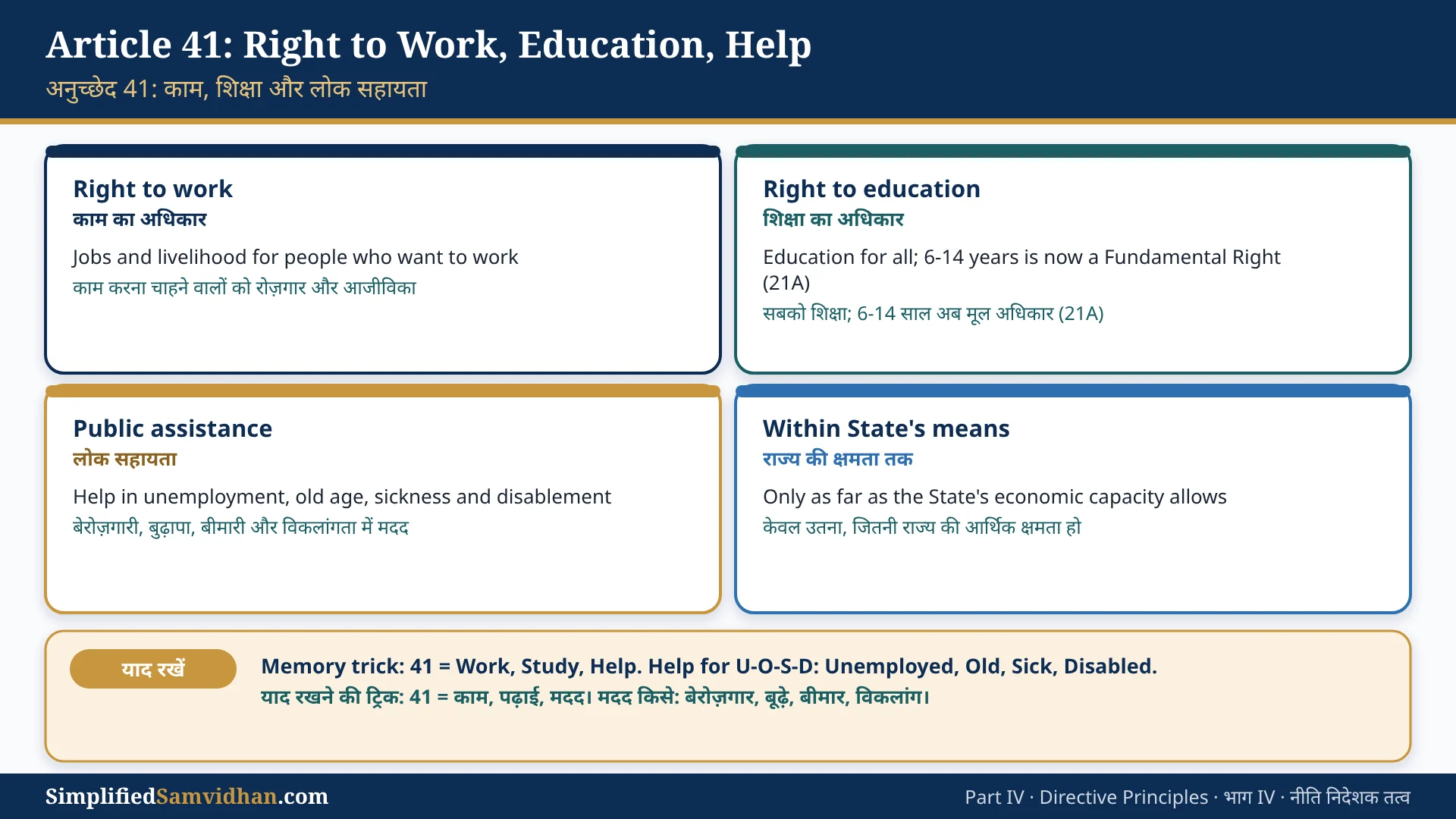
The State should help people get work and education.
It should give public assistance (help from the government) in unemployment, old age, sickness and disablement.
Also in other cases of "undeserved want": need that is not the person's fault.
But only within the State's economic capacity. A poor State does what it can.
🏠 Everyday Analogy
Think of a family where the elder brother earns. He pays for his sister's school, helps his unemployed cousin find a job and buys medicine for grandpa, as far as his salary allows. Article 41 asks the State to be that elder brother.
🇮🇳 Real Indian Example
Lakshmi, a widow in a Tamil Nadu village, gets a monthly widow pension under the National Social Assistance Programme. Her son gets wage work on the village pond under the VB-G RAM G Act. Both are Article 41 in action.
Laws and SchemesArticle 41 of Indian Constitution: Laws and Schemes for Work, Education and Public Assistance
| Promise in Article 41 | How the State applies it |
|---|---|
| Right to work | VB-G RAM G Act, 2025: 125 days of work for rural households (replaced MGNREGA from 1 July 2026) |
| Right to education | Article 21A (86th Amendment, 2002) and the RTE Act, 2009: free schooling for 6-14 |
| Help in old age, widowhood, disability | National Social Assistance Programme (1995): monthly pensions |
| Help in disablement | Rights of Persons with Disabilities Act, 2016 |
Key case
- Olga Tellis v Bombay Municipal Corporation (1985): pavement dwellers in Mumbai faced eviction. The Supreme Court said the right to livelihood is part of the right to life (Article 21), reading it with Articles 39(a) and 41.
Quick RevisionKey Points to Remember
- Article 41: right to work, education and public assistance.
- Public assistance in unemployment, old age, sickness, disablement and undeserved want.
- Limited by the State's economic capacity and development.
- Applied by VB-G RAM G Act, 2025 (125 days of work, replaced MGNREGA from 1 July 2026).
- Category: Socialist principle.
UPSC · State PSC · JudiciaryArticle 41: Exam Corner
- Prelims trap: "Right to work is a Fundamental Right." False. It is a DPSP under Article 41; only a law (like VB-G RAM G) gives a legal guarantee of work.
- Fact (SSC/school): The four cases of public assistance in Article 41 are unemployment, old age, sickness and disablement.
- Mains (150 words): "Within the limits of its economic capacity." Is this phrase a strength or a weakness of Article 41?
Practice MCQTest Yourself: Article 41
Article 41 asks for public assistance in which of these cases? Pick the one NOT named in it.
Doubts ClearedFrequently Asked Questions
What is Article 41 of Indian Constitution?
Article 41 is a Directive Principle that asks the State, within its economic capacity, to secure the right to work, to education and to public assistance in unemployment, old age, sickness and disablement.
Is the right to work a Fundamental Right in India?
No. It is a Directive Principle under Article 41. But the Supreme Court has said the right to livelihood is part of Article 21 (Olga Tellis, 1985), and laws like the VB-G RAM G Act give a legal right to some days of work.
How is Article 41 linked to Article 21A?
Article 41 speaks of a right to education as a goal. The 86th Amendment, 2002 made free and compulsory education for children aged 6 to 14 a Fundamental Right under Article 21A.