Bare ActOfficial Text of Article 48A
48A. Protection and improvement of environment and safeguarding of forests and wild life.—
The State shall endeavour to protect and improve the environment and to safeguard the forests and wild life of the country.
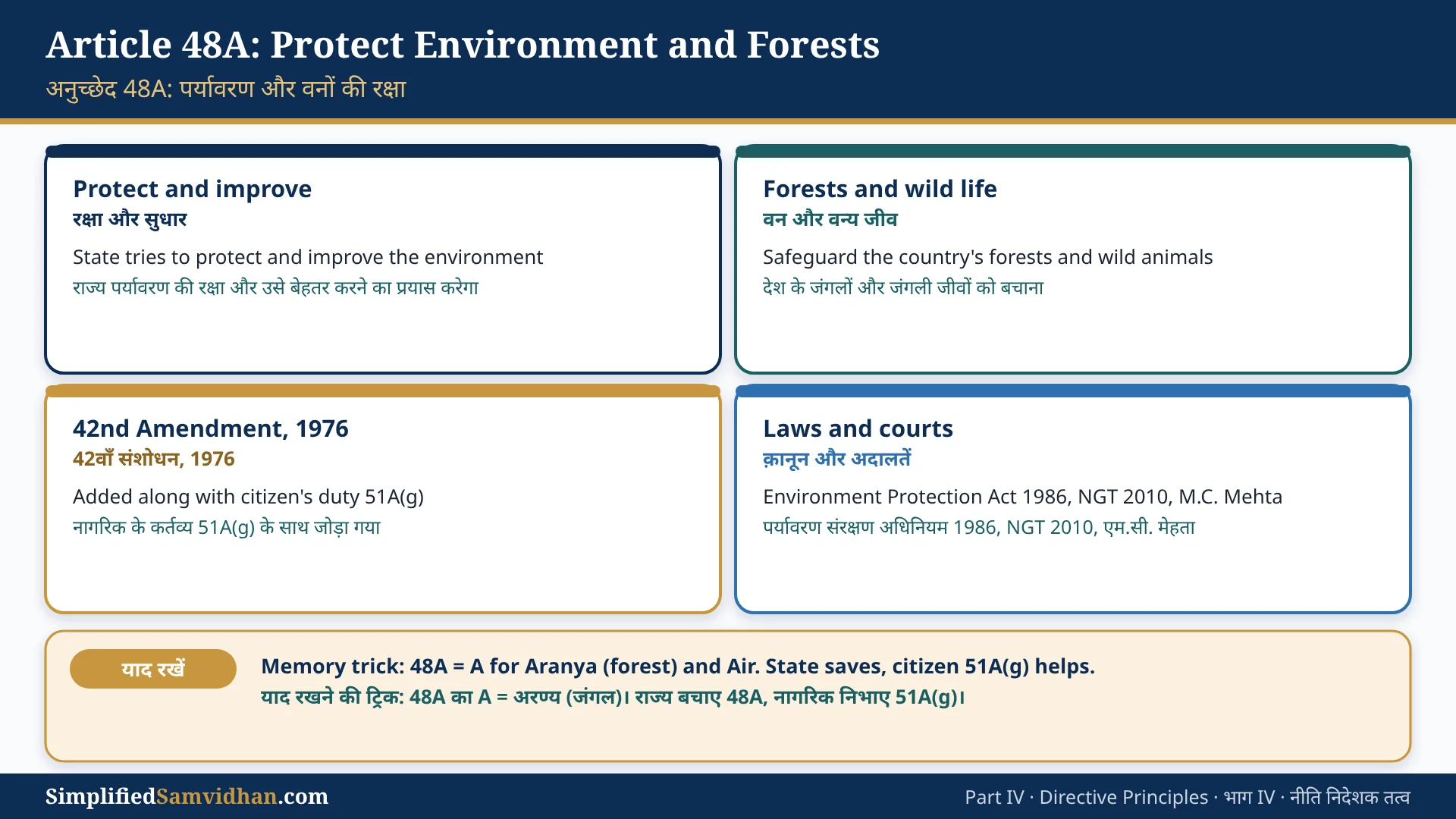
The State must try to protect the environment and also improve it.
It must safeguard forests and wild life of the country.
It is a Directive Principle: you cannot sue under 48A alone, but courts read it with Article 21 (right to life includes a clean environment).
Its partner is Article 51A(g): every citizen's duty to protect nature and have compassion for living creatures.
🏠 Everyday Analogy
Think of the country as a big shared house. Article 48A makes the government the caretaker who must keep the garden green and the water tank clean, and 51A(g) asks every family member not to litter.
🇮🇳 Real Indian Example
Smoke from factories near Agra was turning the white marble of the Taj Mahal yellow. In the M.C. Mehta (Taj Trapezium) case, the Supreme Court told those factories to switch to cleaner fuel like natural gas or move away. That is Article 48A in action.
Laws and CasesArticle 48A of Indian Constitution: Environment Laws and Key Cases
Parliament has made many laws that carry out Article 48A:
| Law | What it does |
|---|---|
| Wildlife (Protection) Act, 1972 | Bans hunting of protected animals; national parks and sanctuaries |
| Water Act, 1974 and Air Act, 1981 | Pollution control boards check factories and cities |
| Forest (Conservation) Act, 1980 | Forest land cannot be used for other work without Centre's approval |
| Environment (Protection) Act, 1986 | Umbrella law, passed after the Bhopal gas tragedy (1984) |
| National Green Tribunal Act, 2010 | A special court (NGT) for environment cases |
Key cases
- M.C. Mehta v. Union of India: a series of cases on the Ganga, Delhi air and the Taj Mahal.
- T.N. Godavarman Thirumulpad v. Union of India (from 1996): "forest" means any forest in the dictionary sense, whoever owns it.
- M.K. Ranjitsinh v. Union of India (2024): the Court said people have a right against the bad effects of climate change (Articles 14 and 21), in a case on the Great Indian Bustard.
Quick RevisionKey Points to Remember
- Article 48A: State shall endeavour to protect and improve the environment.
- Also to safeguard forests and wild life.
- Added by the 42nd Amendment, 1976, together with duty 51A(g).
- Courts read it with Article 21: right to a clean environment.
- Key law: Environment (Protection) Act, 1986; special court: NGT (2010).
UPSC · State PSC · JudiciaryArticle 48A: Exam Corner
- Prelims trap: "Article 48A was in the original Constitution of 1950." False. It came with the 42nd Amendment, 1976.
- Fact (SSC, school): 48A is the State's duty (DPSP); 51A(g) is the citizen's duty (Fundamental Duty). Both came in 1976.
- Mains: "Courts have turned Article 48A into an enforceable right through Article 21." Discuss with cases.
Practice MCQTest Yourself: Article 48A
Article 48A (protection of environment, forests and wild life) was added to the Constitution by which amendment?
Doubts ClearedFrequently Asked Questions
What is Article 48A of Indian Constitution?
Article 48A is a Directive Principle. It says the State shall try to protect and improve the environment and to safeguard the forests and wild life of the country. It was added in 1976.
What is the difference between Article 48A and Article 51A(g)?
Article 48A is a duty of the State (Part IV). Article 51A(g) is a duty of every citizen (Part IVA) to protect forests, lakes, rivers and wild life and to have compassion for living creatures.
Can I go to court under Article 48A?
Not under Article 48A alone, because DPSPs are not enforceable (Article 37). But courts treat a clean environment as part of the right to life in Article 21, so pollution cases are heard as Article 21 cases.