Bare ActOfficial Text of Article 51
51. Promotion of international peace and security.—
The State shall endeavour to—
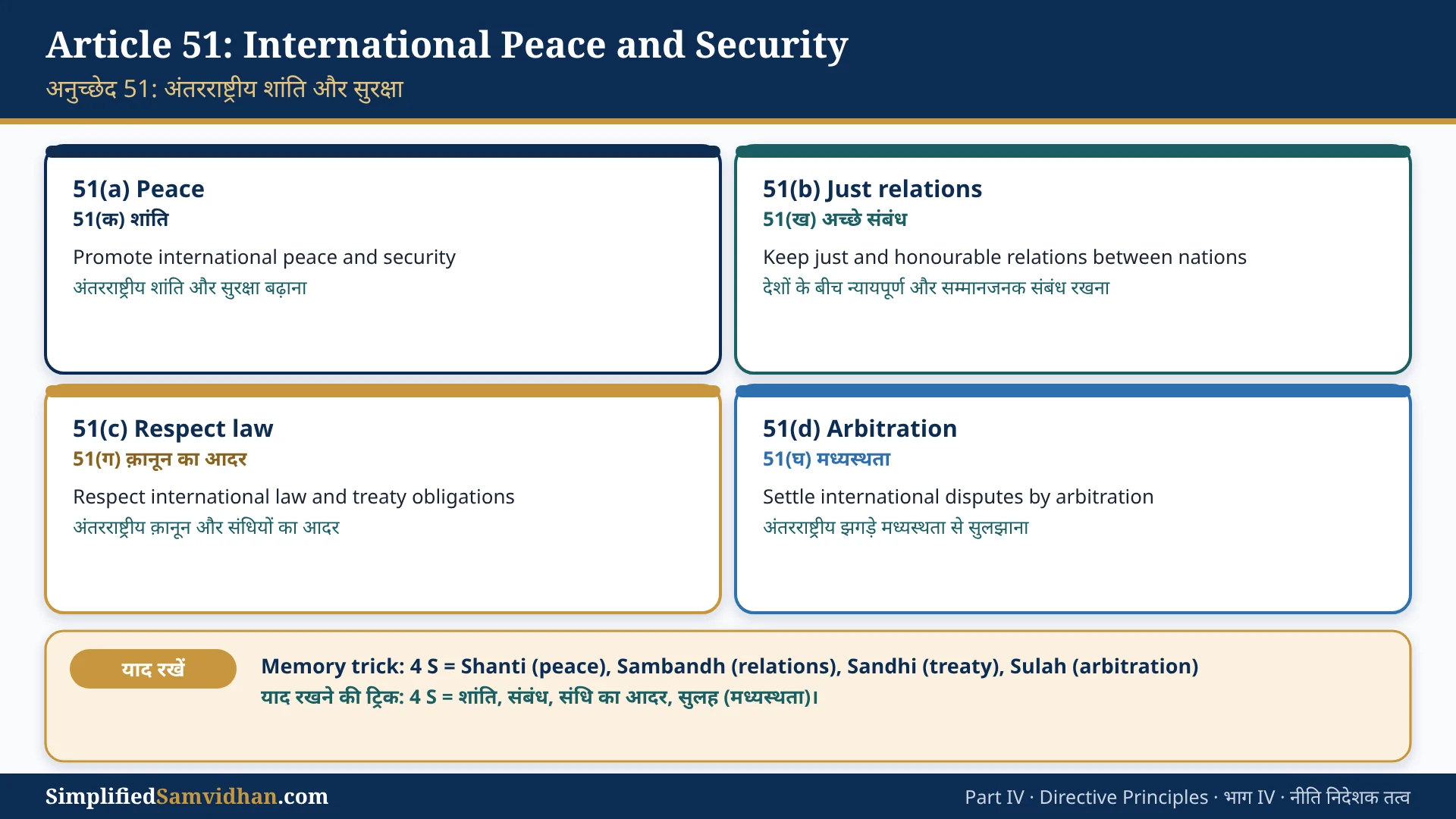
(a) promote international peace and security;
(b) maintain just and honourable relations between nations;
(c) foster respect for international law and treaty obligations in the dealings of organised peoples with one another; and
(d) encourage settlement of international disputes by arbitration.
India should work for world peace and security.
India should keep fair and respectful relations with every country.
India should respect international law and treaties it has signed.
Fights between countries should be settled by arbitration, not war.
🏠 Everyday Analogy
When two families in a village fight over a boundary wall, the wise way is to call the panchayat, not to throw stones. Article 51 asks countries to do the same: talk, respect promises and let a neutral party decide.
🇮🇳 Real Indian Example
In Vishaka v. State of Rajasthan (1997) there was no Indian law on sexual harassment at work. The Supreme Court used an international convention India had signed (CEDAW), relying on Article 51(c) and Article 253, and laid down guidelines that every office had to follow.
Four ClausesArticle 51 of Indian Constitution: Four Clauses for International Peace
| Clause | What it means | Example |
|---|---|---|
| 51(a) | Work for world peace and security | India's soldiers serve in UN peacekeeping missions |
| 51(b) | Fair and respectful relations with all nations | Panchsheel (1954): five principles of peaceful co-existence |
| 51(c) | Respect international law and treaties | Parliament can make laws to carry out treaties (Article 253) |
| 51(d) | Settle disputes by arbitration | Talking to a neutral referee instead of fighting |
End of Part IV
Article 51 is the last Article of Part IV. Right after it comes Part IVA with Article 51A, the Fundamental Duties of citizens, added by the 42nd Amendment, 1976. Do not mix them up: 51 is the State's goal in foreign affairs, 51A is the citizen's duty.
Quick RevisionKey Points to Remember
- Article 51: State shall endeavour to promote international peace and security.
- Four clauses: peace, just relations, respect for law and treaties, arbitration.
- It is the last Article of Part IV; Article 51A (Part IVA) is a different thing.
- Courts have used 51(c) to apply international conventions (Vishaka, 1997).
- Never amended; a liberal-intellectual DPSP.
UPSC · State PSC · JudiciaryArticle 51: Exam Corner
- Prelims trap: "Article 51 lists the Fundamental Duties." False. That is Article 51A in Part IVA; Article 51 is a DPSP on international peace.
- Fact (SSC, school): Article 51 has four clauses (a) to (d); clause (d) speaks of arbitration.
- Mains: "Article 51 reflects the ideals of India's foreign policy." Discuss with examples.
Practice MCQTest Yourself: Article 51
Which of the following is mentioned in Article 51? 1. Promote international peace and security 2. Settle international disputes by arbitration 3. Join a military alliance
Doubts ClearedFrequently Asked Questions
What is Article 51 of Indian Constitution?
Article 51 is the last Directive Principle. It asks the State to promote international peace and security, keep just and honourable relations between nations, respect international law and treaties, and encourage settlement of disputes by arbitration.
What is the difference between Article 51 and Article 51A?
Article 51 (Part IV) is a Directive Principle on international peace, in the Constitution since 1950. Article 51A (Part IVA) lists the Fundamental Duties of citizens and was added in 1976.
How have courts used Article 51?
Courts have used Article 51(c) to read international conventions into Indian law when there is no Indian law on the point and the convention does not clash with it, as in Vishaka v. State of Rajasthan (1997).