Bare ActOfficial Text of Article 42
42. Provision for just and humane conditions of work and maternity relief.—
The State shall make provision for securing just and humane conditions of work and for maternity relief.
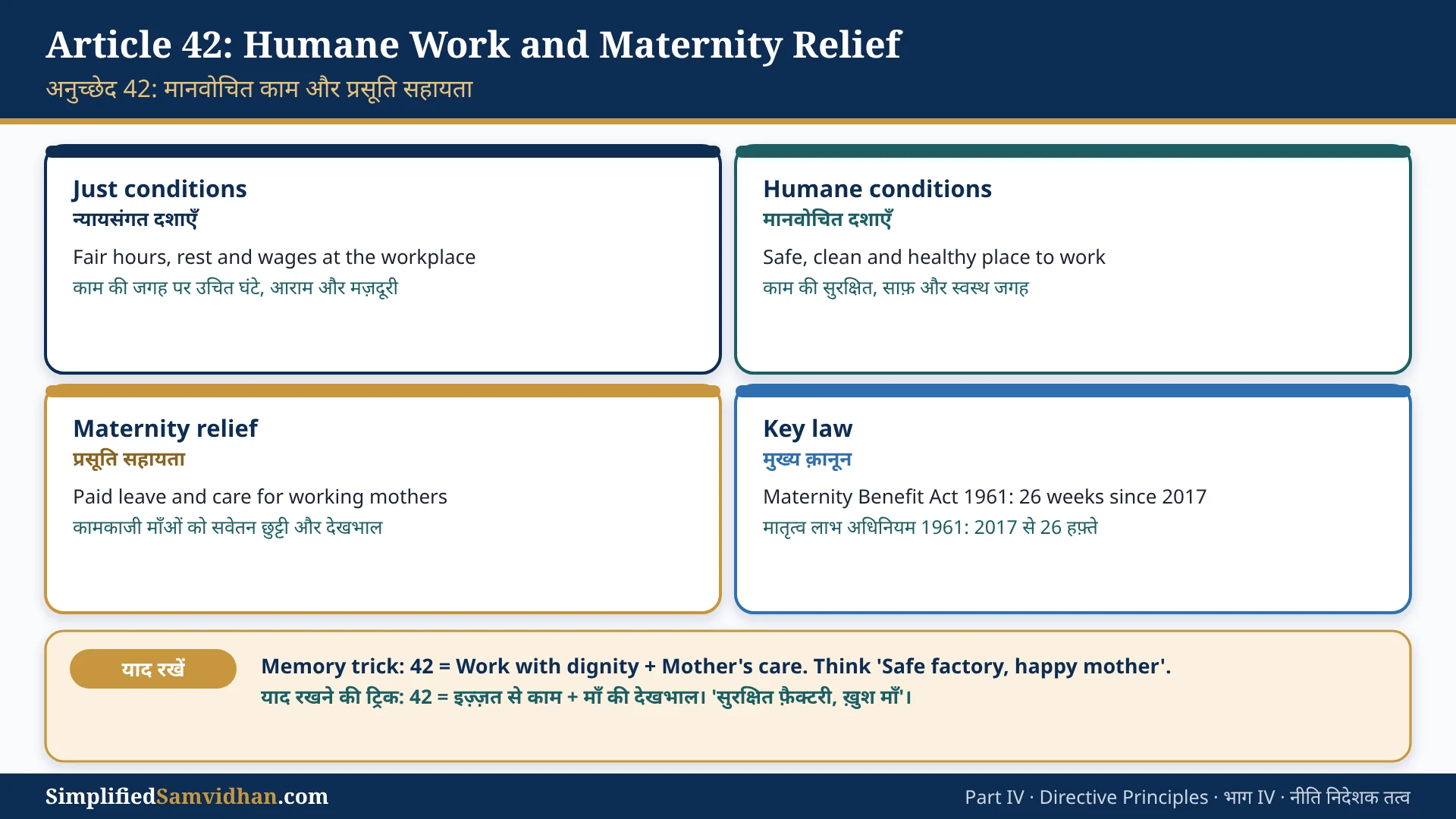
Work should happen in just (fair) conditions: fair hours, rest and pay.
Work should happen in humane conditions: safe, clean, with drinking water and toilets.
Working women should get maternity relief: paid leave and support when they have a baby.
It is one of the shortest Articles in Part IV: just one sentence.
🏠 Everyday Analogy
A good farmer gives his bullock rest, shade and water, or it falls sick. Workers are people, not machines; Article 42 says the workplace must care for them at least that much, and far more.
🇮🇳 Real Indian Example
Priya works in a garment factory in Tiruppur. When her baby is born, she gets 26 weeks of paid maternity leave, and later leaves the baby in the factory creche during work. That is Article 42 in her life.
Laws That Apply ItArticle 42 of Indian Constitution: Laws on Humane Conditions of Work and Maternity Relief
| Law | What it gives |
|---|---|
| Maternity Benefit Act, 1961 (now in the Code on Social Security, 2020) | 26 weeks paid maternity leave since 2017; a creche where there are 50 or more employees |
| Occupational Safety, Health and Working Conditions Code, 2020 | Safety, health, working hours and welfare at workplaces; replaced the Factories Act, 1948 |
| Four Labour Codes (in force 21 November 2025) | One modern set of rules on wages, safety and social security |
Key case
- Municipal Corporation of Delhi v Female Workers (Muster Roll) (2000): women hired on daily wages by the MCD were denied maternity leave. The Supreme Court, relying on Article 42, held that they too must get maternity benefit.
Quick RevisionKey Points to Remember
- Article 42: just and humane conditions of work and maternity relief.
- Maternity Benefit Act, 1961: 26 weeks paid leave since the 2017 amendment.
- Now covered by the Labour Codes, in force from 21 November 2025.
- MCD v Female Workers (2000): maternity benefit for daily wage women too.
- Category: Socialist principle.
UPSC · State PSC · JudiciaryArticle 42: Exam Corner
- Prelims trap: "Maternity relief is a Fundamental Right under Part III." False. It is in Article 42, a DPSP; laws make it binding.
- Fact (SSC/school): Paid maternity leave was raised from 12 to 26 weeks by the 2017 amendment to the Maternity Benefit Act.
- Mains (150 words): How do the new Labour Codes give effect to Article 42 for workers in the unorganised sector?
Practice MCQTest Yourself: Article 42
Which Directive Principle deals with just and humane conditions of work and maternity relief?
Doubts ClearedFrequently Asked Questions
What is Article 42 of Indian Constitution?
Article 42 is a Directive Principle that asks the State to make provision for just and humane conditions of work and for maternity relief.
How many weeks of maternity leave does Indian law give?
26 weeks of paid maternity leave, since the Maternity Benefit (Amendment) Act, 2017. This rule now sits in the Code on Social Security, 2020.
Can a worker go to court under Article 42?
Not under Article 42 alone, because DPSPs are not enforceable (Article 37). But a worker can go to court under the labour laws that apply Article 42, and courts use Article 42 to interpret those laws.