Bare ActOfficial Text of Article 49
49. Protection of monuments and places and objects of national importance.—
It shall be the obligation of the State to protect every monument or place or object of artistic or historic interest, declared by or under law made by Parliament to be of national importance, from spoliation, disfigurement, destruction, removal, disposal or export, as the case may be.
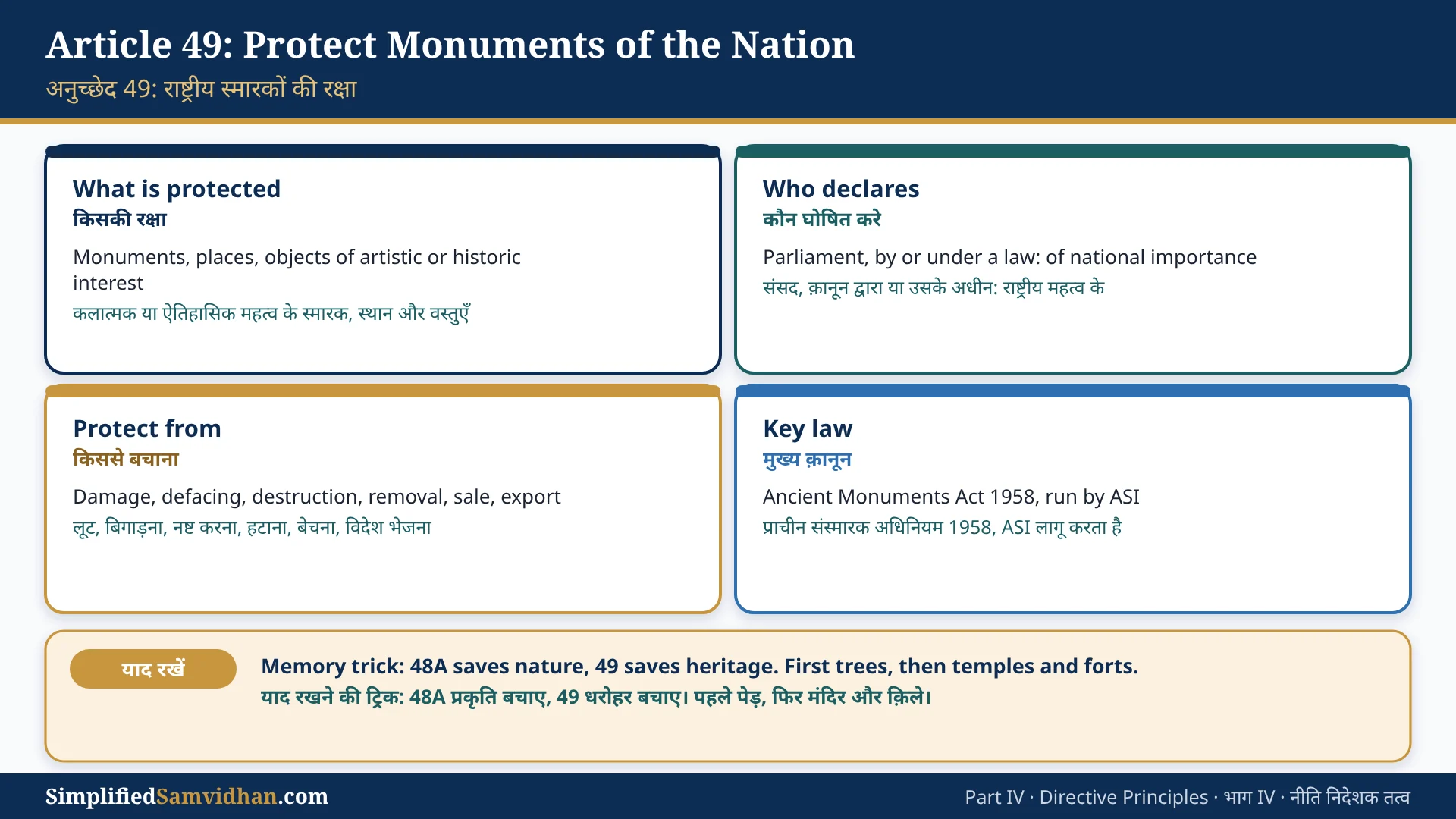
It covers monuments, places and objects of artistic or historic interest.
Only those declared of national importance by or under a law of Parliament.
The State must protect them from being damaged, defaced, destroyed, removed, sold or exported.
Note the strong word: it is an "obligation" of the State, though still not enforceable in court.
🏠 Everyday Analogy
Your grandmother's old wedding saree is kept safe in a trunk, not cut into dusters or sold. Article 49 asks the State to treat the nation's heritage the same way.
🇮🇳 Real Indian Example
A builder in Delhi wants to put up a new shop right next to a protected tomb. Under the Ancient Monuments Act, 1958 (as amended in 2010), no new construction is allowed within 100 metres of it. And someone who scratches names on the walls of a protected fort commits an offence.
Laws and ASIArticle 49 of Indian Constitution: Laws That Protect National Monuments
| Law or body | Role |
|---|---|
| Archaeological Survey of India (ASI) | Looks after centrally protected monuments like the Red Fort and Qutub Minar |
| Ancient Monuments and Archaeological Sites and Remains Act, 1958 | Parliament declares monuments of national importance; damaging them is an offence |
| 2010 amendment to the 1958 Act | No new construction within 100 metres of a protected monument (prohibited area) |
| Antiquities and Art Treasures Act, 1972 | Old statues, coins and paintings cannot be exported without permission |
Article 49 and Article 51A(f)
Article 49 is the State's job. Article 51A(f) gives every citizen the duty to value and preserve our rich heritage of composite culture. So the ASI guards the fort, and visitors must not litter or deface it.
Quick RevisionKey Points to Remember
- Article 49: State's obligation to protect monuments, places and objects of national importance.
- "National importance" is declared by or under a law of Parliament.
- Protect from spoliation, disfigurement, destruction, removal, disposal or export.
- Wording changed by the 7th Amendment, 1956.
- Key law: Ancient Monuments and Archaeological Sites and Remains Act, 1958; body: ASI.
UPSC · State PSC · JudiciaryArticle 49: Exam Corner
- Prelims trap: "Under Article 49, State Legislatures declare monuments of national importance." False. It is Parliament, by or under its law.
- Fact (SSC, school): Article 49 is a liberal-intellectual DPSP; its citizen partner is Fundamental Duty 51A(f).
- Mains: "Protecting heritage is a shared job of the State and the citizen." Discuss with reference to Articles 49 and 51A(f).
Practice MCQTest Yourself: Article 49
Under Article 49, who declares a monument to be of national importance?
Doubts ClearedFrequently Asked Questions
What is Article 49 of Indian Constitution?
Article 49 is a Directive Principle. It makes it the State's obligation to protect every monument, place or object of artistic or historic interest declared of national importance by or under a law of Parliament, from damage, destruction, removal, sale or export.
Which law applies Article 49?
Mainly the Ancient Monuments and Archaeological Sites and Remains Act, 1958, enforced by the Archaeological Survey of India. The Antiquities and Art Treasures Act, 1972 controls export of antiques.
Was Article 49 ever amended?
Yes, once. The Seventh Amendment, 1956 changed "declared by Parliament by law" to "declared by or under law made by Parliament".