Bare ActOfficial Text of Article 43A
43A. Participation of workers in management of industries.—
The State shall take steps, by suitable legislation or in any other way, to secure the participation of workers in the management of undertakings, establishments or other organisations engaged in any industry.
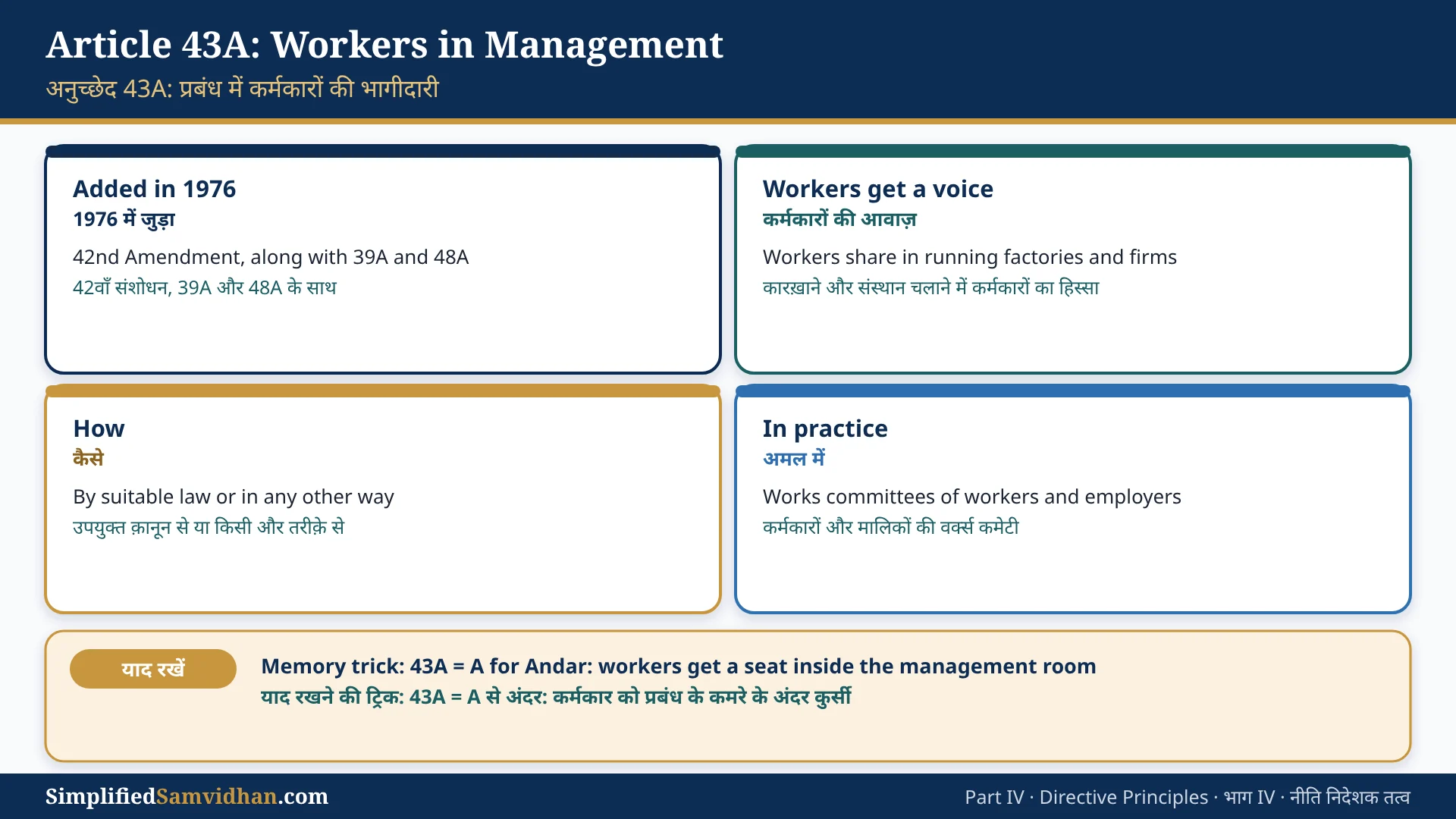
Workers should have a share in managing the factory, office or firm where they work.
It applies to undertakings, establishments and organisations in any industry.
The State can do this by law or in any other way, for example through schemes or committees.
It is a DPSP, so no court can force a company to follow it on its own.
🏠 Everyday Analogy
Think of a school where students have a class monitor and a student council. The principal still runs the school, but students get a voice in decisions that affect them. Article 43A wants the same for workers.
🇮🇳 Real Indian Example
In a car parts factory in Pune, a works committee has an equal number of worker and management members. When workers complain about long night shifts and poor canteen food, the committee discusses it and the management changes the shift roster. That is Article 43A in action.
In PracticeArticle 43A of Indian Constitution: How Workers Take Part in Management
| Level | What workers can do |
|---|---|
| Shop floor | Suggest better ways of working, safety, cleanliness |
| Plant / factory | Discuss production, welfare, working hours with managers |
| Board | In some public sector companies, a worker representative sits on the board |
Laws that apply Article 43A
- Works committees: Section 3 of the Industrial Disputes Act, 1947 provided for committees of worker and employer representatives in larger establishments. The Industrial Relations Code, 2020 (in force 21 November 2025) continues this idea.
- The government has also run voluntary schemes for workers' participation, mainly in the public sector.
- There is no single law that makes workers' participation in management compulsory in every industry.
Quick RevisionKey Points to Remember
- Article 43A: participation of workers in management of industries.
- Added by the 42nd Amendment, 1976 (with 39A and 48A).
- Applies to undertakings, establishments and organisations in any industry.
- Means: suitable legislation or any other way.
- Classed as a Socialist principle.
UPSC · State PSC · JudiciaryArticle 43A: Exam Corner
- Prelims trap: "Article 43A was part of the original Constitution of 1950." False. It was added in 1976 by the 42nd Amendment.
- Fact (SSC / school): the 42nd Amendment added three DPSPs: 39A (free legal aid), 43A (workers in management) and 48A (environment).
- Mains: "Workers' participation in management improves both productivity and industrial peace." Examine with reference to Article 43A.
Practice MCQTest Yourself: Article 43A
Which of these Directive Principles were added by the 42nd Amendment, 1976? 1. Article 39A 2. Article 43A 3. Article 43B
Doubts ClearedFrequently Asked Questions
What is Article 43A of Indian Constitution?
Article 43A is a Directive Principle added in 1976. It asks the State to take steps, by law or otherwise, so that workers take part in the management of industries.
Which amendment added Article 43A?
The 42nd Amendment Act, 1976. It also added Articles 39A and 48A to Part IV.
What is a works committee?
A works committee is a body with equal numbers of worker and employer representatives in an establishment. It discusses day-to-day problems and tries to keep good relations. It is one way of applying Article 43A.