Bare ActOfficial Text of Article 36
36. Definition.—
In this Part, unless the context otherwise requires, "the State" has the same meaning as in Part III.
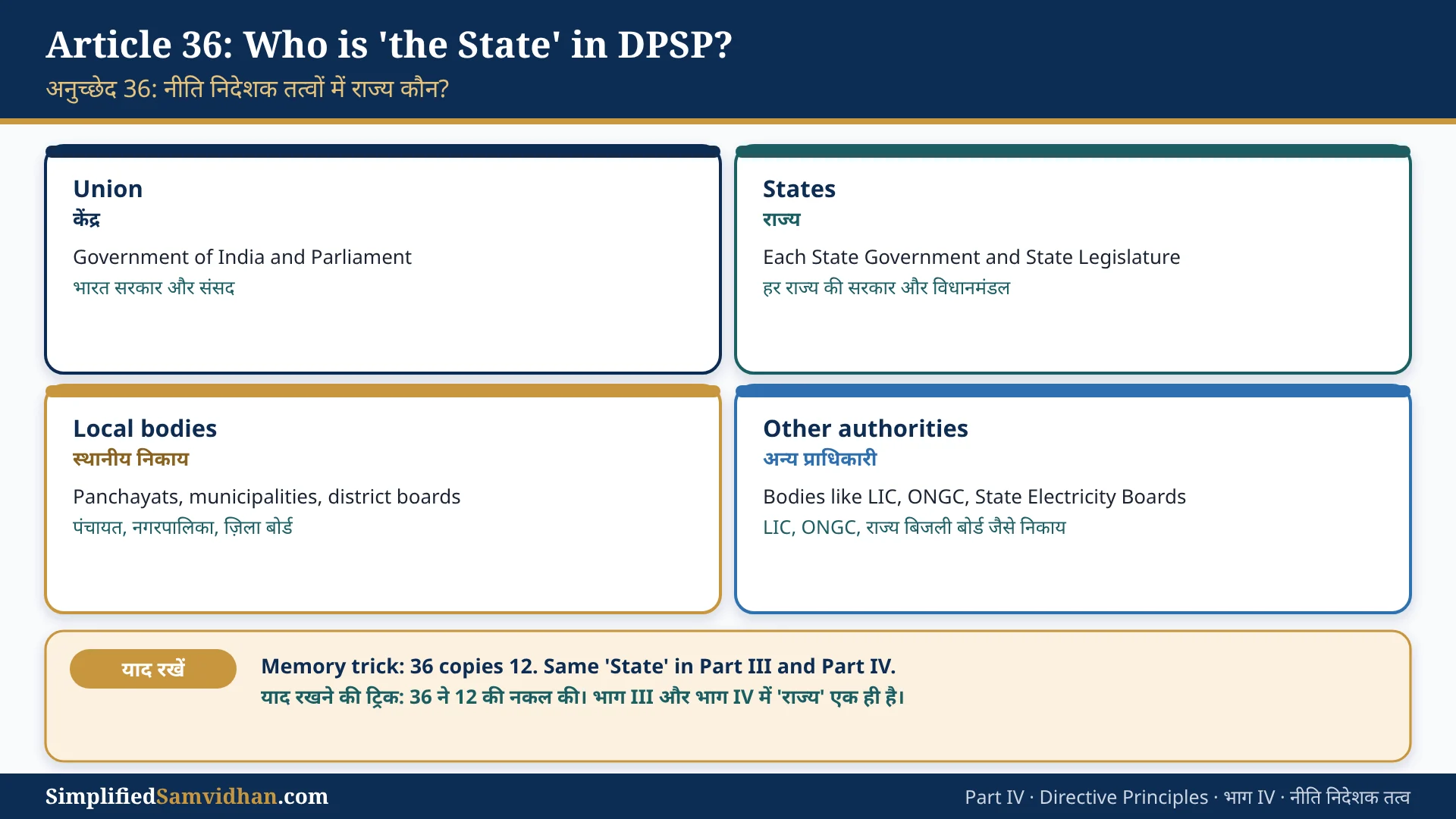
Article 36 does not make a new definition. It says: "the State" means the same as in Part III, that is, Article 12.
So "the State" covers the Union Government and Parliament, every State Government and Legislature, local bodies and other authorities.
All of them must keep the Directive Principles in mind when they make laws and policies.
The words "unless the context otherwise requires" let the meaning change only where a particular Article clearly needs it.
🏠 Everyday Analogy
It is like a school rule book that says "'Teacher' means the same as in the staff list on page 1". No need to write the list again: one list works for both chapters.
🇮🇳 Real Indian Example
Article 40 asks the State to organise village panchayats. Here "the State" means the State Government and Legislature. Article 47 asks the State to improve public health: your Gram Panchayat, which is a local authority and so part of "the State", also shares this job.
Who is the StateArticle 36 of Indian Constitution: Who is the State in DPSP?
| Part of 'the State' | Examples |
|---|---|
| Government and Parliament of India | Union Ministries, Lok Sabha, Rajya Sabha |
| Government and Legislature of each State | State Ministries, Vidhan Sabha |
| Local authorities | Gram Panchayats, Municipal Corporations |
| Other authorities | Bodies controlled by the government, such as LIC or ONGC |
Same word, different power
- Against the State in Part III, you can go to court if a right is broken (Article 32, 226).
- Against the State in Part IV, you cannot go to court to force a Directive Principle (Article 37). The State is guided, not ordered.
Quick RevisionKey Points to Remember
- Article 36 is the first Article of Part IV (Articles 36 to 51).
- "The State" in Part IV has the same meaning as in Part III (Article 12).
- It covers Union, States, local authorities and other authorities.
- Article 36 has never been amended.
UPSC · State PSC · JudiciaryArticle 36: Exam Corner
- Prelims trap: "Article 36 gives a new and wider definition of State for DPSP." False. It simply borrows the Article 12 meaning.
- Fact (SSC, school): Part IV starts at Article 36 and ends at Article 51; Article 36 links it to Article 12.
- Mains (150 words): "The same State is bound by Part III and guided by Part IV." Explain with reference to Articles 12, 36 and 37.
Practice MCQTest Yourself: Article 36
Article 36 says that "the State" in Part IV has the same meaning as in which Article?
Doubts ClearedFrequently Asked Questions
What is Article 36 of Indian Constitution?
Article 36 is the definition Article of Part IV. It says "the State" in the Directive Principles has the same meaning as in Part III (Article 12).
Is a Gram Panchayat part of 'the State' under Article 36?
Yes. Local authorities like panchayats and municipalities are included, because Article 12 includes them.
Can I sue the State under Article 36?
No. Article 36 only defines the State. Directive Principles cannot be enforced in court (Article 37), though Fundamental Rights against the same State can be.