Bare ActOfficial Text of Article 50
50. Separation of judiciary from executive.—
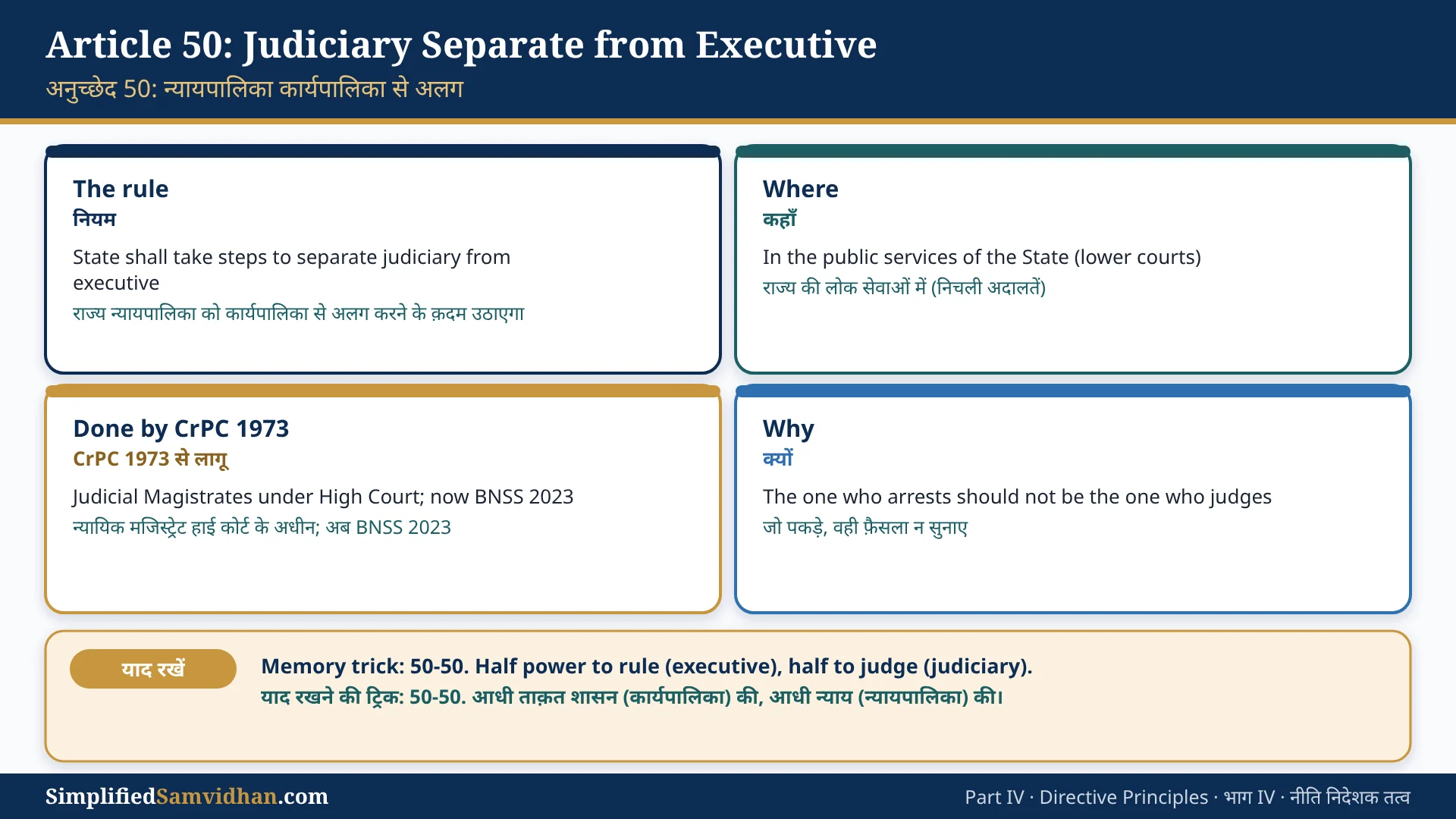
The State shall take steps to separate the judiciary from the executive in the public services of the State.
The State must take steps to keep judges separate from administrators.
It is about the public services of the State, mainly the lower courts in districts.
Before, the Collector ran the district and also tried criminal cases. That was unfair.
The CrPC, 1973 did the separation: Judicial Magistrates now work under the High Court.
🏠 Everyday Analogy
If the police officer who catches a thief also decides his punishment, who will check the officer? Keeping the "ruler" and the "judge" apart keeps everyone honest.
🇮🇳 Real Indian Example
Ramesh, a shopkeeper in a district town, is arrested after a fight. The District Magistrate may order curfew in the area, but Ramesh's bail and trial are decided by a Judicial Magistrate who answers to the High Court, not to the DM or the state government.
Two Kinds of MagistratesArticle 50 of Indian Constitution: Separation of Judiciary from Executive in Practice
| Judicial Magistrate | Executive Magistrate | |
|---|---|---|
| Who | A judge of the lower criminal court | District Magistrate (DM), SDM, Tehsildar |
| Controlled by | High Court | State government |
| Main job | Tries cases, gives bail, convicts or acquits | Law and order, orders to stop a riot or crowd |
| Example power | Sentences a thief after trial | Bans gatherings (old Section 144 CrPC, now Section 163 BNSS) |
Why it matters
- The CrPC, 1973 split the two kinds of magistrates. Its replacement, the Bharatiya Nagarik Suraksha Sanhita (BNSS), 2023 (in force 1 July 2024), keeps this split.
- Under Articles 233 to 237, the High Court controls district courts and judicial officers.
- The Supreme Court treats separation of powers and an independent judiciary as part of the basic structure (Kesavananda Bharati, 1973).
Quick RevisionKey Points to Remember
- Article 50: State shall take steps to separate judiciary from executive.
- Applies to the public services of the State (lower judiciary).
- Carried out by the CrPC, 1973; now continued in the BNSS, 2023.
- Judicial Magistrates under the High Court; Executive Magistrates (DM, SDM) under the State government.
- Never amended; a liberal-intellectual DPSP.
UPSC · State PSC · JudiciaryArticle 50: Exam Corner
- Prelims trap: "Article 50 is a Fundamental Right to an independent judiciary." False. It is a Directive Principle in Part IV.
- Fact (SSC, school): The separation was done by the Code of Criminal Procedure, 1973, not by a constitutional amendment.
- Mains: "District Magistrates still exercise some judicial-type powers." Examine in the light of Article 50.
Practice MCQTest Yourself: Article 50
Which law mainly carried out Article 50 by separating judicial magistrates from executive magistrates?
Doubts ClearedFrequently Asked Questions
What is Article 50 of Indian Constitution?
Article 50 is a Directive Principle. It says the State shall take steps to separate the judiciary from the executive in the public services of the State, so that judges are free from government control.
How was Article 50 implemented?
Mainly by the Code of Criminal Procedure, 1973, which created separate Judicial Magistrates under the High Court. The CrPC was replaced by the BNSS, 2023 from 1 July 2024, with the same arrangement.
Is the District Magistrate a judge?
No. The DM is an Executive Magistrate who handles law and order under the State government. Criminal trials are held by Judicial Magistrates and Sessions Judges under the High Court.