Bare ActOfficial Text of Article 38
38. State to secure a social order for the promotion of welfare of the people.—
(1) The State shall strive to promote the welfare of the people by securing and protecting as effectively as it may a social order in which justice, social, economic and political, shall inform all the institutions of the national life.
(2) The State shall, in particular, strive to minimise the inequalities in income, and endeavour to eliminate inequalities in status, facilities and opportunities, not only amongst individuals but also amongst groups of people residing in different areas or engaged in different vocations.
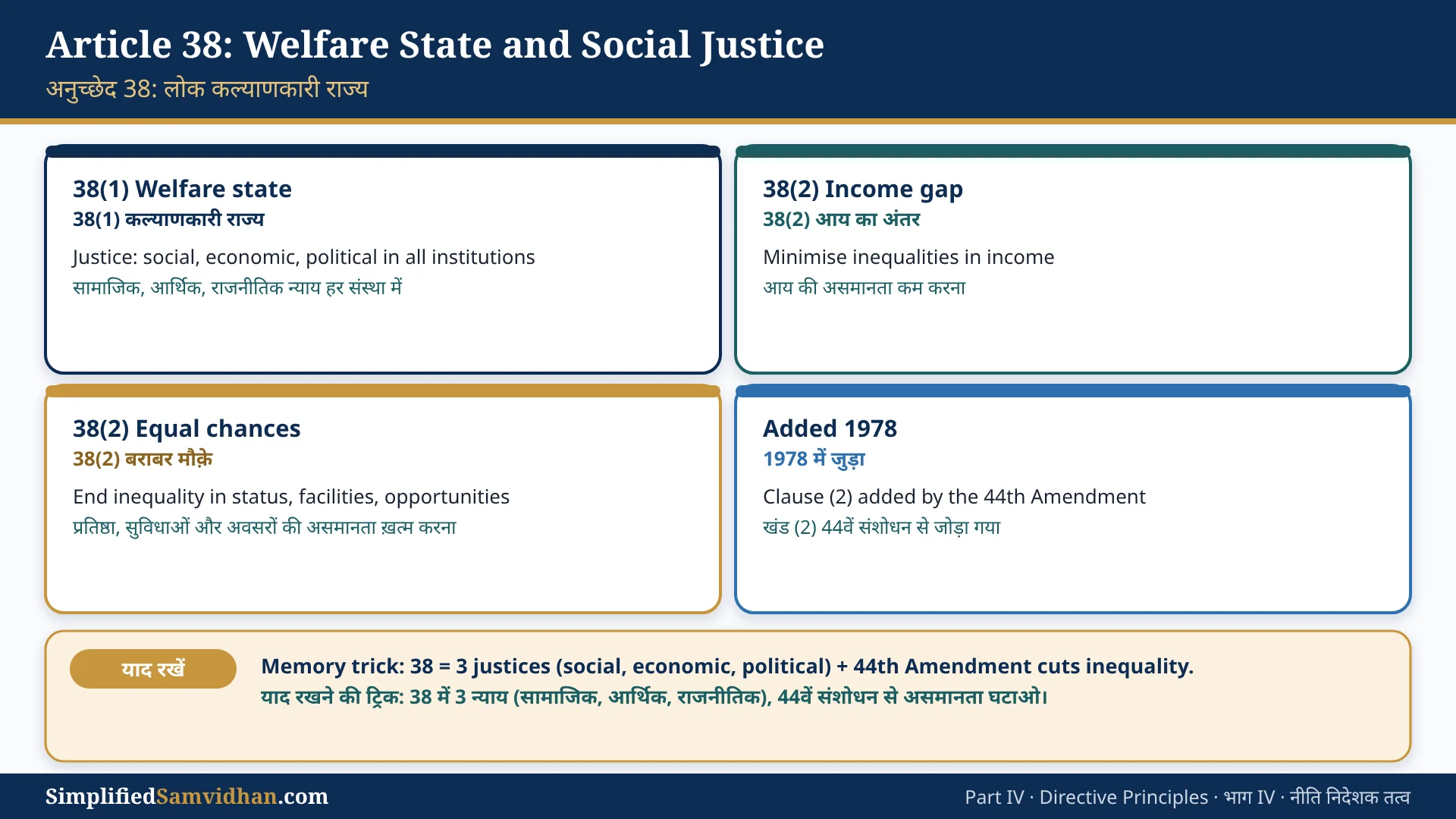
38(1): India should be a welfare state, where justice of three kinds, social, economic and political, reaches every institution.
38(2): the State should reduce income inequality.
It should also remove unequal status, facilities and opportunities, not only between persons but between regions (a hill district and a metro) and occupations (a farmer and an engineer).
These three kinds of justice are the same as in the Preamble.
🏠 Everyday Analogy
Think of a family dinner. A good parent does not give the whole plate to the strongest child: everyone gets enough, and the weakest child gets a little extra care. Article 38 asks the State to be that parent.
🇮🇳 Real Indian Example
Income tax in India is progressive: a person earning very little pays no tax, while a high earner pays a higher rate. That money funds schools, hospitals and ration for the poor. This is Article 38(2) at work: reducing the income gap.
How It Is AppliedArticle 38 of Indian Constitution: Welfare State in Action
| Type of justice / goal | Everyday example |
|---|---|
| Social justice | Reservation and scholarships for weaker sections |
| Economic justice | Progressive income tax, minimum wages, food security |
| Political justice | Universal adult franchise: one person, one vote |
| Equal facilities across areas (38(2)) | Aspirational Districts Programme (NITI Aayog, 2018) for backward districts |
Why it matters
- Article 38 is the umbrella: Articles 39 to 47 give the details of how to build a welfare state.
- It is classed as a Socialist principle (this grouping is by scholars, not in the Constitution).
Quick RevisionKey Points to Remember
- Article 38 makes India a welfare state in aim.
- Justice: social, economic and political, same as the Preamble.
- 38(2) was added by the 44th Amendment, 1978.
- 38(2): reduce inequality among individuals and groups (regions, occupations).
- A Socialist principle; not enforceable in court (Article 37).
UPSC · State PSC · JudiciaryArticle 38: Exam Corner
- Prelims trap: "Article 38(2) was added by the 42nd Amendment." False. It was the 44th Amendment, 1978.
- Fact (SSC, school): Article 38(2) talks of inequality in income (minimise) and in status, facilities and opportunities (eliminate).
- Mains (150 words): "Article 38 is the soul of the welfare state." Discuss with examples of laws and schemes.
Practice MCQTest Yourself: Article 38
Which amendment added clause (2) to Article 38, asking the State to minimise inequalities in income?
Doubts ClearedFrequently Asked Questions
What is Article 38 of Indian Constitution?
Article 38 asks the State to promote the welfare of the people through a social order based on social, economic and political justice, and to reduce inequalities in income, status, facilities and opportunities.
What does 'welfare state' mean?
A welfare state is one that looks after the basic needs of its people, like food, health, education and work, instead of only keeping law and order.
Which amendment added Article 38(2)?
The 44th Amendment, 1978, added clause (2) on minimising inequalities.