Bare ActOfficial Text of Article 37
37. Application of the principles contained in this Part.—
The provisions contained in this Part shall not be enforceable by any court, but the principles therein laid down are nevertheless fundamental in the governance of the country and it shall be the duty of the State to apply these principles in making laws.
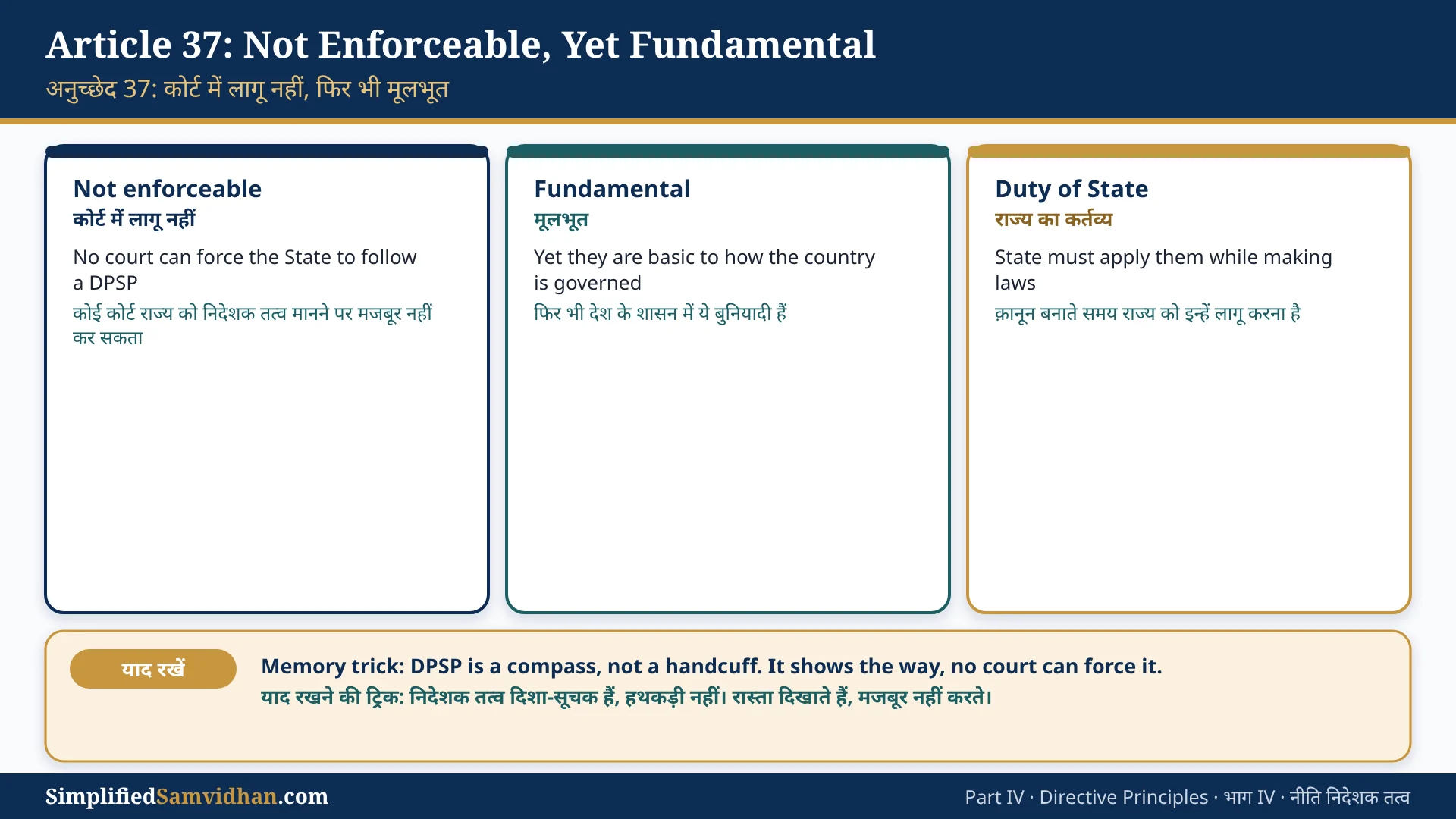
Not enforceable by any court: you cannot file a case only because the State ignored a Directive Principle.
Fundamental in governance: they are still the basic goals for running the country.
Duty of the State: Parliament and State Legislatures must apply them when they make laws.
The real check is the voter: a government that ignores them answers to the people at election time.
🏠 Everyday Analogy
Think of a parent's advice: "Study well, eat healthy, help others." No police will arrest you for ignoring it, but a good life is built on it. Directive Principles are the Constitution's advice to the government.
🇮🇳 Real Indian Example
Article 47 asks the State to improve nutrition. No court can order a new scheme only because of Article 47, but Parliament applied this principle when it passed the National Food Security Act, 2013. Now subsidised ration is a legal right under that Act, so it can be claimed.
DPSP vs RightsArticle 37 of Indian Constitution: DPSP vs Fundamental Rights
| Point | Fundamental Rights (Part III) | Directive Principles (Part IV) |
|---|---|---|
| Court | Enforceable (Articles 32, 226) | Not enforceable (Article 37) |
| Nature | Limits on the State: "do not" | Goals for the State: "try to do" |
| Aim | Political democracy | Social and economic democracy |
| Source idea | USA (Bill of Rights) | Ireland (1937 Constitution) |
What the courts said
- State of Madras v. Champakam Dorairajan (1951): if a Directive Principle and a Fundamental Right clash, the Fundamental Right wins.
- Minerva Mills v. Union of India (1980): Parts III and IV must work in harmony and balance, and this balance is part of the basic structure.
- Courts often read Directive Principles to understand Fundamental Rights and laws better.
Quick RevisionKey Points to Remember
- DPSPs are not enforceable by any court (non-justiciable).
- They are fundamental in the governance of the country.
- The State has a duty to apply them in making laws.
- Champakam Dorairajan (1951): Fundamental Rights prevail in a clash.
- Minerva Mills (1980): harmony between Parts III and IV is basic structure.
UPSC · State PSC · JudiciaryArticle 37: Exam Corner
- Prelims trap: "Since DPSPs are not enforceable, they have no legal value." False. Article 37 calls them fundamental in governance, and courts use them to interpret laws.
- Fact (SSC, school): The words "fundamental in the governance of the country" are in Article 37, and the idea of DPSPs came from the Irish Constitution.
- Mains (150 words): "Directive Principles are non-justiciable, yet fundamental." Explain this paradox with reference to Minerva Mills.
Practice MCQTest Yourself: Article 37
Consider the statements about Article 37: 1. DPSPs are not enforceable by any court. 2. DPSPs are fundamental in the governance of the country. Which is/are correct?
Doubts ClearedFrequently Asked Questions
What is Article 37 of Indian Constitution?
Article 37 says the Directive Principles in Part IV cannot be enforced by any court, but they are fundamental in the governance of the country and the State must apply them in making laws.
Why were Directive Principles made non-justiciable?
In 1950 India did not have enough money and resources to guarantee jobs, health and education to all at once. So these were set as goals to be reached step by step, not rights to be claimed in court.
Can a DPSP ever be enforced?
Not directly. But once Parliament makes a law to apply a DPSP, like the National Food Security Act, 2013, the rights under that law can be enforced.