Bare ActOfficial Text of Article 43
43. Living wage, etc., for workers.—
The State shall endeavour to secure, by suitable legislation or economic organisation or in any other way, to all workers, agricultural, industrial or otherwise, work, a living wage, conditions of work ensuring a decent standard of life and full enjoyment of leisure and social and cultural opportunities and, in particular, the State shall endeavour to promote cottage industries on an individual or co-operative basis in rural areas.
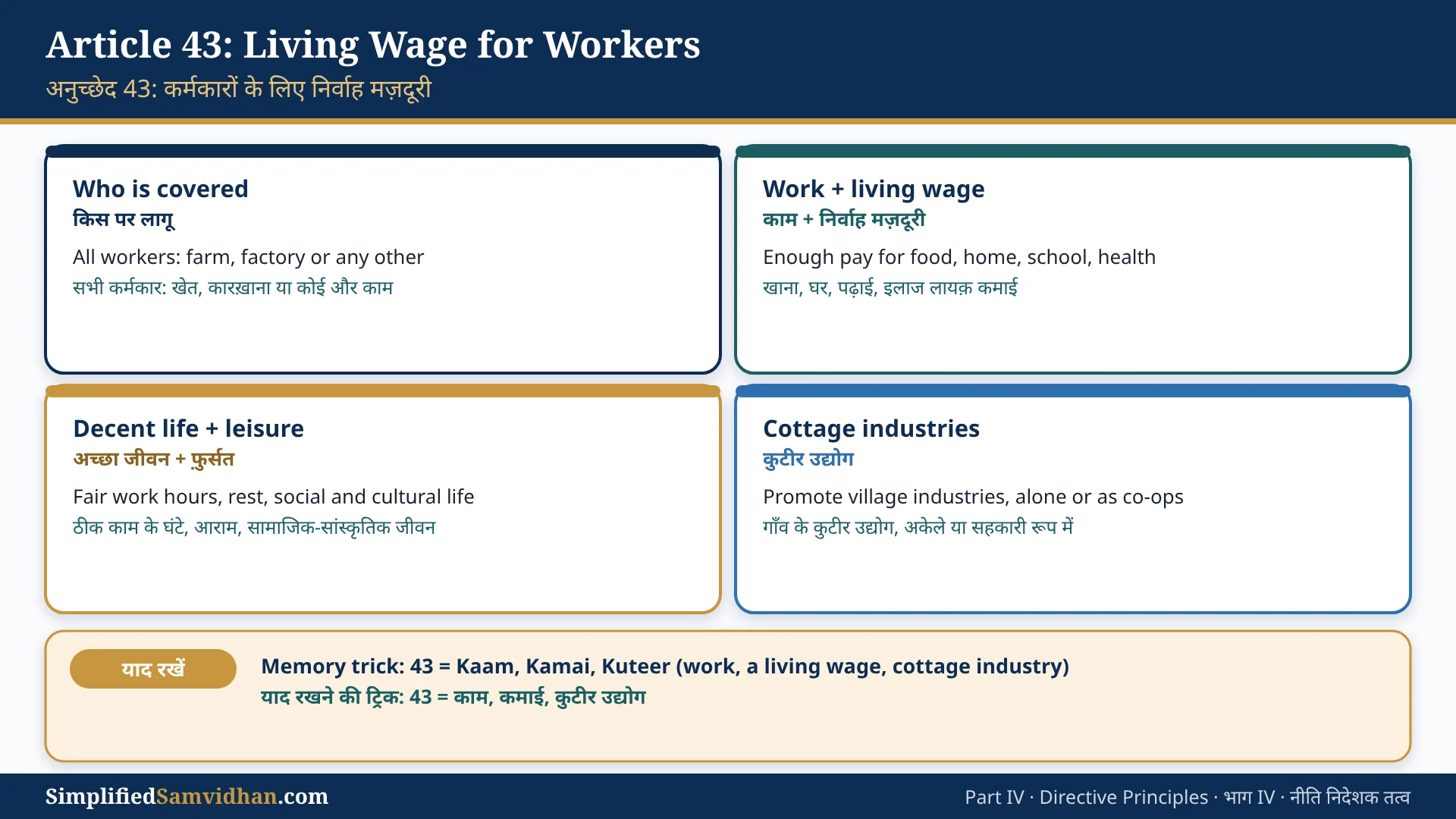
It covers all workers: farm labourers, factory workers and everyone else.
The State should try to give them work and a living wage, not just a minimum wage.
Work conditions should allow a decent life, leisure and social and cultural opportunities.
In villages, the State should promote cottage industries, run by one person or as a co-operative.
🏠 Everyday Analogy
Minimum wage is like a bicycle tyre with just enough air to roll. A living wage is a tyre filled properly, so the family can ride with comfort and even carry some load for the future.
🇮🇳 Real Indian Example
Ramesh works in a textile mill in Surat. The Code on Wages, 2019 (in force from 21 November 2025) gives him a legal minimum wage and fixed working hours. His sister in a village near Varanasi weaves khadi with help from the Khadi and Village Industries Commission (KVIC): that is the cottage-industry part of Article 43.
Living WageArticle 43 of Indian Constitution: Living Wage vs Minimum Wage
The Committee on Fair Wages (1948) described three levels of wages. Article 43 aims at the highest one.
| Wage level | What it covers |
|---|---|
| Minimum wage | Bare survival: food, clothes, shelter, plus a little for health and education |
| Fair wage | Between the two, linked to the industry's capacity to pay |
| Living wage (Article 43) | A decent life: comfort, children's education, health, some savings, social life |
Laws and bodies that apply Article 43
- Four Labour Codes (in force 21 November 2025): the Code on Wages, 2019 replaced the Minimum Wages Act, 1948 and other wage laws; other Codes cover social security and safe working conditions.
- Khadi and Village Industries Commission (set up under a 1956 Act) helps village and cottage industries.
- Article 43 is a DPSP: a worker cannot go to court only to demand a "living wage" under it, but courts use it to read labour laws in favour of workers.
Quick RevisionKey Points to Remember
- Article 43 covers all workers: agricultural, industrial or otherwise.
- Goal: work, a living wage, decent life, leisure, social and cultural opportunities.
- Living wage is higher than minimum wage and fair wage.
- Special duty: promote cottage industries in rural areas (individual or co-operative).
- Both Socialist (living wage) and Gandhian (cottage industries) in nature.
UPSC · State PSC · JudiciaryArticle 43: Exam Corner
- Prelims trap: "Article 43 promises a minimum wage." Wrong word. It says living wage. (Equal pay for equal work is Article 39(d).)
- Fact (SSC / school): cottage industries in villages appear in Article 43; co-operative societies got their own Article, 43B, in 2011.
- Mains: "The gap between minimum wage and living wage shows how far Article 43 is from reality." Discuss.
Practice MCQTest Yourself: Article 43
Which Article of the Constitution asks the State to promote cottage industries in rural areas?
Doubts ClearedFrequently Asked Questions
What is Article 43 of Indian Constitution?
Article 43 is a Directive Principle. It asks the State to secure work, a living wage, decent working conditions and leisure for all workers, and to promote cottage industries in villages.
What is the difference between minimum wage and living wage?
A minimum wage covers bare needs. A living wage, the goal of Article 43, also covers education, health, comfort and some savings, so the worker can live a decent life.
Can a worker go to court under Article 43?
Not directly. Article 37 says Directive Principles are not enforceable by any court. Workers go to court under labour laws, such as the Code on Wages, which put Article 43 into practice.