Bare ActOfficial Text of Article 39
39. Certain principles of policy to be followed by the State.—
The State shall, in particular, direct its policy towards securing—
(a) that the citizens, men and women equally, have the right to an adequate means of livelihood;
(b) that the ownership and control of the material resources of the community are so distributed as best to subserve the common good;
(c) that the operation of the economic system does not result in the concentration of wealth and means of production to the common detriment;
(d) that there is equal pay for equal work for both men and women;
(e) that the health and strength of workers, men and women, and the tender age of children are not abused and that citizens are not forced by economic necessity to enter avocations unsuited to their age or strength;
(f) that children are given opportunities and facilities to develop in a healthy manner and in conditions of freedom and dignity and that childhood and youth are protected against exploitation and against moral and material abandonment.
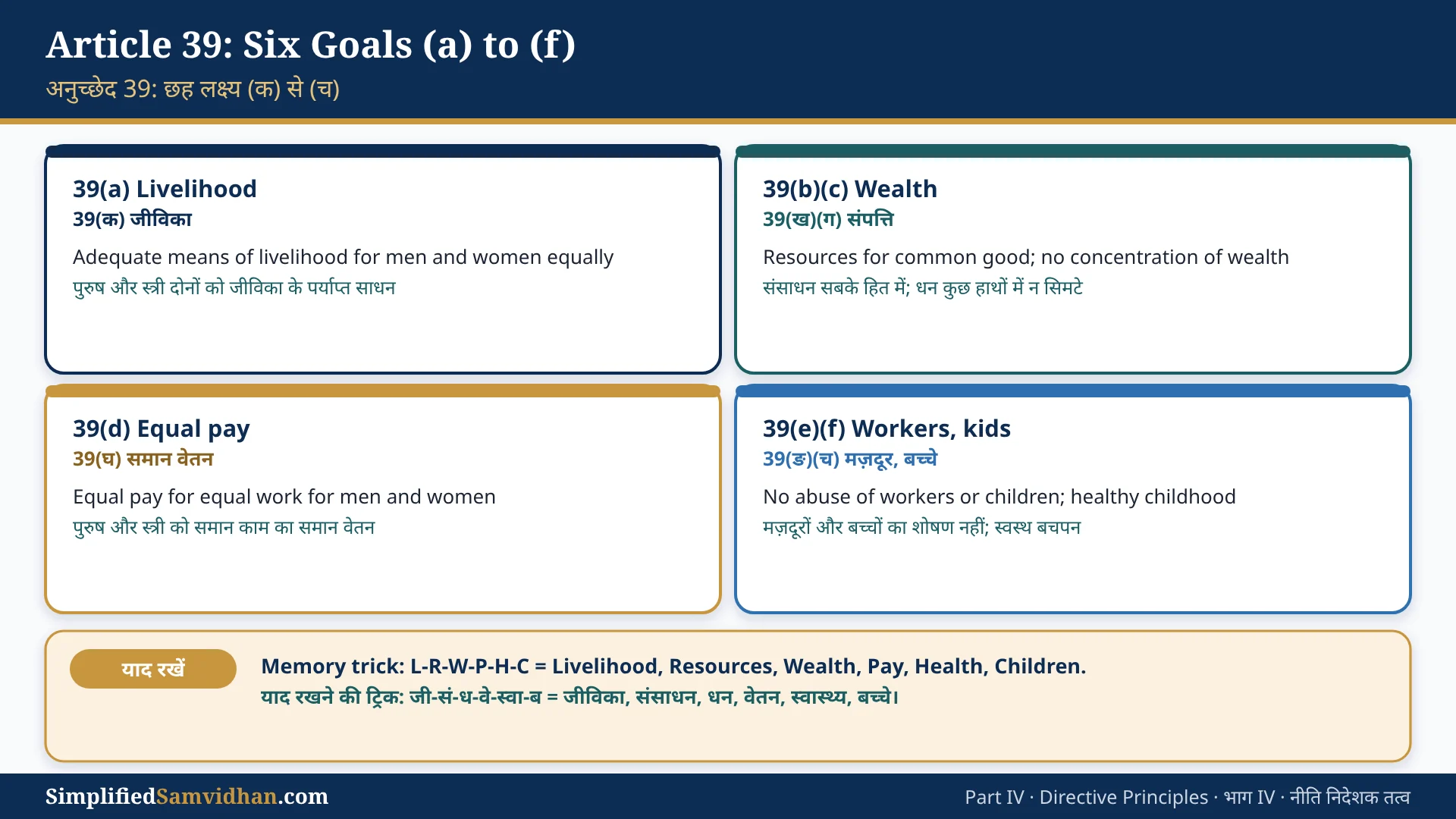
(a) Everyone, man or woman, should have a fair way to earn a living.
(b) and (c) Nature's wealth and the economy should serve everyone, not a few rich people.
(d) Equal pay for equal work for men and women.
(e) and (f) No one, especially a child, should be pushed by poverty into work that harms them; children should grow up healthy and free.
🏠 Everyday Analogy
Think of a village pond. It belongs to the whole village, so one rich family should not fence it off. Everyone gets water, those who work equally get paid equally, and children go to school, not to work.
🇮🇳 Real Indian Example
Sunita and Ramesh both pack boxes in the same factory for eight hours. Under the Code on Wages, which applies Article 39(d), the owner cannot pay Sunita less just because she is a woman.
Six ClausesArticle 39 of Indian Constitution: Six Clauses and the Laws Behind Them
| Clause | Goal | Law or step that applies it |
|---|---|---|
| 39(a) | Adequate livelihood for men and women equally | Rural job guarantee laws, now the VB-G RAM G Act, 2025 |
| 39(b) | Material resources of the community used for the common good | Land reforms; nationalisation of coking coal mines (1972) |
| 39(c) | No concentration of wealth to the common harm | MRTP Act, 1969, now the Competition Act, 2002 |
| 39(d) | Equal pay for equal work for men and women | Code on Wages (replaced the Equal Remuneration Act, 1976) |
| 39(e) | Health of workers and children not abused | Child and Adolescent Labour Act (1986, amended 2016) |
| 39(f) | Children grow in freedom and dignity, safe from exploitation | Juvenile Justice Act, 2015; mid-day meals |
Key cases
- Article 31C (25th Amendment, 1971) protects laws made to apply 39(b) and (c) from challenge under Articles 14 and 19.
- Randhir Singh v. Union of India (1982): equal pay for equal work can be enforced through Articles 14 and 16, read with 39(d).
- Property Owners Association v. State of Maharashtra (9 judges, 5 November 2024): not every private property is a "material resource of the community" under 39(b). It depends on the resource's nature, scarcity and effect on the community.
Article 39A (equal justice and free legal aid) has its own page.
Quick RevisionKey Points to Remember
- Article 39 has six clauses, (a) to (f); a Socialist principle.
- 39(d): equal pay for equal work for men and women.
- 39(b), (c) are protected by Article 31C.
- 39(f) was substituted by the 42nd Amendment, 1976.
- 2024 (9 judges): not all private property is a community resource under 39(b).
UPSC · State PSC · JudiciaryArticle 39: Exam Corner
- Prelims trap: "Equal pay for equal work is a Fundamental Right written in Part III." False. It is written in Article 39(d), a DPSP; courts enforce it through Articles 14 and 16.
- Fact (SSC, school): Free legal aid is 39A, not 39; both are Socialist principles.
- Mains (250 words): "Discuss how the Supreme Court read 'material resources of the community' in the Property Owners Association case (2024)."
Practice MCQTest Yourself: Article 39
Which clause of Article 39 provides for equal pay for equal work for both men and women?
Doubts ClearedFrequently Asked Questions
What is Article 39 of Indian Constitution?
Article 39 lists six goals for State policy: livelihood for all, fair use of community resources, no concentration of wealth, equal pay for equal work, protection of workers and children, and healthy growth of children.
What did the Supreme Court decide on Article 39(b) in 2024?
In Property Owners Association v. State of Maharashtra (5 November 2024), a nine-judge bench held that not every privately owned resource is a "material resource of the community" that the State can take over under 39(b).
Is free legal aid part of Article 39?
No. Free legal aid is in Article 39A, added by the 42nd Amendment, 1976. It has its own page.