Bare ActOfficial Text of Article 43B
43B. Promotion of co-operative societies.—
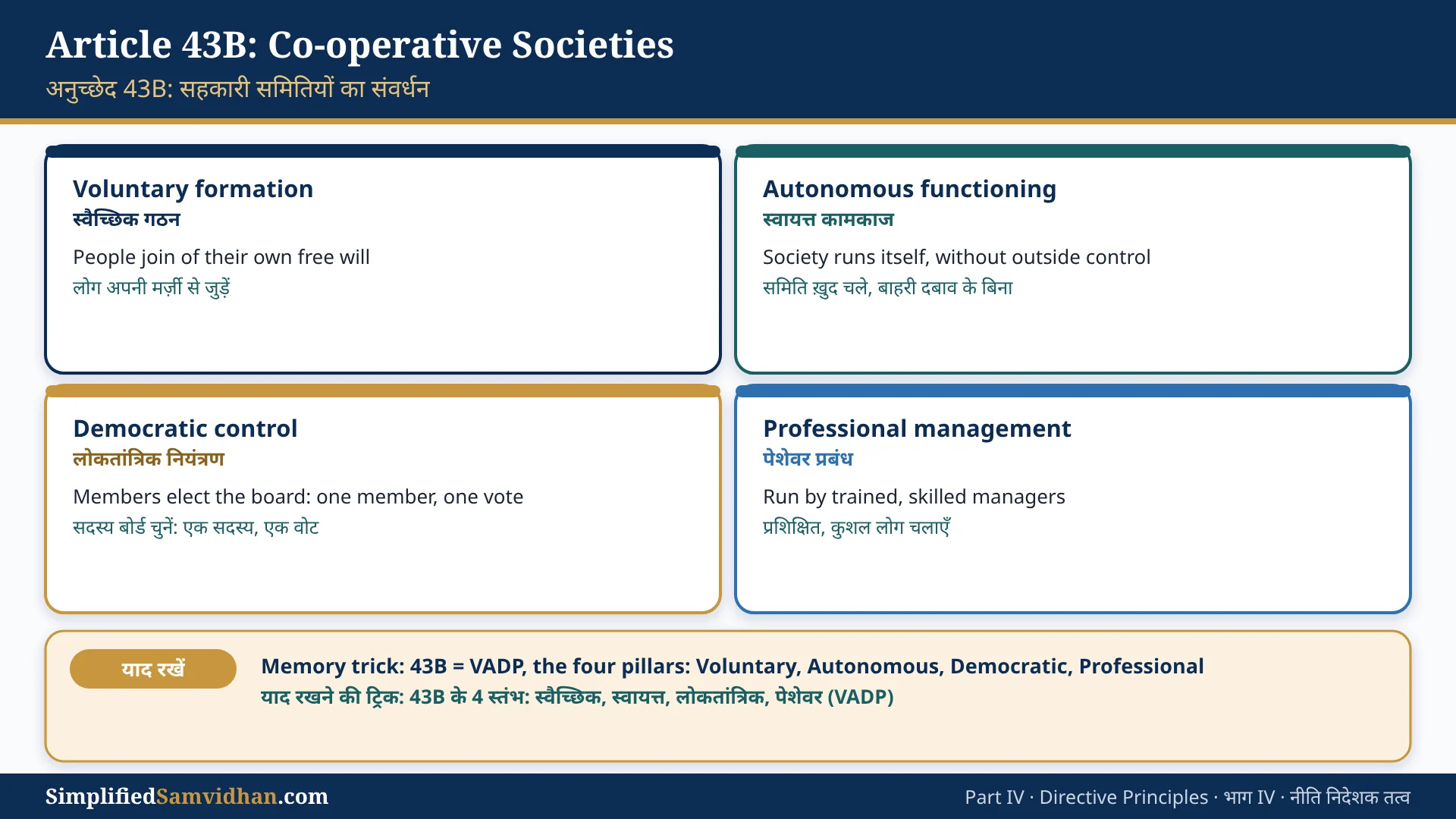
The State shall endeavour to promote voluntary formation, autonomous functioning, democratic control and professional management of co-operative societies.
A co-operative society is a group of people who pool money and work for a common benefit.
The State should help people form them voluntarily and let them run on their own.
Members should control them democratically, and they should be run by skilled managers.
It is the youngest of the Articles from 36 to 51 so far (added in 2011).
🏠 Everyday Analogy
A co-operative is like friends sharing one auto-rickshaw to school instead of each taking a separate one. Everyone pays a share, everyone has a say in the route, and everyone saves money.
🇮🇳 Real Indian Example
Amul began as a milk co-operative in Gujarat. Village farmers sell milk to their own village society, elect its leaders, and share the profit. Today Amul is one of India's best-known brands. Article 43B wants the State to support more such success stories.
97th AmendmentArticle 43B of Indian Constitution and the 97th Amendment on Co-operative Societies
The 97th Amendment, 2011 changed three places in the Constitution at once:
| Part of the Constitution | What the 97th Amendment did |
|---|---|
| Article 19(1)(c) | Forming co-operative societies became a Fundamental Right |
| Article 43B (Part IV) | State to promote co-operative societies (this page) |
| Part IXB (Articles 243ZH to 243ZT) | Rules on boards, elections and audit of co-operatives |
Key case and later steps
- Union of India v. Rajendra N. Shah (20 July 2021): the Supreme Court struck down the parts of Part IXB dealing with State co-operative societies, because co-operatives are a State subject and the amendment had not been ratified by half the States. Article 43B itself was not struck down. The rules for multi-State co-operatives survive.
- In July 2021 the Union government created a separate Ministry of Co-operation.
Quick RevisionKey Points to Remember
- Article 43B: State to promote co-operative societies.
- Four aims: voluntary formation, autonomous functioning, democratic control, professional management.
- Added by the 97th Amendment, 2011, with Article 19(1)(c) change and Part IXB.
- Rajendra N. Shah (2021): Part IXB parts on State co-operatives struck down; 43B survives.
- Classed as a Gandhian principle.
UPSC · State PSC · JudiciaryArticle 43B: Exam Corner
- Prelims trap: "Article 43B was added by the 42nd Amendment." False. 42nd (1976) added 43A; 43B came by the 97th Amendment, 2011.
- Fact (SSC / school): the right to form co-operative societies is a Fundamental Right under Article 19(1)(c); promoting them is a DPSP under Article 43B.
- Mains: "Co-operatives can be a tool of rural development only if they stay free of political control." Discuss with reference to Article 43B.
Practice MCQTest Yourself: Article 43B
The 97th Constitutional Amendment, 2011 relates to which of the following?
Doubts ClearedFrequently Asked Questions
What is Article 43B of Indian Constitution?
Article 43B is a Directive Principle added in 2011. It asks the State to promote the voluntary formation, autonomous functioning, democratic control and professional management of co-operative societies.
Did the Supreme Court strike down Article 43B?
No. In Union of India v. Rajendra N. Shah (2021) the Court struck down only the Part IXB provisions on State co-operative societies. Article 43B and the multi-State co-operative provisions remain.
Is forming a co-operative society a Fundamental Right?
Yes. Since the 97th Amendment, Article 19(1)(c) gives citizens the right to form associations, unions or co-operative societies.