Bare ActOfficial Text of Article 47
47. Duty of the State to raise the level of nutrition and the standard of living and to improve public health.—
The State shall regard the raising of the level of nutrition and the standard of living of its people and the improvement of public health as among its primary duties and, in particular, the State shall endeavour to bring about prohibition of the consumption except for medicinal purposes of intoxicating drinks and of drugs which are injurious to health.
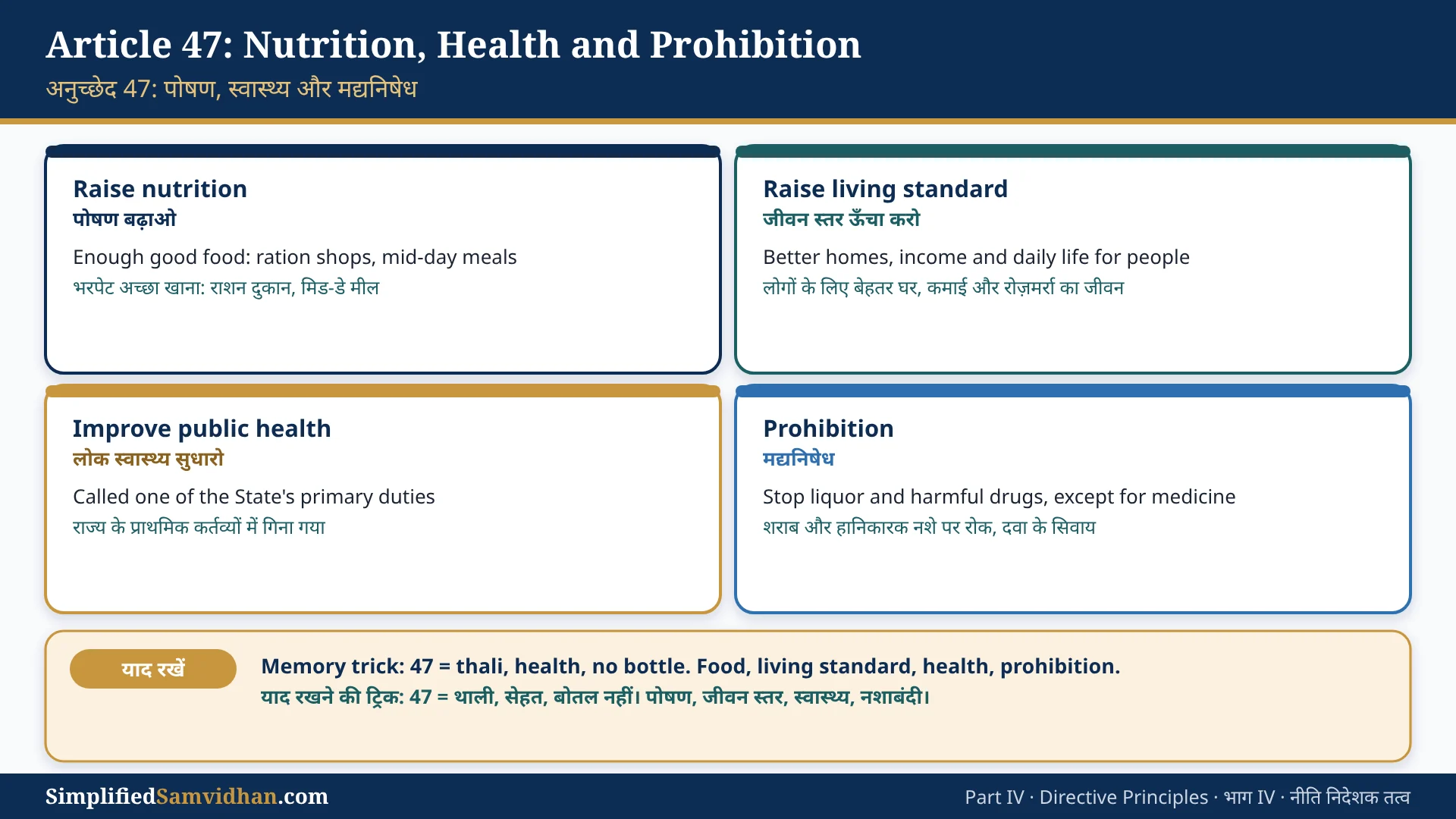
Three primary duties of the State: better nutrition, a better standard of living, and better public health.
In particular, the State should try to stop people from consuming liquor and harmful drugs.
Medicinal use is allowed: a cough syrup or a medicine prescribed by a doctor is not banned.
It is a DPSP: each State decides whether to ban liquor. There is no all-India ban.
🏠 Everyday Analogy
Article 47 makes the State act like a careful mother at home: she makes sure everyone eats well, takes the sick child to the doctor, and keeps the bottle of liquor out of the house.
🇮🇳 Real Indian Example
Raju's family gets cheap wheat and rice from the ration shop under the National Food Security Act 2013, and Raju eats a free mid-day meal at school. In Bihar, where liquor has been banned since 2016, the State says it is following Article 47.
Laws and SchemesArticle 47 of Indian Constitution: Laws on Nutrition, Public Health and Prohibition
| Goal in Article 47 | Law or scheme that applies it |
|---|---|
| Nutrition | National Food Security Act 2013 (cheap ration grain), PM POSHAN (mid-day meal), anganwadi food |
| Public health | Government hospitals and health centres, vaccination drives |
| Prohibition | Liquor bans in Gujarat, Bihar (2016), Nagaland and Mizoram; NDPS Act on harmful drugs |
What the courts said
- Vincent Panikurlangara v. Union of India (1987): the Supreme Court read Article 47 with Article 21 and said keeping up public health is part of the right to life, so the State must act on unsafe drugs.
- Courts have generally upheld State liquor bans, because Article 47 itself asks for prohibition.
Quick RevisionKey Points to Remember
- Nutrition, standard of living and public health are among the State's primary duties.
- State shall endeavour to bring about prohibition of liquor and harmful drugs.
- Exception: medicinal purposes.
- Prohibition states: Gujarat, Bihar, Nagaland, Mizoram.
- Category: Socialist (food, health) and Gandhian (prohibition). Never amended.
UPSC · State PSC · JudiciaryArticle 47: Exam Corner
- Prelims trap: "Article 47 bans all alcohol, even in medicines." False. It allows medicinal use, and it only asks the State to endeavour; it does not ban anything by itself.
- Fact (SSC / school): Article 47 calls nutrition, living standard and public health the State's "primary duties", unusually strong words for a DPSP.
- Mains: "Prohibition protects families but hurts State revenue." Discuss with reference to Article 47.
Practice MCQTest Yourself: Article 47
Under Article 47, prohibition of intoxicating drinks and harmful drugs is allowed to have which exception?
Doubts ClearedFrequently Asked Questions
What is Article 47 of Indian Constitution?
Article 47 is a Directive Principle. It makes raising nutrition and the standard of living, and improving public health, primary duties of the State, and asks it to try to prohibit liquor and harmful drugs except for medicine.
Is there a liquor ban in all of India under Article 47?
No. Article 47 cannot be enforced in court and each State decides for itself. Gujarat, Bihar, Nagaland and Mizoram have prohibition; most States allow liquor with licences and taxes.
Which schemes apply Article 47?
The National Food Security Act 2013 (ration shops), PM POSHAN (mid-day meals) and anganwadi nutrition are the main ones, along with public health programmes.