Bare ActOfficial Text of Article 44
44. Uniform civil code for the citizens.—
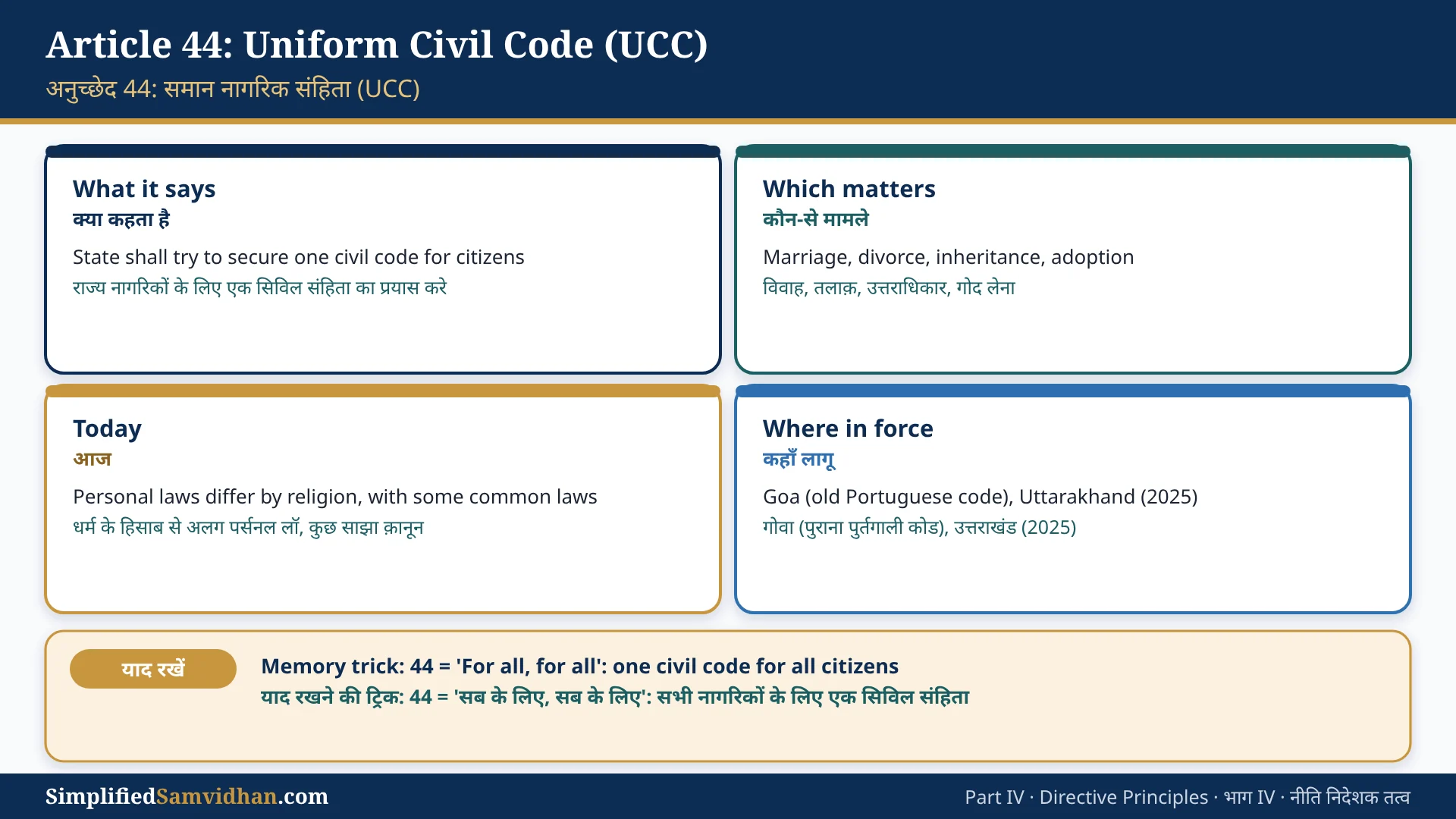
The State shall endeavour to secure for the citizens a uniform civil code throughout the territory of India.
A civil code here means personal matters: marriage, divorce, inheritance, adoption.
Today these are mostly governed by personal laws that differ for Hindus, Muslims, Christians, Parsis and others.
Article 44 asks the State to try ("endeavour") to have one code for all citizens.
It is a DPSP: no court can order the government to make a UCC.
🏠 Everyday Analogy
Think of a school where every class follows the same rulebook for exams, but each class has its own rules for sports day. A UCC would mean one rulebook for "sports day" too: the family-law matters.
🇮🇳 Real Indian Example
In Goa, a family law based on the old Portuguese Civil Code applies to people of all religions there. In Uttarakhand, since 27 January 2025, a state UCC sets common rules on marriage, divorce and inheritance, and asks for registration of marriages and live-in relationships.
TimelineArticle 44 of Indian Constitution: Uniform Civil Code Timeline and Debate
| Year | Event |
|---|---|
| 1950 | Article 44 placed in Part IV as a Directive Principle, not a Fundamental Right |
| 1954 to 1956 | Special Marriage Act (optional civil marriage for anyone); Hindu Marriage Act and Hindu Succession Act |
| 1985 | Shah Bano: Supreme Court said a common civil code would help national integration |
| 1995 | Sarla Mudgal: Court asked the government to consider Article 44 |
| 2018 | 21st Law Commission: a UCC is "neither necessary nor desirable at this stage" |
| 2023 | 22nd Law Commission invited fresh public views |
| 27 Jan 2025 | Uttarakhand UCC comes into force (Scheduled Tribes kept outside) |
| 2026 | Gujarat UCC Bill passed (24 March) and got the President's assent; start date not yet notified |
The two sides, in short
- Those in favour say one code supports equality before law, gender justice and national unity, and simplifies laws.
- Those with concerns point to Article 25 (freedom of religion), the variety of customs, especially among tribal communities, and say change should come with wide consultation.
- Exams usually ask about the facts (text, cases, Goa, Uttarakhand), and Mains asks you to balance both sides.
Quick RevisionKey Points to Remember
- Article 44: State shall endeavour to secure a uniform civil code for citizens.
- Covers personal matters: marriage, divorce, inheritance, adoption.
- Goa has a common family law (Portuguese Civil Code); Uttarakhand UCC in force since 27 January 2025.
- Key cases: Shah Bano (1985), Sarla Mudgal (1995).
- Classed as a Liberal-intellectual principle.
UPSC · State PSC · JudiciaryArticle 44: Exam Corner
- Prelims trap: "The Uniform Civil Code is a Fundamental Right." False. It is a Directive Principle (Article 44, Part IV).
- Fact (SSC / school): the first state to bring its own UCC into force after Independence is Uttarakhand (2025); Goa's common code dates from before it joined India.
- Mains: "Discuss the constitutional position of the Uniform Civil Code and the main arguments for and against it."
Practice MCQTest Yourself: Article 44
The Uniform Civil Code is mentioned in which part of the Indian Constitution?
Doubts ClearedFrequently Asked Questions
What is Article 44 of Indian Constitution?
Article 44 is a Directive Principle. It says the State shall endeavour to secure a uniform civil code for citizens throughout India, meaning common rules on marriage, divorce, inheritance and adoption.
Which states have a Uniform Civil Code?
Goa has long had a common family law based on the Portuguese Civil Code. Uttarakhand's UCC came into force on 27 January 2025. Gujarat's UCC law has received the President's assent (2026), but its start date is not yet notified.
Can the Supreme Court order the government to make a Uniform Civil Code?
No. Article 44 is a Directive Principle and, under Article 37, cannot be enforced by any court. The Court has only urged the government, as in Sarla Mudgal (1995). Making a UCC is for the legislature.