How Is the US President Elected? The Electoral College Explained
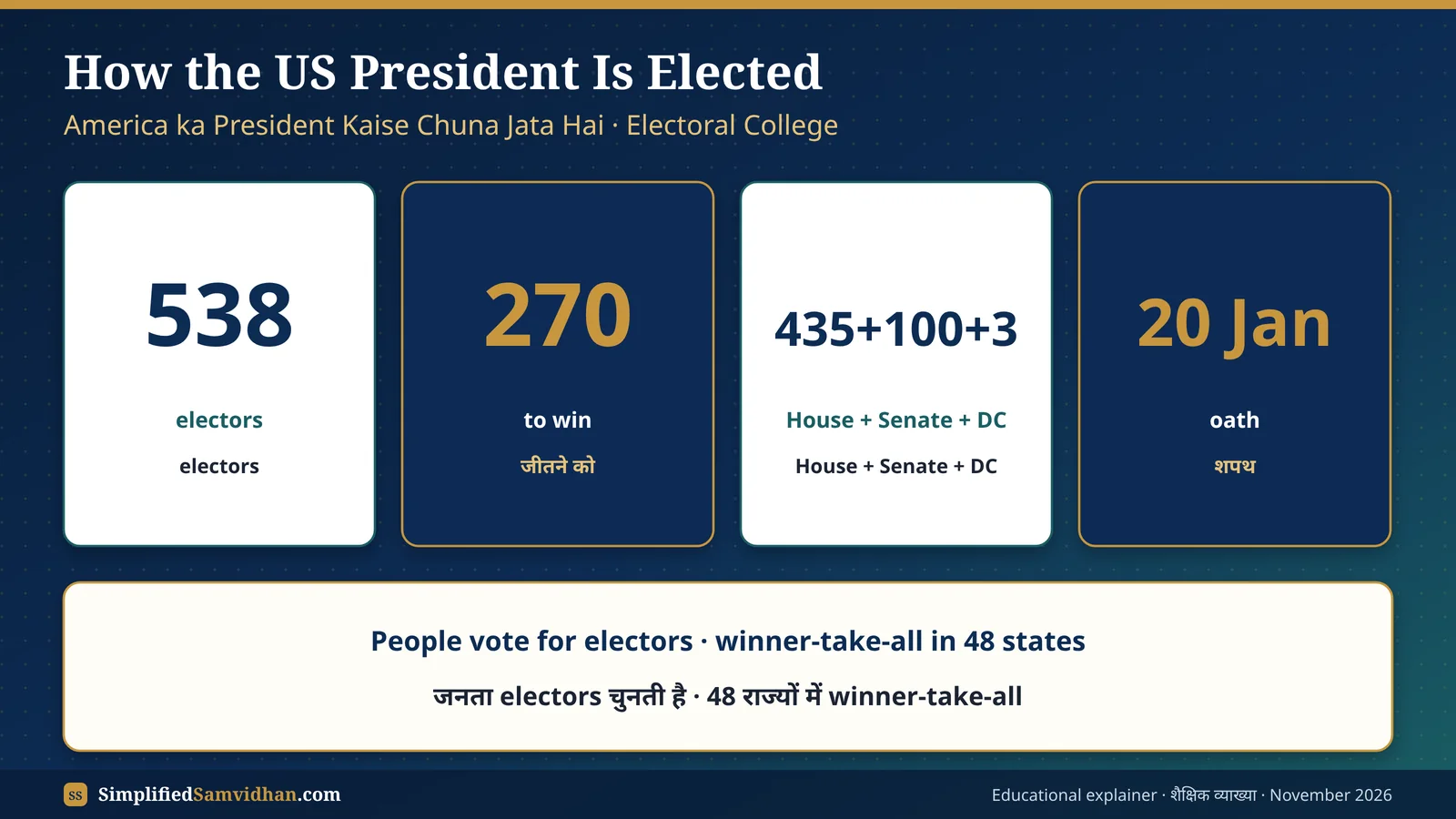
Americans vote for electors, not directly for the President. There are 538 electors; a candidate needs 270. In 48 states the winner takes all the electors, so the national vote winner can still lose.
Simple meaningHow Is the US President Elected? Electoral College in Simple Words
Americans do not elect their President directly. On election day a voter in, say, Texas ticks the name of a candidate pair (President + Vice President). Legally, that vote chooses the candidate's team of electors for Texas. Each state has as many electors as it has members in Congress (House seats + 2 Senators). Add 3 for Washington DC and you get 538. The candidate who wins 270 or more becomes President.
The twist: in 48 states the candidate who wins the most votes in the state takes all of its electors (winner-take-all). So it is possible to win more votes nationwide and still lose, as happened in 2000 and 2016.
🏠 Everyday analogy
Think of the IPL points table, not total runs. A team that scores the most runs across the season can still miss the playoffs if it lost close matches. Winning states (matches) matters more than total votes (runs).
🇮🇳 Real Indian example
Our Lok Sabha works similarly: a party can get more votes nationally but fewer seats. In 2024 the US result was Trump 312 electors, Harris 226.
| Biggest states | Electoral votes | Smallest | Electoral votes |
|---|---|---|---|
| California | 54 | Alaska | 3 |
| Texas | 40 | Wyoming | 3 |
| Florida | 30 | Vermont | 3 |
| New York | 28 | Washington DC | 3 (23rd Amendment) |
| Pennsylvania / Illinois | 19 / 19 | Delaware, N. Dakota, S. Dakota | 3 each |
ConstitutionArticle II of the US Constitution: The Electors
Article II, Section 1, Clause 1. The executive Power shall be vested in a President of the United States of America. He shall hold his Office during the Term of four Years, and, together with the Vice President, chosen for the same Term, be elected, as follows:
Clause 2. Each State shall appoint, in such Manner as the Legislature thereof may direct, a Number of Electors, equal to the whole Number of Senators and Representatives to which the State may be entitled in the Congress: but no Senator or Representative, or Person holding an Office of Trust or Profit under the United States, shall be appointed an Elector.
Step by stepUS Presidential Election Process: From Primaries to 20 January
- 1Primaries (Jan-Jun)
Each party picks its candidate through state primaries and caucuses.
- 2Conventions (Jul-Aug)
Party conventions formally nominate the President and Vice President pair.
- 3Election Day (November)
Tuesday after the first Monday of November. Next: 7 November 2028.
- 4Electors vote (December)
Each state's winning electors meet in their state capital and cast votes.
- 5Congress counts (6 January)
The Vice President opens the certificates before both Houses; the count is declared.
- 6Inauguration (20 January)
The new President takes the oath at noon at the Capitol.
For and againstWhen the Popular Vote Loser Won: Electoral College Debate
| Year | Won the Electoral College | Won more popular votes |
|---|---|---|
| 2000 | George W. Bush (271) | Al Gore (about 5.4 lakh more votes) |
| 2016 | Donald Trump (304) | Hillary Clinton (about 29 lakh more votes) |
| 2024 | Donald Trump (312) | Donald Trump too (about 49.8% vs 48.3%) |
- For the system: forces candidates to win across many states, protects smaller states, keeps disputes local (a recount in one state, not the whole country).
- Against: a vote in a safe state counts for less; campaigns focus on 6-7 swing states (Pennsylvania, Michigan, Wisconsin, Georgia, Arizona, Nevada, North Carolina); the popular-vote winner can lose.
- Compare with India: How the President is elected in India vs USA.
Quick revisionOne-Line Revision Points (Exam Ready)
- Electoral College = 538 (435 + 100 + 3 DC).
- Win = 270 electoral votes.
- Maine and Nebraska split electors; others winner-take-all.
- Largest: California 54.
- No 270: House picks (1 vote per state).
- Inauguration 20 January.
Practice MCQPractice MCQs (with Answers): Electoral College
How many electoral votes are needed to become US President?
Which amendment gave Washington DC electoral votes?
Which two states do not use winner-take-all?
If no candidate gets 270, who elects the President?
Doubts ClearedFrequently Asked Questions
Is the US President elected directly by the people?
Not legally. People vote for electors pledged to a candidate; the 538 electors then elect the President. In practice the result is known on election night.
What does 270 mean in US elections?
It is the majority of the 538 electoral votes, the number a candidate needs to win the presidency.
Can someone lose the popular vote and still win?
Yes. It happened in 1824, 1876, 1888, 2000 and 2016.
Sources and further readingSources We Checked
Facts checked on 4 November 2026 from the National Archives (Electoral College) and USA.gov. Electoral vote numbers follow the 2020 census and apply to 2024 and 2028.