Democrats vs Republicans: America's Two Big Parties Explained
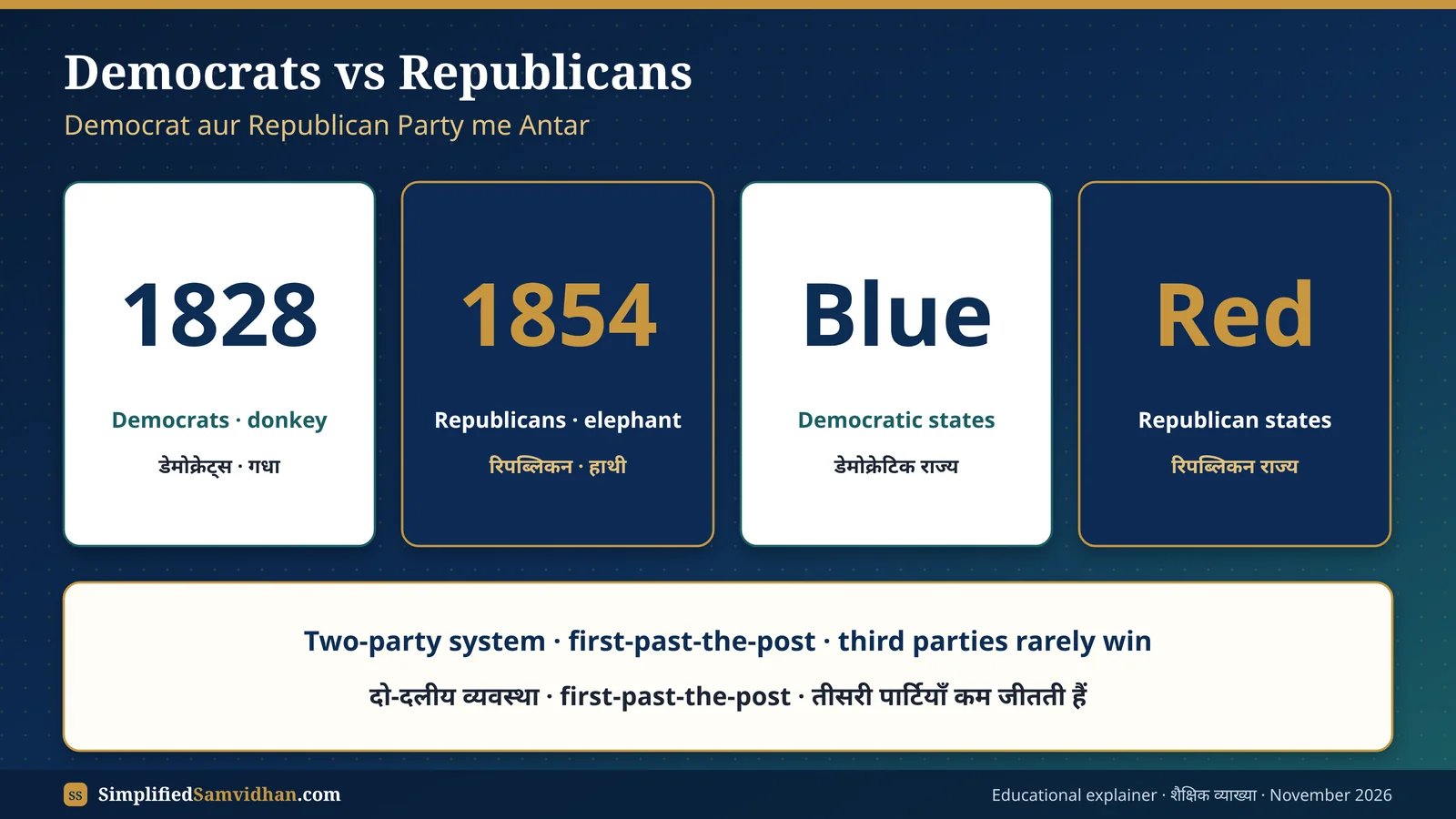
Almost every US election is a fight between the Democrats (blue, donkey, 1828) and the Republicans (red, elephant, 1854). What each stands for, why third parties rarely win, and how it differs from India's many-party system.
The two partiesDemocrats vs Republicans: The Difference in Simple Words
America has many parties on paper, but for 150 years almost every President, Senator and governor has come from just two: the Democratic Party and the Republican Party. Democrats today generally favour a bigger role for the government in health care, welfare, climate action and civil rights. Republicans generally favour lower taxes, a smaller government, strong border control and traditional social values. On TV maps, Democratic states are blue and Republican states are red; a state that can go either way is a swing or "purple" state.
🏠 Everyday analogy
Like a city with two big cricket clubs that have dominated for a century. New clubs start every few years, but players and sponsors keep joining the two big ones because that is where matches are won.
🇮🇳 Real Indian example
India is the opposite: the Election Commission recognises 6 national parties and dozens of State parties, and coalition governments are common. A two-party system would be like only BJP and Congress ever winning seats.
| Point | Democratic Party | Republican Party |
|---|---|---|
| Founded | 1828 (Andrew Jackson); oldest active party in the world | 1854, by opponents of slavery |
| Nickname and symbol | Donkey | GOP (Grand Old Party), elephant |
| Colour | Blue | Red |
| Famous Presidents | F.D. Roosevelt, J.F. Kennedy, Barack Obama, Joe Biden | Abraham Lincoln, Ronald Reagan, George W. Bush, Donald Trump |
| Today's leaders | Hakeem Jeffries (House), Chuck Schumer (Senate) | President Donald Trump, VP JD Vance |
| Strongholds | Big cities, coasts (California, New York) | Rural areas, South and Midwest (Texas, Alabama) |
| After 2026 midterms | Majority in House, Senate and governorships | Holds the White House till January 2029 |
Why two partiesWhy the US Has a Two-Party System (and India Doesn't)
- First-past-the-post with single-member seats: only the top candidate wins, so voters avoid "wasting" votes on small parties. Political scientists call this Duverger's law.
- Winner-take-all Electoral College: a third party can win 19% nationally and still get zero electors, as Ross Perot did in 1992.
- Primaries absorb rebels: new movements (Tea Party, progressives) fight inside the big parties instead of forming new ones.
- Ballot access laws and money favour the two established parties.
Third partiesThird Parties and Independents in US Elections
| Party / person | Best result |
|---|---|
| Theodore Roosevelt (Progressive 'Bull Moose', 1912) | About 27% and 88 electors, the best ever for a third party |
| Ross Perot (independent, 1992) | About 19% of the vote, zero electors |
| Libertarian Party | Third-largest; about 3% in 2016 |
| Green Party | Ralph Nader 2.7% in 2000, blamed by Democrats for Gore's loss in Florida |
| Independents in Congress | Bernie Sanders and Angus King sit in the Senate and vote with the Democrats |
- How candidates are chosen inside parties: Primaries and caucuses. Voting itself: How voting works in the US.
- Indian side: NOTA, electoral bonds and party funding.
Quick revisionOne-Line Revision Points (Exam Ready)
- Democrats: 1828, donkey, blue.
- Republicans (GOP): 1854, elephant, red; first President Lincoln.
- Two-party system explained by Duverger's law.
- Best third party: Theodore Roosevelt 1912 (27%).
- Sanders and King: independents who vote with Democrats.
Practice MCQPractice MCQs (with Answers): US political parties
'GOP' is the nickname of which party?
Who was the first Republican President?
Duverger's law links the two-party system with:
Doubts ClearedFrequently Asked Questions
What is the main difference between Democrats and Republicans?
Democrats generally want a larger role for government in welfare and rights; Republicans generally want lower taxes, smaller government and traditional values.
Why is the Republican Party red and the Democratic Party blue?
TV networks fixed these colours on their election maps in 2000, and they stuck.
Which party is Donald Trump from?
The Republican Party.
Sources and further readingSources We Checked
Facts checked on 4 November 2026. Party positions are described in general terms; individual members often differ.