US House of Representatives Explained: America's Lok Sabha in Simple Words
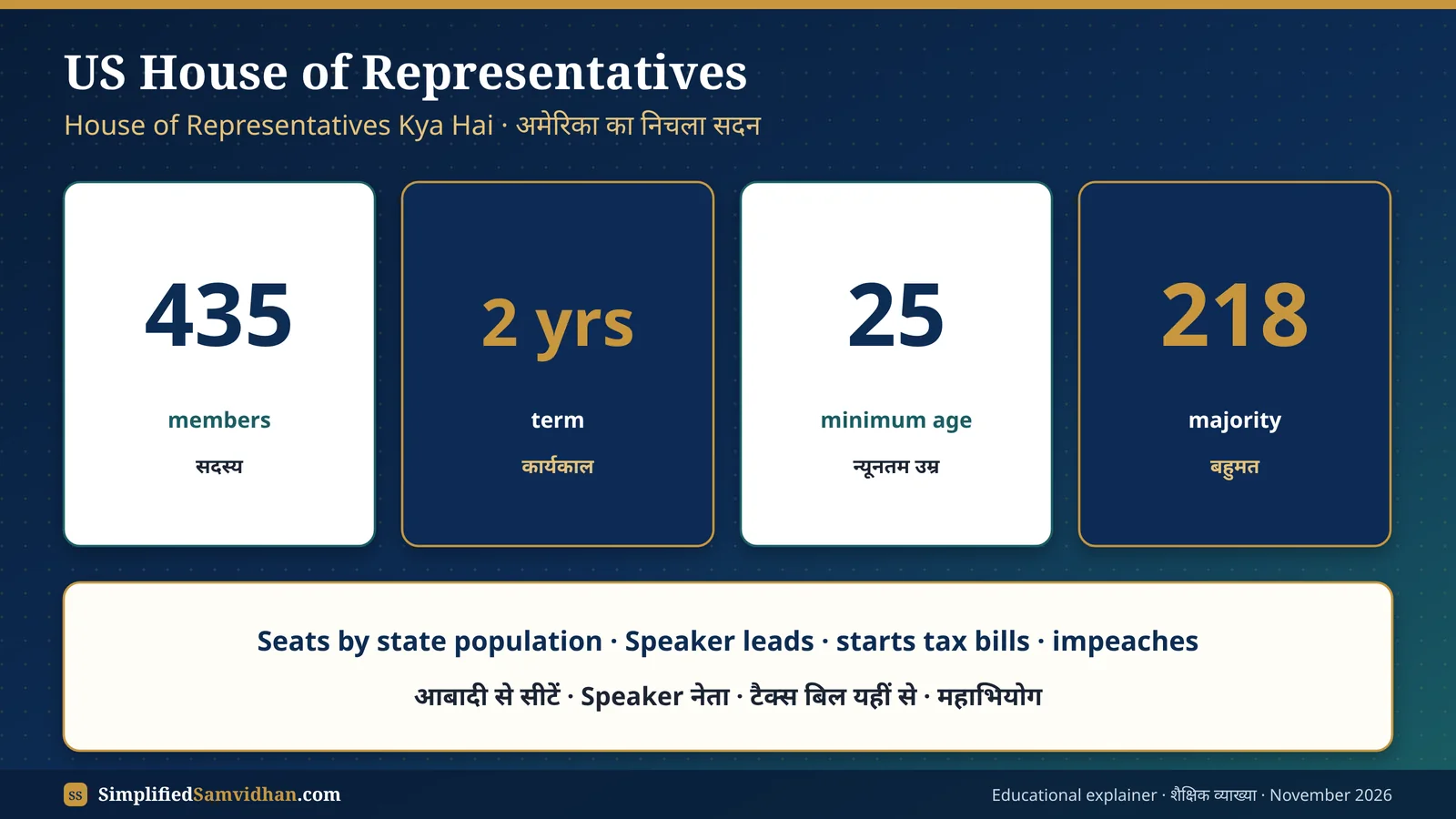
The House of Representatives has 435 members, each elected for just 2 years from a district of about 7.6 lakh people. It starts every tax bill, impeaches officials and is led by the Speaker.
MeaningWhat Is the US House of Representatives?
The House of Representatives is the lower House of the US Congress, the closest thing America has to our Lok Sabha. It has 435 voting members, each elected from one district of roughly 7.6 lakh people for a 2-year term. Whoever gets the most votes in the district wins, just like our first-past-the-post system. Because every seat comes up every two years, the House reacts fastest to the public mood.
🏠 Everyday analogy
Like a Lok Sabha that faces the voters every two years instead of five: members are always in campaign mode.
🇮🇳 Real Indian example
An average Lok Sabha seat has about 25 lakh voters, more than three times a US House district. India has 543 seats for 140 crore people; the US has 435 for about 34 crore.
| State | House seats (after 2020 census) |
|---|---|
| California | 52 |
| Texas | 38 |
| Florida | 28 |
| New York | 26 |
| Pennsylvania / Illinois | 17 / 17 |
| Alaska, Delaware, North Dakota, South Dakota, Vermont, Wyoming | 1 each |
ConstitutionArticle I of the US Constitution: Rules for the House
Article I, Section 2, Clause 1. The House of Representatives shall be composed of Members chosen every second Year by the People of the several States, and the Electors in each State shall have the Qualifications requisite for Electors of the most numerous Branch of the State Legislature.
Clause 2. No Person shall be a Representative who shall not have attained to the Age of twenty five Years, and been seven Years a Citizen of the United States, and who shall not, when elected, be an Inhabitant of that State in which he shall be chosen.
Article I, Section 2, Clause 5. The House of Representatives shall chuse their Speaker and other Officers; and shall have the sole Power of Impeachment.
Article I, Section 4, Clause 1. The Times, Places and Manner of holding Elections for Senators and Representatives, shall be prescribed in each State by the Legislature thereof; but the Congress may at any time by Law make or alter such Regulations, except as to the Places of chusing Senators.
Three rules to remember: a member must be 25 years old, a citizen for 7 years and live in the state (not necessarily the district). The House chooses its own Speaker and has the sole power of impeachment. Each state runs the election and draws district maps, which is why fights over gerrymandering are so common.
Speaker and powersSpeaker of the House and the Special Powers of the House
- Speaker of the House: elected by all members, usually the leader of the majority party. Controls which bills come to the floor. Second in line to become President, after the Vice President.
- Speaker Mike Johnson (Republican) has held the post since October 2023. After the 2026 midterms the Democrats have the majority, so a new Speaker will be elected on 3 January 2027.
- Majority and minority leaders and whips manage party votes, much like the chief whip in our Parliament.
- Compare India: the Lok Sabha Speaker (Art. 93) is also elected by members, but is expected to act neutrally; the US Speaker is openly a party leader.
| Power | What it means |
|---|---|
| Money bills start here | All tax (revenue) bills must begin in the House (Art. I, s.7). |
| Impeachment | A simple majority impeaches (charges) the President or a judge; the Senate holds the trial. |
| Tie in the Electoral College | If no one gets 270, the House chooses the President, one vote per state (happened in 1800 and 1824). |
How electedHow Members of the House Are Elected, Step by Step
- 1Census every 10 years
Seats are shared among the 50 states by population (reapportionment). Total stays 435 (law of 1929).
- 2States draw districts
Each state legislature or a commission draws the map of districts.
- 3Party primaries
Voters choose each party's candidate, usually in spring or summer of the election year.
- 4General election
In November of every even year; highest votes wins (Maine and Alaska use ranked-choice voting).
- 5Sworn in 3 January
The new House meets, elects the Speaker and starts work.
- India's equivalent process: types of elections in India. Map-drawing in India: Delimitation and gerrymandering.
- Compare with the upper House: Senate vs House.
Quick revisionOne-Line Revision Points (Exam Ready)
- House = 435 voting members (fixed since 1929 law).
- Term 2 years; age 25; citizen 7 years.
- Seats reapportioned after every census.
- Largest: California 52; six states have 1.
- Speaker is 2nd in line for President.
- Sole power of impeachment.
Practice MCQPractice MCQs (with Answers): US House of Representatives
What is the minimum age to be a member of the US House?
Who is second in line to the US presidency after the Vice President?
Which US state has the most House seats?
Doubts ClearedFrequently Asked Questions
How many members are in the House of Representatives?
435 voting members plus 6 non-voting delegates from Washington DC and US territories.
Why is the House term only two years?
The framers wanted one House that stays very close to the people and can be changed quickly.
Who is the Speaker of the US House?
Mike Johnson (Republican) since October 2023. A new Speaker will be chosen when the new House meets on 3 January 2027.
Sources and further readingSources We Checked
Facts checked on 4 November 2026. Seat numbers from the 2020 census apportionment. Hindi text of the Constitution is a simple rendering.