US Senate vs House of Representatives: How America's Congress Works
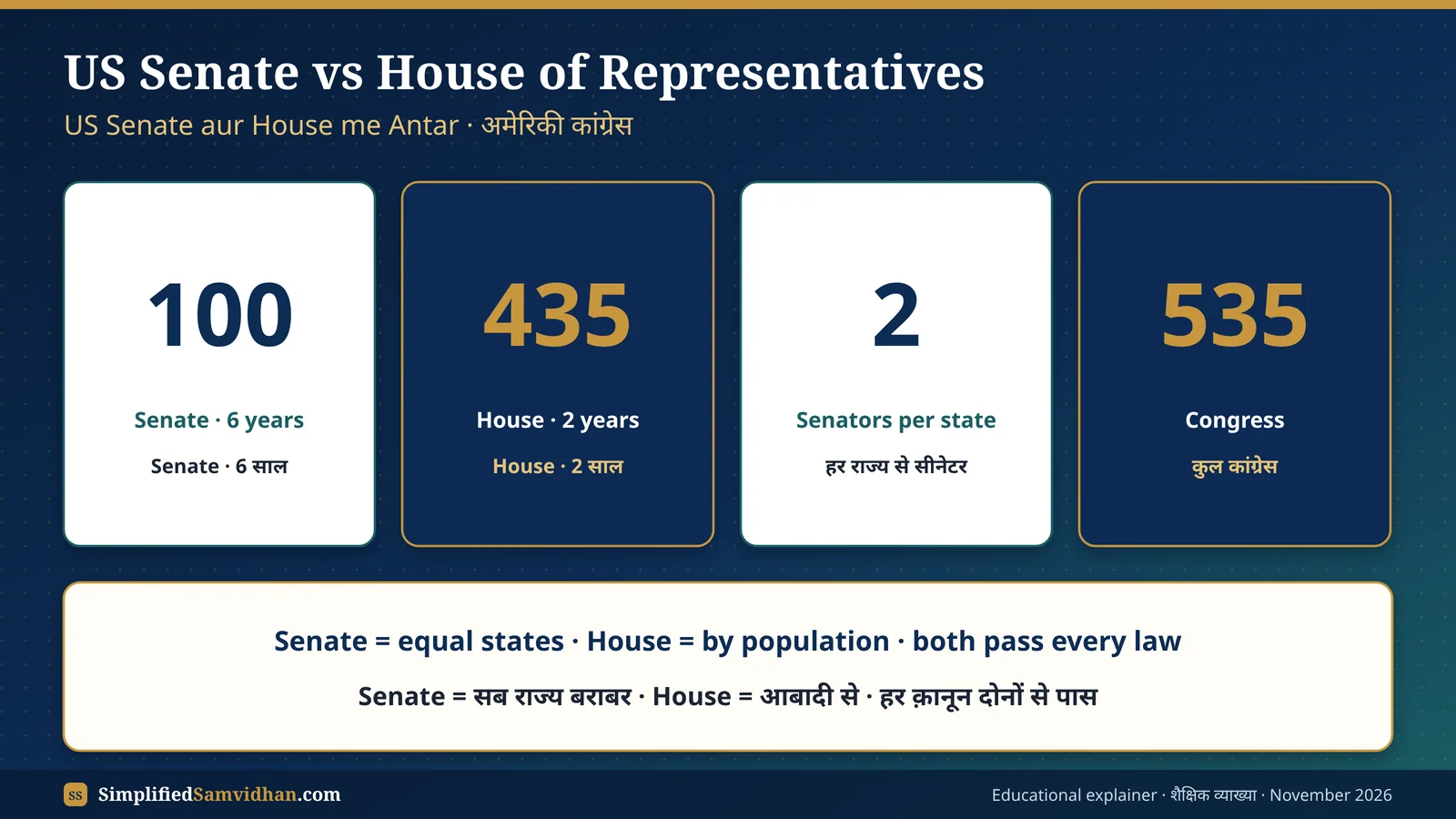
The US Congress has two Houses: the House of Representatives (435 members, 2-year term) and the Senate (100 members, 6-year term). Here is how they differ, how a law is made, and how they compare with our Lok Sabha and Rajya Sabha.
DifferenceUS Senate vs House of Representatives: The Key Differences
America's Parliament is called Congress. It has two Houses. The House of Representatives (the lower House) has 435 members, given to states by population, each elected for 2 years. The Senate (the upper House) has 100 members, exactly 2 from every state, big or small, each elected for 6 years. A bill becomes law only when both pass it in the same words and the President signs it.
🏠 Everyday analogy
The House is like a class monitor election every year: quick, noisy, close to the mood of students. The Senate is like the senior prefect council chosen for longer: calmer and slower to change.
🇮🇳 Real Indian example
California with about 39 million people gets 52 House seats; Wyoming with under 6 lakh people gets 1. But in the Senate both get 2. Compare: in our Rajya Sabha Uttar Pradesh has 31 seats and Goa 1, because seats follow population.
| Point | House of Representatives | Senate |
|---|---|---|
| Members | 435 (+6 non-voting delegates) | 100 |
| Seats per state | By population (1 to 52) | 2 for every state |
| Term | 2 years, all at once | 6 years, one-third every 2 years |
| Minimum age | 25 | 30 |
| Citizenship | 7 years | 9 years |
| Presiding officer | Speaker (elected by the House) | Vice President (President of the Senate) |
| Special powers | Tax bills start here; impeaches officials | Confirms judges and ministers; ratifies treaties; tries impeachments |
| Majority | 218 | 51 |
ConstitutionWhat the US Constitution Says About Congress
Article I, Section 2, Clause 1. The House of Representatives shall be composed of Members chosen every second Year by the People of the several States, and the Electors in each State shall have the Qualifications requisite for Electors of the most numerous Branch of the State Legislature.
Clause 2. No Person shall be a Representative who shall not have attained to the Age of twenty five Years, and been seven Years a Citizen of the United States, and who shall not, when elected, be an Inhabitant of that State in which he shall be chosen.
Amendment XVII (1913). The Senate of the United States shall be composed of two Senators from each State, elected by the people thereof, for six years; and each Senator shall have one vote.
Article I, Section 3, Clause 3. No Person shall be a Senator who shall not have attained to the Age of thirty Years, and been nine Years a Citizen of the United States, and who shall not, when elected, be an Inhabitant of that State for which he shall be chosen.
How laws are madeHow a Bill Becomes Law in the US Congress
| Step | What happens |
|---|---|
| 1 | A member introduces a bill in either House (tax bills only in the House). |
| 2 | Committee studies it, holds hearings and changes it. |
| 3 | Full House votes (simple majority); in the Senate most bills need 60 votes to end debate (filibuster). |
| 4 | The other House passes the same text, or a joint conference committee settles the differences. |
| 5 | President signs it, or vetoes it. Congress can override a veto by two-thirds in both Houses. |
India vs USUS Congress vs Indian Parliament: Senate vs Rajya Sabha, House vs Lok Sabha
US Congress
- House 435 + Senate 100 = 535 voting members
- Both Houses directly elected
- Senate equal for all states (federal principle)
- Senate is as strong as the House, even stronger on appointments and treaties
- Neither House can be dissolved; fixed election dates
- Ministers are NOT members of Congress
Indian Parliament
- Lok Sabha 543 + Rajya Sabha 245 (233 elected + 12 nominated)
- Lok Sabha direct; Rajya Sabha elected by MLAs
- Rajya Sabha seats by population
- Lok Sabha is stronger: money bills, no-confidence motion
- Lok Sabha can be dissolved early (Art. 85)
- PM and ministers must be MPs (Art. 75)
- Go deeper: US House of Representatives explained and US Senate explained.
- Who controls Congress after 2026: House results 2026, Senate results 2026.
Quick revisionOne-Line Revision Points (Exam Ready)
- Congress = House (435) + Senate (100).
- House term 2 years, age 25; Senate 6 years, age 30.
- Every state has 2 Senators.
- Senate presided by the Vice President.
- Tax bills start in the House; treaties need 2/3 of the Senate.
- Veto override: 2/3 of both Houses.
Practice MCQPractice MCQs (with Answers): US Congress
How many Senators does each US state have?
Which body ratifies treaties in the US?
Which pair is correctly matched?
In India, unlike the US Senate, Rajya Sabha seats are given to states:
Doubts ClearedFrequently Asked Questions
What is the main difference between the Senate and the House?
The House has 435 members by population for 2 years; the Senate has 100 members, 2 per state, for 6 years. The Senate also confirms appointments and treaties.
Which is more powerful, the Senate or the House?
They are equal for making laws. The Senate has extra powers over appointments and treaties; the House alone starts tax bills and impeachment.
Is the US Senate like the Rajya Sabha?
Both are upper Houses that represent states and never dissolve, but the Senate is directly elected, gives equal seats to every state and is far more powerful.
Sources and further readingSources We Checked
Facts checked on 4 November 2026. US Constitution text from the National Archives; the Hindi text is a simple rendering.