US Midterm Elections 2026: What Is at Stake and Why India Is Watching
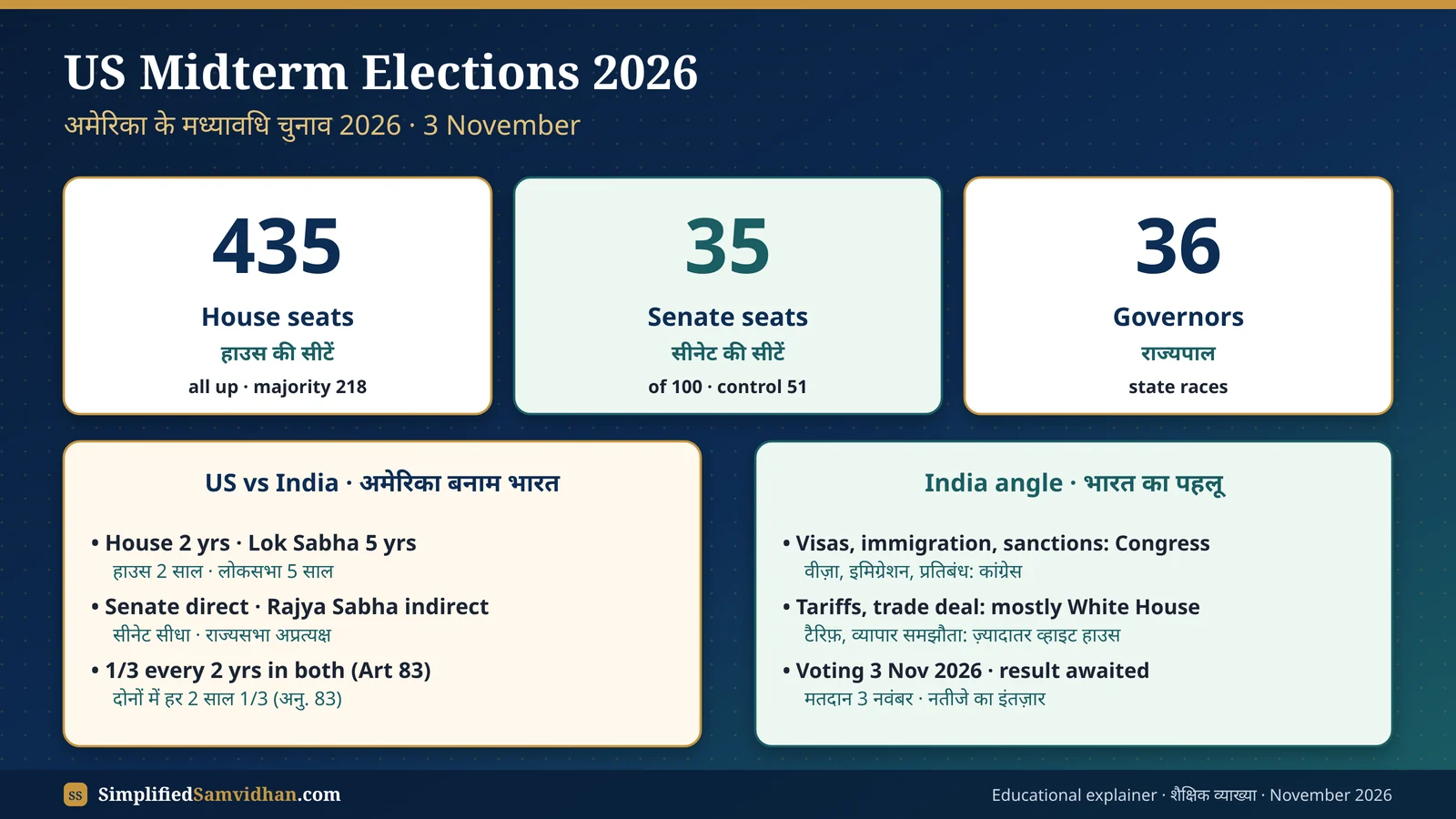
On 3 November 2026 Americans vote in the midterm elections, held halfway through a President's four-year term. President Donald Trump is not on the ballot, but control of Congress is: all 435 seats of the House of Representatives and 35 of the 100 Senate seats. The result decides how freely the White House can pass laws for the next two years. Here is how the system works, how it compares with India's Parliament, and what it means for India.
Where things stand
Voting takes place on Tuesday, 3 November 2026. By election eve, reports said about 57 million Americans had already voted early. Before polling, forecasts suggested the Democrats were favoured to win back the House, where the Republicans held a very narrow majority, while the Senate looked close, with a few toss-up states expected to decide control.
Because of the time difference, results come in through Wednesday, 4 November, Indian time, and close races can take days to call. We will add the final result to this page once it is clear. Forecasts are not results.
At a GlanceUS Midterms 2026: Key Facts
| Point | Fact |
|---|---|
| Polling day | Tuesday, 3 November 2026 |
| House of Representatives | All 435 seats (2-year term); 218 needed for a majority |
| Senate | 35 of 100 seats (33 regular + 2 special elections, in Florida and Ohio); 51 for control, or 50 plus the Vice President's vote |
| Governors | 36 states |
| President | Not on the ballot; Donald Trump's term runs to January 2029 |
| New Congress meets | January 2027 |
| Why 'midterm' | Held in the middle of the President's four-year term |
In America the President and Congress are elected separately. The President runs the government, but laws and the budget need Congress. If the President's party loses one House in the midterms, he still stays President, but his plans can be blocked or slowed and his government can face more inquiries. This is called a 'divided government'.
🏠 Everyday analogy
Think of a school principal who cannot change the timetable without the staff committee. Halfway through the principal's term, the committee is re-elected. If the new committee is unfriendly, the principal stays, but every big change becomes a negotiation.
🇮🇳 Real Indian example
If the House changes hands, its committees can call officials to explain tariff or visa decisions, which can affect Indian exporters and IT professionals.
US vs IndiaUS Congress vs Indian Parliament
| Point | United States | India |
|---|---|---|
| System | Presidential | Parliamentary |
| Lower House | House of Representatives, 435, 2-year term | Lok Sabha, up to 550 elected, 5-year term (can be dissolved earlier) |
| Upper House | Senate, 100, directly elected (since 1913), 6-year term | Rajya Sabha, indirectly elected by State MLAs, 6-year term |
| Staggered upper House | About one-third every 2 years | About one-third retire every 2 years (Article 83(1)) |
| Executive and legislature | President is not a member and cannot dissolve Congress | PM and ministers sit in Parliament and are responsible to the Lok Sabha |
| Upper House presiding officer | Vice President is President of the Senate | Vice President is ex officio Chairman of the Rajya Sabha |
Official TextArticle 83: India's Equivalent of a Staggered Upper House
Constitution of India, Article 83. Duration of Houses of Parliament.
(1) The Council of States shall not be subject to dissolution, but as nearly as possible one-third of the members thereof shall retire as soon as may be on the expiration of every second year in accordance with the provisions made in that behalf by Parliament by law.
(2) The House of the People, unless sooner dissolved, shall continue for five years from the date appointed for its first meeting and no longer and the expiration of the said period of five years shall operate as a dissolution of the House.
- Like the US Senate, the Rajya Sabha is a permanent body; it is never dissolved as a whole.
- Unlike the US House, the Lok Sabha can be dissolved early by the President on the advice of the Council of Ministers.
- India has no fixed 'midterm' poll; but Rajya Sabha biennial elections and State Assembly elections often act as a mid-term test.
India AngleWhat the Midterms Can and Cannot Change for India
Can change
- Congressional oversight of tariff and trade decisions
- Laws on H-1B visas, green cards and immigration
- Funding and scrutiny of sanctions policy
- Tone of debate on defence and technology ties
Cannot easily change
- Tariffs set by the President using executive powers
- The pending India-US trade agreement, negotiated by the White House
- Broad bipartisan support for the India-US strategic partnership
- Presidential vetoes, which need two-thirds of both Houses to override
UPSC CornerUS Midterms for UPSC Prelims and Mains
- Prelims: The US House has 435 voting members with 2-year terms; the Senate has 100 members with 6-year terms.
- Prelims: The 17th Amendment (1913) of the US Constitution made Senators directly elected.
- Prelims: In India, about one-third of Rajya Sabha members retire every second year (Article 83(1)).
- Mains (GS II): "Divided government is a feature of the presidential system, not a flaw." Compare with India's parliamentary system.
Practice MCQTest Yourself: US Midterms 2026: India's Stakes
With reference to the 2026 US midterm elections, consider the following statements: (1) All seats of the House of Representatives are up for election. (2) The President of the United States is also elected in the midterms. (3) Only about one-third of the Senate seats are contested. Which of the statements given above is/are correct?
Doubts ClearedFrequently Asked Questions
When are the 2026 US midterm elections?
Polling day is Tuesday, 3 November 2026.
What is at stake in the US midterms?
All 435 House seats, 35 of the 100 Senate seats and 36 State governorships.
Is Donald Trump on the ballot?
No. Midterms are held in the middle of a President's four-year term. His term runs to January 2029.
How do the US midterms affect India?
Congress shapes laws on visas, immigration and sanctions and can scrutinise tariff decisions, but most trade and tariff choices rest with the White House.
How is the US Senate different from the Rajya Sabha?
US Senators are directly elected by voters, while Rajya Sabha members are elected by State MLAs. Both have 6-year terms, with about one-third retiring every two years.
Sources and further readingSources We Checked
Facts checked against the reports below on 3 November 2026, while voting was under way. Forecasts quoted are pre-poll estimates; the final result will be added after counting.
- Outlook India: US Midterm Elections 2026 live (3 Nov 2026)
- Fox News: Everything to know about House and Senate control, ballot measures and 2026 Election Day poll closing
- The Pioneer: America votes, India waits: what Tuesday's midterms can and cannot change for New Delhi
- Business Today: Why a Democratic House may not ease Trump's tariff pressure on India (Oct 2026)
- Wikipedia: 2026 United States elections (overview of seats up)