US Constitution Amendments on Voting Rights: Who Got the Vote and When
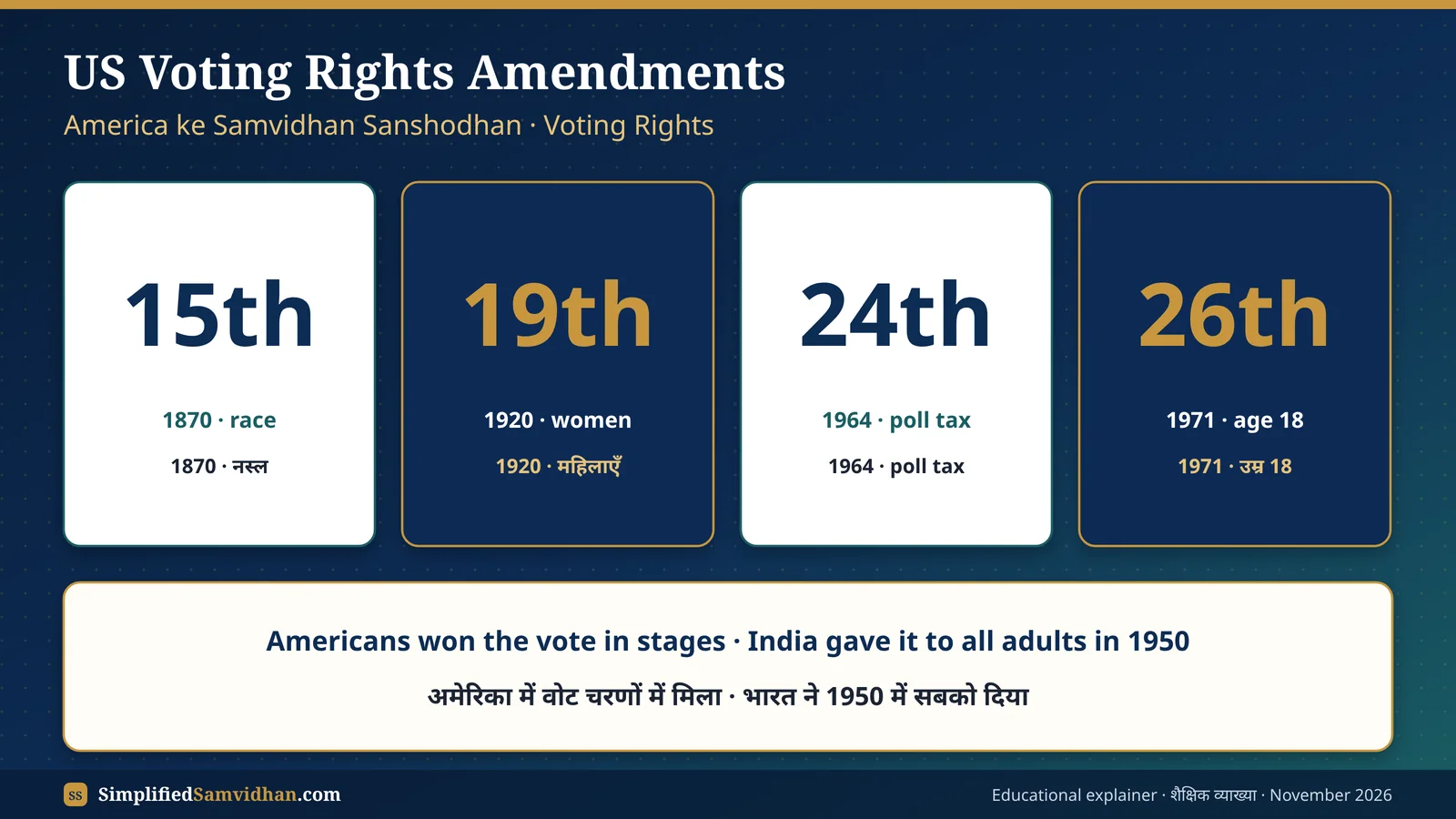
Americans won the vote in stages: race (1870), women (1920), no poll tax (1964), age 18 (1971). Here is the exact text of each amendment, a table of every election amendment, and how India gave all adults the vote in 1950.
The storyHow Americans Won the Right to Vote, One Amendment at a Time
When the US Constitution began in 1789, in practice only white men who owned property could vote in most states. Over the next 180 years, a chain of amendments opened the vote to others: Black men (15th, 1870), women (19th, 1920), the poor who could not pay a poll tax (24th, 1964) and 18-year-olds (26th, 1971). Even then, many Southern states blocked Black voters with literacy tests and violence until the Voting Rights Act of 1965.
🏠 Everyday analogy
Like a club that first let in only rich men, then, one rule-change at a time over two centuries, opened its doors to everyone.
🇮🇳 Real Indian example
India gave the vote to every adult, man or woman, rich or poor, on day one in 1950 (Article 326). American women waited 131 years after their Constitution; Indian women voted in the very first election of 1951-52.
Exact text15th, 19th, 24th and 26th Amendments: The Exact Words
Amendment XV, Section 1 (1870). The right of citizens of the United States to vote shall not be denied or abridged by the United States or by any State on account of race, color, or previous condition of servitude.
Amendment XIX (1920). The right of citizens of the United States to vote shall not be denied or abridged by the United States or by any State on account of sex.
Amendment XXIV, Section 1 (1964). The right of citizens of the United States to vote in any primary or other election for President or Vice President, for electors for President or Vice President, or for Senator or Representative in Congress, shall not be denied or abridged by the United States or any State by reason of failure to pay any poll tax or other tax.
Amendment XXVI, Section 1 (1971). The right of citizens of the United States, who are eighteen years of age or older, to vote shall not be denied or abridged by the United States or by any State on account of age.
All election amendmentsAll US Constitutional Amendments About Elections in One Table
| Amendment | Year | What it did |
|---|---|---|
| 12th | 1804 | Separate electoral votes for President and Vice President |
| 14th | 1868 | Citizenship for all born in the US; equal protection; Section 3 bars insurrectionists from office |
| 15th | 1870 | No denial of the vote because of race |
| 17th | 1913 | Senators elected directly by the people |
| 19th | 1920 | Women's right to vote |
| 20th | 1933 | Congress starts 3 January, President 20 January (shorter lame-duck period) |
| 22nd | 1951 | Two-term limit for President |
| 23rd | 1961 | Washington DC gets 3 electors |
| 24th | 1964 | No poll tax in federal elections |
| 25th | 1967 | Presidential succession and disability |
| 26th | 1971 | Voting age lowered to 18 |
Amendment XVII (1913). The Senate of the United States shall be composed of two Senators from each State, elected by the people thereof, for six years; and each Senator shall have one vote.
Amendment XXII, Section 1 (1951). No person shall be elected to the office of the President more than twice, and no person who has held the office of President, or acted as President, for more than two years of a term to which some other person was elected President shall be elected to the office of the President more than once.
India vs USVoting Rights: How India Did It in One Day
| Right | 🇺🇸 USA | 🇮🇳 India |
|---|---|---|
| Women's vote | 1920 (19th Amendment) | 1950, from the start (Art. 326) |
| No race or caste bar | 1870 on paper; real only after 1965 | 1950 (Arts. 325, 326) |
| No tax or property test | 1964 (24th Amendment) | 1950 |
| Voting age 18 | 1971 (26th Amendment) | 1989 (61st Amendment) |
- India's story of 18: 61st Amendment: voting age 18. The universal vote in India: types of elections in India.
- Rest of the US Constitution: US Constitution vs Indian Constitution.
Quick revisionOne-Line Revision Points (Exam Ready)
- 15th (1870): no race bar.
- 19th (1920): women's vote.
- 24th (1964): no poll tax.
- 26th (1971): age 18.
- 17th (1913): direct Senate; 22nd (1951): two terms.
- India: universal adult franchise from 1950 (Art. 326).
Practice MCQPractice MCQs (with Answers): US voting amendments
Which amendment gave American women the right to vote?
The 24th Amendment abolished:
Arrange in order: 19th, 15th, 26th, 24th Amendments
Doubts ClearedFrequently Asked Questions
When did women get the right to vote in the US?
In 1920, through the 19th Amendment.
What is a poll tax?
A fee charged to vote, used in Southern states to keep poor and Black citizens away. The 24th Amendment banned it in federal elections in 1964, and the Supreme Court banned it in state elections in 1966.
When did India give women the right to vote?
From the start of the Constitution on 26 January 1950, under Article 326.
Sources and further readingSources We Checked
Facts checked on 4 November 2026 from the National Archives (Amendments 11-27). Hindi text is a simple rendering.