Bare ActOfficial Text of Article 17
17. Abolition of Untouchability.—"Untouchability" is abolished and its practice in any form is forbidden. The enforcement of any disability arising out of "Untouchability" shall be an offence punishable in accordance with law.
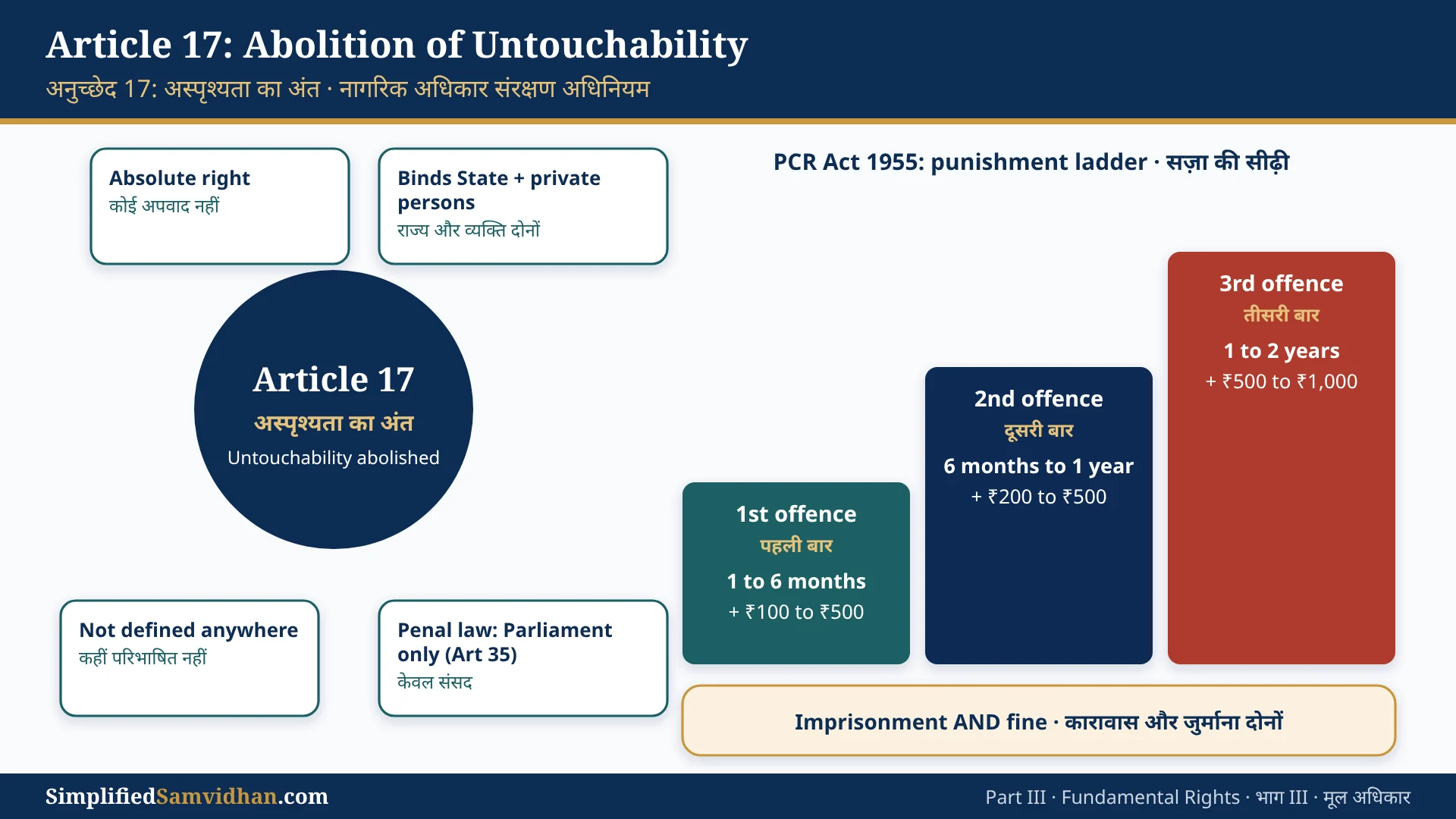
Article 17 is an absolute right: it has no exceptions and no "reasonable restrictions". No one can claim a religious custom to justify untouchability.
It applies to the State and to private individuals. A shopkeeper, a temple trust or a village panchayat that practises untouchability breaks the Constitution.
The Constitution does not define "untouchability". Courts read it in its historical sense: caste-based exclusion, not the literal "not touching" of a sick person (Devarajiah v. Padmanna, Mysore HC, 1958).
Practising untouchability is a crime. Parliament first passed the Untouchability (Offences) Act, 1955, renamed in 1976 as the Protection of Civil Rights (PCR) Act.
🏠 Everyday Analogy
Think of Article 17 as a red line painted across the whole country. Most rights have a gate in the fence ("reasonable restrictions"). This one has no gate at all: no government, community or custom can cross it.
🇮🇳 Real Indian Example
At a village tea stall, Dalit customers are served in separate glasses kept aside (the "two-glass system"). This is untouchability. The stall owner can be prosecuted under the PCR Act and, since the victims are Scheduled Castes, also under the SC/ST (Prevention of Atrocities) Act, where anticipatory bail is barred.
Nature of the RightArticle 17 of Indian Constitution: Meaning and Nature of Abolition of Untouchability
- Absolute: unlike Article 19, there are no reasonable restrictions.
- Horizontal: enforceable against private persons as well as the State. In People's Union for Democratic Rights v. Union of India (Asiad Workers, 1982) the Supreme Court said Articles 17, 23 and 24 bind private individuals, and the State must act when they are violated.
- Not defined in the Constitution or the PCR Act. It means the social disabilities imposed on people because of their birth in certain castes. The word is placed in inverted commas to show this historical meaning.
- Linked articles: Article 15(2) (access to shops, wells, tanks, roads), Article 23 (no forced labour), Article 25(2)(b) (temple entry for all Hindus), Article 35 (only Parliament makes the penal law), Article 46 (protect SC/ST from social injustice) and Article 338 (National Commission for Scheduled Castes).
- In State of Karnataka v. Appa Balu Ingale (1993) the Supreme Court called untouchability an indirect form of slavery and asked courts to treat PCR cases seriously.
1955 → 1976Protection of Civil Rights Act 1955: Offences and Punishment for Untouchability
The Untouchability (Offences) Act, 1955 was amended and renamed the Protection of Civil Rights Act in 1976, with stricter punishment. These acts are offences when done on the ground of untouchability:
- Stopping a person from entering a place of public worship or praying there.
- Denying access to a shop, restaurant, hotel, hospital, public entertainment or the use of utensils kept there.
- Denying use of a well, tank, tap, bathing ghat, road, cremation ground or any public place.
- Refusing admission to a hospital, dispensary or educational institution, or a hostel.
- Refusing to sell goods or render services.
- Insulting a person of a Scheduled Caste on the ground of untouchability, or preaching or justifying untouchability, directly or indirectly.
- Forcing anyone to do scavenging, sweeping or removing carcasses on that ground, or social boycott of a person for exercising these rights.
The punishment ladder
| Conviction | Imprisonment | Fine (and) |
|---|---|---|
| First offence | 1 month to 6 months | ₹100 to ₹500 |
| Second offence | 6 months to 1 year | ₹200 to ₹500 |
| Third and later offence | 1 year to 2 years | ₹500 to ₹1,000 |
Stronger Law, 1989SC/ST (Prevention of Atrocities) Act 1989: Why a Second Law Was Needed
Challenges that remained (from the notes)
- Punishments under the PCR Act were light, so they did not deter.
- Untouchability continued in hidden forms in villages and even in cities: separate utensils, denial of temple entry, bans on wedding processions, social boycott.
- Victims rarely complained because of fear, poverty and social pressure, and conviction rates stayed low.
- Article 17 protects everyone, but in practice the victims were mostly Scheduled Castes and Scheduled Tribes. A law focused on them was needed.
So Parliament passed the Scheduled Castes and Scheduled Tribes (Prevention of Atrocities) Act, 1989:
- Punishment generally of 6 months to 5 years with fine, and much more for grave crimes.
- No anticipatory bail (Section 18).
- The 2015 amendment (in force from 26 January 2016) added new offences such as tonsuring, garlanding with footwear, denying access to irrigation, forcing to dispose of carcasses and social or economic boycott; it created exclusive Special Courts with charge-sheets in 60 days and trial within two months where possible.
- Back-and-forth in court: Subhash Kashinath Mahajan (20 March 2018) allowed anticipatory bail and a preliminary inquiry before arrest. After protests, Parliament added Section 18A in August 2018 to undo this, and in Prathvi Raj Chauhan v. Union of India (10 February 2020) the Supreme Court upheld Section 18A, saying courts may still grant anticipatory bail only where no prima facie case is made out.
- Hitesh Verma v. State of Uttarakhand (2020): an insult is an offence under the Act when it is made because of the victim's caste and in public view.
| Point | Protection of Civil Rights Act, 1955 | SC/ST (Prevention of Atrocities) Act, 1989 |
|---|---|---|
| Protects | Anyone facing untouchability | Members of Scheduled Castes and Scheduled Tribes |
| Offender | Any person | A person who is not SC/ST |
| Punishment | Up to 6 months for a first offence, rising to 2 years; always with fine | Generally 6 months to 5 years with fine; life imprisonment or death for the gravest offences |
| Anticipatory bail | Available | Barred (Section 18, and 18A added in 2018) |
| Courts | Ordinary courts; offences are cognizable | Exclusive Special Courts and Special Public Prosecutors (2015 amendment) |
Updated October 2026Untouchability Today: Manual Scavenging, Caste in Prisons and Recent Judgments
- Manual scavenging is untouchability in its harshest form. It is banned by the Prohibition of Employment as Manual Scavengers and their Rehabilitation Act, 2013. In Safai Karamchari Andolan (2014) the Court ordered ₹10 lakh compensation for sewer deaths; in Dr. Balram Singh v. Union of India (20 October 2023) it raised this to ₹30 lakh and said governments must end the practice. Sewer and septic-tank deaths are still reported, and the Centre's NAMASTE scheme (2023) aims at mechanised cleaning.
- Caste in prisons (3 October 2024): in Sukanya Shantha v. Union of India the Supreme Court struck down jail manual rules that gave cleaning and sweeping work by caste and called them a violation of Articles 14, 15, 17, 21 and 23. States had to change their manuals.
- Temple entry: courts continue to order access where Dalits are kept out of village temples and festivals; denial of entry on caste grounds is an offence under the PCR and Atrocities Acts.
- Data: the NCRB "Crime in India" reports each year record tens of thousands of crimes against Scheduled Castes, while cases filed under the PCR Act are very few, showing that most cases are now booked under the stronger Atrocities Act.
Quick RevisionKey Points to Remember
- Article 17 abolishes untouchability and forbids its practice in any form.
- It is absolute and binds private persons as well as the State.
- "Untouchability" is not defined in the Constitution or in any Act.
- Only Parliament can make the penal law (Article 35).
- Untouchability (Offences) Act 1955 → Protection of Civil Rights Act 1976.
- PCR punishment: 1–6 months, then 6 months–1 year, then 1–2 years, with fine.
- SC/ST (Prevention of Atrocities) Act 1989: no anticipatory bail, Special Courts.
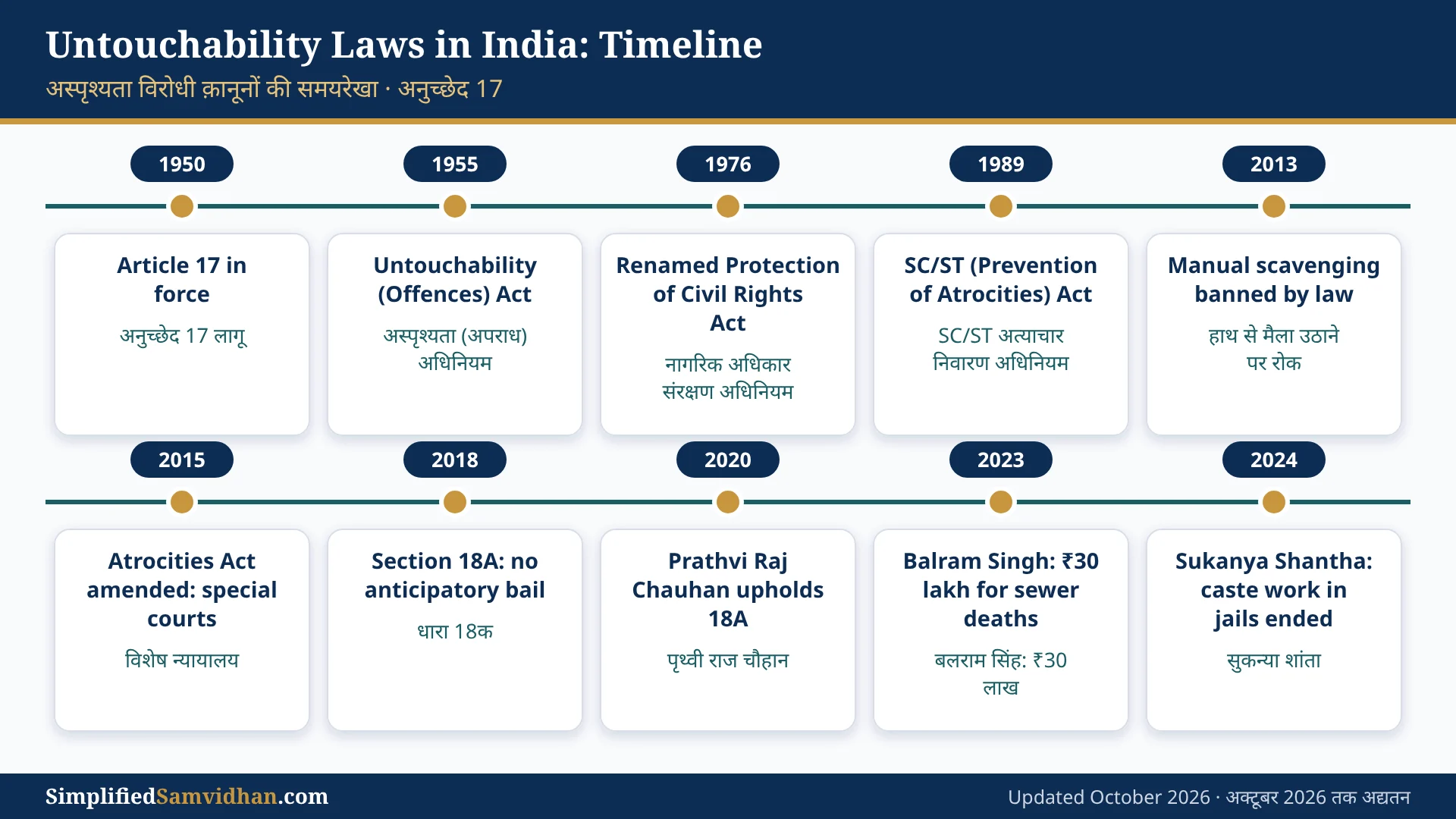
TimelineArticle 17 and Untouchability Laws: Key Dates
| Year | Event |
|---|---|
| 1950 | Article 17 comes into force; untouchability abolished. |
| 1955 | Untouchability (Offences) Act passed under Article 35. |
| 1976 | Renamed Protection of Civil Rights Act; punishments made stricter. |
| 1982 | Asiad Workers case: Article 17 binds private persons. |
| 1989 | SC/ST (Prevention of Atrocities) Act. |
| 2013 | Manual Scavengers Act bans manual scavenging. |
| 2015 | Atrocities Act amended: new offences, exclusive Special Courts. |
| 2018 | Subhash Kashinath Mahajan (March); Section 18A added (August). |
| 2020 | Prathvi Raj Chauhan upholds Section 18A. |
| 2023 | Balram Singh: ₹30 lakh for sewer deaths. |
| 2024 | Sukanya Shantha strikes down caste-based prison work. |
UPSC · State PSC · JudiciaryArticle 17: UPSC Exam Corner
- Prelims trap: "Untouchability is defined in Article 366." False. It is defined nowhere.
- Prelims trap: "State Legislatures can prescribe punishment for untouchability." False. Article 35 gives this power only to Parliament.
- Prelims fact: Articles 17, 23 and 24 are among the rights enforceable against private individuals.
- Mains (150 words): Despite Article 17 and special laws, caste discrimination persists. Discuss the reasons and suggest measures.
- Mains (150 words): Manual scavenging is the worst surviving form of untouchability. Examine the legal and judicial response.
Practice MCQTest Yourself: Article 17
Under which Article can only Parliament make laws prescribing punishment for practising untouchability?
Doubts ClearedFrequently Asked Questions
What is Article 17 of Indian Constitution?
Article 17 abolishes untouchability, forbids its practice in any form and makes enforcing any disability arising out of untouchability an offence punishable by law.
Is untouchability defined in the Constitution?
No. Neither the Constitution nor the PCR Act defines it. Courts read it as the caste-based social disabilities historically imposed on certain communities.
What is the punishment for untouchability in India?
Under the Protection of Civil Rights Act, 1 to 6 months' imprisonment and ₹100 to ₹500 fine for a first offence, rising to 1 to 2 years and ₹500 to ₹1,000 for a third offence. Atrocities against SC/ST carry 6 months to 5 years or more under the 1989 Act.
Does Article 17 apply to private individuals?
Yes. Article 17 is one of the few fundamental rights that bind private persons, as held in the Asiad Workers case (1982).