Bare ActOfficial Text of Article 23
23. Prohibition of traffic in human beings and forced labour.—
(1) Traffic in human beings and begar and other similar forms of forced labour are prohibited and any contravention of this provision shall be an offence punishable in accordance with law.
(2) Nothing in this article shall prevent the State from imposing compulsory service for public purposes, and in imposing such service the State shall not make any discrimination on grounds only of religion, race, caste or class or any of them.
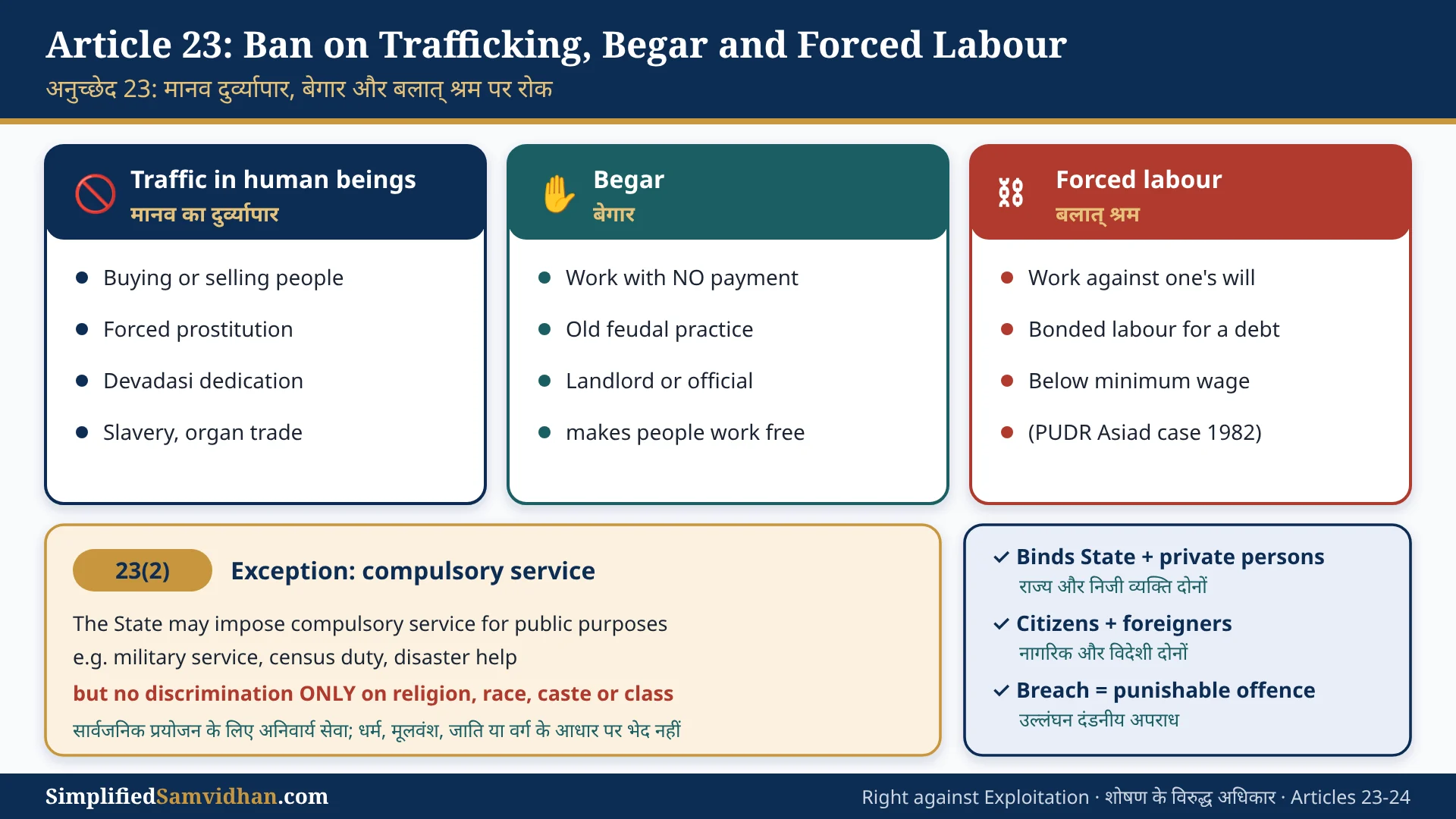
No one can buy or sell a human being, or move a person to exploit them (trafficking).
No one can make you work for free (begar) or against your will (forced or bonded labour). Paying less than the minimum wage also counts as forced labour.
Breaking this rule is a crime. It protects citizens and foreigners, against the State and private persons alike.
The State may still make people do compulsory service for public purposes (for example military service or census duty), but it cannot pick people only by religion, race, caste or class.
🏠 Everyday Analogy
A job is a deal between two free people: you give your work, you get a fair wage, and you can walk away. Article 23 bans every "deal" where one side has no real choice: the worker who cannot leave because of an old loan, or the one who is paid so little that he only works out of hunger.
🇮🇳 Real Indian Example
Brick kilns are a common setting for bonded labour. A family takes an advance of a few thousand rupees before the season, then is told the debt keeps growing and they cannot leave. When the district administration raids such a kiln, it issues release certificates under the Bonded Labour System (Abolition) Act 1976, the debt is wiped out, and the workers get rehabilitation help under the central scheme. Each step comes from Article 23.
Three BansArticle 23 of Indian Constitution: Ban on Trafficking, Begar and Forced Labour
| What is banned | Meaning | Examples |
|---|---|---|
| Traffic in human beings | Buying, selling or moving people for exploitation, like goods | Sale of women and children, forced prostitution, devadasi dedication, slavery, trafficking for labour or organs |
| Begar | Forcing a person to work without any payment | A landlord or official making villagers carry loads or work fields for free |
| Other similar forced labour | Work taken against a person's will, by force or by economic compulsion | Bonded labour to repay a loan; paying less than the minimum wage (PUDR, 1982) |
Key features
- Against everyone: Article 23 applies to the State and to private persons. The State must also act to end these practices.
- For everyone: citizens and non-citizens are both protected.
- A crime, not just a right: clause (1) itself says any breach is an offence punishable by law.
- Begar vs bonded labour: begar is work with no pay at all; bonded labour is work to pay off a debt, often passed from parents to children. Both are covered.
- Devadasi system: dedicating girls to temples, which often led to sexual exploitation, is banned by State laws (Madras 1947, Karnataka 1982, Andhra Pradesh 1988, Maharashtra 2006). In Vishal Jeet v. Union of India (1990) the Supreme Court directed States to act against forced prostitution and the devadasi and jogin practices.
Exception 23(2)Article 23(2) of Indian Constitution: Compulsory Service for Public Purposes
- Clause (2) lets the State impose compulsory service for public purposes. This is not forced labour in the banned sense, because it serves the whole community.
- Examples: compulsory military service in a crisis (India has never used conscription), census duty (the Census Act 1948 lets the Government require persons to act as census officers), and help during disasters.
- Limit: the State cannot choose people for such service only on the basis of religion, race, caste or class. Note that "sex" and "place of birth" are not in this list.
- Prisoners sentenced to rigorous imprisonment can be made to work, but courts have held they must be paid fair wages (State of Gujarat v. Hon'ble High Court of Gujarat, 1998).
Laws and CasesArticle 23 of Indian Constitution: Laws and Landmark Cases on Forced Labour
| Law | What it does |
|---|---|
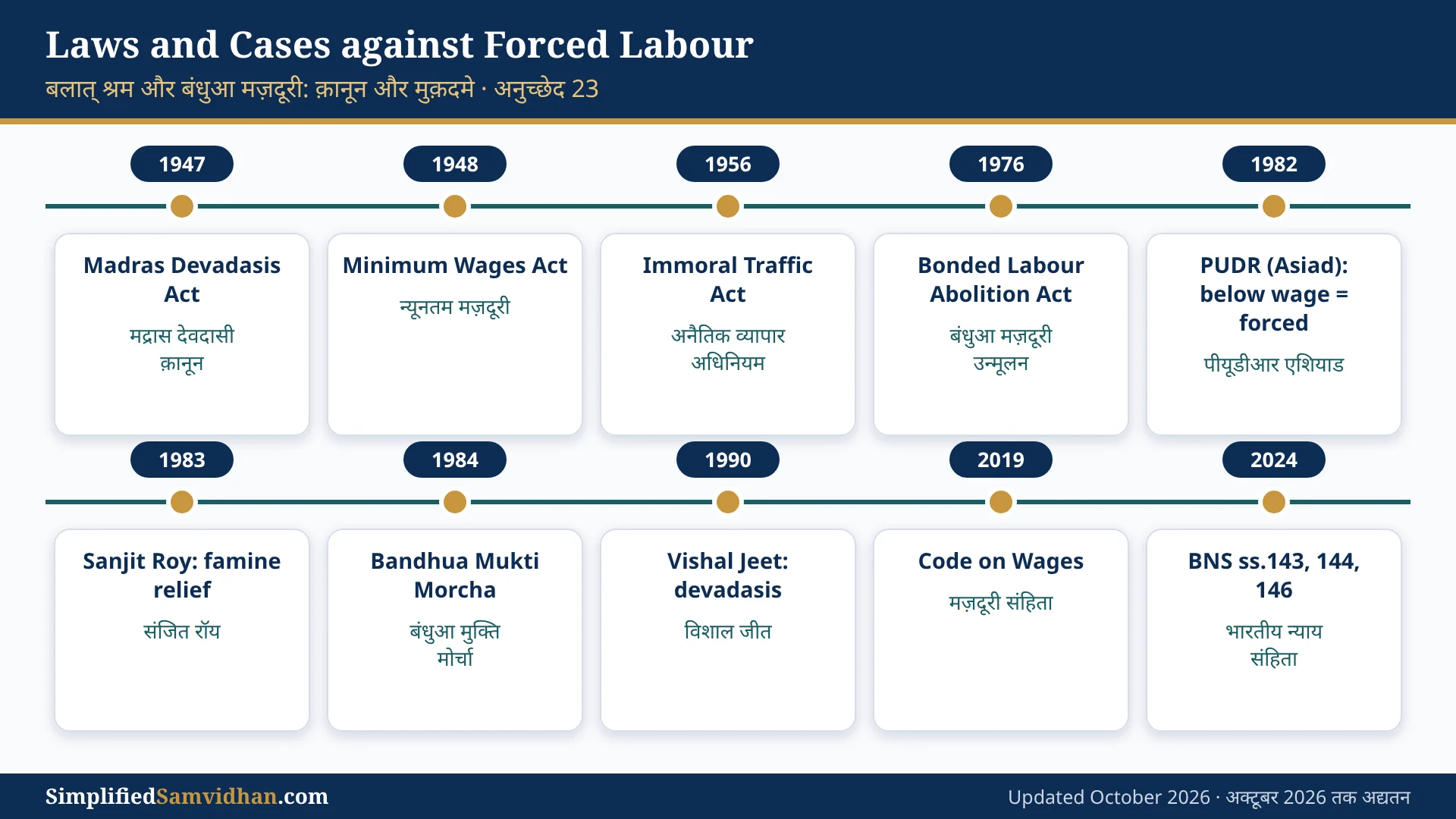
| Minimum Wages Act, 1948 (subsumed in the Code on Wages, 2019) | Fixes a wage floor; paying below it can amount to forced labour |
| Immoral Traffic (Prevention) Act, 1956 | Punishes trafficking for sexual exploitation and running brothels; renamed in 1986 from the Suppression of Immoral Traffic in Women and Girls Act |
| Bonded Labour System (Abolition) Act, 1976 | Abolishes bonded labour, cancels bonded debts, frees bonded labourers; District Magistrates and vigilance committees enforce it |
| State devadasi laws (Madras 1947, Karnataka 1982, Andhra Pradesh 1988, Maharashtra 2006) | Ban dedicating girls to temples as devadasis |
| Bharatiya Nyaya Sanhita, 2023 (from 1 July 2024) | s.143 trafficking (old IPC s.370), s.144 exploiting a trafficked person (old s.370A), s.146 unlawful compulsory labour (old s.374) |
How the Supreme Court widened "forced labour"
- People's Union for Democratic Rights (PUDR) v. Union of India (1982), the Asiad workers case: workers building venues for the 1982 Asian Games in Delhi were paid less than the minimum wage. The Court held that "force" includes economic compulsion: a person who works for less than the minimum wage because of hunger or poverty is doing forced labour.
- Sanjit Roy v. State of Rajasthan (1983): workers on famine relief works cannot be paid below the minimum wage; that too is forced labour.
- Bandhua Mukti Morcha v. Union of India (1984): bonded labourers in the stone quarries of Faridabad. The Court ordered identification, release and rehabilitation, and said a letter to the Court can be treated as a PIL.
- Neeraja Chaudhary v. State of Madhya Pradesh (1984): release without rehabilitation is not enough; freed bonded labourers must be resettled.
- A comprehensive anti-trafficking bill (the Trafficking of Persons Bill 2018) passed the Lok Sabha but lapsed in 2019; trafficking is now dealt with under the BNS, ITPA and other laws.
Challenges TodayArticle 23 of Indian Constitution: Challenges Today and Way Forward
- Bonded labour still appears in brick kilns, stone quarries, agriculture and some small factories, often among Dalit, Adivasi and migrant families.
- Trafficking takes new forms: fake job offers abroad, online recruitment, domestic work in cities, and forced labour in overseas scam centres reported in recent years.
- The Central Sector Scheme for Rehabilitation of Bonded Labourer (revamped in 2016) gives financial help to released workers; Anti-Human Trafficking Units work in districts.
Points often made in UPSC answers
- Survey and identify bonded labourers regularly, as the 1976 Act requires, and issue release certificates quickly.
- Pay rehabilitation money on time and link freed workers to housing, land and skills.
- Pass a single, victim-centred anti-trafficking law, while balancing the concerns raised by sex workers' groups and civil society about the 2018 Bill.
- Enforce minimum wages, since the Supreme Court treats underpayment itself as forced labour.
Quick RevisionKey Points to Remember
- Article 23 bans traffic in human beings, begar and other forced labour.
- Any breach is an offence; only Parliament can make the penal law (Article 35).
- It binds the State and private persons and protects citizens and non-citizens.
- PUDR (1982): paying below the minimum wage is forced labour (economic compulsion).
- 23(2): compulsory service for public purposes is allowed, without discrimination only on religion, race, caste or class.
TimelineArticle 23 and Forced Labour: Key Dates
| Year | Event |
|---|---|
| 1947 | Madras Devadasis (Prevention of Dedication) Act. |
| 1948 | Minimum Wages Act. |
| 1950 | Article 23 in force. |
| 1956 | Suppression of Immoral Traffic Act (ITPA from 1986). |
| 1976 | Bonded Labour System (Abolition) Act. |
| 1982 | PUDR (Asiad): below minimum wage is forced labour. |
| 1983 | Sanjit Roy: famine relief workers. |
| 1984 | Bandhua Mukti Morcha: release and rehabilitation. |
| 1990 | Vishal Jeet: directions on forced prostitution and devadasis. |
| 2016 | Bonded labour rehabilitation scheme revamped. |
| 2019 | Code on Wages enacted; Trafficking Bill 2018 lapses. |
| 2024 | BNS in force (1 July): ss.143, 144, 146. |
UPSC · State PSC · JudiciaryArticle 23: UPSC Exam Corner
- Prelims trap: "Article 23 is available only against the State." False: it also binds private persons.
- Prelims trap: "Under 23(2) the State cannot discriminate on grounds of sex." The list in 23(2) is religion, race, caste or class only.
- Prelims fact: Articles 23 and 24 form the Right against Exploitation; both are available to non-citizens too.
- Mains (150 words): How has the Supreme Court widened the meaning of "forced labour" under Article 23? Illustrate with cases.
- Mains (250 words): Despite the Bonded Labour System (Abolition) Act 1976, bonded labour persists in India. Examine the reasons and suggest measures.
Practice MCQTest Yourself: Article 23
In which case did the Supreme Court hold that paying a worker less than the minimum wage amounts to forced labour under Article 23?
Doubts ClearedFrequently Asked Questions
What is Article 23 of Indian Constitution?
Article 23 prohibits traffic in human beings, begar and other similar forms of forced labour, and makes any breach a punishable offence. Clause (2) allows the State to impose compulsory service for public purposes without discrimination only on religion, race, caste or class.
What is begar?
Begar is forcing a person to work without any payment. It was common under zamindars and colonial officials. Bonded labour, where a person works to pay off a debt, is a related form also banned by Article 23.
Does Article 23 apply to private employers?
Yes. Unlike most Fundamental Rights, Article 23 protects people against private persons too, such as landlords, contractors and employers.
Is compulsory military service allowed in India?
Yes, Article 23(2) allows the State to impose compulsory service for public purposes, which can include military service. India has never introduced conscription, and any such service cannot discriminate only on religion, race, caste or class.