Bare ActOfficial Text of Article 24
24. Prohibition of employment of children in factories, etc.—
No child below the age of fourteen years shall be employed to work in any factory or mine or engaged in any other hazardous employment.
No child below 14 can be employed in a factory, a mine or any other hazardous work.
The Constitution does not define "hazardous". Laws and courts fill it in: mining, fireworks and matches, chemicals, explosives, brick kilns and similar work.
Since 2016, children below 14 cannot be employed in any work, except helping their family after school or acting as child artists. Teenagers aged 14 to 18 cannot do hazardous work.
Article 24 is backed by Article 21A (free schooling from 6 to 14) and the Directive Principles in Article 39(e) and (f) that protect children from abuse and from work unsuited to their age.
🏠 Everyday Analogy
Childhood is like the foundation of a house. If you load bricks on it before the concrete has set, it cracks and the whole house is weak for life. Article 24 says: let the foundation set first; school now, work later.
🇮🇳 Real Indian Example
Sivakasi in Tamil Nadu makes most of India's fireworks and matches. In the 1990s many children worked there, and accidents killed several of them. In M.C. Mehta v. State of Tamil Nadu (1996) the Supreme Court ordered every employer found using child labour to pay Rs 20,000 per child into a welfare fund, so that the child could go to school instead. Today a 13-year-old in a cracker unit is a crime by the employer; the same child helping in the family shop after school is allowed.
What Article 24 SaysArticle 24 of Indian Constitution: Meaning and Scope of the Child Labour Ban
- Three places: a factory, a mine, and "any other hazardous employment". Domestic work, farms and dhabas were not named in 1950, which is why later laws were needed.
- Age 14: matches the free and compulsory education age in Article 21A (6 to 14) and Article 45 as it stood in 1950.
- Hazardous is not defined. Examples: mining, fireworks and match-making, chemical units, explosives, glass and brick kilns, carpet weaving with harmful dust.
- Against private employers too: like Article 23, Article 24 binds private persons, and breach is punishable under law.
- Part of a bigger plan: Article 39(e) (children's tender age not abused), Article 39(f) (children grow in freedom and dignity), Article 45 (early childhood care), Article 51A(k) (parents' duty to send children aged 6 to 14 to school).
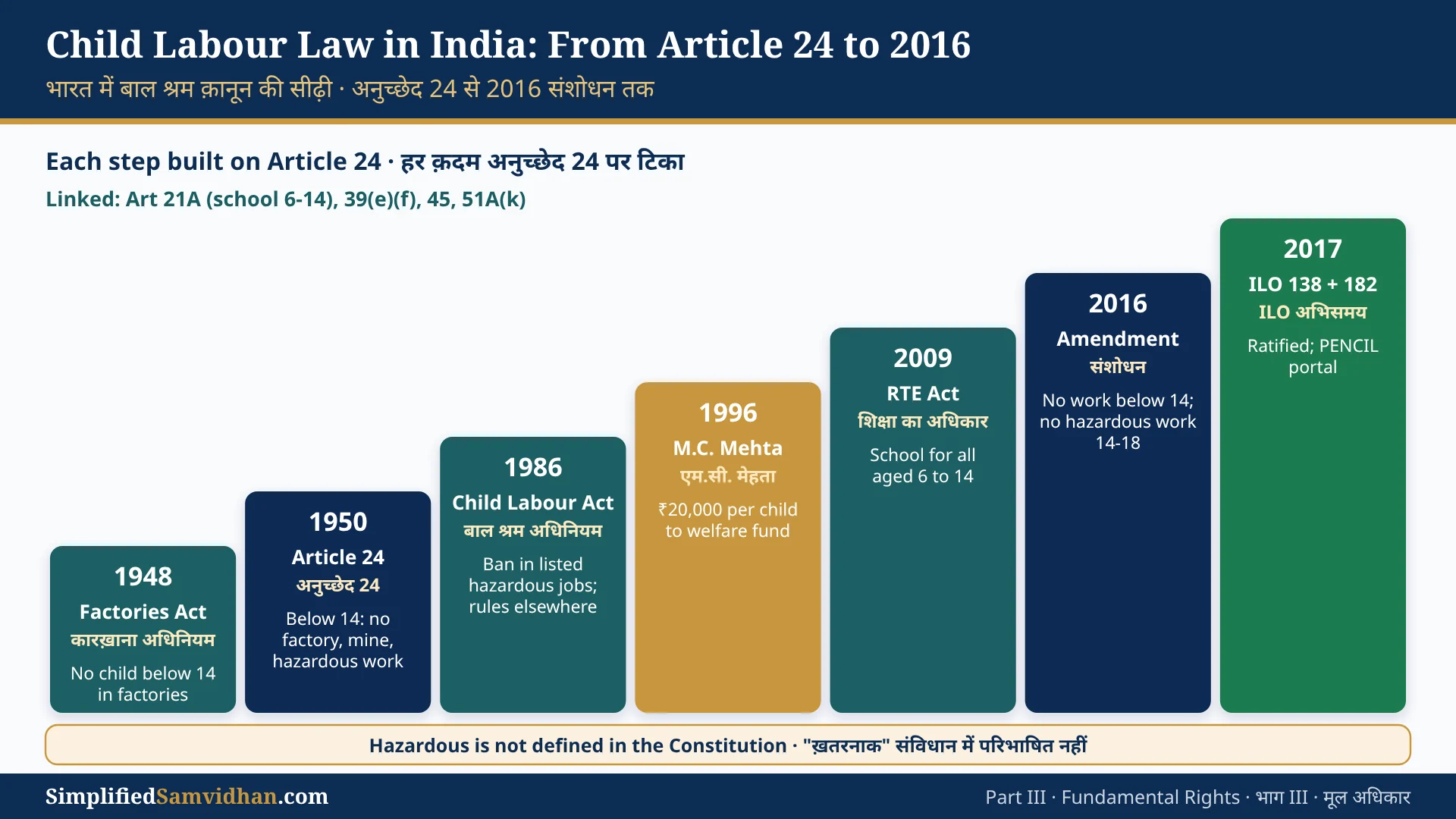
Law LadderArticle 24 of Indian Constitution: Child Labour Laws from 1948 to the 2016 Amendment
- Factories Act 1948 and Mines Act 1952: no child below 14 in a factory; strict limits on young persons in mines.
- Child Labour (Prohibition and Regulation) Act 1986: banned children below 14 in listed hazardous occupations and processes, and regulated their work elsewhere through working conditions.
- M.C. Mehta v. State of Tamil Nadu (10 December 1996): the Sivakasi case. The offending employer pays Rs 20,000 per child into a Child Labour Rehabilitation-cum-Welfare Fund; the State gives a job to an adult member of the family or adds Rs 5,000; the interest pays for the child's education.
- RTE Act 2009 (in force 1 April 2010): free and compulsory schooling for ages 6 to 14 makes the school, not the workplace, the child's legal place.
- 2016 Amendment: renamed the Child and Adolescent Labour (Prohibition and Regulation) Act; total ban below 14 with two exceptions; ban on hazardous work for adolescents aged 14 to 18; tougher penalties; offences made cognizable.
- 2017: India ratified ILO Conventions 138 (minimum age) and 182 (worst forms of child labour); the PENCIL portal was launched for complaints and enforcement.
Penalties after 2016
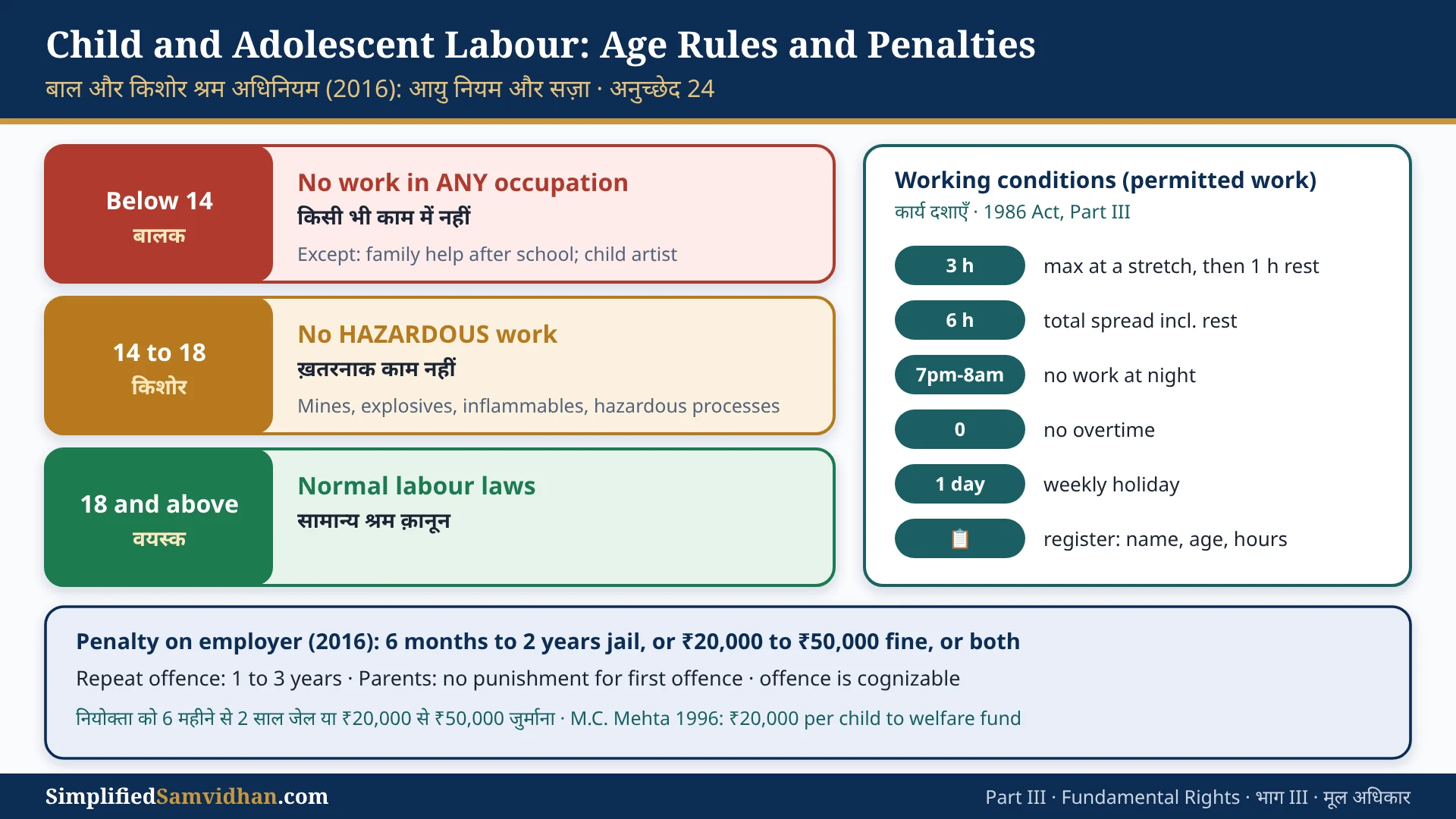
- Employer: 6 months to 2 years in jail, or a fine of Rs 20,000 to Rs 50,000, or both. A repeat offence: 1 to 3 years.
- Parents or guardians: no punishment for a first offence; a fine for a repeat offence.
- Each district has a rehabilitation fund for rescued children and adolescents.
Age Rules and HoursArticle 24 of Indian Constitution: Age Rules and Working Conditions under the 2016 Act
| Age group | Rule under the 2016 Act | Exceptions and conditions |
|---|---|---|
| Child: below 14 | No employment in any occupation or process | May help the family or a family enterprise in non-hazardous work after school hours or in vacations; may work as a child artist in films, TV, ads, sports (not at the cost of schooling) |
| Adolescent: 14 to 18 | No work in hazardous occupations or processes (mines, inflammable substances or explosives, hazardous processes under the Factories Act) | Allowed in non-hazardous work under the working conditions below |
| Adult: 18 and above | Normal labour laws apply |
Working conditions for permitted work
| Working condition (1986 Act, Part III) | Rule |
|---|---|
| Hours at a stretch | No more than 3 hours, then a rest of at least 1 hour |
| Spread of the day | No more than 6 hours in all, including rest and waiting time |
| Night work | Not between 7 pm and 8 am |
| Overtime | Not allowed; no work at two places on the same day |
| Weekly holiday | One full day off every week |
| Register | Employer keeps a register: name, date of birth, nature of work, hours and rest |
- These rules were written in 1986 for children in non-hazardous work. After 2016 they protect adolescents (14 to 18) in permitted work.
Debate and Way ForwardArticle 24 of Indian Constitution: Debate on the Family Exception and Way Forward
- Census 2011 counted about 1 crore (10.1 million) working children aged 5 to 14. The numbers fell over the decades, but child labour has not ended, especially in agriculture, home-based work, domestic help and small eateries.
- The family enterprise exception of 2016 is the most debated part of the law.
Points often made in UPSC answers
- Arguments given for the exception: poor families depend on every hand; children learn traditional crafts at home; a total ban that ignores reality may push work underground; the law still puts school first.
- Arguments given against it: "family enterprise" is hard to check and may hide exploitation; home-based work can be long and harmful; the age of 14 is lower than the 18 used in the Juvenile Justice Act and the UN Convention on the Rights of the Child; the list of hazardous work was narrowed in 2016.
- Way forward (exam view): tie the ban to school attendance and mid-day meals, raise awareness among parents, fund rescue and rehabilitation on time, use the PENCIL portal and labour inspections, and keep reviewing the hazardous list.
Quick RevisionKey Points to Remember
- No child below 14 in a factory, mine or hazardous employment.
- "Hazardous" is not defined in the Constitution; laws list hazardous work.
- 2016 Amendment: ban on all work below 14 (family help and child artists excepted); no hazardous work for 14 to 18.
- M.C. Mehta (1996): Rs 20,000 per child from the offending employer into a welfare fund.
- Linked with Articles 21A, 39(e), 39(f), 45 and 51A(k); ILO Conventions 138 and 182 ratified in 2017.
TimelineArticle 24 and Child Labour Law: Key Dates
| Year | Event |
|---|---|
| 1948 | Factories Act: no child below 14 in factories. |
| 1950 | Article 24 in force. |
| 1952 | Mines Act. |
| 1986 | Child Labour (Prohibition and Regulation) Act. |
| 1996 | M.C. Mehta (Sivakasi): Rs 20,000 per child into a welfare fund. |
| 2002 | 86th Amendment: Article 21A, new Article 45, Article 51A(k). |
| 2010 | RTE Act in force (1 April). |
| 2016 | Amendment: total ban below 14; no hazardous work 14 to 18. |
| 2017 | ILO Conventions 138 and 182 ratified; PENCIL portal. |
UPSC · State PSC · JudiciaryArticle 24: UPSC Exam Corner
- Prelims trap: "Article 24 bans all employment of children below 14." False: the Article covers factories, mines and hazardous work; the near-total ban comes from the 2016 law.
- Prelims trap: "The Rs 20,000 per child rule is in the Child Labour Act 1986." It came from M.C. Mehta v. State of Tamil Nadu (1996).
- Prelims fact: Article 24 is available to citizens and non-citizens and binds private employers.
- Mains (150 words): Examine how the Child and Adolescent Labour (Prohibition and Regulation) Act 2016 changed the law on child labour. Is the family enterprise exception justified?
- Mains (250 words): "Child labour is a symptom of poverty and a cause of it." Discuss with reference to Articles 21A and 24.
Practice MCQTest Yourself: Article 24
Under the Child and Adolescent Labour (Prohibition and Regulation) Act as amended in 2016, which of the following is correct? 1. A child below 14 may help in a family enterprise after school hours in non-hazardous work. 2. An adolescent aged 16 may work in a mine. 3. A child below 14 may work as an artist in a TV serial, subject to safeguards.
Doubts ClearedFrequently Asked Questions
What is Article 24 of Indian Constitution?
Article 24 says no child below 14 shall be employed in any factory or mine or engaged in any other hazardous employment. With Article 23 it forms the Right against Exploitation.
Can a child below 14 work in India at all?
Only in two cases under the 2016 law: helping the family or a family enterprise in non-hazardous work after school hours or in vacations, and working as a child artist in audio-visual entertainment or sports, without affecting schooling.
What is the punishment for employing a child?
Imprisonment of 6 months to 2 years, or a fine of Rs 20,000 to Rs 50,000, or both; 1 to 3 years for a repeat offence. The offence is cognizable.
What did the Supreme Court order in M.C. Mehta v. State of Tamil Nadu (1996)?
The employer of a child in hazardous work must pay Rs 20,000 per child into a Child Labour Rehabilitation-cum-Welfare Fund; the State must give a job to an adult of the family or contribute Rs 5,000; the interest is used for the child's education.