Bare ActOfficial Text of Article 29
29. Protection of interests of minorities.—
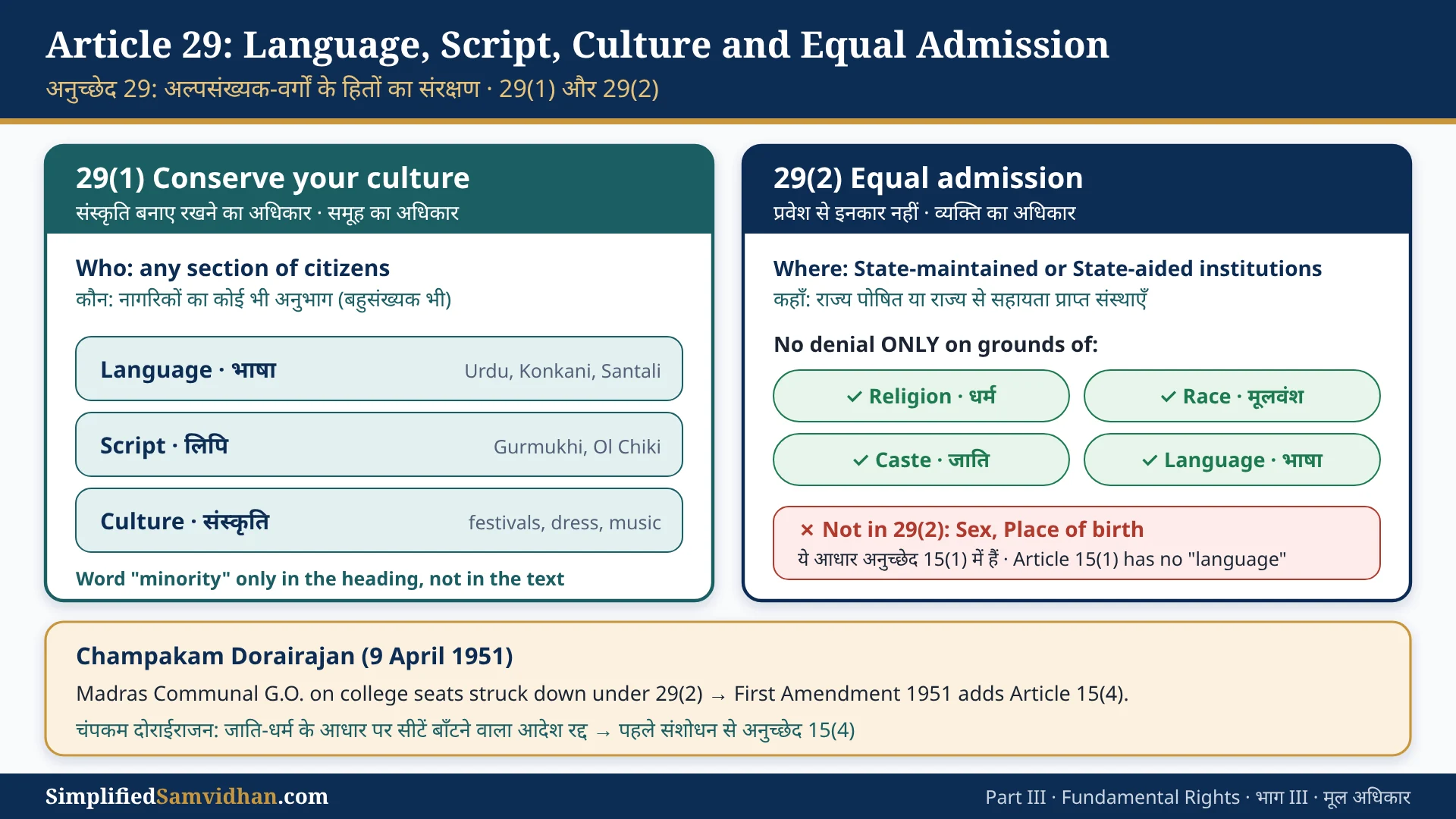
(1) Any section of the citizens residing in the territory of India or any part thereof having a distinct language, script or culture of its own shall have the right to conserve the same.
(2) No citizen shall be denied admission into any educational institution maintained by the State or receiving aid out of State funds on grounds only of religion, race, caste, language or any of them.
29(1): any group of citizens with its own language, script or culture can preserve it: run language classes, cultural festivals, libraries or schools.
The text says "section of citizens", not "minority". So it protects majority groups too, such as a Marathi-speaking group in Karnataka or a Tamil-speaking group in Delhi.
29(2): a government or government-aided school or college cannot refuse a citizen admission only because of religion, race, caste or language.
29(2) does not list sex or place of birth; those grounds are in Article 15.
Article 29 is for citizens only. Foreigners cannot claim it.
🏠 Everyday Analogy
Think of India as a big housing society. Article 29(1) says every family may speak its own language at home, cook its own food and celebrate its own festivals; the society cannot force one common culture. Article 29(2) says the society's common library, run with everyone's money, must let every member in, whatever their religion, caste or language.
🇮🇳 Real Indian Example
A Bengali association in Delhi runs weekend Bengali classes and a Durga Puja cultural programme; a Tamil sangam in Mumbai teaches children the Tamil script. Both use Article 29(1). Meanwhile, if a government college in Lucknow refused a seat to a Malayalam-speaking student only because of her language, that would break Article 29(2).
Language, Script, CultureArticle 29(1) of Indian Constitution: Right to Conserve Language, Script and Culture
| Clause | Who is protected | What it gives |
|---|---|---|
| 29(1) | Any section of citizens living in India or any part of it, with a distinct language, script or culture of its own | The right to conserve (keep alive) that language, script or culture |
| 29(2) | Every citizen (as an individual) | No denial of admission into a State-maintained or State-aided educational institution on grounds only of religion, race, caste, language or any of them |
What 29(1) means
- Three things are protected: a distinct language (e.g. Urdu, Konkani, Santali), a distinct script (e.g. Gurmukhi, Ol Chiki, Devanagari) and a distinct culture (customs, festivals, dress, music).
- "Section of citizens", not "minority": the word minority appears only in the heading. A group that is a majority in India can still be a small section in some State, and any section is covered. Courts read 29(1) in this broad way.
- The right includes agitating for one's language: in Jagdev Singh Sidhanti v. Pratap Singh Daulta (1965) the Court said the right to conserve a language includes the right to campaign for its protection, including in an election.
- Script matters too: in D.A.V. College v. State of Punjab (1971) the Court struck down a university rule that made Punjabi in the Gurmukhi script the only medium, because it affected the right of other sections to conserve their own script. The Court also said that, for a State law, minority status is judged against that State's population.
- 29(1) is a right of conservation, not of domination: it does not let one group stop another group from using its language.
Equal AdmissionArticle 29(2) of Indian Constitution: No Denial of Admission in Educational Institutions
- Which institutions: only those maintained by the State or receiving aid out of State funds. A purely private unaided institution is not covered by 29(2).
- Which grounds: religion, race, caste, language, or any of them. The word "only" matters: admission can still depend on merit, marks, age or residence.
- Not in 29(2): sex and place of birth. Those are grounds in Article 15(1), which covers all State discrimination. So a government women's college does not break 29(2), and Article 15(3) allows special provisions for women anyway.
- It is an individual right of every citizen, majority or minority.
Champakam Dorairajan and the First Amendment
- The Madras government's Communal G.O. fixed seats in medical and engineering colleges community by community (for example, so many for non-Brahmin Hindus, Brahmins, Muslims, Christians).
- In State of Madras v. Champakam Dorairajan (9 April 1951) the Supreme Court struck it down under Article 29(2): seats were denied on the ground of caste and religion. The Court also said Directive Principles (Article 46) cannot override Fundamental Rights.
- Parliament responded with the First Amendment 1951, adding Article 15(4): special provisions for socially and educationally backward classes, SCs and STs. Later, Article 15(5) (2005) covered admissions in private institutions too, except minority institutions under Article 30(1).
Balance with Article 30
- A minority college that takes State aid is bound by 29(2). Yet Article 30(1) lets it serve its own community.
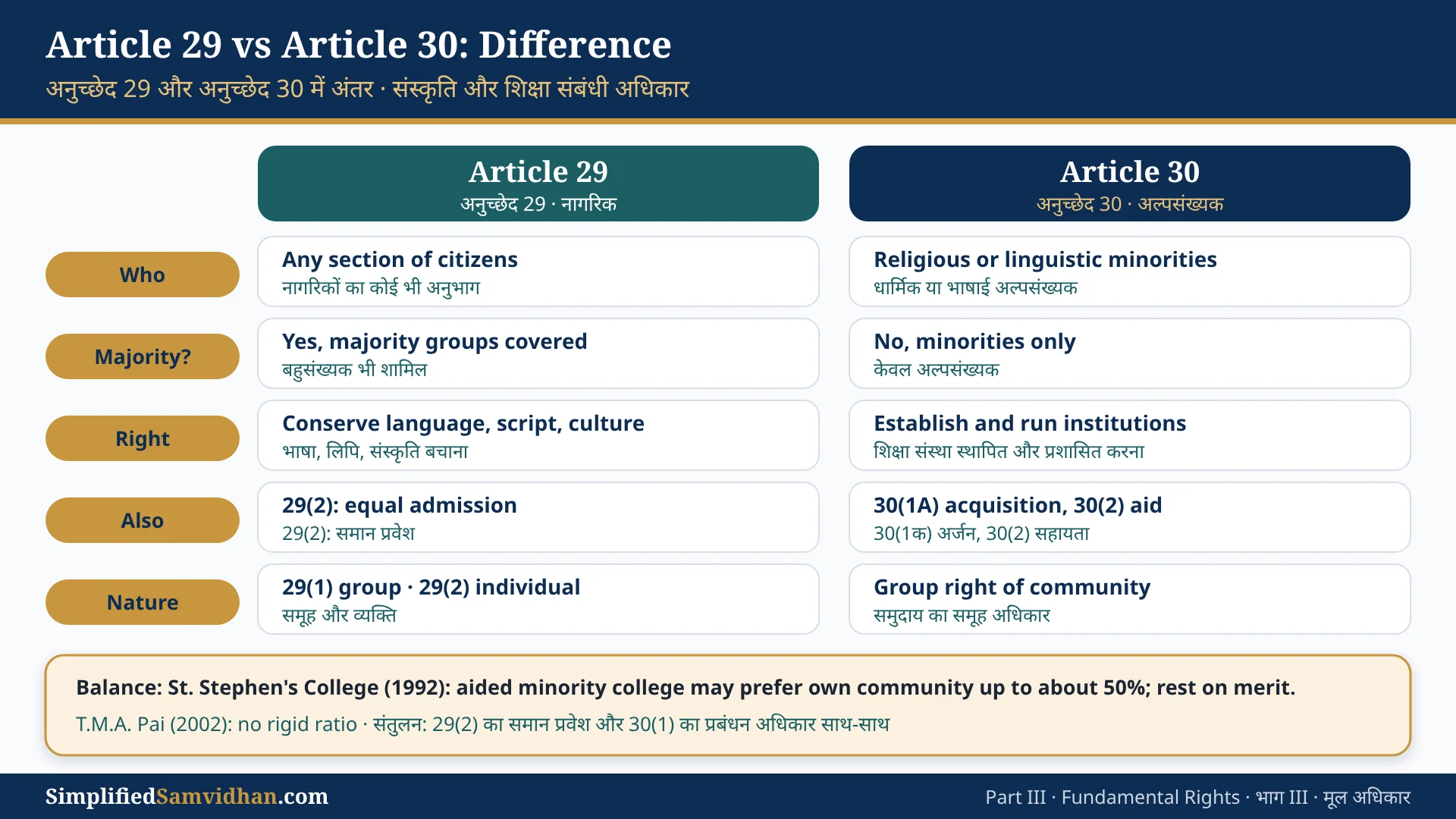
- In St. Stephen's College v. University of Delhi (1992) the Court balanced the two: an aided minority college may prefer students of its own community up to about 50% of seats, and the rest must be open to all on merit.
- In T.M.A. Pai Foundation (2002) the 11-judge bench said there is no fixed ratio: the State may fix a reasonable share for non-minority students, keeping in view the type of institution and local needs.
Article 29 vs 30Article 29 vs Article 30 of Indian Constitution: Key Differences
| Point | Article 29 | Article 30 |
|---|---|---|
| Who | Any section of citizens (majority or minority) | Only minorities: religious or linguistic |
| Uses the word "minority"? | Only in the heading, not in the text | Yes, in the text |
| Main right | Conserve language, script or culture; admission without discrimination | Establish and administer educational institutions of their choice |
| Nature | 29(1) a group right; 29(2) an individual right | A group right of the minority community |
| Link | Culture is kept alive through schools | Schools are the means to conserve culture |
- The two Articles work as a pair: 29(1) protects culture, and 30(1) gives minorities the main tool to protect it, their own schools and colleges.
- But they are independent: a minority institution under Article 30 need not teach only its own language or religion. It can give ordinary secular education (Kerala Education Bill, 1958).
- Article 15(1) vs 29(2): 15(1) binds the State in everything and includes sex and place of birth; 29(2) is only about admission to State-run or aided institutions, but it includes language, which 15(1) does not.
Who is a MinorityArticle 29 and Minorities: Who is a Minority in India? (Short Summary)
- The Constitution does not define "minority". Article 29 does not even use the word in its text; Article 30 speaks of minorities "based on religion or language".
- Religious minorities (national list): under Section 2(c) of the National Commission for Minorities Act, 1992, the Central Government notifies them. Five were notified on 23 October 1993 (Muslims, Christians, Sikhs, Buddhists, Parsis) and Jains on 27 January 2014.
- For Article 30, the Supreme Court in T.M.A. Pai Foundation (2002) held that religious and linguistic minorities are to be counted State-wise.
- Whether Hindus and other groups who are fewer in some States should get minority status there is the subject of the Ashwini Kumar Upadhyay petition, pending before the Supreme Court. The full discussion is on the Article 30 page.
- Linguistic minorities also have Articles 350A (primary education in the mother tongue) and 350B (Special Officer for Linguistic Minorities), added by the 7th Amendment 1956, and Article 347 (official recognition of a language spoken by a section of a State's people).
Quick RevisionKey Points to Remember
- 29(1): any section of citizens can conserve its distinct language, script or culture.
- The text uses "section of citizens", not "minority", so majority groups are covered too.
- 29(2): no denial of admission to State-maintained or aided institutions on grounds of religion, race, caste, language.
- 29(2) does not include sex or place of birth; Article 15(1) does not include language.
- Champakam Dorairajan (1951) under 29(2) led to the First Amendment and Article 15(4).
TimelineArticle 29: Key Dates and Cases
| Year | Event |
|---|---|
| 1950 | Article 29 comes into force with the Constitution (26 January). |
| 1951 | Champakam Dorairajan (9 Apr): Communal G.O. struck down under 29(2); First Amendment adds Article 15(4). |
| 1956 | 7th Amendment adds Articles 350A and 350B for linguistic minorities. |
| 1958 | Kerala Education Bill reference: Articles 29 and 30 explained. |
| 1965 | Jagdev Singh Sidhanti: right to conserve a language includes campaigning for it. |
| 1971 | D.A.V. College v. State of Punjab: script protected under 29(1). |
| 1992 | St. Stephen's College: aided minority college may prefer its community up to about 50%. |
| 2002 | T.M.A. Pai (11 judges): minorities counted State-wise; no rigid ratio. |
UPSC · State PSC · JudiciaryArticle 29: UPSC Exam Corner
- Prelims trap: "Article 29 protects only minorities." False. It protects any section of citizens with a distinct language, script or culture.
- Prelims trap: "Article 29(2) bars denial of admission on the ground of sex." False. Its grounds are religion, race, caste and language.
- Prelims fact: Article 29 is available to citizens only and has never been amended.
- Mains (from the class notes, 250 words): Describe the constitutional and legal provisions for identifying minorities, and how far identifying them on the basis of national or State population is appropriate, keeping the Supreme Court's view in mind.
- Practice (150 words): "Article 29 is a shield for India's diversity of language and culture." Discuss with cases.
Practice MCQTest Yourself: Article 29
Under Article 29(2), admission to a State-aided educational institution cannot be denied on which of these grounds only? 1. Religion 2. Sex 3. Language 4. Caste
Doubts ClearedFrequently Asked Questions
What is Article 29 of Indian Constitution?
Article 29 protects the interests of minorities. Clause (1) lets any section of citizens with a distinct language, script or culture conserve it. Clause (2) says no citizen can be denied admission to a State-maintained or State-aided educational institution only on grounds of religion, race, caste or language.
Does Article 29 protect only minorities?
No. Its text says "any section of the citizens", so it also protects majority communities or groups that are small in one region, such as Marathi speakers in another State. Only the heading uses the word minorities.
What is the difference between Article 29 and Article 30?
Article 29 is for any section of citizens and protects language, script and culture, plus equal admission under 29(2). Article 30 is only for religious and linguistic minorities and gives them the right to establish and administer educational institutions of their choice.
Does Article 29(2) apply to private schools?
Only if the school is maintained by the State or receives aid out of State funds. A private unaided school is outside 29(2), though other laws (such as the RTE Act for non-minority schools) still apply.