Bare ActOfficial Text of Article 28
28. Freedom as to attendance at religious instruction or religious worship in certain educational institutions.—
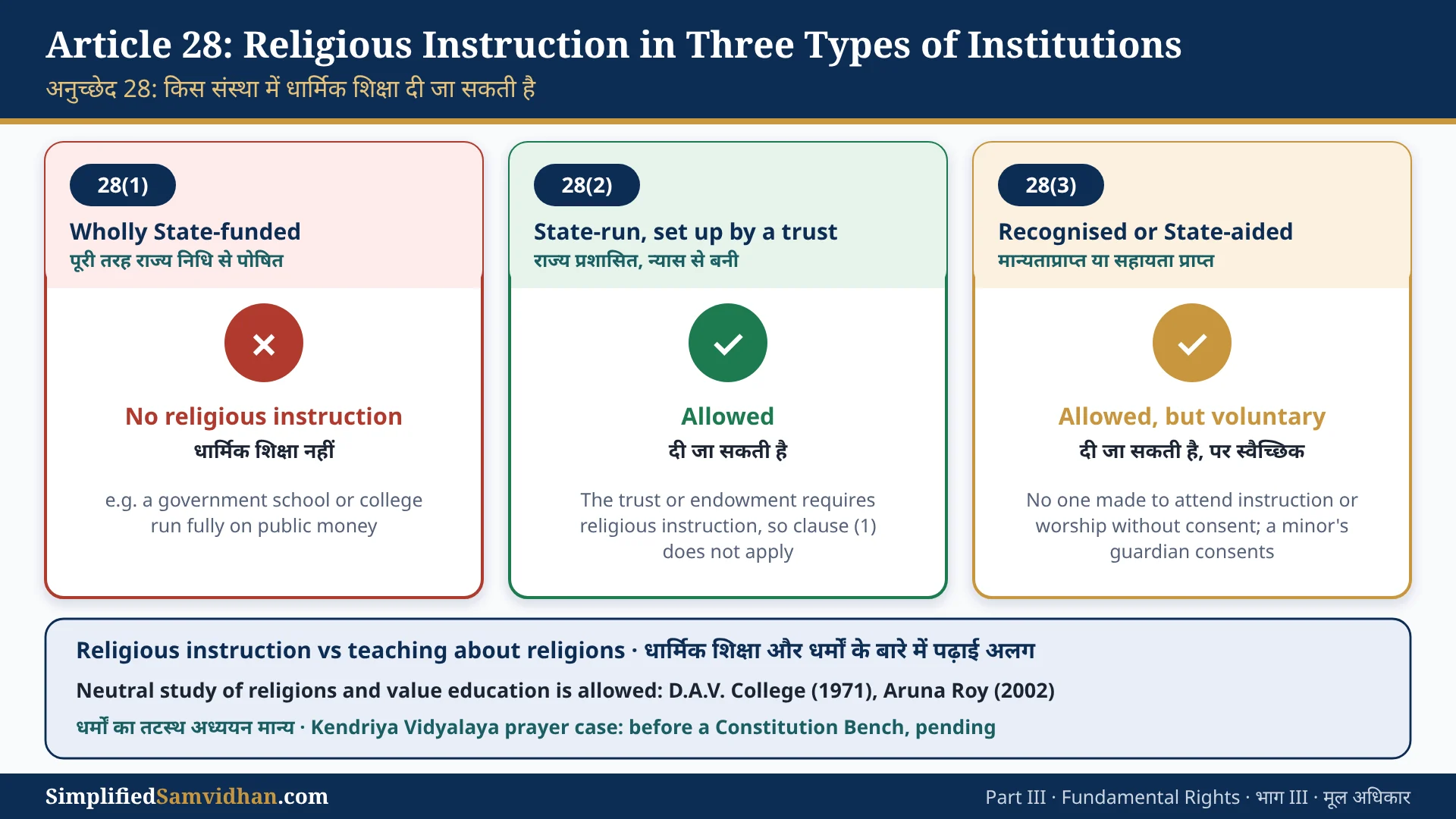
(1) No religious instruction shall be provided in any educational institution wholly maintained out of State funds.
(2) Nothing in clause (1) shall apply to an educational institution which is administered by the State but has been established under any endowment or trust which requires that religious instruction shall be imparted in such institution.
(3) No person attending any educational institution recognised by the State or receiving aid out of State funds shall be required to take part in any religious instruction that may be imparted in such institution or to attend any religious worship that may be conducted in such institution or in any premises attached thereto unless such person or, if such person is a minor, his guardian has given his consent thereto.
In an institution run wholly on State money, no religious instruction can be given.
If the State runs an institution that was set up by a trust or endowment requiring religious teaching, the teaching can go on.
In a school or college that is only recognised or aided by the State, religious classes or prayers may be held, but no one can be forced to attend.
For a minor, the guardian's consent is needed.
Teaching about religions in a neutral way, like history or value education, is not "religious instruction".
🏠 Everyday Analogy
Think of three canteens. The government canteen paid fully by the State serves only common food, with no special religious menu. A canteen that a donor set up on the condition that it serve a certain religious meal keeps that condition even if the State now runs it. A private canteen that gets a government grant may offer a religious meal, but cannot force anyone to eat it.
🇮🇳 Real Indian Example
Ayaan studies in an aided convent school in Lucknow. The school holds a short Bible class on Fridays. His parents tell the school they do not consent, so Ayaan spends that period in the library. His cousin in a government school in Bhopal has no religion class at all, but her history book explains the teachings of Buddha, Kabir and Guru Nanak. Both are consistent with Article 28.
Three Types of InstitutionsArticle 28 of Indian Constitution: Three Types of Educational Institutions
| Clause | Type of institution | Religious instruction? | Example |
|---|---|---|---|
| 28(1) | Wholly maintained out of State funds | Not allowed | A government school or college run fully on public money |
| 28(2) | Administered by the State but set up under an endowment or trust that requires religious instruction | Allowed (clause (1) does not apply) | An old endowed pathshala or school whose trust deed requires religious teaching, now managed by the State |
| 28(3) | Recognised by the State or receiving State aid | Allowed, but voluntary: no one can be made to attend without consent; for a minor, the guardian consents | An aided convent school, madrasa, gurukul or DAV school |
- Clause (2) is only an exception to clause (1). It does not itself mention consent; the "no compulsion" rule is in clause (3).
- Clause (3) protects against compulsory religious worship too, held in the institution or in premises attached to it, such as a chapel or prayer hall on the campus.
- "No person" means students of every faith, and also students of no faith.
Instruction vs StudyArticle 28: Religious Instruction vs Teaching about Religions
- Religious instruction means teaching the rituals, ceremonies, prayers and modes of worship of a particular faith, as something to be followed.
- Teaching about religions means studying their history, philosophy and values in a neutral, academic way. This is not barred.
- D.A.V. College, Bhatinda v. State of Punjab (1971): setting up a university chair to study the life and teachings of Guru Nanak was academic study, not religious instruction.
- Aruna Roy v. Union of India (12 September 2002): the National Curriculum Framework that included value education and study of religions was upheld. The Court said Article 28 does not ban learning about religions; it bars instruction in a particular faith in fully State-funded institutions.
School Prayers and ConsentArticle 28 and School Prayers: Consent and the Kendriya Vidyalaya Case
- Many schools begin the day with an assembly. Whether a common prayer is "religious instruction" or "worship" under Article 28 depends on its content and on how the school is funded.
- A petition challenging the Hindi and Sanskrit morning prayer in Kendriya Vidyalayas (Veenayak Shah v. Union of India) was referred to a Constitution Bench on 28 January 2019. One side argues the prayer is religious and KVs are fully State-funded; the other argues it carries universal values and is not instruction in any religion. The matter was pending at the last verified hearing.
- Bijoe Emmanuel v. State of Kerala (1986) is often cited here: students who stood respectfully but did not sing the national anthem for reasons of faith could not be expelled.
- In aided minority schools (Article 30), religious classes and prayers are allowed, but under 28(3) a student who does not consent (or whose guardian does not consent) cannot be made to join.
Articles 25 to 28Article 28 in the Scheme of Religious Freedom (Articles 25 to 28)
| Article | What it protects | Key idea |
|---|---|---|
| 25 | Individual freedom of conscience; profess, practise, propagate | Faith of the person, with limits |
| 26 | Denominations manage institutions, affairs, property | Faith of the group |
| 27 | No tax earmarked to promote a religion | Financial neutrality of the State |
| 28 | No religious instruction in wholly State-funded institutions; no compulsion elsewhere | Neutral public education |
- Together these Articles make the State neutral among faiths while protecting each person's and each group's freedom. This is the Indian model of secularism.
- Where can restrictions apply? Article 25 (public order, morality, health, other rights, secular activity, reform), Article 26 (public order, morality, health; property by law), Article 27 (only taxes, not fees or small secular spending) and Article 28 (depends on funding and consent). This table is a ready outline for the Mains question below.
Quick RevisionKey Points to Remember
- 28(1): no religious instruction in institutions wholly maintained out of State funds.
- 28(2): exception for State-administered institutions set up under an endowment or trust requiring religious instruction.
- 28(3): in recognised or aided institutions, no one can be made to attend religious instruction or worship without consent.
- For a minor, the guardian gives consent.
- Teaching about religions neutrally is allowed (Aruna Roy, 2002).
TimelineArticle 28: Key Dates
| Year | Event |
|---|---|
| 1950 | Article 28 comes into force with the Constitution. |
| 1971 | D.A.V. College, Bhatinda: study of Guru Nanak's teachings is not religious instruction. |
| 1986 | Bijoe Emmanuel: students not forced to sing the anthem against their faith. |
| 2002 | Aruna Roy (12 Sep): neutral study of religions in the curriculum is valid. |
| 2019 | Kendriya Vidyalaya prayer case referred to a Constitution Bench (28 Jan); pending. |
UPSC · State PSC · JudiciaryArticle 28: UPSC Exam Corner
- Prelims trap: "Religious instruction is banned in all educational institutions in India." False. Only in institutions wholly maintained out of State funds.
- Prelims trap: "Clause (2) of Article 28 requires the consent of the guardian." False. The consent rule is in clause (3).
- Prelims fact: Article 28(3) also covers religious worship held in premises attached to the institution.
- Mains (250 words, from class notes): Describe the provisions of religious freedom in the Constitution and explain where reasonable restrictions can be placed on them.
Practice MCQTest Yourself: Article 28
In which of the following institutions can religious instruction be imparted under Article 28? 1. An institution wholly maintained out of State funds 2. An institution administered by the State but established under a trust that requires religious instruction 3. A State-aided institution, for students who consent
Doubts ClearedFrequently Asked Questions
What is Article 28 of Indian Constitution?
Article 28 bars religious instruction in educational institutions wholly maintained out of State funds, except those set up under a trust or endowment requiring it, and says no student of a recognised or aided institution can be made to attend religious instruction or worship without consent.
Can a government school teach about religions?
Yes. Neutral teaching about the history, philosophy and values of religions is allowed. In Aruna Roy v. Union of India (2002) the Supreme Court held that Article 28 bars instruction in a particular faith, not the study of religions.
Can an aided convent school or madrasa make religious classes compulsory?
It may hold religious classes or worship, but under Article 28(3) it cannot require any student to attend without consent; for a minor, the guardian's consent is needed.