Bare ActOfficial Text of Article 31B
31B. Validation of certain Acts and Regulations.—Without prejudice to the generality of the provisions contained in article 31A, none of the Acts and Regulations specified in the Ninth Schedule nor any of the provisions thereof shall be deemed to be void, or ever to have become void, on the ground that such Act, Regulation or provision is inconsistent with, or takes away or abridges any of the rights conferred by, any provisions of this Part, and notwithstanding any judgment, decree or order of any court or tribunal to the contrary, each of the said Acts and Regulations shall, subject to the power of any competent Legislature to repeal or amend it, continue in force.
Ninth Schedule = a protected list. If Parliament puts an Act in this list by a constitutional amendment, that Act cannot be challenged for breaking any right in Part III (Articles 14 to 32).
It works backwards too: "shall not be deemed to be void, or ever to have become void" means even a law that a court has already struck down comes back to life once it enters the list.
It covers both Central and State Acts. Most entries are State land reform, tenancy and ceiling laws; some are Central laws like parts of the Essential Commodities Act and the old MRTP Act.
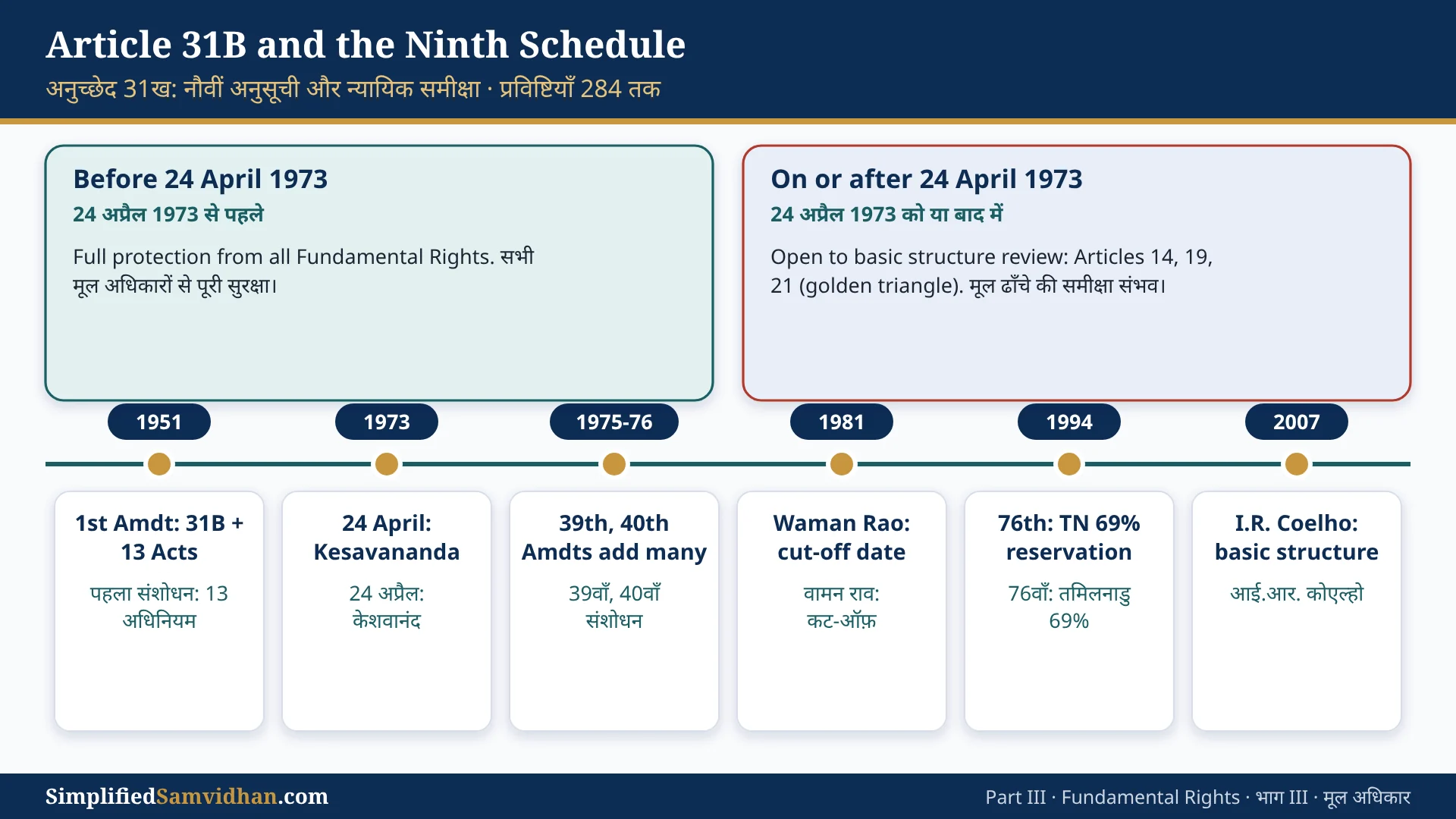
The limit (I.R. Coelho 2007): for Acts added after 24 April 1973 (the day Kesavananda was decided), courts can check whether the law damages the basic structure, including the core of Articles 14, 19 and 21.
Legislature keeps control: the Act can still be amended or repealed by the legislature that made it.
🏠 Everyday Analogy
Think of the Ninth Schedule as a VIP pass for laws. A law with the pass walks past the Fundamental Rights security check. In 2007 the Supreme Court added one rule: passes issued after 24 April 1973 still go through the basic structure metal detector.
🇮🇳 Real Indian Example
Tamil Nadu gives 69% reservation in State jobs and colleges, above the 50% ceiling of the Indra Sawhney case. To protect it, the State's 1993 Reservation Act was placed in the Ninth Schedule by the 76th Amendment, 1994. Because it was added after 24 April 1973, its validity can still be tested on the basic structure; challenges are pending before the Supreme Court.
How It CameArticle 31B and the Ninth Schedule: When and Why It Was Added
- 1951: courts in Bihar and elsewhere were striking down zamindari abolition laws. The Nehru Government added Article 31B and the Ninth Schedule by the First Amendment, putting 13 land reform Acts (like the Bihar Land Reforms Act, 1950) beyond challenge.
- Dr. Ambedkar and Nehru saw it as a temporary tool for land reform. Over time it was used much more widely: in the Emergency years, the 39th Amendment 1975 and 40th Amendment 1976 added dozens of laws, including election and economic laws.
- The 44th Amendment 1978 removed some of the Emergency-era election laws from the list.
- The list has entries up to 284. Most are land laws; the last batch came with the 78th Amendment 1995.
Court's LimitCan Ninth Schedule Laws Be Challenged? Waman Rao and I.R. Coelho
- Waman Rao v Union of India (1981): Acts placed in the Ninth Schedule before 24 April 1973 are fully safe. Acts placed after that date are open to challenge if they damage the basic structure.
- I.R. Coelho v State of Tamil Nadu (11 January 2007, nine judges): the Court confirmed the 24 April 1973 line and said the basic structure includes the core of Fundamental Rights, the "golden triangle" of Articles 14, 19 and 21. Parliament cannot give a law total immunity simply by listing it.
- Two-step test after Coelho: (1) does the law violate a Fundamental Right? (2) if yes, does that violation destroy the basic structure? Only then is it struck down.
- A law already upheld earlier is not reopened only because of Coelho.
| Act put in Ninth Schedule | Protection |
|---|---|
| Before 24 April 1973 | Full protection from Part III |
| On or after 24 April 1973 | Protected from Part III, but open to basic structure review |
Quick RevisionKey Points to Remember
- Article 31B and the Ninth Schedule were added by the 1st Amendment 1951.
- Ninth Schedule Acts cannot be void for violating any Fundamental Right; protection is retrospective.
- Acts are added only by a constitutional amendment; both Central and State Acts can be listed.
- Cut-off date: 24 April 1973 (Waman Rao 1981; I.R. Coelho 2007).
- Post-1973 entries can be struck down if they damage the basic structure.
TimelineArticle 31B and Ninth Schedule: Key Dates
| Year | Event |
|---|---|
| 1951 | 1st Amendment adds Article 31B and the Ninth Schedule with 13 Acts. |
| 1973 | Kesavananda Bharati decided on 24 April: basic structure doctrine. |
| 1975-76 | 39th and 40th Amendments add many laws during the Emergency. |
| 1981 | Waman Rao: 24 April 1973 becomes the cut-off date. |
| 1994 | 76th Amendment adds Tamil Nadu's 69% reservation Act. |
| 1995 | 78th Amendment: last additions, entries up to 284. |
| 2007 | I.R. Coelho (9 judges): post-1973 entries open to basic structure review. |
UPSC · State PSC · JudiciaryArticle 31B: UPSC Exam Corner
- Prelims fact (UPSC has asked this): the Ninth Schedule was introduced by the First Amendment during Nehru's time, and post-1973 entries are open to judicial review (I.R. Coelho).
- Prelims trap: "Only State laws can be put in the Ninth Schedule." False. Central laws are also listed.
- Mains (150 words): "The Ninth Schedule was meant as a shield for land reform but became a tool to avoid judicial review." Examine in the light of I.R. Coelho.
Practice MCQTest Yourself: Article 31B
With reference to the Ninth Schedule, consider: 1. It was added by the First Amendment, 1951. 2. Laws placed in it after 24 April 1973 can be reviewed on the touchstone of the basic structure. 3. Only State laws can be included in it. Which are correct?
Doubts ClearedFrequently Asked Questions
What is Article 31B of Indian Constitution?
Article 31B says that Acts and Regulations listed in the Ninth Schedule cannot be declared void for violating any Fundamental Right. It was added by the First Amendment, 1951.
How many laws are in the Ninth Schedule?
Entries are numbered up to 284; a few were later omitted. The last additions came with the 78th Amendment, 1995.
What did the I.R. Coelho case decide?
In 2007 a nine-judge Bench held that laws added to the Ninth Schedule after 24 April 1973 can be struck down if they violate the basic structure, including the essence of Articles 14, 19 and 21.