Bare ActOfficial Text of Article 31
31. [Compulsory acquisition of property.] Omitted by the Constitution (Forty-fourth Amendment) Act, 1978, s. 6 (w.e.f. 20-6-1979).
What Article 31(1) said until 1979: "No person shall be deprived of his property save by authority of law."
The same words now stand in Article 300A (Part XII, Chapter IV, "Right to Property", inserted by s. 34 of the same Act):
300A. Persons not to be deprived of property save by authority of law.—No person shall be deprived of his property save by authority of law.
Is the right to property a Fundamental Right today? No. Since 20 June 1979 it is a constitutional right under Article 300A (and the Supreme Court calls it a human right too).
What Article 31 did (1950-1979): no one could lose property except by law, and when the State took property for a public purpose the law had to give compensation (later called an "amount").
Why it was removed: zamindari abolition, land ceilings and bank nationalisation kept getting stuck in court cases about "compensation". Parliament amended the Constitution again and again (1st, 4th, 17th, 25th Amendments). The Janata Government finally moved property out of Part III by the 44th Amendment.
What protection is left: the State can still take your land or house only under a law made by a legislature, for a public purpose, through a fair procedure with compensation. A mere executive order, a police threat or quiet occupation is illegal.
Where to go: you cannot file a writ under Article 32 for property alone. Go to the High Court under Article 226 or file a civil suit. If the act also hits Article 14 or 21 (for example, home demolition without notice), Article 32 can still be used for those rights.
🏠 Everyday Analogy
Think of a cricket rule that the umpire keeps overturning. Article 31 was a rule that said "the State must pay for what it takes". Every time the government tried land reform, the courts asked "is the payment fair?" and the match stopped. So Parliament moved the rule from the main rulebook (Part III) to the appendix (Part XII). It is still a rule, and the State still cannot take your bat without following it, but you now complain to the regional umpire (High Court) instead of the match referee (Supreme Court under Article 32).
🇮🇳 Real Indian Example
In Vidya Devi v State of Himachal Pradesh (2020), an illiterate widow's land had been used by the State for a road in 1967-68 without acquisition or payment. The State argued it now owned the land by "adverse possession". The Supreme Court said a welfare State cannot grab a citizen's land like that, called the right to property a human and constitutional right under Article 300A, and ordered compensation with interest.
Parliament vs CourtsWhy Was Article 31 Omitted? The Right to Property Battle 1950-1978
- 1951, land reform: the Patna High Court struck down the Bihar Land Reforms Act in Kameshwar Singh. Parliament replied with the First Amendment: Articles 31A, 31B and the Ninth Schedule (upheld in Shankari Prasad).
- 1954-55, compensation: Bela Banerjee said compensation must be a "just equivalent" (market value). The 4th Amendment made its adequacy non-justiciable.
- 1964-67, ceilings: the 17th Amendment widened 31A; Golaknath (1967) then said Parliament cannot amend Fundamental Rights at all.
- 1970-71, banks and privy purses: R.C. Cooper (Bank Nationalisation) and Madhav Rao Scindia went against the Government. The 24th, 25th and 26th Amendments followed: "amount" replaced "compensation" and Article 31C came.
- 1973: Kesavananda Bharati allowed such amendments subject to the basic structure; property was not treated as basic structure.
- 1978, the end: after the Emergency, the Janata Government's 44th Amendment moved property out of Part III so it could no longer block land reform, and kept protection against arbitrary deprivation in Article 300A.
Article 300A TodayIs Right to Property a Fundamental Right? Article 300A Explained
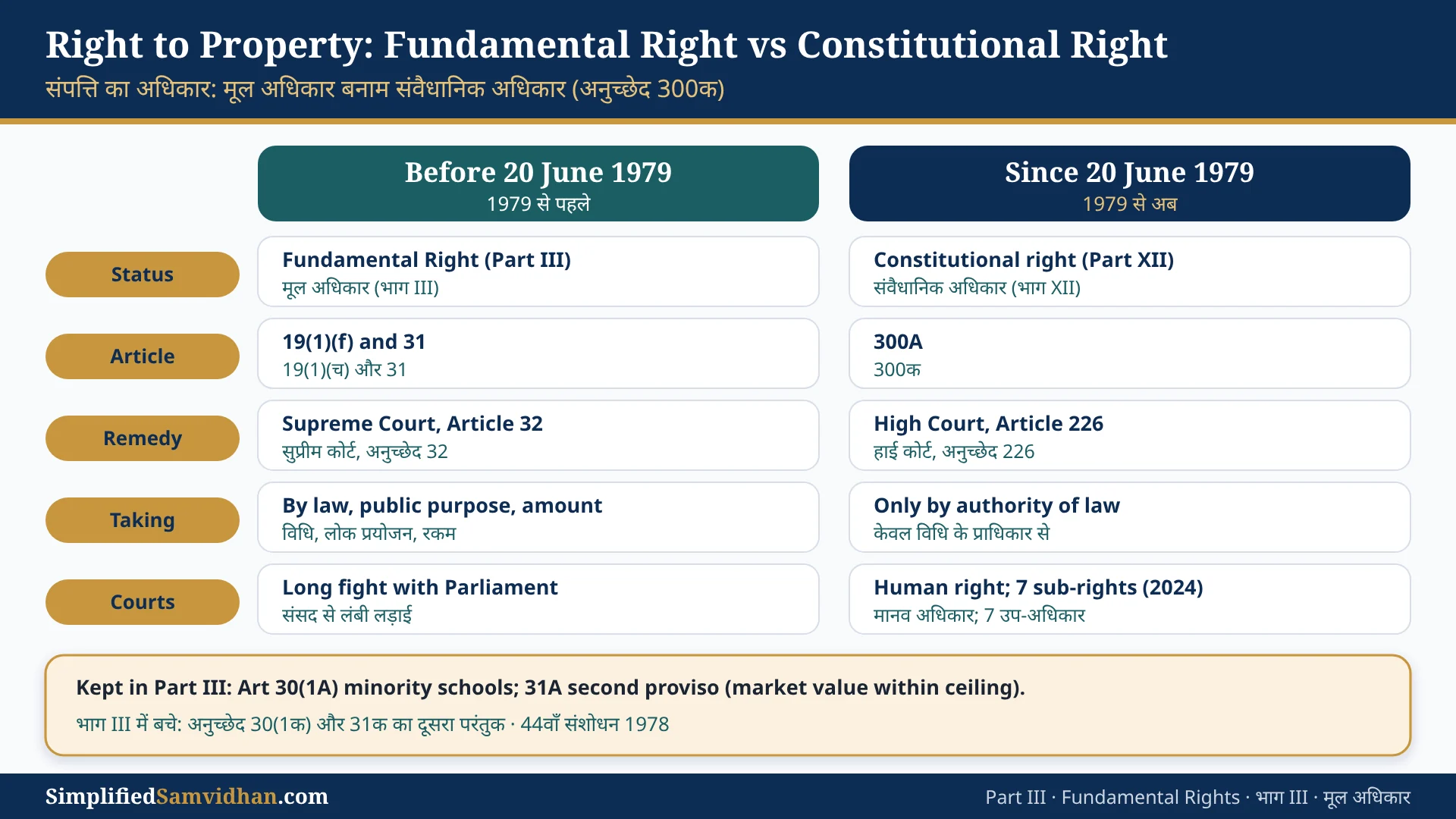
| Point | Before 20 June 1979 (Articles 19(1)(f) and 31) | Since 20 June 1979 (Article 300A) |
|---|---|---|
| Status | Fundamental Right in Part III | Constitutional right in Part XII (Chapter IV) |
| Remedy | Directly to the Supreme Court under Article 32, or High Court under 226 | High Court under Article 226 or a civil suit; not under Article 32 |
| Who can take property | The State, only by law and for public purpose with an "amount" | The State, only by authority of law (executive order alone is not enough) |
| Compensation | Written in Article 31(2) ("amount") | Not written, but courts read in a fair, just process (K.T. Plantation 2011, Bimal Kumar Shah 2024) |
What the Supreme Court has read into Article 300A
- Not basic structure: Jilubhai Nanbhai Khachar v State of Gujarat (1995) said Article 300A is not part of the basic structure; it is a constitutional right.
- Public purpose and compensation are implied: K.T. Plantation v State of Karnataka (2011, five judges) said the law under 300A must be just, fair and reasonable; the obligation to pay compensation, though not written, is inherent.
- Human right: Tukaram Kana Joshi (2013) and Vidya Devi (2020) called the right to property a human right; the State cannot use "adverse possession" against its own citizen.
- Seven sub-rights (2024): Kolkata Municipal Corporation v Bimal Kumar Shah (16 May 2024) held that even a valid acquisition law must follow seven procedural rights (table below).
- Demolitions: in In re Directions in the matter of demolition of structures (13 November 2024) the Supreme Court laid down notice and hearing rules before any demolition, linking shelter to Article 21 and fair process.
If Your Property Is TakenRight to Property in Practice: What to Do if the Government Takes Your Land
- Compensation law: acquisitions follow the Land Acquisition Act, 2013 (RFCTLARR, in force 1 January 2014): up to four times the market value in rural areas and two times in urban areas, consent of 80% families for private projects, Social Impact Assessment and rehabilitation.
- Ask for the law and the notice: under which Act and section is the land being taken? Under the 2013 Act a preliminary notification (section 11) and a hearing on objections (section 15) come first.
- File objections in writing within the time given (60 days under section 15) and keep a receipt.
- Go to the High Court under Article 226 if the procedure is not followed, the land is taken without any law, or compensation is not paid for years. Delay by the State is no excuse (Vidya Devi 2020).
- Demolition without notice: the 2024 Supreme Court directions require a 15-day notice and a personal hearing before demolishing a structure, with exceptions for public places and court orders.
Quick RevisionKey Points to Remember
- Article 31 (compulsory acquisition of property) was omitted by the 44th Amendment 1978, w.e.f. 20 June 1979.
- Article 19(1)(f) was omitted by the same Amendment; property is now in Article 300A, Part XII, Chapter IV.
- Right to property is a constitutional right and a human right, not a Fundamental Right; remedy: Article 226, not 32.
- "Authority of law" means a law of the legislature; executive action alone cannot deprive property.
- Amendments on property: 1st (1951), 4th (1955), 17th (1964), 25th (1971), 44th (1978).
- Still in Part III: 30(1A) and the second proviso of 31A(1) protect property.
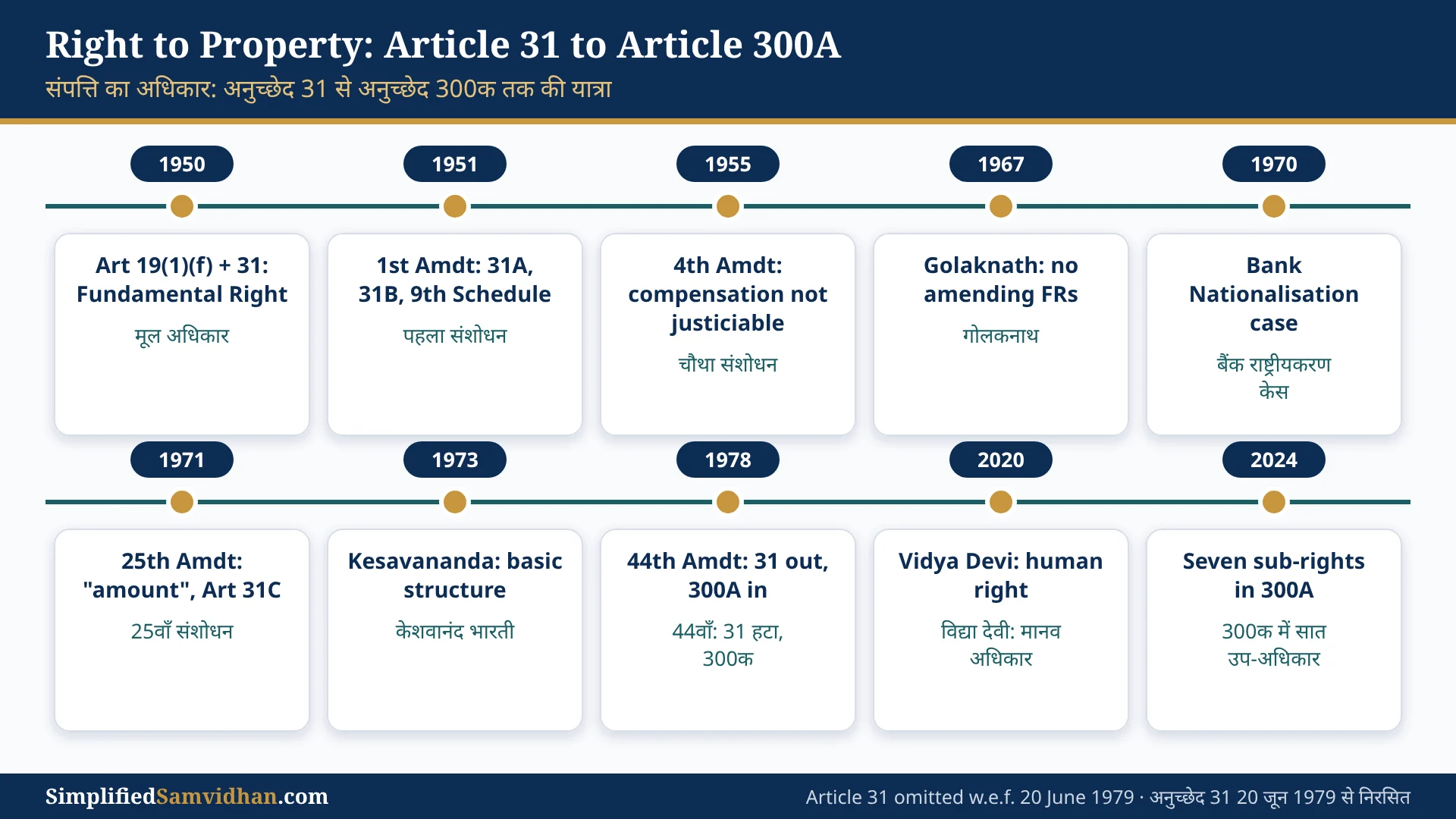
TimelineArticle 31 and the Right to Property: Key Dates and Cases
| Year | Event |
|---|---|
| 1950 | Articles 19(1)(f) and 31 make property a Fundamental Right (26 January). |
| 1951 | Kameshwar Singh (Patna HC); First Amendment adds 31A, 31B, Ninth Schedule; Shankari Prasad upholds it. |
| 1970 | R.C. Cooper (Bank Nationalisation) and Madhav Rao Scindia (privy purses). |
| 1971 | 24th, 25th, 26th Amendments: "amount" replaces "compensation"; Article 31C. |
| 1973 | Kesavananda Bharati: basic structure; property not part of it. |
| 1978-79 | 44th Amendment omits 19(1)(f) and 31, adds 300A and 30(1A); in force 20 June 1979. |
| 2020 | Vidya Devi: property is a human right; no adverse possession by the State. |
| 2024 | Bimal Kumar Shah: seven sub-rights in 300A; demolition guidelines (13 Nov). |
UPSC · State PSC · JudiciaryArticle 31: UPSC Exam Corner
- Prelims fact (asked often): right to property was removed from Fundamental Rights by the 44th Amendment (not the 42nd) and is now a legal/constitutional right under Article 300A.
- Prelims trap: "Article 300A is in Part III." False. It is in Part XII (Finance, Property, Contracts and Suits), Chapter IV.
- Mains (250 words): "The journey of the right to property from Article 31 to Article 300A mirrors the tension between individual rights and social justice." Discuss.
Practice MCQTest Yourself: Article 31
Consider the statements: 1. The right to property was deleted from Part III by the 42nd Amendment, 1976. 2. Article 300A says no person shall be deprived of property save by authority of law. 3. A violation of Article 300A can be challenged before a High Court under Article 226. Which are correct?
Doubts ClearedFrequently Asked Questions
What is Article 31 of Indian Constitution?
Article 31 dealt with compulsory acquisition of property and made the right to property a Fundamental Right. It was omitted by the 44th Amendment Act, 1978 with effect from 20 June 1979. Its main idea now lives in Article 300A.
Is the right to property a Fundamental Right in India?
No. Since 1979 it is a constitutional right under Article 300A, and the Supreme Court also calls it a human right. You can enforce it through the High Court under Article 226, not directly under Article 32.
Can the government take my land without compensation?
Article 300A does not use the word compensation, but the Supreme Court has held that a fair law and fair compensation are implied (K.T. Plantation 2011, Bimal Kumar Shah 2024). In practice the 2013 Land Acquisition Act fixes compensation of up to four times the market value in rural areas.