Bare ActOfficial Text of Article 34
34. Restriction on rights conferred by this Part while martial law is in force in any area.—Notwithstanding anything in the foregoing provisions of this Part, Parliament may by law indemnify any person in the service of the Union or of a State or any other person in respect of any act done by him in connection with the maintenance or restoration of order in any area within the territory of India where martial law was in force or validate any sentence passed, punishment inflicted, forfeiture ordered or other act done under martial law in such area.
Martial law is a situation like war or a massive riot in one area where the army takes over, makes rules and may punish people through military courts, because normal courts and police cannot function.
What Article 34 does: after things settle, Parliament can pass a law that (1) protects officers and others from cases for actions taken in good faith to restore order, and (2) makes martial law sentences and punishments legally valid.
Fundamental Rights cannot be used to challenge such an Indemnity Act.
Who decides martial law? The Constitution is silent. It is a common law idea; it is understood to apply only to a specific area and only when civil courts have actually stopped working.
It is not an Emergency: a National Emergency under Article 352 is declared by the President for the whole country or a part, and civil government continues. Martial law is not declared by any article.
🏠 Everyday Analogy
Think of a fire in a crowded market. Firefighters break doors, push people and pull down a stall to stop the fire. Later, shop owners could sue them for damage. Article 34 is like a rule that Parliament can later pass a law saying "what the firefighters did in good faith to save the market cannot be punished".
🇮🇳 Real Indian Example
India has never used Article 34. The best-known example is from British India: martial law was declared in Punjab in April 1919. During it, General Dyer fired on the crowd at Jallianwala Bagh on 13 April 1919, and people were flogged and made to crawl. The colonial government then passed an Indemnity Act to protect its officers. The framers kept Article 34 but put the power only with Parliament, the elected body.
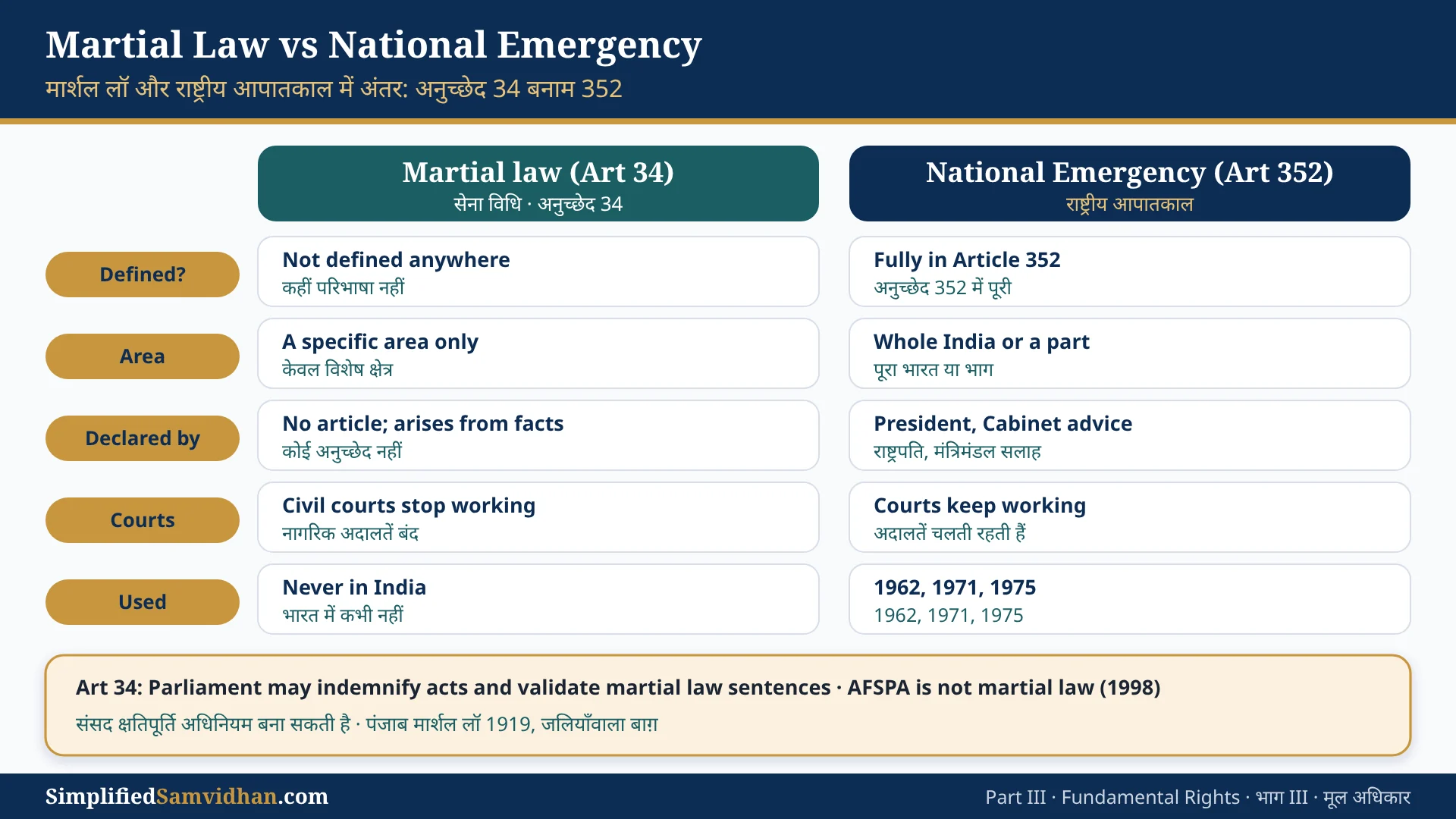
Martial Law vs EmergencyMartial Law vs National Emergency: Article 34 vs Article 352
| Point | Martial law (Article 34) | National Emergency (Article 352) |
|---|---|---|
| Meaning | Army rule where civil administration has broken down | Special constitutional state due to war, external aggression or armed rebellion |
| Defined in Constitution? | No | Yes, with full procedure |
| Area | A specific area only | Whole of India or any part |
| Who declares | No article; follows from the situation | President, on the Cabinet's written advice; Parliament approves in one month |
| Effect on government | Civil government and courts suspended in that area | Civil government and courts continue |
| Effect on rights | Acts can be indemnified later by Parliament | Art 358 suspends Art 19 (war/aggression); Art 359 suspends enforcement of others, not 20 and 21 |
| Used in India? | Never | 1962, 1971, 1975 |
- AFSPA is not martial law. In Naga People's Movement of Human Rights v Union of India (1998), five judges held that the Armed Forces (Special Powers) Act, 1958 only lets the army help civil authorities; the civil government and courts keep working.
Quick RevisionKey Points to Remember
- Article 34: Parliament may indemnify acts done to restore order in a martial law area.
- It may also validate sentences, punishments and forfeitures made under martial law.
- Martial law is not defined in the Constitution and has never been declared in independent India.
- Martial law ≠ National Emergency (Article 352); AFSPA ≠ martial law.
TimelineArticle 34 and Martial Law: Key Dates
| Year | Event |
|---|---|
| 1919 | Martial law in Punjab; Jallianwala Bagh (13 April); Indemnity Act follows. |
| 1950 | Article 34 in force; power given only to Parliament. |
| 1958 | AFSPA passed (not martial law). |
| 1998 | Naga People's Movement case: AFSPA upheld, not martial law. |
UPSC · State PSC · JudiciaryArticle 34: UPSC Exam Corner
- Prelims trap: "The President declares martial law under Article 34." False. No article provides for declaring martial law; Article 34 only lets Parliament pass an indemnity law.
- Prelims fact: martial law affects only Fundamental Rights through Article 34; a National Emergency affects them through Articles 358 and 359.
Practice MCQTest Yourself: Article 34
Which of the following is correct about martial law in India? 1. It is defined in Article 34. 2. Parliament may by law indemnify acts done under it. 3. It has been declared during the 1975 Emergency.
Doubts ClearedFrequently Asked Questions
What is Article 34 of Indian Constitution?
Article 34 lets Parliament pass a law to indemnify persons for acts done to restore order in an area under martial law, and to validate sentences and punishments given under martial law, even if they broke Fundamental Rights.
Has martial law ever been imposed in India?
Not since independence. The best-known case is the 1919 martial law in Punjab under British rule, the time of the Jallianwala Bagh massacre.