Bare ActOfficial Text of Article 18
18. Abolition of titles.—
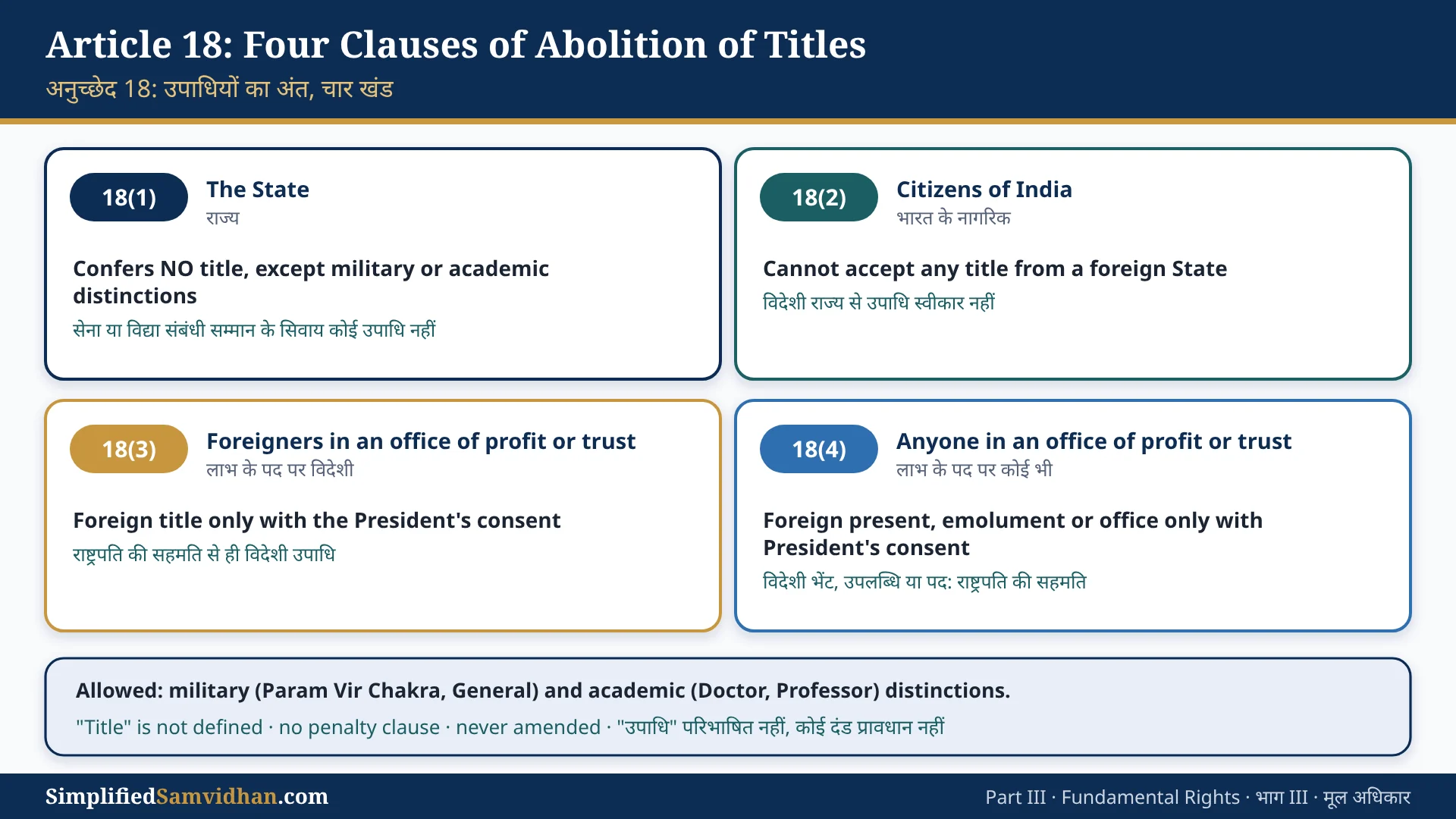
(1) No title, not being a military or academic distinction, shall be conferred by the State.
(2) No citizen of India shall accept any title from any foreign State.
(3) No person who is not a citizen of India shall, while he holds any office of profit or trust under the State, accept without the consent of the President any title from any foreign State.
(4) No person holding any office of profit or trust under the State shall, without the consent of the President, accept any present, emolument, or office of any kind from or under any foreign State.
The State cannot create titles such as Maharaja or Rai Bahadur. It can only honour military (General, Param Vir Chakra) and academic (Doctor, Professor) distinctions.
An Indian citizen cannot accept a title from a foreign country.
A foreigner working for the Indian government needs the President's permission to accept a foreign title; anyone in such a post needs it to accept gifts, pay or a post from a foreign State.
"Title" is not defined. The Supreme Court has said national awards are not titles, as long as they are not used with the name.
🏠 Everyday Analogy
A title is like a crown that stays on your head and tells everyone you are above them. An award is like a medal for a race you ran well: you can be proud of it, but you don't wear it as part of your name.
🇮🇳 Real Indian Example
A doctor who receives the Padma Shri writes "Dr. Meera Rao, recipient of Padma Shri" in her biography. That is fine. But a film poster that says "Padma Shri Meera Rao" uses the award as a title. In 2013 the Andhra Pradesh High Court asked actors Mohan Babu and Brahmanandam not to use "Padma Shri" before their names.
Four ClausesArticle 18 of Indian Constitution: Four Clauses of Abolition of Titles
| Clause | Who | Rule |
|---|---|---|
| 18(1) | The State | Shall confer no title, except a military or academic distinction |
| 18(2) | Citizens of India | Shall not accept any title from a foreign State |
| 18(3) | Foreigners holding an office of profit or trust under the State | Need the President's consent to accept a foreign title |
| 18(4) | Anyone (citizen or foreigner) holding an office of profit or trust under the State | Need the President's consent to accept any present, emolument or office from a foreign State |
Office of profit or trust
- Clauses (3) and (4) apply to a person holding an office of profit or trust under the State: a government post that carries pay or allowances, or a position of trust.
- The idea also matters for legislators: under Articles 102 and 191 an MP or MLA holding an office of profit is disqualified, unless Parliament exempts that office under the Parliament (Prevention of Disqualification) Act, 1959. In Jaya Bachchan v. Union of India (2006) the test was whether the office can yield pecuniary gain, not whether money was actually taken.
- Clause (4) is why officials must declare and often deposit valuable foreign gifts in the government's toshakhana.
Awards vs TitlesAre Bharat Ratna and Padma Awards Titles? The Balaji Raghavan Case
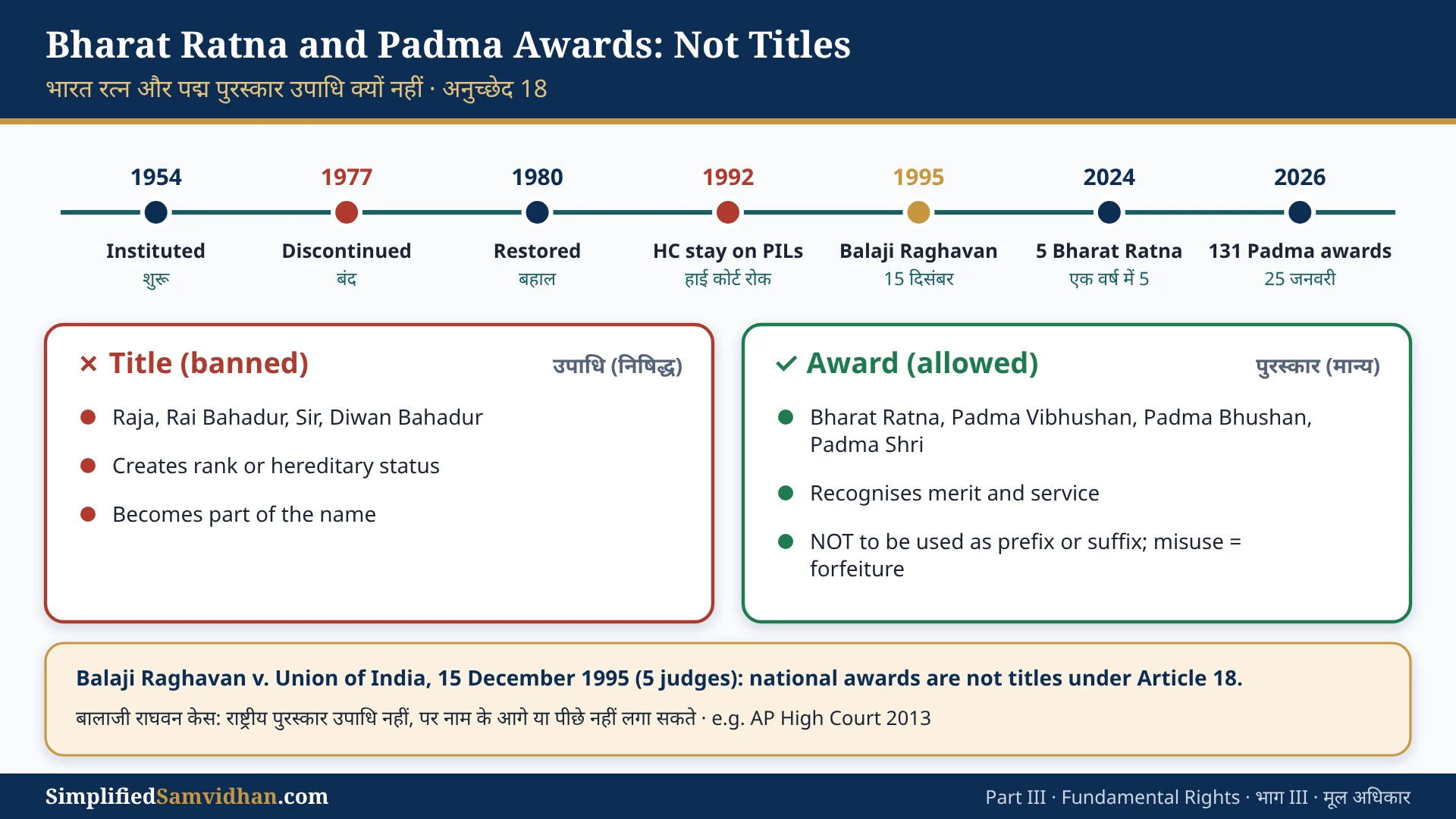
- 1954: the Bharat Ratna and Padma awards were instituted (2 January 1954).
- 1977: the Janata government discontinued them, calling them against the spirit of Article 18.
- 1980: the Indira Gandhi government restored them.
- 1992: PILs in the Kerala and Madhya Pradesh High Courts challenged them; the awards were stayed for a while.
- 15 December 1995: in Balaji Raghavan v. Union of India a five-judge bench held that national awards are not titles under Article 18. They recognise merit and service, and do not create a hereditary rank. But they must not be used as a prefix or suffix to the name; if misused, the award can be forfeited. The Court also asked for a fair selection process and limits on numbers. (Your notes say 1996; the judgment was delivered on 15 December 1995.)
| Title (banned) | Award (allowed) |
|---|---|
| Creates a rank or hereditary status: Raja, Rai Bahadur, Sir, Diwan Bahadur | Recognises service or merit: Bharat Ratna, Padma Vibhushan, Padma Bhushan, Padma Shri |
| Becomes part of the name and sets the holder above others | Cannot be used as a prefix or suffix to the name |
| Against equality (Article 14) and fraternity | Consistent with equality, as the Supreme Court held in 1995 |
| Allowed exceptions: military (Param Vir Chakra, General) and academic (Doctor, Professor) | Can be withdrawn if misused |
2024 to 2026
- Bharat Ratna 2024 went to five people, the most in one year: Karpoori Thakur, L.K. Advani, Chaudhary Charan Singh, P.V. Narasimha Rao and M.S. Swaminathan. The usual practice is no more than three a year.
- Padma Awards 2026 were announced on 25 January 2026: 131 awards (5 Padma Vibhushan, 13 Padma Bhushan, 113 Padma Shri). Nominations are open online to the public, a change made in 2016 to widen selection, which follows the spirit of Balaji Raghavan.
- Indian leaders and citizens regularly receive foreign civilian honours. These are treated as decorations, not titles creating a rank; for anyone holding an office of profit or trust, clause (4) still requires the President's consent for presents or offices from a foreign State.
Quick RevisionKey Points to Remember
- The State confers no title except military or academic distinctions.
- Citizens cannot accept foreign titles.
- Office-of-profit holders need the President's consent for foreign titles (foreigners) and foreign gifts or posts (all).
- "Title" is not defined; Article 18 has no penalty clause.
- Balaji Raghavan (1995): Bharat Ratna and Padma awards are not titles, but cannot be used with the name.
TimelineArticle 18 and National Awards: Key Dates
| Year | Event |
|---|---|
| 1950 | Article 18 abolishes titles; British titles lose legal meaning. |
| 1954 | Bharat Ratna and Padma awards instituted. |
| 1959 | Parliament (Prevention of Disqualification) Act lists exempt offices of profit. |
| 1977 | Awards discontinued by the Janata government. |
| 1980 | Awards restored. |
| 1992 | High Court PILs; awards stayed. |
| 1995 | Balaji Raghavan (15 Dec): awards are not titles; no prefix or suffix. |
| 2006 | Jaya Bachchan: test for office of profit. |
| 2024 | Five Bharat Ratna awards in one year. |
| 2026 | 131 Padma awards announced (25 Jan). |
UPSC · State PSC · JudiciaryArticle 18: UPSC Exam Corner
- Prelims trap: "A foreigner holding an office of profit under the State can never accept a foreign title." False. He can, with the President's consent.
- Prelims trap: "Bharat Ratna is a title under Article 18." False (Balaji Raghavan, 1995).
- Prelims fact: Article 18 allows only military and academic distinctions; it is never amended.
- Mains (150 words): "National awards are consistent with the principle of equality." Discuss with reference to Article 18.
Practice MCQTest Yourself: Article 18
Which of the following can the State confer without violating Article 18? 1. A military distinction 2. An academic distinction 3. A hereditary title like Rai Bahadur
Doubts ClearedFrequently Asked Questions
What is Article 18 of Indian Constitution?
Article 18 abolishes titles. The State cannot confer any title except military or academic distinctions, citizens cannot accept foreign titles, and holders of offices of profit need the President's consent for foreign titles, gifts or posts.
Is Bharat Ratna a title?
No. In Balaji Raghavan v. Union of India (15 December 1995) the Supreme Court held that Bharat Ratna and Padma awards are not titles, but they must not be used as a prefix or suffix to the name.
Can an Indian citizen accept a foreign award?
A citizen cannot accept a foreign title. Civilian honours and decorations are generally not treated as titles, but anyone holding an office of profit or trust needs the President's consent to accept presents, emoluments or offices from a foreign State.