Bare ActOfficial Text of Article 31C
31C. Saving of laws giving effect to certain directive principles.—Notwithstanding anything contained in article 13, no law giving effect to the policy of the State towards securing the principles specified in clause (b) or clause (c) of article 39 shall be deemed to be void on the ground that it is inconsistent with, or takes away or abridges any of the rights conferred by article 14 or article 19; and no law containing a declaration that it is for giving effect to such policy shall be called in question in any court on the ground that it does not give effect to such policy:
Provided that where such law is made by the Legislature of a State, the provisions of this article shall not apply thereto unless such law, having been reserved for the consideration of the President, has received his assent.
Note: the second part ("and no law containing a declaration ... such policy") was held invalid in Kesavananda Bharati (1973). The 42nd Amendment's words "all or any of the principles laid down in Part IV" were struck down in Minerva Mills (1980).
Two Directive Principles get extra power: Article 39(b) (material resources of the community distributed for the common good) and 39(c) (wealth and means of production not concentrated to the common detriment).
The shield: a law that genuinely carries out 39(b) or (c) cannot be struck down for being unequal (Article 14) or for restricting trade, profession or other freedoms (Article 19).
The court can still check whether the law really has a link with 39(b) or (c); a mere label in the law is not enough (Kesavananda struck down the "declaration" part).
Not all DPSPs: the 42nd Amendment tried to cover all Directive Principles, but Minerva Mills (1980) said that would make Part IV master over Part III and destroy the basic structure.
State laws need the President's assent, as under Article 31A.
🏠 Everyday Analogy
Fundamental Rights and Directive Principles are like the two wheels of a bicycle. Article 31C lets the "social justice" wheel lead on two specific roads, 39(b) and 39(c). When the 42nd Amendment tried to let that wheel lead on every road, Minerva Mills said a bicycle with only one working wheel falls over.
🇮🇳 Real Indian Example
The Coking Coal Mines (Nationalisation) Act, 1972 took over private coking coal mines so that coal, a resource of the community, served the public. In Sanjeev Coke v Bharat Coking Coal (1983) owners said the compensation was unequal under Article 14. The Court applied Article 31C: the law carried out Article 39(b), so the Article 14 challenge could not succeed.
How It CameArticle 31C History: 25th Amendment, Kesavananda and Minerva Mills
- 1970: the Supreme Court struck down bank nationalisation (R.C. Cooper) and the abolition of privy purses. Indira Gandhi won the 1971 election on the slogan "Garibi Hatao".
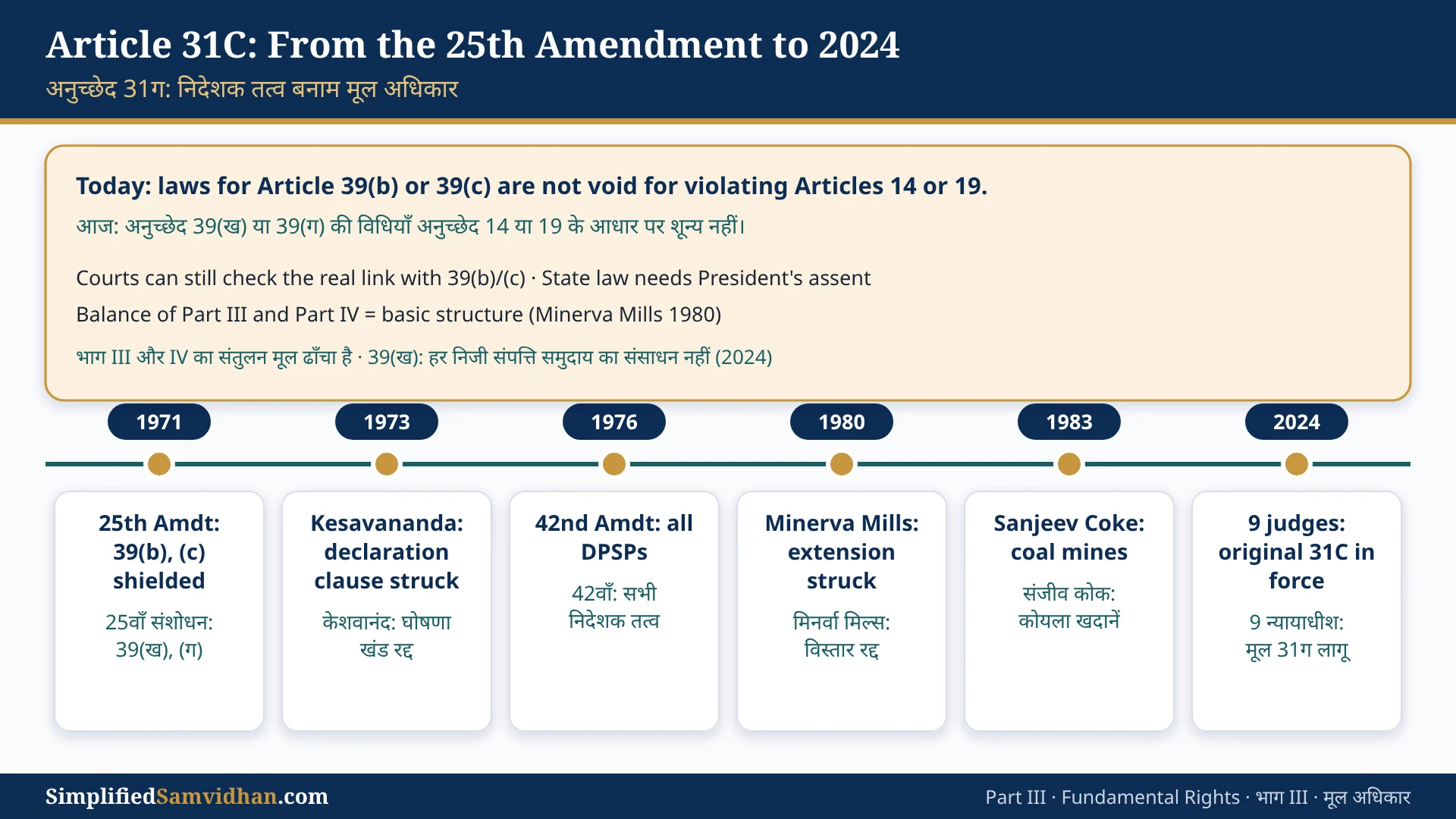
- 1971: the 25th Amendment added Article 31C so that socialist economic laws under 39(b) and (c) could not be blocked by Articles 14, 19 and 31, and courts could not even ask whether the law really served that policy.
- 1973, Kesavananda Bharati: the first part was upheld; the second part (no court can question the declaration) was struck down, because it shut out judicial review.
- 1976, 42nd Amendment: during the Emergency, 31C was widened to cover all Directive Principles.
- 1980, Minerva Mills: the widening was struck down. The Court said Parts III and IV must be in harmony and balance, which is itself part of the basic structure.
- 2024, Property Owners Association v State of Maharashtra (nine judges, 5 November): the original 31C, as upheld in Kesavananda, still stands. By majority, the Bench also held that not every private property is a "material resource of the community" under 39(b); it depends on the nature of the resource and its effect on the community.
What 31C Means TodayArticle 31C Today: Fundamental Rights vs Directive Principles
| Question | Answer today |
|---|---|
| Which laws are protected? | Only laws giving effect to Article 39(b) or 39(c) |
| Against which rights? | Articles 14 and 19 only (not 21, 25 or others) |
| Can a court check the link with 39(b)/(c)? | Yes; the declaration clause is invalid (Kesavananda 1973) |
| Does it cover all Directive Principles? | No; the 42nd Amendment extension was struck down (Minerva Mills 1980) |
| Is 31C still valid? | Yes, in its original 1971 form (Property Owners Association 2024) |
| Does a State law need anything extra? | Yes, the President's assent |
Quick RevisionKey Points to Remember
- Article 31C was added by the 25th Amendment 1971.
- It saves laws for Article 39(b) and 39(c) from Articles 14 and 19.
- Kesavananda (1973) struck down the clause barring courts from checking the declaration.
- Minerva Mills (1980) struck down the 42nd Amendment's extension to all DPSPs.
- 2024: a nine-judge Bench held the original 31C still in force.
TimelineArticle 31C: Key Dates and Cases
| Year | Event |
|---|---|
| 1971 | 25th Amendment adds Article 31C (in force 20 April 1972). |
| 1973 | Kesavananda Bharati: first part valid, declaration clause invalid. |
| 1976 | 42nd Amendment extends 31C to all Directive Principles. |
| 1978 | 44th Amendment removes "article 31" from 31C. |
| 1980 | Minerva Mills strikes down the 42nd Amendment extension. |
| 1983 | Sanjeev Coke applies 31C to coal nationalisation. |
| 2024 | Property Owners Association (9 judges): original 31C in force; narrow reading of 39(b). |
UPSC · State PSC · JudiciaryArticle 31C: UPSC Exam Corner
- Prelims trap: "Article 31C protects laws implementing any Directive Principle." False today; only 39(b) and (c).
- Prelims fact: Minerva Mills (1980) made the balance between Fundamental Rights and DPSPs part of the basic structure.
- Mains (250 words): "Article 31C reflects the constitutional struggle between Fundamental Rights and Directive Principles." Discuss with Kesavananda, Minerva Mills and the 2024 nine-judge ruling.
Practice MCQTest Yourself: Article 31C
Which case struck down the 42nd Amendment's extension of Article 31C to all the Directive Principles?
Doubts ClearedFrequently Asked Questions
What is Article 31C of Indian Constitution?
Article 31C protects laws giving effect to Article 39(b) or (c) of the Directive Principles from being struck down for violating Articles 14 or 19. It was added by the 25th Amendment, 1971.
Is Article 31C still valid after Minerva Mills?
Yes. Minerva Mills struck down only the 42nd Amendment's extension. In 2024 a nine-judge Bench held that the original Article 31C, as upheld in Kesavananda, continues in force.
Does Article 31C protect laws from Article 21?
No. It protects only against Articles 14 and 19. A law violating Article 21 can still be struck down.