Bare ActOfficial Text of Article 26
26. Freedom to manage religious affairs.—
Subject to public order, morality and health, every religious denomination or any section thereof shall have the right—
(a) to establish and maintain institutions for religious and charitable purposes;
(b) to manage its own affairs in matters of religion;
(c) to own and acquire movable and immovable property; and
(d) to administer such property in accordance with law.
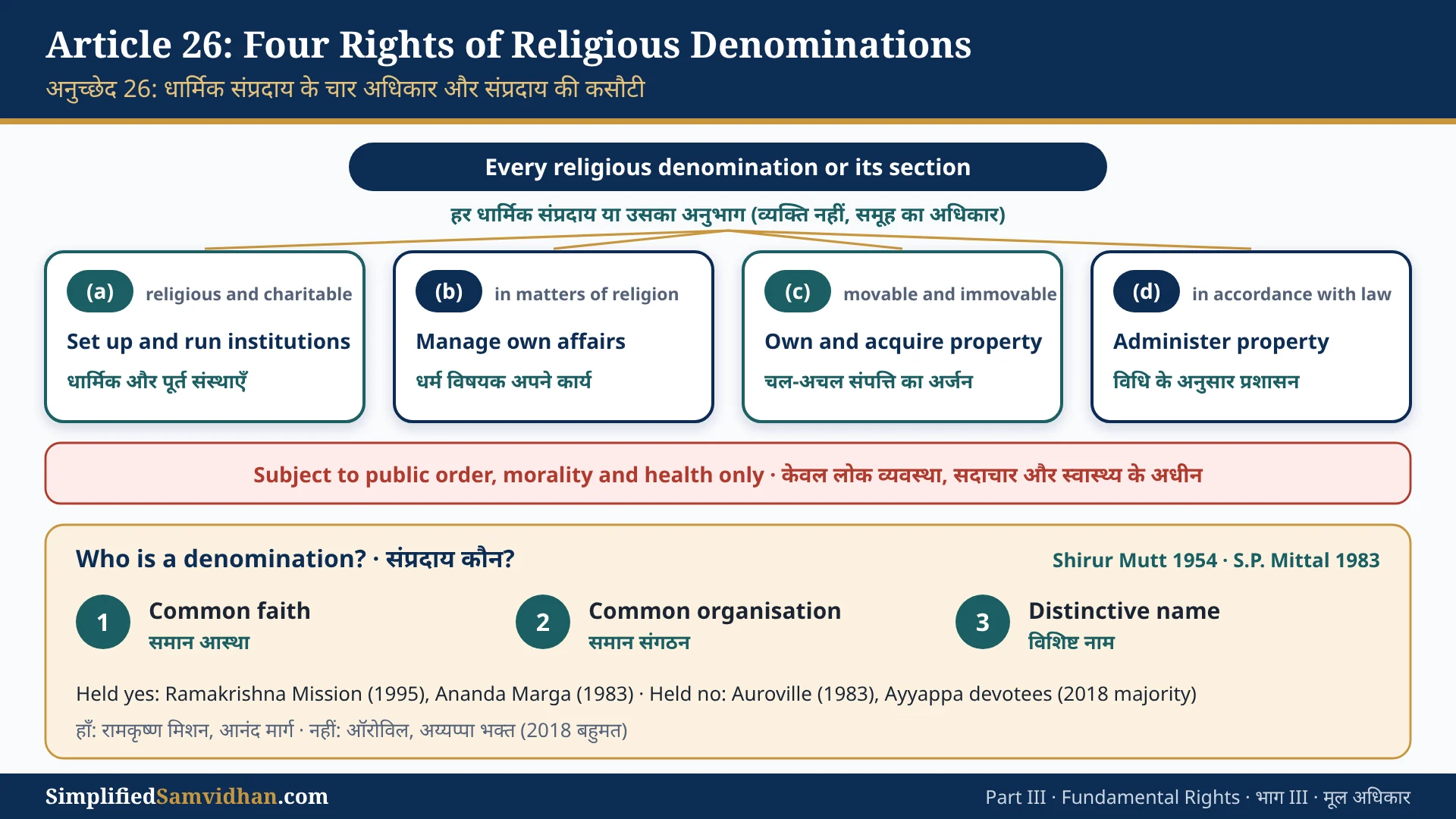
Article 26 gives rights to a religious denomination (a group with a common faith, organisation and name) or a section of it, not to a single person.
The group can set up and run institutions for religious and charitable work.
It can decide its own matters of religion, such as rituals and modes of worship.
It can own and acquire property, but must administer it according to law; the State can regulate the secular side, like accounts.
All this is subject to public order, morality and health.
🏠 Everyday Analogy
Think of a cricket club. The club decides its own team rules, uniform and match rituals (its own affairs). It can own a ground and a pavilion. But its accounts are audited under the law of the land, and it cannot hold a match that blocks a highway. Article 26 gives a religious group the same kind of self-rule within limits.
🇮🇳 Real Indian Example
The Shiromani Gurdwara Parbandhak Committee manages many gurdwaras in Punjab under the Sikh Gurdwaras Act 1925. Hindu temples in Tamil Nadu are supervised under the State's HR&CE Act, and waqf properties under the Waqf law. Each community decides its rituals, while the law watches the money and property side.
Four RightsArticle 26 of Indian Constitution: Four Rights of Religious Denominations
| Clause | Right of the denomination | Example |
|---|---|---|
| 26(a) | Establish and maintain institutions for religious and charitable purposes | A math, a gurdwara, a church-run hospital, a waqf-run orphanage |
| 26(b) | Manage its own affairs in matters of religion | Deciding rituals, festivals and modes of worship |
| 26(c) | Own and acquire movable and immovable property | Buying land for a new place of worship |
| 26(d) | Administer such property in accordance with law | Running temple or waqf property under the State's endowment or waqf laws |
- The rights belong to every religious denomination or any section of it. Your notes say "individuals"; the individual's freedom is in Article 25, while Article 26 is a group right.
- Article 26 covers all religions, majority and minority alike.
- "In accordance with law" (26(d)): in Ratilal Panachand Gandhi v. State of Bombay (1954) the Court held that the State may regulate how religious property is administered, but cannot take the right to administer away from the denomination and hand it to another body.
Article 25 vs Article 26
| Point | Article 25 | Article 26 |
|---|---|---|
| Right holder | Every individual (all persons) | Every religious denomination or section of it |
| Nature | Freedom of conscience; profess, practise, propagate | Collective right to manage institutions, affairs and property |
| Limits | Public order, morality, health and other provisions of Part III | Public order, morality, health |
| State reform power | Clause (2): secular activity, social reform, temple entry | Property administered "in accordance with law" |
What is a DenominationArticle 26: What is a Religious Denomination? The Shirur Mutt Test
- The Constitution does not define "religious denomination". In Commissioner, Hindu Religious Endowments, Madras v. Sri Lakshmindra Thirtha Swamiar of Sri Shirur Mutt (1954, seven judges) the Court took it to mean a collection of persons with a common system of beliefs, a common organisation and a distinctive name.
- S.P. Mittal v. Union of India (1983) stated these as a three-part test: (1) common faith, (2) common organisation, (3) distinctive name. On this test the Aurobindo Society and Auroville were held not to be a religious denomination.
- Groups held to be denominations include the followers of a math such as Shirur Mutt, the Ananda Marga (1983) and the Ramakrishna Mission (Bramchari Sidheswar Shai v. State of West Bengal, 1995), which the Court also held is not a separate non-Hindu minority for Article 30.
- In the Sabarimala case (2018) the majority held that the devotees of Lord Ayyappa do not form a separate denomination; the dissent held that they do.
Essential PracticesArticle 26 and the Essential Religious Practices Doctrine
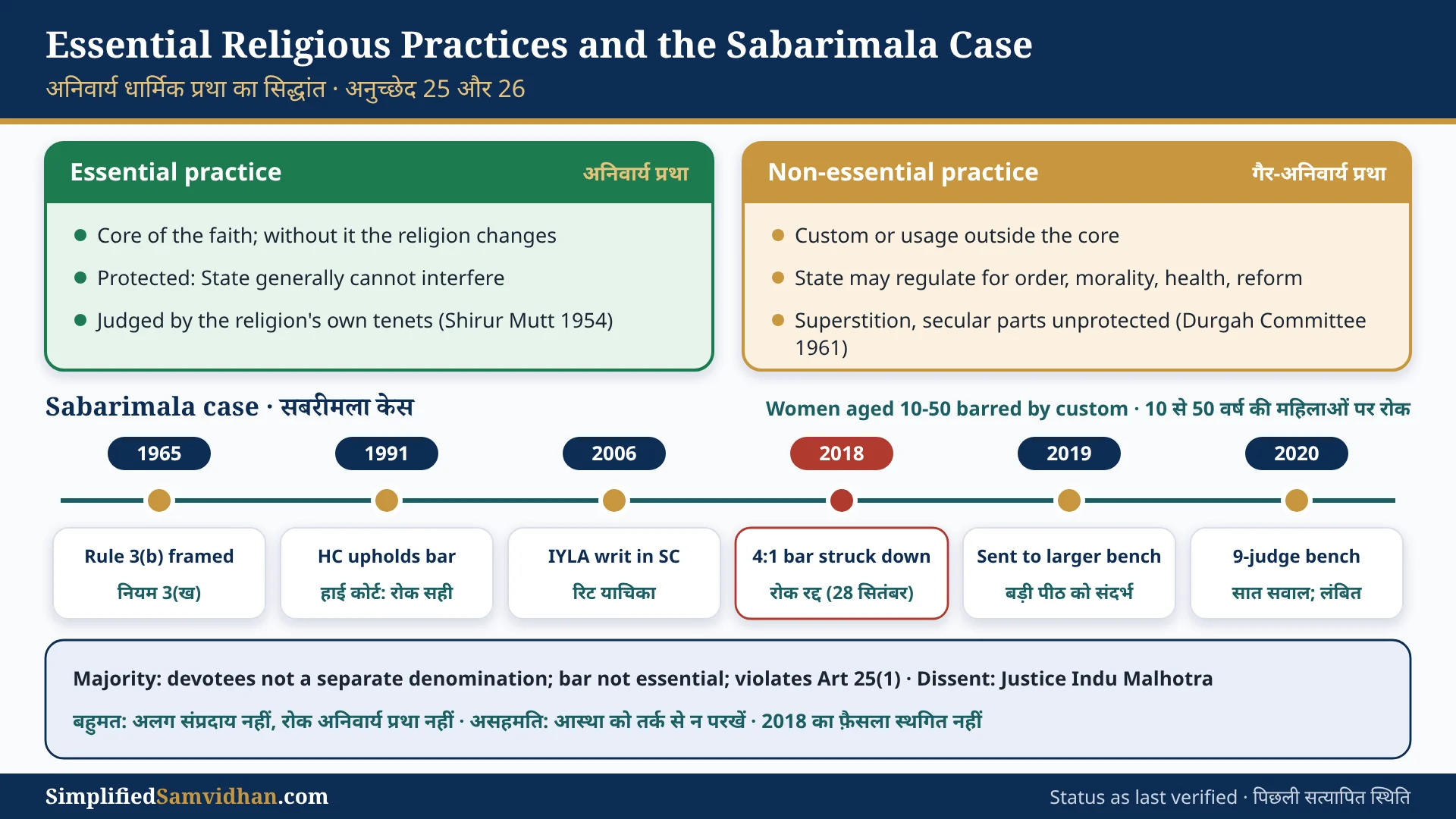
- Shirur Mutt (1954): "matters of religion" include rituals, ceremonies and modes of worship that are an essential part of a religion, and what is essential is to be judged mainly from the doctrines of that religion itself.
- Durgah Committee, Ajmer v. Syed Hussain Ali (1961): only practices that are essential and integral to a religion get protection; purely secular practices or superstitious beliefs do not.
- Sri Venkataramana Devaru v. State of Mysore (1958): a denomination's right under 26(b) is subject to a temple-entry law under 25(2)(b), so a denominational temple must open to all Hindus; but it may keep some special rituals limited to its own members.
- Seshammal v. State of Tamil Nadu (1972): appointing a temple priest is a secular act, so ending hereditary priesthood was valid; but the priest must still follow the temple's rituals.
| Essential religious practice | Non-essential practice |
|---|---|
| Part of the core of the faith: without it the religion would change its basic character | A custom or usage that is not part of the core |
| Protected; the State generally cannot interfere | Can be regulated by the State for public order, morality, health or reform |
| Example: offering namaz is essential (Ismail Faruqui, 1994) | Example: offering namaz in a particular mosque, unless it has special significance (same case) |
| Judged mainly from the religion's own texts and beliefs (Shirur Mutt, 1954) | Example: tandava dance in public by Ananda Margis (Jagdishwaranand, 1983) |
- Debate on the doctrine: supporters say it stops harmful customs from hiding behind religion. Critics, from different sides, say judges should not decide theology, and that a simpler test would ask only whether a practice harms public order, morality, health or other rights.
Sabarimala CaseArticle 26 and the Sabarimala Case: Indian Young Lawyers Association (2018)
- At the Sabarimala temple in Kerala, Lord Ayyappa is worshipped as a naishtika brahmachari (eternal celibate). By custom, women aged 10 to 50 were not allowed to enter.
- The bar was given legal form by Rule 3(b) of the Kerala Hindu Places of Public Worship (Authorisation of Entry) Rules, 1965, framed under the Kerala Act of 1965.
- 1991: the Kerala High Court upheld the restriction (S. Mahendran v. Secretary, Travancore Devaswom Board).
- 2006: the Indian Young Lawyers Association filed a writ petition in the Supreme Court. It went to a Constitution Bench in 2017.
The judgment of 28 September 2018 (5 judges, 4:1)
- Majority (Chief Justice Dipak Misra with Justice A.M. Khanwilkar; Justices R.F. Nariman and D.Y. Chandrachud concurring): Ayyappa devotees are not a separate denomination; the exclusion is not an essential practice; Rule 3(b) is invalid; it violates women's right to worship under Article 25(1). Article 26 lets a group manage its affairs, but here it could not be used to deny an individual's right to worship. Justice Chandrachud also relied on Articles 14, 15 and 17.
- Dissent (Justice Indu Malhotra): courts should not test religious practices by notions of rationality; the character of the deity and the beliefs of devotees deserve respect; the devotees form a denomination and the practice is protected by Articles 25 and 26.
Review and the larger bench
- 14 November 2019: a five-judge bench, by 3:2, kept the review petitions pending and referred wider questions to a larger bench: the scope of essential practices, the link between Articles 25 and 26, and how far courts can review religious practices. The 2018 judgment was not stayed.
- February 2020: a nine-judge bench framed seven questions. Related issues (entry of women into mosques, the Dawoodi Bohra practice of female genital cutting, and Parsi women married outside the community) are tagged with it. The reference was pending at the last verified hearing.
- Related cases: the Bombay High Court allowed women into the inner sanctum of Haji Ali Dargah (2016), and said women have the right to enter places of worship where men may go, in the Shani Shingnapur matter (2016); in both, the managements later allowed entry.
Exam ViewArticle 26 Debate: Religious Autonomy and Gender Equality (Exam View)
- The Constitution gives religious groups wide freedom: worship, finances, institutions and administration. This sometimes meets questions of gender equality at places of worship.
| Points often made for reform by courts | Points often made for denominational autonomy |
|---|---|
| Articles 14, 15 and 25(1) protect every individual's equal right to worship | Article 26(b) lets a group decide its own matters of religion |
| Non-essential customs can be regulated (Article 25(2)(b)) | Faith of devotees and the character of a deity are not matters of logic |
| The Constitution is transformative and aims at dignity for all | Change accepted from within a community lasts longer than change ordered by courts |
Way forward (exam view)
- Points often made in exam answers: governments and civil society can encourage dialogue so that communities reform practices themselves, as happened at Haji Ali and Shani Shingnapur.
- Where a practice violates others' rights or disturbs public order, the State has power to act under Articles 25(2) and 26; courts check that such action is reasonable.
- A clear answer from the nine-judge bench on essential practices and on Articles 25 and 26 would guide future cases.
Quick RevisionKey Points to Remember
- Article 26 gives rights to a religious denomination or its section, not to individuals.
- Four rights: institutions, own affairs in matters of religion, own and acquire property, administer it by law.
- Limits: only public order, morality and health (no "other provisions of this Part").
- Denomination test: common faith, common organisation, distinctive name (Shirur Mutt 1954, S.P. Mittal 1983).
- Sabarimala (2018, 4:1): exclusion of women struck down; wider questions pending before a nine-judge bench.
TimelineArticle 26 and the Sabarimala Case: Key Dates
| Year | Event |
|---|---|
| 1954 | Shirur Mutt: meaning of denomination and essential practices; Ratilal Gandhi on 26(d). |
| 1958 | Venkataramana Devaru: 26(b) yields to temple-entry law under 25(2)(b). |
| 1961 | Durgah Committee, Ajmer: only essential and integral practices protected. |
| 1965 | Kerala entry rules; Rule 3(b) allows exclusion of women by custom. |
| 1983 | S.P. Mittal: three-part denomination test; Auroville not a denomination. |
| 1991 | Kerala High Court upholds the Sabarimala restriction. |
| 2006 | Indian Young Lawyers Association files writ in the Supreme Court. |
| 2016 | Bombay HC: Haji Ali Dargah and Shani Shingnapur entry for women. |
| 2018 | Sabarimala judgment (28 Sep, 4:1): Rule 3(b) struck down. |
| 2019 | Review bench (14 Nov, 3:2) refers wider questions to a larger bench. |
| 2020 | Nine-judge bench frames seven questions; pending. |
UPSC · State PSC · JudiciaryArticle 26: UPSC Exam Corner
- Prelims trap: "Article 26 rights are available to every individual." False. They belong to religious denominations or their sections.
- Prelims trap: "Article 26 is subject to the other provisions of Part III, like Article 25." False. Its text names only public order, morality and health.
- Prelims fact: The Sabarimala verdict (2018) was 4:1; Justice Indu Malhotra was the lone dissent.
- Practice Mains (250 words, built from class notes): Religious freedom in the Constitution covers worship, finances and administration. Discuss, with reference to the Sabarimala case, the essential religious practices doctrine and the balance between denominational autonomy and gender equality.
Practice MCQTest Yourself: Article 26
The rights under Article 26 are expressly made subject to which of the following? 1. Public order 2. Morality 3. Health 4. The other provisions of Part III
Doubts ClearedFrequently Asked Questions
What is Article 26 of Indian Constitution?
Article 26 gives every religious denomination or its section the right to establish and maintain religious and charitable institutions, manage its own affairs in matters of religion, own and acquire property, and administer that property according to law, subject to public order, morality and health.
What is the difference between Article 25 and Article 26?
Article 25 is an individual right of all persons to conscience and to profess, practise and propagate religion. Article 26 is a group right of religious denominations to manage their institutions, religious affairs and property.
What is the essential religious practices doctrine?
It is a test developed by the Supreme Court from the Shirur Mutt case (1954): practices that are essential and integral to a religion get strong protection, while non-essential practices can be regulated by the State.
What is the current status of the Sabarimala case?
The 28 September 2018 judgment allowing women of all ages was not stayed. On 14 November 2019 wider questions were referred to a larger bench, and a nine-judge bench framed them in 2020. The reference was pending at the last verified hearing.