Bare ActOfficial Text of Article 33
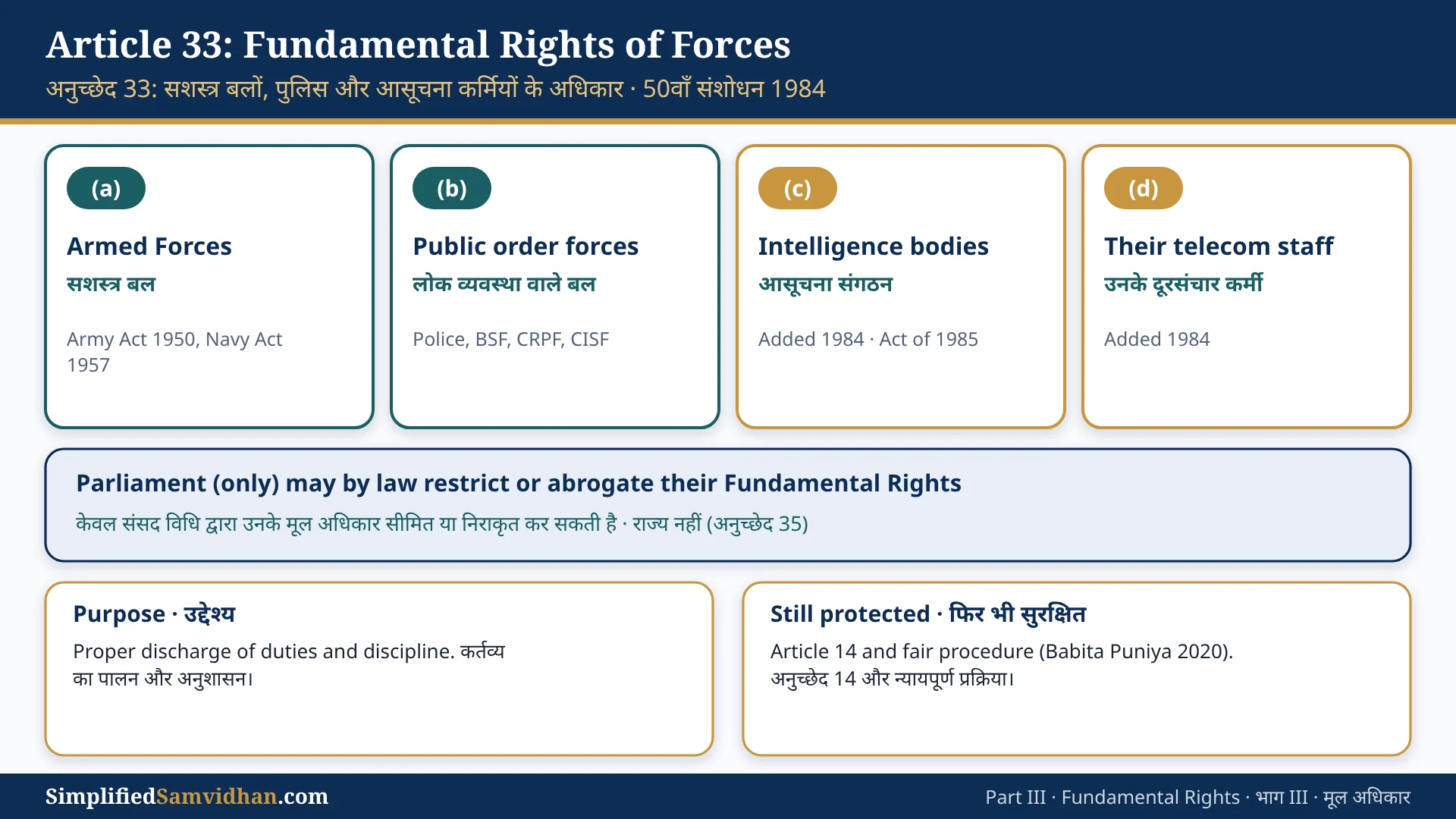
33. Power of Parliament to modify the rights conferred by this Part in their application to Forces, etc.—Parliament may, by law, determine to what extent any of the rights conferred by this Part shall, in their application to,—
(a) the members of the Armed Forces; or
(b) the members of the Forces charged with the maintenance of public order; or
(c) persons employed in any bureau or other organisation established by the State for purposes of intelligence or counter intelligence; or
(d) persons employed in, or in connection with, the telecommunication systems set up for the purposes of any Force, bureau or organisation referred to in clauses (a) to (c),
be restricted or abrogated so as to ensure the proper discharge of their duties and the maintenance of discipline amongst them.
Why it exists: an army runs on orders. If soldiers could form unions, strike or campaign for a party under Article 19, discipline and national security would suffer.
Only Parliament can make this law (Article 35). A State Assembly cannot cut down the rights of its own police under Article 33.
Restrict or abrogate: Parliament can limit a right (for example, speech) or remove it fully (for example, the right to form associations), but only as much as is needed for discipline and duty.
Court-martial: Article 33 also allows military courts under the Army, Navy and Air Force Acts. A court-martial decision can be appealed to the Armed Forces Tribunal (2007 Act), and then to the Supreme Court.
Rights still kept: courts have held that soldiers remain citizens: Article 14 applies to them (women officers' permanent commission, Babita Puniya 2020), and punishment needs a fair procedure.
🏠 Everyday Analogy
A school cricket team captain can tell players when to sleep, what to wear and not to talk to the media during a tournament, rules that would be strange for an ordinary student. Article 33 is the rule that allows such special discipline for those who guard the country, but the captain still cannot treat players unfairly.
🇮🇳 Real Indian Example
Under the Police Forces (Restriction of Rights) Act, 1966, a constable of the Delhi Police cannot become a member of a trade union or political association without permission and cannot speak to the press on political matters. When Delhi Police staff challenged limits on their association, the Supreme Court upheld them in Delhi Police Non-Gazetted Karmachari Sangh v Union of India (1987) under Article 33.
Who and Which LawsArticle 33 of Indian Constitution: Who Is Covered and Which Laws Apply
| Group under Article 33 | Examples | Laws made by Parliament |
|---|---|---|
| (a) Armed Forces | Army, Navy, Air Force; GREF staff (R. Viswan 1983) | Army Act 1950, Air Force Act 1950, Navy Act 1957 |
| (b) Forces for public order | Police, BSF, CRPF, ITBP, SSB, Assam Rifles, CISF, NSG | Police Forces (Restriction of Rights) Act 1966, BSF Act 1968, CRPF Act 1949, CISF Act 1968 |
| (c) Intelligence bodies | Intelligence Bureau, R&AW, other intelligence units | Intelligence Organisations (Restriction of Rights) Act 1985 |
| (d) Their telecom staff | Signal and communication staff of the above | Same Acts |
- Rights usually restricted: freedom of speech, assembly and association under Article 19, and the right to strike; trial by court-martial instead of ordinary courts.
- Prithi Pal Singh Bedi v Union of India (1982): restrictions are valid only to the extent necessary for discipline; the rest of Part III still protects the soldier.
Story and CasesArticle 33 History and Cases: From 1950 to the 50th Amendment and Beyond
- 1950: the framers copied the idea from democracies like the UK and USA, where military law has always been separate. The original text covered only the Armed Forces and public-order forces.
- 1984: after the assassination of Prime Minister Indira Gandhi and growing security threats, the 50th Amendment extended Article 33 to intelligence organisations and their telecom staff. The Intelligence Organisations (Restriction of Rights) Act followed in 1985.
- Ram Sarup v Union of India (1964): Army Act provisions on court-martial were upheld under Article 33.
- Babita Puniya (2020): the Supreme Court ordered permanent commission for women officers in the Army, saying Article 33 does not allow unfair discrimination.
- Joseph Shine clarification (2023): although adultery is no longer a crime, the armed forces can still punish it as misconduct under service law, because of Article 33.
Quick RevisionKey Points to Remember
- Only Parliament can restrict or abrogate Fundamental Rights under Article 33.
- Four groups: Armed Forces, public-order forces, intelligence bodies, their telecom staff.
- Clauses (c) and (d) were added by the 50th Amendment 1984.
- Purpose: discipline and proper discharge of duties only.
- Article 14 and fair procedure still protect members (Babita Puniya 2020).
TimelineArticle 33: Key Dates and Cases
| Year | Event |
|---|---|
| 1950 | Article 33 in force; Army Act and Air Force Act passed. |
| 1964 | Ram Sarup: court-martial under Army Act upheld. |
| 1966 | Police Forces (Restriction of Rights) Act. |
| 1982 | Prithi Pal Singh Bedi: restriction only as far as necessary. |
| 1984 | 50th Amendment adds intelligence and telecom staff. |
| 2007 | Armed Forces Tribunal Act: appeals against court-martial. |
| 2020 | Babita Puniya: permanent commission for women officers. |
UPSC · State PSC · JudiciaryArticle 33: UPSC Exam Corner
- Prelims trap: "State Legislatures can restrict the Fundamental Rights of the State police under Article 33." False. Only Parliament (Article 35).
- Prelims fact: intelligence organisations were added to Article 33 by the 50th Amendment, 1984.
Practice MCQTest Yourself: Article 33
Under Article 33, who can restrict the Fundamental Rights of members of the Armed Forces?
Doubts ClearedFrequently Asked Questions
What is Article 33 of Indian Constitution?
Article 33 allows Parliament to make laws restricting or abrogating the Fundamental Rights of the Armed Forces, public-order forces, intelligence organisations and their telecom staff, to ensure discipline and duty.
Can soldiers form a union or go on strike in India?
No. The Army Act 1950 and similar laws made under Article 33 bar members from forming unions, striking or taking part in political activity.