Bare ActOfficial Text of Article 25
25. Freedom of conscience and free profession, practice and propagation of religion.—
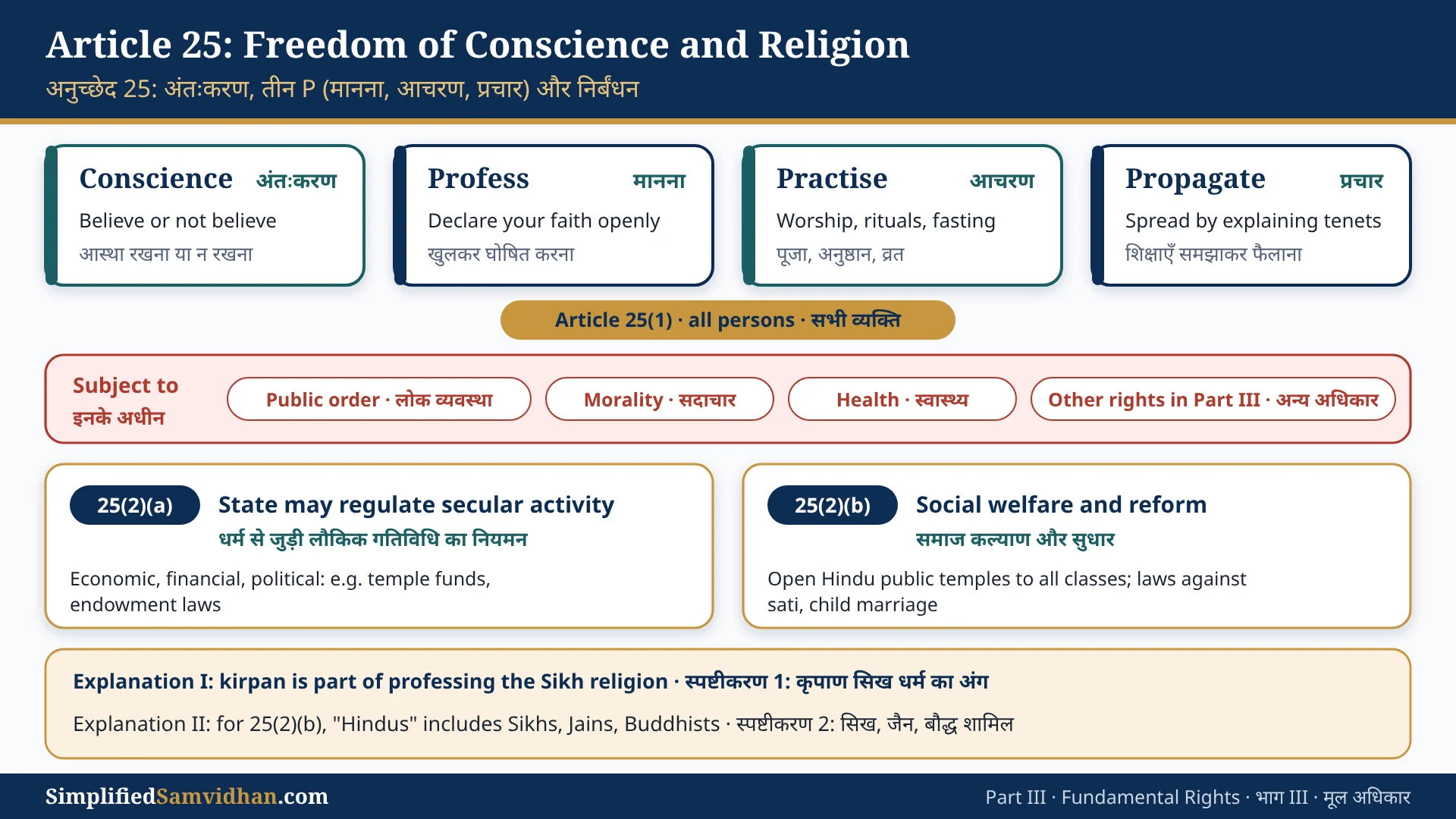
(1) Subject to public order, morality and health and to the other provisions of this Part, all persons are equally entitled to freedom of conscience and the right freely to profess, practise and propagate religion.
(2) Nothing in this article shall affect the operation of any existing law or prevent the State from making any law—
(a) regulating or restricting any economic, financial, political or other secular activity which may be associated with religious practice;
(b) providing for social welfare and reform or the throwing open of Hindu religious institutions of a public character to all classes and sections of Hindus.
Explanation I.—The wearing and carrying of kirpans shall be deemed to be included in the profession of the Sikh religion.
Explanation II.—In sub-clause (b) of clause (2), the reference to Hindus shall be construed as including a reference to persons professing the Sikh, Jaina or Buddhist religion, and the reference to Hindu religious institutions shall be construed accordingly.
Every person has freedom of conscience: you may believe in any religion, or in none.
You can profess (declare), practise (follow) and propagate (spread) your religion. These are often called the 3 Ps.
The right is for all persons, citizens and foreigners alike.
It is not absolute: the State can limit it for public order, morality and health, and can make laws on the money and politics linked to religion and for social reform.
Sikhs may wear and carry the kirpan (Explanation I).
🏠 Everyday Analogy
Think of a big apartment society. Every family may decorate its own home, pray in its own way and invite friends to its festivals. But the society can still say: no fireworks at 2 am, no blocking the gate, keep the stairs clean. Article 25 works the same way: your faith is yours, but shared spaces have shared rules.
🇮🇳 Real Indian Example
In Amritsar, Harpreet carries a kirpan to college; Explanation I protects this. In Kochi, a church runs a radio programme on its teachings; that is propagation. In Delhi, the police fix a route and timing for a Muharram procession and a Ram Navami procession in the same week; that is regulation for public order. None of these takes away anyone's faith.
Conscience and the 3 PsArticle 25 of Indian Constitution: Freedom of Conscience and the 3 Ps
| Part of the right | Meaning | Example |
|---|---|---|
| Freedom of conscience | Inner freedom to believe or not to believe; it also covers atheists | A person may follow no religion at all |
| Profess | Declare your faith openly | Wearing a cross, a turban, a tilak or a skullcap |
| Practise | Perform worship, rituals and ceremonies | Namaz, puja, prayers in a gurdwara or church, fasting |
| Propagate | Spread your faith by explaining its tenets | Preaching, printing books, religious talks on TV |
- The words are "all persons are equally entitled". So foreigners living in India also have this right, unlike Article 19, which is for citizens only.
- Explanation I: wearing and carrying a kirpan is part of professing the Sikh religion. Rules on its size, for example on flights, are still possible as reasonable regulation.
- Explanation II: for clause (2)(b) only, "Hindus" includes Sikhs, Jains and Buddhists. So a temple-entry or reform law can cover their public institutions too. It does not say these religions are part of Hinduism for any other purpose.
The Indian idea of secularism
- India has no State religion. Articles 25 to 28 together make the State neutral among faiths.
- Western secularism (for example in the USA or France) keeps a strict wall between State and religion. Indian secularism is often described as equal respect for all religions (sarva dharma sambhava) with principled distance: the State does not favour any faith, but it can step in for reform, as Article 25(2) allows.
- The word "secular" was added to the Preamble by the 42nd Amendment, 1976; S.R. Bommai (1994) made secularism part of the basic structure.
Reasonable RestrictionsArticle 25 Restrictions: Public Order, Morality, Health and Social Reform
| Limit | What it allows | Example from courts |
|---|---|---|
| Public order | Stop religious acts that disturb peace | Processions may be regulated by the police |
| Morality | Stop practices against public morality | Devadasi dedication is banned by State laws |
| Health | Protect the health of the public | Church of God (Full Gospel) v. KKR Majestic Colony (2000): no religion needs loudspeakers that disturb others |
| Other provisions of Part III | Religion must respect other rights | Article 17: untouchability cannot be justified by religion |
| 25(2)(a) secular activity | Regulate money, property, politics linked to religion | Laws on management of temple funds and endowments |
| 25(2)(b) social reform | Reform laws and opening Hindu temples to all classes | Temple entry laws; laws against sati and child marriage |
Essential religious practices (a short note)
- Courts give the strongest protection to practices that are essential to a religion. The idea started in Commissioner, Hindu Religious Endowments, Madras v. Sri Lakshmindra Thirtha Swamiar of Sri Shirur Mutt (1954).
- Mohd. Hanif Quareshi v. State of Bihar (1958): sacrifice of a cow on Bakrid was held not to be an essential practice of Islam, so a ban on cow slaughter was valid.
- Bijoe Emmanuel v. State of Kerala (1986): three Jehovah's Witness children who stood respectfully but did not sing the national anthem could not be expelled (Articles 19(1)(a) and 25).
- The full test, with the Sabarimala case, is on the Article 26 page.
Propagation and ConversionArticle 25 and Conversion: Rev. Stainislaus v. State of Madhya Pradesh (1977)
- The right to propagate led some people to believe that converting others is also a fundamental right. In some remote tribal areas, conversions led to tension and law and order problems.
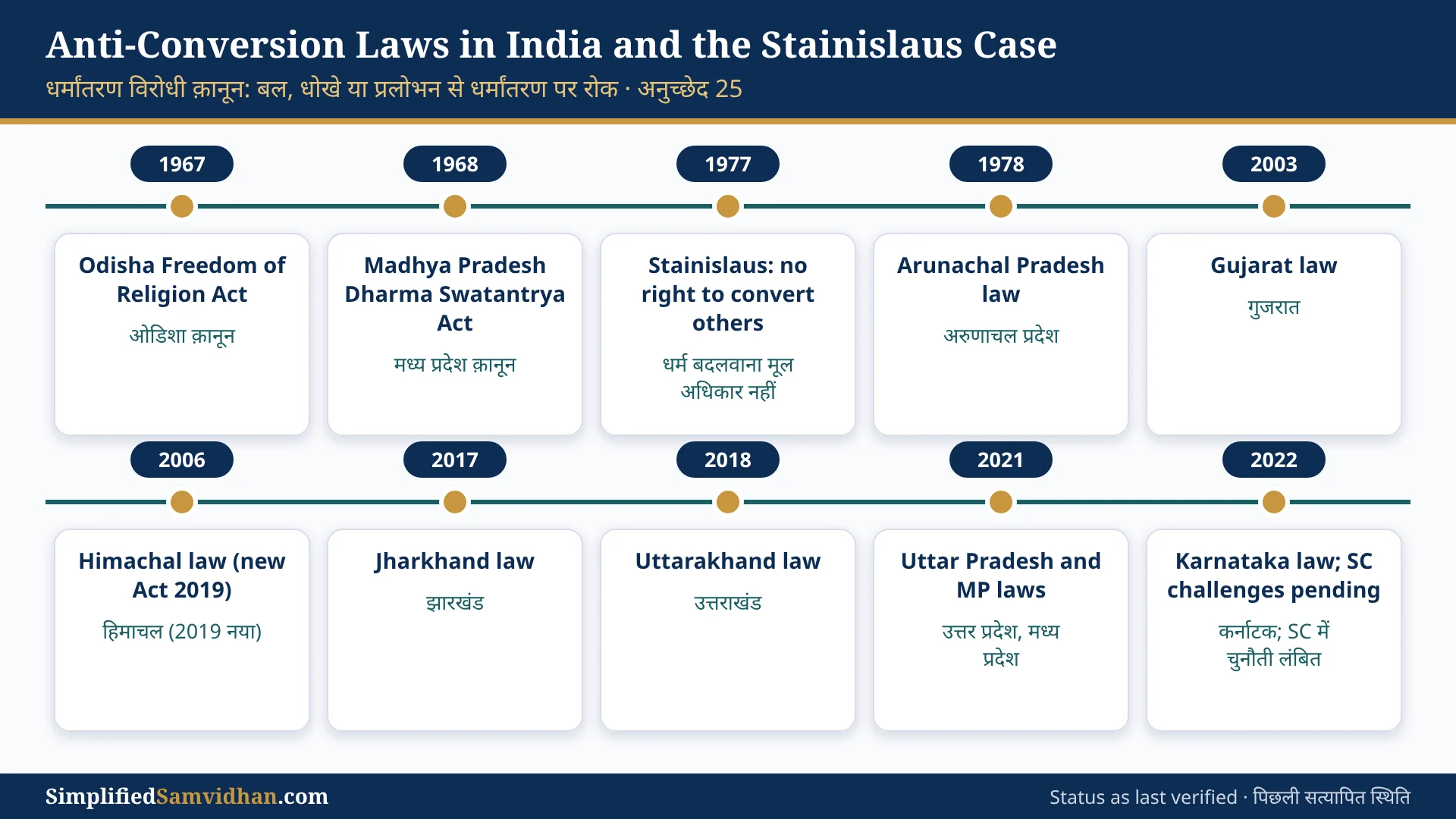
- Odisha (Orissa Freedom of Religion Act, 1967) and Madhya Pradesh (Dharma Swatantrya Adhiniyam, 1968) passed laws against conversion by force, fraud or allurement. The MP law required the conversion to be reported to the District Magistrate.
- Rev. Stainislaus v. State of Madhya Pradesh (17 January 1977, five judges): Article 25 gives the right to propagate, that is, to spread one's religion by explaining its tenets. It does not give a fundamental right to convert another person, because that would hit the equal freedom of conscience of the other person. The laws were upheld as laws for public order, a State subject.
- A person's own choice to change faith is protected. In Shafin Jahan v. Asokan K.M. (Hadiya case, 2018) the Court said an adult's choice of faith and partner is part of liberty and privacy.
- Conversion cannot be used to escape other laws. In Sarla Mudgal (1995) and Lily Thomas (2000) the Court held that a Hindu husband who converts only to marry again still commits bigamy.
State laws today
- Several States have laws on conversion, for example Arunachal Pradesh (1978), Gujarat (2003), Himachal Pradesh (2006, replaced in 2019, amended 2022), Jharkhand (2017), Uttarakhand (2018), Uttar Pradesh (2021), Madhya Pradesh (2021) and Karnataka (2022).
- Many newer laws add rules on conversion for marriage, prior notice to the District Magistrate and a burden of proof on the person who converts or helps.
- Petitions challenging several of these laws (for example from Uttar Pradesh, Uttarakhand, Himachal Pradesh and Madhya Pradesh) were pending before the Supreme Court at the last verified hearing. Some parts of the Gujarat 2021 amendment on interfaith marriage were stayed by the Gujarat High Court in 2021.
- Conversion also affects Scheduled Caste status: see our explainer on religious conversion and reservation.
National Law DebateArticle 25 Debate: Should India Have a National Anti-Conversion Law?
- There is no central law on religious conversion. Private member's bills for one were moved in Parliament (for example in 1954, 1960 and 1979) but none was passed.
- A PIL asking for a national law against conversion by force, fraud or allurement (Ashwini Kumar Upadhyay v. Union of India) was filed in 2022. In November 2022 a bench called forced conversion a serious issue and sought the Centre's response; the matter was pending at the last verified hearing.
- The main arguments on each side, as usually presented in exam answers:
| Arguments for a national law | Arguments against a national law |
|---|---|
| One uniform standard instead of different State laws | Public order is a State subject (List II, Entry 1); States already legislate as needed |
| Protects poor and vulnerable people from force, fraud and allurement | Existing criminal law (BNS) already punishes force, fraud and cheating |
| Stainislaus (1977): there is no fundamental right to convert another person | Choice of faith is part of privacy and dignity (Puttaswamy 2017; Shafin Jahan 2018) |
| Conversion disputes can create law and order problems in remote areas | Prior-notice rules and vague words like "allurement" may be misused against genuine converts |
| In 2022 the Supreme Court called forced conversion a serious issue | Root causes are poverty, lack of schools and health care; a law alone does not fix them |
Way forward (exam view)
- Points often made in UPSC answers: conversion disputes are mostly seen in remote, backward areas, not in cities, so development (roads, schools, health care, jobs) reduces the pressure that makes people vulnerable.
- Any law, State or central, should define "force", "fraud" and "allurement" clearly, protect an adult's free choice, and have safeguards against misuse.
- Many answers treat a new law as a last resort, used only where existing laws and development measures fall short. Others argue a uniform law gives clarity. A balanced answer presents both.
Santhara (Sallekhana)Article 25 and Santhara: The Jain Practice of Sallekhana
- Santhara or sallekhana is a Jain vow of giving up food and water step by step, usually at the end of life, to meet death calmly.
- 2006: a PIL, Nikhil Soni v. Union of India, was filed in the Rajasthan High Court, arguing that santhara is like suicide.
- 10 August 2015: the Rajasthan High Court held that santhara is not an essential practice of Jainism, that Article 21 does not include a right to die, and that it is punishable like suicide and abetment (IPC sections 309 and 306).
- 31 August 2015: the Supreme Court stayed the High Court judgment. The appeals are pending; there is no final Supreme Court ruling. Meanwhile the practice continues.
Arguments on each side
- Jain community view: santhara is a spiritual practice protected by the right to profess and practise religion (Article 25) and the right to manage religious affairs (Article 26). It is not suicide, which comes from despair; it is a calm vow taken with religious guidance.
- Petitioners' view: the State must protect life; elderly or sick persons may face social pressure; Gian Kaur v. State of Punjab (1996) held that Article 21 does not include a right to die by suicide.
- Law today: the IPC was replaced by the Bharatiya Nyaya Sanhita on 1 July 2024. BNS has no general offence of attempt to suicide (section 226 covers only attempts to compel or restrain a public servant), and the Mental Healthcare Act 2017 (section 115) presumes severe stress in a suicide attempt. The question of abetment remains for the Supreme Court.
Hijab CaseArticle 25 and the Karnataka Hijab Case: The 2022 Split Verdict
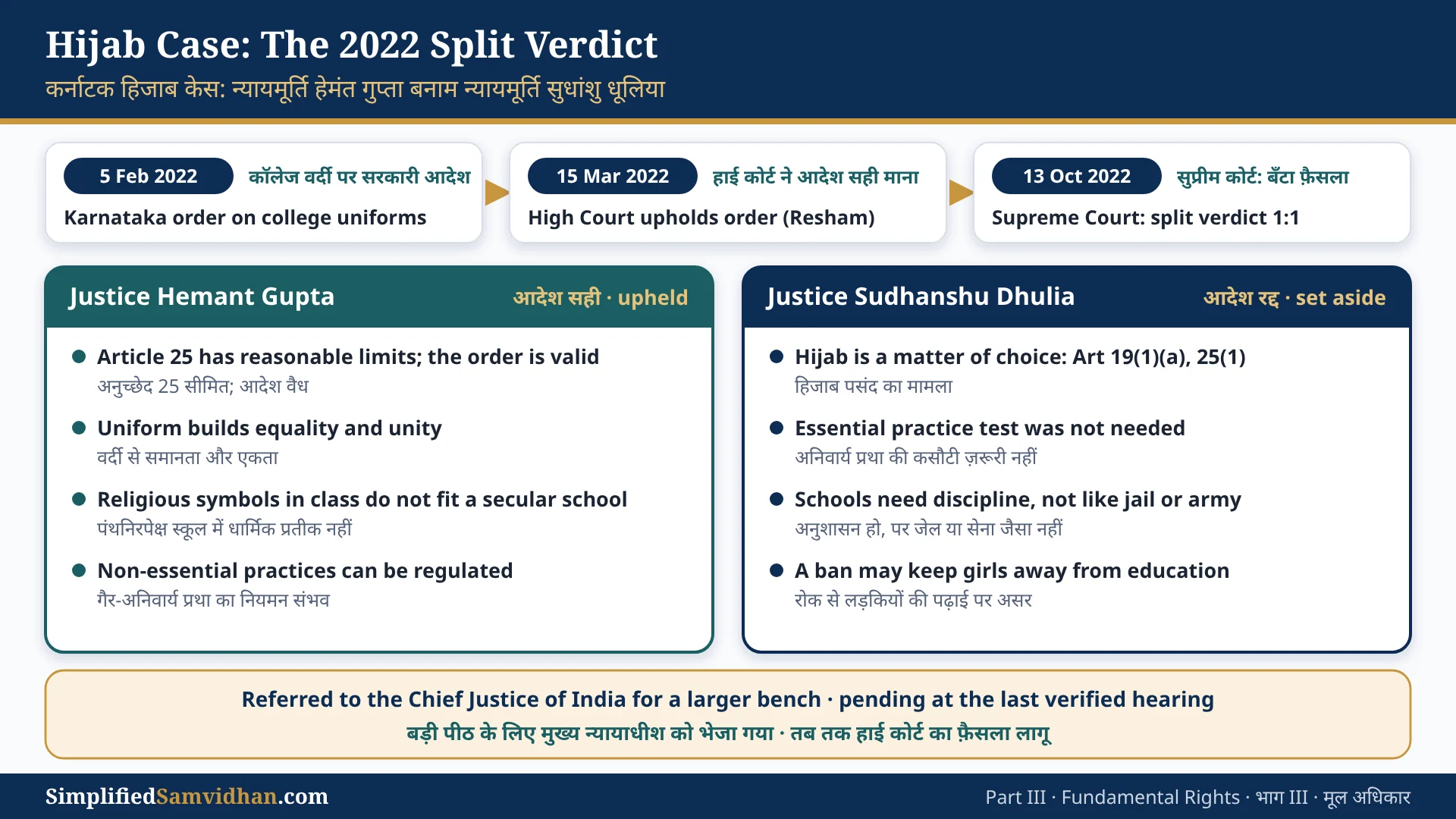
- 5 February 2022: a Karnataka government order asked pre-university colleges to follow the uniform set by their college committees. In practice this stopped students from wearing the hijab in classrooms in several colleges.
- 15 March 2022: a three-judge bench of the Karnataka High Court (Resham v. State of Karnataka) upheld the order. It held that wearing the hijab is not an essential religious practice of Islam, that a uniform is a reasonable restriction, and that it promotes equality.
- 13 October 2022: a two-judge bench of the Supreme Court (Aishat Shifa v. State of Karnataka) gave a split verdict:
| Justice Hemant Gupta (upheld the order) | Justice Sudhanshu Dhulia (set aside the order) |
|---|---|
| Article 25 is subject to reasonable restrictions; the order is valid | Wearing a hijab is a matter of choice, protected by Articles 19(1)(a) and 25(1) |
| A uniform builds equality and unity; religious symbols in class do not fit a secular school | The essential religious practice test was not needed to decide the case |
| Practices that are not essential can be regulated | Schools need discipline, but not the discipline of a jail or the army |
| Dismissed the appeals | Worried that a ban may push girls out of education; allowed the appeals |
- Because the judges differed, the matter was placed before the Chief Justice of India for a larger bench. It was pending at the last verified hearing; the High Court judgment stands until then.
- The case raises wider questions that are also before the nine-judge Sabarimala reference: how far courts should decide what is essential to a religion, and how Article 25 fits with Articles 14, 19 and 21. A larger bench may give clarity.
Quick RevisionKey Points to Remember
- Article 25 gives all persons freedom of conscience and the right to profess, practise and propagate religion.
- Limits: public order, morality, health and other provisions of Part III; plus laws under 25(2) on secular activity and social reform.
- Explanation I: kirpan; Explanation II: "Hindus" in 25(2)(b) includes Sikhs, Jains and Buddhists.
- Rev. Stainislaus (1977): right to propagate, but no fundamental right to convert another person.
- Santhara (stay since 2015) and the hijab case (split verdict 2022) are pending before the Supreme Court.
TimelineArticle 25 Freedom of Religion: Key Dates
| Year | Event |
|---|---|
| 1950 | Article 25 comes into force with the Constitution (26 January). |
| 1954 | Shirur Mutt: essential practices of religion are protected. |
| 1958 | Hanif Quareshi: cow sacrifice on Bakrid not an essential practice. |
| 1967-68 | Odisha (1967) and Madhya Pradesh (1968) conversion laws. |
| 1977 | Rev. Stainislaus (17 Jan): no fundamental right to convert another person. |
| 1986 | Bijoe Emmanuel: no one forced to sing the national anthem. |
| 1994 | S.R. Bommai: secularism is part of the basic structure. |
| 2015 | Santhara: Rajasthan HC ruling (10 Aug), stayed by the Supreme Court (31 Aug). |
| 2018 | Hadiya case: adult's choice of faith protected; Sabarimala judgment. |
| 2021-22 | New conversion laws in UP, MP (2021) and Karnataka (2022). |
| 2022 | Hijab case: HC upholds order (15 Mar); SC split verdict (13 Oct). |
UPSC · State PSC · JudiciaryArticle 25: UPSC Exam Corner
- Prelims trap: "Freedom of religion under Article 25 is available only to citizens." False. It is for all persons.
- Prelims trap: "The right to propagate includes the right to convert others." False (Stainislaus, 1977).
- Prelims fact: For Article 25(2)(b), "Hindus" includes Sikhs, Jains and Buddhists (Explanation II).
- Mains (250 words, from class notes): The Constitution gives freedom to worship and to propagate religion, and conversion creates challenges. In your view, is a national anti-conversion law appropriate? Give arguments.
- Mains (250 words, from class notes): Describe the provisions of religious freedom in the Constitution and explain where reasonable restrictions can be placed on them.
Practice MCQTest Yourself: Article 25
Which of the following statements about Article 25 are correct? 1. It is available to foreigners also. 2. In Rev. Stainislaus (1977) the Supreme Court held that the right to propagate includes the right to convert another person. 3. Wearing and carrying a kirpan is deemed part of professing the Sikh religion.
Doubts ClearedFrequently Asked Questions
What is Article 25 of Indian Constitution?
Article 25 gives all persons freedom of conscience and the right to freely profess, practise and propagate religion, subject to public order, morality, health and the other fundamental rights. The State may also regulate secular activities linked to religion and make laws for social reform.
Is religious conversion a fundamental right in India?
A person's own free choice to change religion is protected. But in Rev. Stainislaus v. State of Madhya Pradesh (1977) the Supreme Court held that the right to propagate does not include a fundamental right to convert another person. States may regulate conversion by force, fraud or allurement.
Is Santhara legal in India?
The Rajasthan High Court treated santhara as punishable in August 2015, but the Supreme Court stayed that judgment on 31 August 2015. The appeals are pending, so there is no final ruling and the practice continues.
What did the Supreme Court decide in the hijab case?
On 13 October 2022 a two-judge bench gave a split verdict: Justice Hemant Gupta upheld the Karnataka order, Justice Sudhanshu Dhulia set it aside. The case was sent to the Chief Justice for a larger bench and was pending at the last verified hearing.