Bare ActOfficial Text of Article 21A
21A. Right to education.—
The State shall provide free and compulsory education to all children of the age of six to fourteen years in such manner as the State may, by law, determine.
Every child aged 6 to 14 has a Fundamental Right to free and compulsory education.
Free means no fees or charges that stop a child from finishing class 8. Compulsory means the State must ensure admission, attendance and completion; it is a duty on the State, not a punishment for parents.
The words "in such manner as the State may, by law, determine" let Parliament decide the details: that law is the RTE Act 2009.
Private schools must keep 25% of entry-level seats for children from poorer and disadvantaged families, and the government pays their fees.
🏠 Everyday Analogy
Think of Article 21A as a ticket that every child gets at age six. It is valid for eight years of school, class 1 to class 8. No one can charge for the ticket, no school near home can refuse it, and the State is the conductor who must make sure the child actually boards the bus and reaches the last stop.
🇮🇳 Real Indian Example
Seven-year-old Aarav's father drives an auto-rickshaw in Jaipur. Through the State's online RTE lottery, Aarav gets a seat in a well-known private school near his home under section 12(1)(c). He pays no tuition fee; the Rajasthan government reimburses the school. The school cannot interview his parents or ask for a donation.
OriginArticle 21A of Indian Constitution: How Education Became a Fundamental Right
- The original Article 45 (a Directive Principle) asked the State to provide free and compulsory education for all children until 14 years within ten years of 1950. The target was missed, and a Directive Principle cannot be enforced in court.
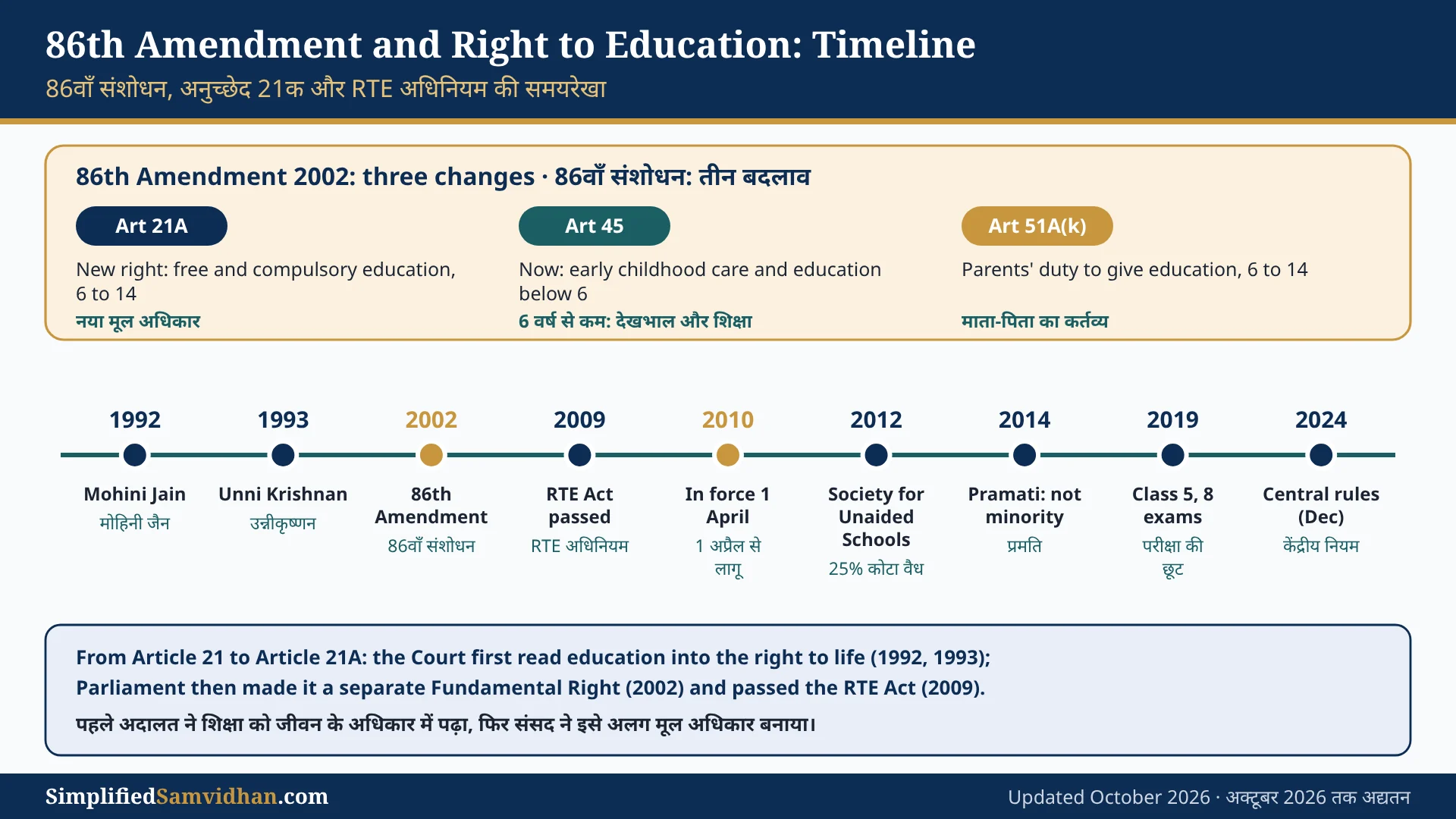
- Mohini Jain v. State of Karnataka (1992): the Court held that the right to education flows from the right to life in Article 21, and charging a capitation fee is against it.
- Unni Krishnan v. State of Andhra Pradesh (1993, 5 judges): narrowed it to a clear rule. Every child has a right to free education until 14; after that, it depends on the State's economic capacity.
- Parliament then passed the 86th Amendment, 2002, inserting Article 21A. It was brought into force on 1 April 2010, together with the RTE Act.
Three changes made by the 86th Amendment
| Article | Change |
|---|---|
| 21A (Part III) | New Fundamental Right: free and compulsory education for children of 6 to 14 |
| 45 (Part IV) | Substituted: the State shall endeavour to provide early childhood care and education for all children until they complete six years |
| 51A(k) (Part IVA) | New Fundamental Duty: a parent or guardian shall provide opportunities for education to his child or ward between 6 and 14 |
RTE Act 2009Article 21A of Indian Constitution and the RTE Act 2009: Key Provisions
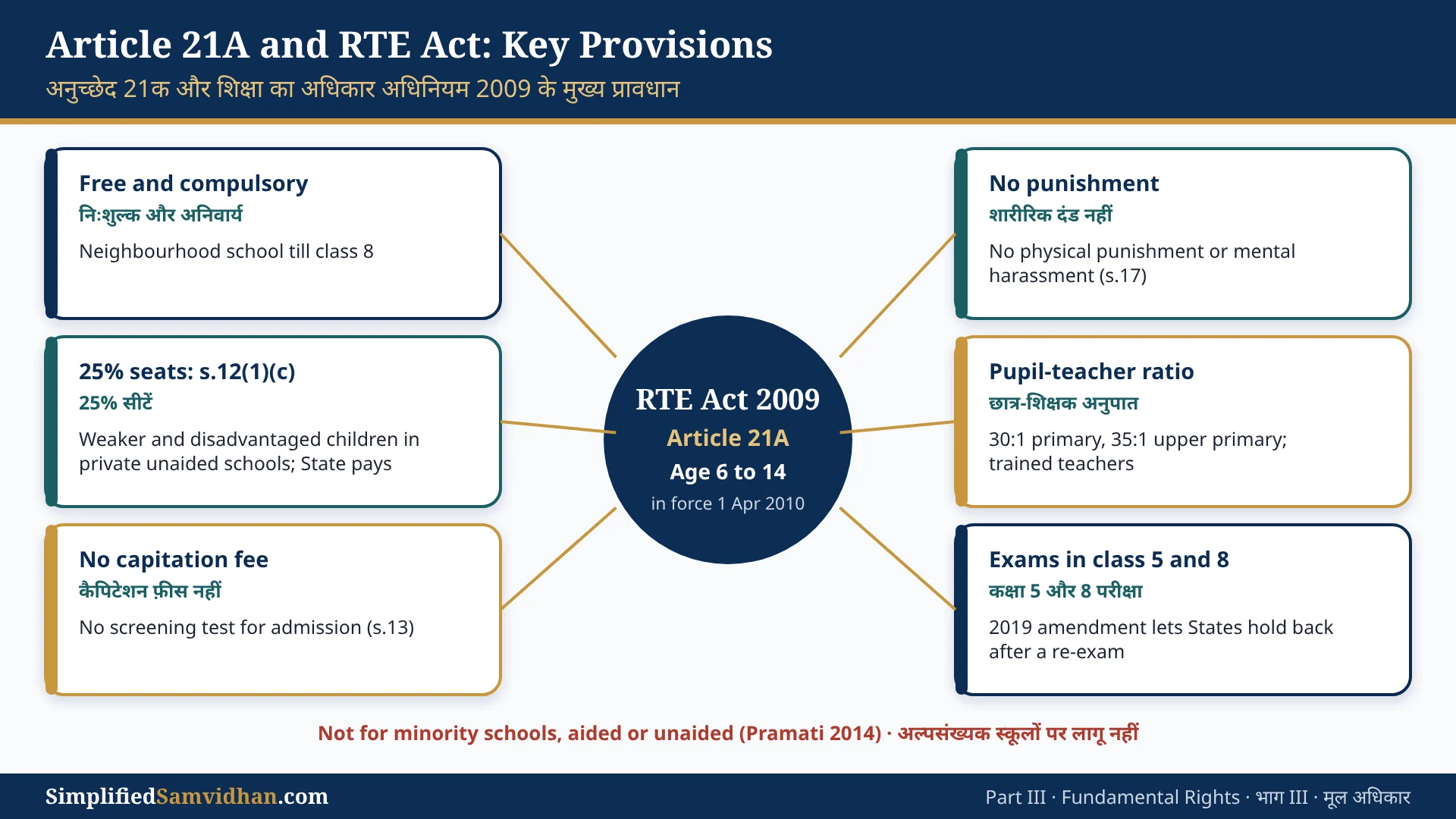
- The Right of Children to Free and Compulsory Education Act, 2009 was passed by Parliament and came into force on 1 April 2010. It is the law that Article 21A asks for.
| Section of RTE Act 2009 | What it says |
|---|---|
| s.3 | Every child of 6 to 14 has the right to free and compulsory education in a neighbourhood school till elementary education (class 1 to 8) is complete |
| s.8, s.9 | The appropriate Government and local authority must ensure admission, attendance and completion, and set up schools within a set distance |
| s.12(1)(c) | Private unaided schools reserve 25% of entry-level seats for children from weaker sections and disadvantaged groups; the State reimburses the cost (s.12(2)) |
| s.13 | No capitation fee and no screening test of the child or parents for admission |
| s.16 | No-detention rule; since the 2019 amendment, States may hold regular exams in classes 5 and 8 and hold back a child who fails a re-exam within two months |
| s.17 | No physical punishment or mental harassment |
| s.19, s.25 and Schedule | Norms for schools: buildings, teaching days, pupil-teacher ratio of 30:1 (primary) and 35:1 (upper primary) |
| s.21 | School Management Committees with parents as at least three-fourths of members |
| s.23 | Teachers must have the minimum qualifications set by the academic authority (NCTE) |
| s.31 | NCPCR and State Commissions for Protection of Child Rights monitor the right |
Key CasesArticle 21A of Indian Constitution: 25% Quota, Minority Schools and Key Cases
- Society for Unaided Private Schools of Rajasthan v. Union of India (12 April 2012, 3 judges, 2:1): the RTE Act and the 25% quota under section 12(1)(c) are valid for government, aided and unaided non-minority schools. It was held not to apply to unaided minority schools.
- Pramati Educational and Cultural Trust v. Union of India (6 May 2014, 5 judges): Article 21A and Article 15(5) are valid and do not damage the basic structure. But the RTE Act does not apply to minority schools, whether aided or unaided, because forcing it on them would affect their rights under Article 30(1).
- So the 25% quota binds private non-minority unaided schools; religious and linguistic minority schools are outside the Act.
- Points often made in exam answers: supporters say the quota builds social mixing and gives poor children a fair start; private schools point to late or low reimbursement, and some say the minority exemption creates an uneven field. Both views appear in the debate.
No-Detention PolicyArticle 21A of Indian Constitution: No-Detention Policy and Recent Changes
- The original section 16 of the RTE Act said no child would be held back or expelled till class 8, together with continuous and comprehensive evaluation. The aim was to stop children dropping out after failing.
- Many States reported that learning levels fell because children were promoted without basic skills. The RTE (Amendment) Act, 2019 allowed the appropriate Government to hold regular exams in classes 5 and 8; a child who fails gets extra teaching and a re-exam within two months, and may be held back if he fails again. No child can be expelled till class 8.
- Each State decides whether to use this option, so the rule differs from State to State.
- In December 2024 the Centre amended its RTE rules for the schools it runs, such as Kendriya Vidyalayas, Navodaya Vidyalayas and Sainik Schools, to apply this exam-and-re-exam system in classes 5 and 8.
- The National Education Policy 2020 aims to bring education from age 3 to 18 within reach; this is a policy goal, while Article 21A still covers ages 6 to 14.
Quick RevisionKey Points to Remember
- Article 21A: free and compulsory education for all children of 6 to 14.
- Inserted by the 86th Amendment 2002, which also changed Article 45 and added Article 51A(k).
- RTE Act 2009 in force from 1 April 2010, together with Article 21A.
- 25% entry-level seats in private unaided schools for weaker and disadvantaged children (s.12(1)(c)).
- Pramati (2014): RTE Act does not apply to minority schools, aided or unaided.
TimelineArticle 21A and RTE: Key Dates
| Year | Event |
|---|---|
| 1950 | Article 45 sets a ten-year goal of free education till 14. |
| 1992 | Mohini Jain: education linked to Article 21. |
| 1993 | Unni Krishnan: free education till 14 is a right. |
| 2002 | 86th Amendment: Articles 21A, 45 and 51A(k). |
| 2009 | RTE Act passed by Parliament. |
| 2010 | Article 21A and RTE Act in force (1 April). |
| 2012 | Society for Unaided Private Schools: 25% quota upheld. |
| 2014 | Pramati: RTE Act not for minority schools. |
| 2019 | RTE Amendment: exams in classes 5 and 8 allowed. |
| 2024 | Centre amends rules for its own schools (December). |
UPSC · State PSC · JudiciaryArticle 21A: UPSC Exam Corner
- Prelims trap: "Article 21A was added by the 42nd Amendment." False. 86th Amendment, 2002.
- Prelims trap: "The RTE Act's 25% quota applies to unaided minority schools." False (Pramati, 2014).
- Prelims fact: The 86th Amendment changed three Articles: 21A (right), 45 (early childhood care, below 6) and 51A(k) (parents' duty).
- Mains PYQ: "Right of Children to Free and Compulsory Education Act, 2009 remains inadequate in promoting incentive-based system for children's education without generating awareness about the importance of education." Analyse.
- Practice (150 words): How did the right to education move from a Directive Principle to a Fundamental Right?
Practice MCQTest Yourself: Article 21A
The 86th Constitutional Amendment Act, 2002 made changes to which of the following? 1. Article 21A 2. Article 45 3. Article 51A 4. Article 30
Doubts ClearedFrequently Asked Questions
What is Article 21A of Indian Constitution?
Article 21A makes free and compulsory education for all children aged 6 to 14 a Fundamental Right, in the manner the State decides by law. It was added by the 86th Amendment 2002 and came into force on 1 April 2010.
What is the 25% quota under the RTE Act?
Section 12(1)(c) requires private unaided schools to admit children from weaker sections and disadvantaged groups in at least 25% of entry-level seats, free of cost. The government reimburses the school.
Does the RTE Act apply to minority schools?
No. In Pramati Educational and Cultural Trust v. Union of India (2014) a five-judge bench held that the RTE Act does not apply to minority schools, aided or unaided, because of their rights under Article 30(1).
Can a child be failed in class 5 or 8 now?
Since the RTE (Amendment) Act 2019, a State may hold regular exams in classes 5 and 8. A child who fails gets a re-exam within two months and may be held back if he fails again. The Centre adopted this for its own schools in December 2024. No child can be expelled till class 8.