Bare ActOfficial Text of Article 27
27. Freedom as to payment of taxes for promotion of any particular religion.—
No person shall be compelled to pay any taxes, the proceeds of which are specifically appropriated in payment of expenses for the promotion or maintenance of any particular religion or religious denomination.
The State cannot levy a tax and set its money aside to promote or maintain one religion.
It protects every person, citizen or foreigner, and no religious group is favoured or burdened.
It is about taxes, not fees. A fee for a service, such as supervising temple accounts, is allowed.
Spending a small part of general revenue on secular aspects linked to religion, such as pilgrim safety, is not barred.
🏠 Everyday Analogy
Think of a housing society's maintenance fund. Everyone pays for lifts, water and security. The committee cannot use that common fund to build a prayer hall for only one faith. But if residents of a faith ask the society to clean up after their festival and pay a cleaning charge, that is a fee, and it is fine.
🇮🇳 Real Indian Example
At the Kumbh Mela in Prayagraj, the government spends public money on roads, toilets, police and medical camps for crores of visitors. These are secular arrangements for public safety and health. A special "Kumbh tax" on all citizens whose money went only to promote one faith would raise an Article 27 question.
What Article 27 SaysArticle 27 of Indian Constitution: No Tax to Promote Any Particular Religion
- Three conditions together attract Article 27: (1) there is a tax; (2) its proceeds are specifically appropriated, that is, earmarked; (3) the purpose is to promote or maintain a particular religion or denomination.
- The word is "No person", so the right protects citizens, foreigners and companies alike.
- It keeps the State neutral: it cannot use its taxing power to favour one faith over others. This is one pillar of Indian secularism, with Articles 25, 26 and 28.
| Point | Tax | Fee |
|---|---|---|
| Purpose | Raises general revenue for public purposes | Paid for a specific service to the payer |
| Link to service | No direct service in return | Roughly linked to the cost of that service |
| Under Article 27 | Barred if its proceeds are specifically appropriated to promote one religion | Allowed, e.g. a charge for supervising temple or math accounts |
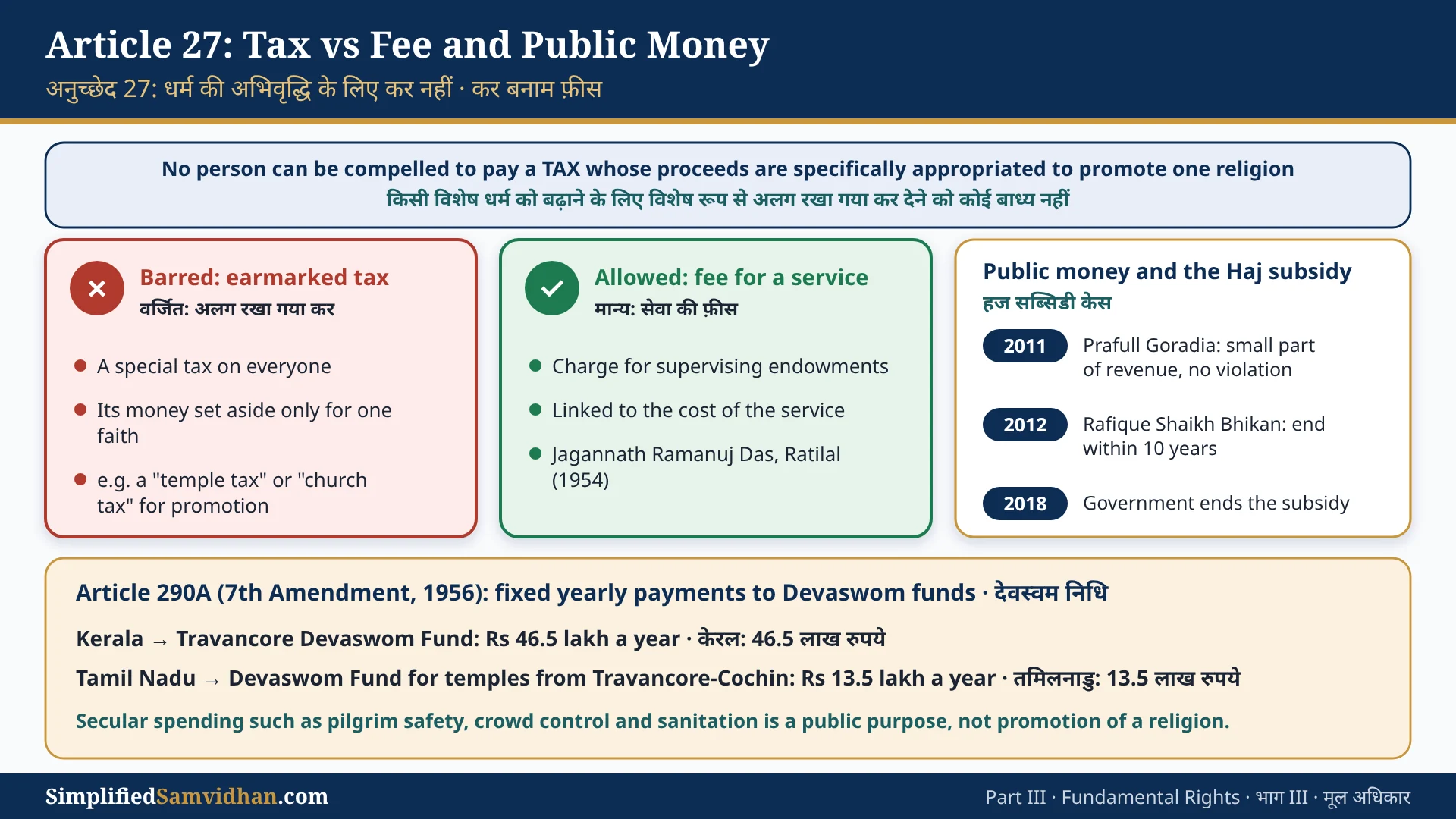
Tax vs FeeArticle 27 Tax vs Fee: The Shirur Mutt and Jagannath Ramanuj Das Cases
- Commissioner, Hindu Religious Endowments, Madras v. Shirur Mutt (1954) explained the difference: a tax is a compulsory payment for general public purposes, while a fee is charged for a special service and is linked to its cost. The Court said Article 27 forbids the specific appropriation of a tax for one religion.
- Jagannath Ramanuj Das v. State of Orissa (1954) and Ratilal Panachand Gandhi v. State of Bombay (1954): a contribution collected from religious endowments to meet the cost of supervising them was a fee, not a tax, so Article 27 was not violated.
- So States can run boards that supervise temples, maths and waqfs and charge a reasonable fee. The money pays for the service of supervision, not for spreading any faith.
Haj Subsidy and Public MoneyArticle 27 and Public Money: Haj Subsidy Case and Article 290A
- Prafull Goradia v. Union of India (28 January 2011): the Haj subsidy was challenged under Article 27. The Court held that Article 27 is violated only if a substantial part of a tax is used for one religion; spending a relatively small part of general revenue was not a violation. It noted that the State also spends on other pilgrimages, such as the Kumbh Mela and the Kailash Mansarovar Yatra.
- Union of India v. Rafique Shaikh Bhikan (8 May 2012): the Court asked the Government to reduce the Haj subsidy step by step and end it within ten years. The Government ended the subsidy from 2018.
- Spending on secular aspects linked to religion, such as security, crowd control, sanitation and roads at pilgrim sites, or upkeep of protected heritage monuments, is generally treated as a public purpose, not promotion of a religion.
Article 290A: Devaswom funds
- Added by the 7th Amendment, 1956, after the reorganisation of States.
- Every year Rs 46.5 lakh is paid from the Consolidated Fund of Kerala to the Travancore Devaswom Fund, and Rs 13.5 lakh from Tamil Nadu to the Devaswom Fund for Hindu temples in the areas that came from Travancore-Cochin.
- These payments continue a promise made when the princely State of Travancore merged; the temples' lands had been taken over by the State earlier. Being a specific constitutional provision, Article 290A stands on its own footing.
Article 27 and SecularismArticle 27 and Indian Secularism: How It Differs from the USA
- The US First Amendment says Congress shall make no law "respecting an establishment of religion", read by US courts as a strict separation of church and State.
- India does not build such a wall. The State may regulate the secular side of religion (Article 25(2)), supervise religious endowments, give aid to schools run by religious groups (Article 30(2)), and spend on pilgrim safety. What it cannot do is tax people to promote one faith.
- There is a continuing debate on State control of temple administration: some argue that it ensures accountability for large funds, others argue that other faiths manage their institutions themselves and Hindu temples should have the same autonomy. Both views appear in exam answers.
Quick RevisionKey Points to Remember
- No person can be compelled to pay a tax whose proceeds are specifically appropriated to promote a particular religion.
- Applies to all persons, citizens and foreigners.
- A fee for a service, such as supervising religious endowments, is allowed (1954 cases).
- Prafull Goradia (2011): using a small part of general revenue, as in the Haj subsidy, did not violate Article 27; the subsidy ended in 2018.
- Article 290A (1956) provides fixed yearly payments to Devaswom funds in Kerala and Tamil Nadu.
TimelineArticle 27: Key Dates
| Year | Event |
|---|---|
| 1950 | Article 27 comes into force with the Constitution. |
| 1954 | Shirur Mutt: tax vs fee; Jagannath Ramanuj Das and Ratilal Gandhi: supervision fee valid. |
| 1956 | 7th Amendment adds Article 290A (Devaswom funds). |
| 2011 | Prafull Goradia (28 Jan): Haj subsidy does not violate Article 27. |
| 2012 | Rafique Shaikh Bhikan (8 May): phase out the Haj subsidy within ten years. |
| 2018 | Government ends the Haj subsidy. |
UPSC · State PSC · JudiciaryArticle 27: UPSC Exam Corner
- Prelims trap: "Article 27 bars the State from spending any public money on anything linked to religion." False. It bars taxes specifically appropriated to promote a particular religion.
- Prelims trap: "A fee charged for supervising religious endowments violates Article 27." False. Article 27 covers taxes, not fees.
- Prelims fact: Article 290A on Devaswom funds was added by the 7th Amendment, 1956.
- Mains (250 words, from class notes): Describe the provisions of religious freedom in the Constitution and explain where reasonable restrictions can be placed on them. (Use Article 27 as the "financial neutrality" part.)
Practice MCQTest Yourself: Article 27
Consider the following statements about Article 27: 1. It forbids the State from spending any public money on any religious event. 2. A fee charged to meet the cost of supervising religious endowments does not violate it. 3. Its protection is available to foreigners also. Which are correct?
Doubts ClearedFrequently Asked Questions
What is Article 27 of Indian Constitution?
Article 27 says no person shall be compelled to pay any tax whose proceeds are specifically appropriated for the promotion or maintenance of any particular religion or religious denomination.
Did the Haj subsidy violate Article 27?
No. In Prafull Goradia v. Union of India (2011) the Supreme Court held that using a relatively small part of general revenue did not violate Article 27. Separately, in 2012 it asked for the subsidy to be phased out, and the Government ended it from 2018.
Can the State charge a fee from temples or religious trusts?
Yes. A reasonable fee to meet the cost of supervising religious endowments is not a tax, so it does not violate Article 27 (Jagannath Ramanuj Das and Ratilal Panachand Gandhi, 1954).