Bare ActOfficial Text of Article 31A
Saving of Certain Laws
31A. Saving of Laws providing for acquisition of estates, etc.—(1) Notwithstanding anything contained in article 13, no law providing for—
(a) the acquisition by the State of any estate or of any rights therein or the extinguishment or modification of any such rights, or
(b) the taking over of the management of any property by the State for a limited period either in the public interest or in order to secure the proper management of the property, or
(c) the amalgamation of two or more corporations either in the public interest or in order to secure the proper management of any of the corporations, or
(d) the extinguishment or modification of any rights of managing agents, secretaries and treasurers, managing directors, directors or managers of corporations, or of any voting rights of shareholders thereof, or
(e) the extinguishment or modification of any rights accruing by virtue of any agreement, lease or licence for the purpose of searching for, or winning, any mineral or mineral oil, or the premature termination or cancellation of any such agreement, lease or licence,
shall be deemed to be void on the ground that it is inconsistent with, or takes away or abridges any of the rights conferred by article 14 or article 19:
Provided that where such law is a law made by the Legislature of a State, the provisions of this article shall not apply thereto unless such law, having been reserved for the consideration of the President, has received his assent:
Provided further that where any law makes any provision for the acquisition by the State of any estate and where any land comprised therein is held by a person under his personal cultivation, it shall not be lawful for the State to acquire any portion of such land as is within the ceiling limit applicable to him under any law for the time being in force or any building or structure standing thereon or appurtenant thereto, unless the law relating to the acquisition of such land, building or structure, provides for payment of compensation at a rate which shall not be less than the market value thereof.
(2) In this article,—
(a) the expression "estate" shall, in relation to any local area, have the same meaning as that expression or its local equivalent has in the existing law relating to land tenures in force in that area and shall also include—
(i) any jagir, inam or muafi or other similar grant and in the States of Tamil Nadu and Kerala, any janmam right;
(ii) any land held under ryotwari settlement;
(iii) any land held or let for purposes of agriculture or for purposes ancillary thereto, including waste land, forest land, land for pasture or sites of buildings and other structures occupied by cultivators of land, agricultural labourers and village artisans;
(b) the expression "rights", in relation to an estate, shall include any rights vesting in a proprietor, sub-proprietor, under-proprietor, tenure-holder, raiyat, under-raiyat or other intermediary and any rights or privileges in respect of land revenue.
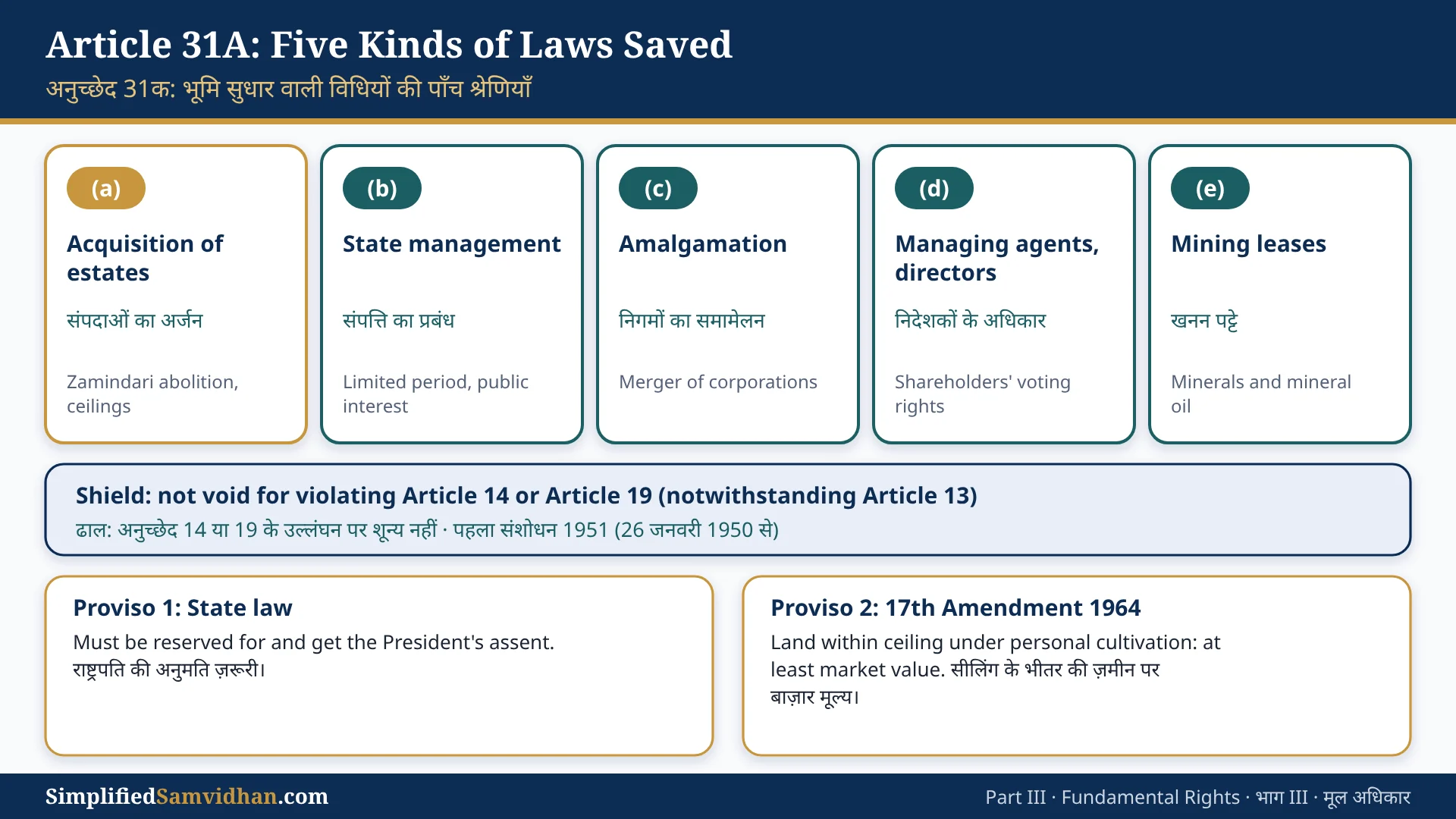
What it does: if a law falls in one of the five boxes of 31A(1), nobody can get it struck down by saying "it is unequal (Article 14)" or "it takes away my freedom of trade or property (Article 19)".
Box (a) is the big one: taking over estates of zamindars, jagirdars and other intermediaries, and land ceiling laws. This is how zamindari was abolished across India.
Boxes (b) to (e) cover temporary State management of property, mergers of companies, ending rights of managing agents and directors, and changing mining leases.
Safeguard 1: a State law gets this shield only if the President has given assent after it was reserved for him.
Safeguard 2 (17th Amendment): a small farmer's land within the ceiling that he cultivates himself cannot be taken unless at least market value is paid.
What it does not do: it does not protect against Article 21, 15, 25 or any right other than 14 and 19, and the law can still be checked for legislative competence and for the basic structure.
🏠 Everyday Analogy
Think of a village where a few families own all the fields and everyone else works on them. The panchayat decides to redistribute land. The big landlords rush to court saying "this treats us unequally". Article 31A is like a notice pasted on the court door: "Land redistribution cases cannot be argued on the ground of unequal treatment or loss of trade freedom." But the notice also says the small farmer's own field within the limit cannot be touched without full price.
🇮🇳 Real Indian Example
The Uttar Pradesh Zamindari Abolition and Land Reforms Act, 1950 ended the rights of zamindars and made the actual tillers bhumidhars. Later, ceiling Acts in Punjab, Maharashtra and West Bengal fixed the maximum land a family could hold and gave the surplus to landless labourers. Challenges under Articles 14 and 19 failed because of Article 31A. If a State today took a farmer's 3-acre field (within the ceiling) that he farms himself, it would have to pay at least the market value under the second proviso.
Five Kinds of LawsArticle 31A(1) of Indian Constitution: Five Categories of Laws Saved
| Clause | Kind of law saved | Real example |
|---|---|---|
| 31A(1)(a) | Acquisition by the State of any estate or rights in it, or ending or changing such rights | Zamindari abolition Acts of U.P. (1950), Bihar, Madhya Pradesh; land ceiling Acts |
| 31A(1)(b) | Taking over the management of any property for a limited period, in the public interest or for proper management | Government taking over a badly run mill or estate for some years |
| 31A(1)(c) | Amalgamation of two or more corporations in the public interest or for proper management | Merger of weak companies or banks ordered by law |
| 31A(1)(d) | Ending or changing rights of managing agents, directors, managers or voting rights of shareholders | Abolition of the managing agency system (1969-70) |
| 31A(1)(e) | Ending or changing rights under a mining lease, licence or agreement for minerals or mineral oil, or ending it early | Cancelling or revising old coal and oil prospecting leases |
Why 31A Was AddedArticle 31A and Land Reform: Why the First Amendment Added It
- At independence, a large part of farmland in many provinces was held under zamindari, with tillers paying rent to intermediaries. Abolishing zamindari was a Congress promise and a Directive Principle (Article 39(b) and (c)).
- States passed abolition Acts in 1949-51. The Patna High Court struck down the Bihar Land Reforms Act, 1950 in Kameshwar Singh (1951) because different rates of compensation for big and small zamindars broke Article 14.
- Within months the Nehru Government passed the Constitution (First Amendment) Act, 1951 (assent 18 June 1951). It added 31A and 31B, made 31A apply from 26 January 1950, and created the Ninth Schedule with 13 State land laws.
- Shankari Prasad v Union of India (1951) upheld the First Amendment, holding that Parliament could amend Fundamental Rights.
- The 4th Amendment 1955 added the other four categories, (b) to (e), to cover industrial and corporate reforms. The 17th Amendment 1964 widened "estate" after Karimbil Kunhikoman v State of Kerala (1962) held that ryotwari land in Kerala was not an "estate".
31A vs 31B vs 31CDifference Between Article 31A, 31B and 31C of Indian Constitution
| Point | Article 31A | Article 31B | Article 31C |
|---|---|---|---|
| Added by | 1st Amendment 1951 | 1st Amendment 1951 | 25th Amendment 1971 |
| Protects | Five categories of laws | Acts listed in the Ninth Schedule | Laws for Article 39(b) and (c) |
| Against | Articles 14 and 19 | Any Fundamental Right | Articles 14 and 19 |
| Needs listing? | No, falls in a category | Yes, must be in the Ninth Schedule | No, must give effect to 39(b)/(c) |
| State law | President's assent needed | Added by constitutional amendment | President's assent needed |
| Basic structure test | Upheld (Waman Rao 1981) | Laws after 24 Apr 1973 open (I.R. Coelho 2007) | Original part valid; extension struck (Minerva 1980) |
Quick RevisionKey Points to Remember
- Article 31A was added by the 1st Amendment 1951, effective from 26 January 1950.
- It saves five categories of laws from challenge under Articles 14 and 19 only.
- Category (a): acquisition of estates (zamindari abolition, ceiling); (b) to (e) added by the 4th Amendment 1955.
- State law must be reserved for and get the President's assent.
- 17th Amendment 1964: land within ceiling under personal cultivation only at market value.
- Waman Rao (1981): Article 31A is valid.
TimelineArticle 31A: Key Dates and Cases
| Year | Event |
|---|---|
| 1950 | U.P., Bihar and M.P. pass zamindari abolition Acts. |
| 1951 | Kameshwar Singh (Patna HC); 1st Amendment adds 31A (from 26 Jan 1950); Shankari Prasad. |
| 1955 | 4th Amendment rewrites 31A(1) with categories (a) to (e). |
| 1964 | 17th Amendment widens "estate" and adds the ceiling proviso. |
| 1965 | Sajjan Singh upholds the 17th Amendment. |
| 1978 | 44th Amendment removes the reference to Article 31. |
| 1981 | Waman Rao: Article 31A valid, not against basic structure. |
UPSC · State PSC · JudiciaryArticle 31A: UPSC Exam Corner
- Prelims trap: "Article 31A protects laws against all Fundamental Rights." False. Only against Articles 14 and 19 (31B protects against all of Part III).
- Prelims fact: Articles 31A and 31B were both added by the First Amendment, 1951; Article 31C by the 25th Amendment, 1971.
- Prelims fact: the ceiling proviso (market value for land within ceiling under personal cultivation) came with the 17th Amendment, 1964.
- Mains (150 words): "Articles 31A, 31B and 31C were the constitutional tools of land reform." Explain how each works and how the courts limited them.
Practice MCQTest Yourself: Article 31A
A law protected by Article 31A cannot be declared void on the ground that it violates which of the following? 1. Article 14 2. Article 19 3. Article 21
Doubts ClearedFrequently Asked Questions
What is Article 31A of Indian Constitution?
Article 31A saves five kinds of laws, mainly land reform and acquisition of estates, from being declared void for violating Articles 14 or 19. It was added by the First Amendment, 1951.
Does Article 31A need the President's assent?
Yes, for a law made by a State Legislature. The law must be reserved for the President's consideration and receive assent; otherwise it gets no protection under 31A.
What is the difference between Article 31A and 31B?
31A protects five categories of laws only against Articles 14 and 19, without listing. 31B protects Acts listed in the Ninth Schedule against all Fundamental Rights.