Bare ActOfficial Text of Article 35
35. Legislation to give effect to the provisions of this Part.—Notwithstanding anything in this Constitution,—
(a) Parliament shall have, and the Legislature of a State shall not have, power to make laws—
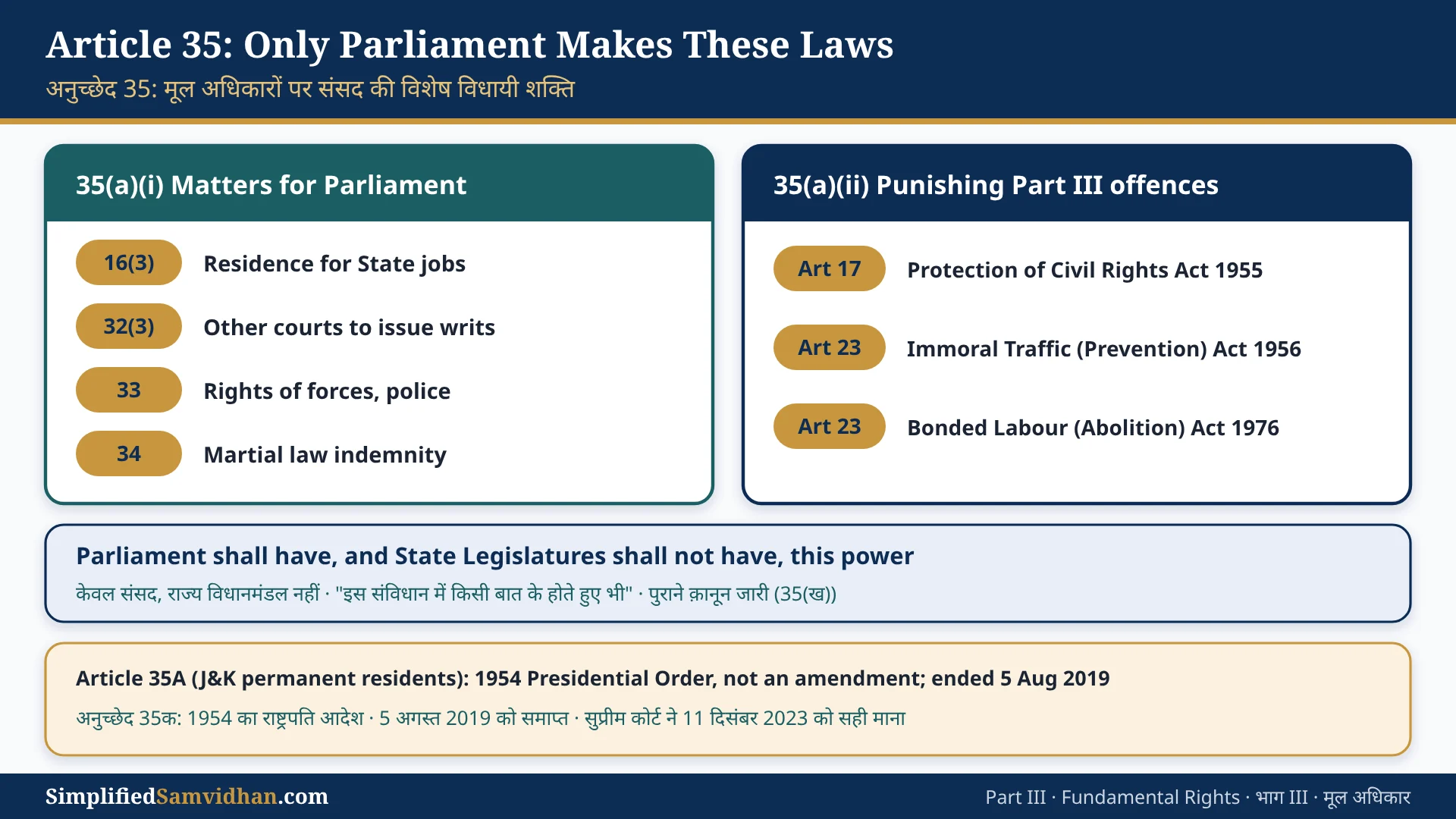
(i) with respect to any of the matters which under clause (3) of article 16, clause (3) of article 32, article 33 and article 34 may be provided for by law made by Parliament; and
(ii) for prescribing punishment for those acts which are declared to be offences under this Part;
and Parliament shall, as soon as may be after the commencement of this Constitution, make laws for prescribing punishment for the acts referred to in sub-clause (ii);
(b) any law in force immediately before the commencement of this Constitution in the territory of India with respect to any of the matters referred to in sub-clause (i) of clause (a) or providing for punishment for any act referred to in sub-clause (ii) of that clause shall, subject to the terms thereof and to any adaptations and modifications that may be made therein under article 372, continue in force until altered or repealed or amended by Parliament.
Explanation.—In this article, the expression "law in force" has the same meaning as in article 372.
One law for the whole country: if every State made its own punishment for untouchability, a person could be jailed in one State and fined lightly in another. Article 35 gives this power only to Parliament.
Duty, not just power: Parliament "shall, as soon as may be" make punishment laws. It did so with the Untouchability (Offences) Act, 1955 (now the Protection of Civil Rights Act).
Old laws continue: laws on these matters that existed before 1950 stay in force until Parliament changes them (clause (b)).
"Notwithstanding anything in this Constitution": this overrides the State List too, so even police and public order (State subjects) cannot be used by States to make laws under Article 33.
🏠 Everyday Analogy
In a cricket tournament played in many cities, the rules on no-balls and penalties are set by one central board, not by each stadium. Article 35 makes Parliament that central board for punishing Part III offences, so the rules are the same everywhere in India.
🇮🇳 Real Indian Example
If a shopkeeper in Bihar or Gujarat refuses to sell goods to a Dalit customer because of caste, the same Central law applies in both places: the Protection of Civil Rights Act, 1955, with up to six months' jail and a fine for a first offence. A State cannot make a softer or different punishment, because of Article 35.
Laws Made Under 35Article 35 of Indian Constitution: Matters and Laws Only Parliament Can Make
| Matter | What it is about | Law made by Parliament |
|---|---|---|
| Article 16(3) | Residence requirement for jobs in a State | Public Employment (Requirement as to Residence) Act, 1957 (lapsed 1974) |
| Article 32(3) | Other courts to issue writs | No law made so far |
| Article 33 | Rights of armed forces, police, intelligence | Army Act 1950, Police Forces (Restriction of Rights) Act 1966 |
| Article 34 | Indemnity after martial law | None (never needed) |
| Article 17 offence | Untouchability | Protection of Civil Rights Act, 1955 (renamed 1976) |
| Article 23 offence | Traffic in human beings, begar, forced labour | Immoral Traffic (Prevention) Act 1956; Bonded Labour System (Abolition) Act 1976 |
Article 35A StoryWhat Was Article 35A? Jammu and Kashmir Permanent Residents (1954-2019)
- Not in the main text: Article 35A was never passed by Parliament under Article 368. It was added by the Constitution (Application to Jammu and Kashmir) Order, 1954, issued by President Rajendra Prasad on 14 May 1954 under Article 370. It appeared only in the appendix of printed Constitutions.
- What it did: it protected J&K laws that defined "permanent residents" and gave them special rights in State jobs, buying land, settling in the State and scholarships, even if these laws broke Fundamental Rights of other Indian citizens.
- Why it was controversial: people from outside (and, for many years, women who married non-residents) could not buy property or get State jobs; West Pakistan refugees settled in J&K since 1947 could not vote in Assembly elections.
- How it ended: on 5 August 2019 the President issued C.O. 272 applying the whole Constitution to J&K, and Article 370 was made inoperative. Article 35A ended with it. The J&K Reorganisation Act, 2019 created two Union Territories.
- Supreme Court: in In re Article 370 (11 December 2023, five judges) the Court upheld the 2019 decisions.
Quick RevisionKey Points to Remember
- Article 35 is the last Article of Part III.
- Only Parliament legislates on Articles 16(3), 32(3), 33 and 34.
- Only Parliament prescribes punishment for Part III offences (Articles 17, 23).
- Pre-1950 laws on these matters continue until Parliament changes them.
- Article 35A (J&K, 1954 Presidential Order) ended on 5 August 2019.
TimelineArticle 35 and 35A: Key Dates
| Year | Event |
|---|---|
| 1950 | Article 35 in force with the Constitution. |
| 1954 | Article 35A added for J&K by Presidential Order (14 May). |
| 1955 | Untouchability (Offences) Act passed. |
| 1976 | Renamed Protection of Civil Rights Act; Bonded Labour Act passed. |
| 2019 | Article 35A ends with C.O. 272 (5 August). |
| 2023 | In re Article 370: Supreme Court upholds the 2019 changes (11 December). |
UPSC · State PSC · JudiciaryArticle 35: UPSC Exam Corner
- Prelims trap: "Article 35A was inserted by a constitutional amendment." False. It came by a Presidential Order under Article 370 in 1954.
- Prelims fact: Parliament's power under Article 35 overrides the State List ("Notwithstanding anything in this Constitution").
Practice MCQTest Yourself: Article 35
Under Article 35, the power to prescribe punishment for the practice of untouchability lies with:
Doubts ClearedFrequently Asked Questions
What is Article 35 of Indian Constitution?
Article 35 gives Parliament, and not the States, the power to make laws on matters under Articles 16(3), 32(3), 33 and 34 and to prescribe punishment for offences declared in Part III, such as untouchability.
Is Article 35A still in force?
No. Article 35A applied only to Jammu and Kashmir and ended on 5 August 2019, when the whole Constitution was applied to J&K. The Supreme Court upheld this in December 2023.