Bare ActOfficial Text of Article 30
30. Right of minorities to establish and administer educational institutions.—
(1) All minorities, whether based on religion or language, shall have the right to establish and administer educational institutions of their choice.
(1A) In making any law providing for the compulsory acquisition of any property of an educational institution established and administered by a minority, referred to in clause (1), the State shall ensure that the amount fixed by or determined under such law for the acquisition of such property is such as would not restrict or abrogate the right guaranteed under that clause.
(2) The State shall not, in granting aid to educational institutions, discriminate against any educational institution on the ground that it is under the management of a minority, whether based on religion or language.
Two kinds of minorities get this right: religious (e.g. Christians, Sikhs, Jains) and linguistic (e.g. Telugu speakers in Karnataka, Bengali speakers in Odisha).
"Establish and administer": the community must have set up the institution, and then it can run it: admissions, staff, management.
"Of their choice": it can be any kind of institution, a school, an engineering college or a university, teaching any subject, not only religion or language.
The right is not absolute: the State can regulate standards, fees and fairness, but cannot take away the minority's control.
Who counts as a minority is decided State by State for Article 30 (T.M.A. Pai, 2002).
🏠 Everyday Analogy
A minority institution is like a house a family built with its own savings. The city can make it follow building and fire-safety rules (standards), and the family cannot use it to cheat buyers (no capitation fee). But the city cannot take away the keys and run the house itself (administration stays with the family).
🇮🇳 Real Indian Example
St. Stephen's College in Delhi was founded by a Christian mission and can give some preference to Christian students. Khalsa College, Amritsar, is run by a Sikh body. A Telugu association running a Telugu-medium school in Bengaluru uses the same Article as a linguistic minority. Each can choose its staff, but each must follow the university's or board's academic rules.
Three ClausesArticle 30 of Indian Constitution: Three Clauses Explained
| Clause | What it says | In simple words |
|---|---|---|
| 30(1) | All minorities, based on religion or language, have the right to establish and administer educational institutions of their choice | A minority community can open and run its own school, college or university |
| 30(1A) | If the State compulsorily acquires the property of a minority institution, the amount fixed must not restrict or abrogate the right in 30(1) | Compensation must be fair enough that the institution can carry on. Added by the 44th Amendment 1978 |
| 30(2) | The State shall not discriminate in granting aid to an institution because it is under minority management | Minority schools get grants on the same terms as others |
Key features
- A group right: it belongs to the minority community, and is exercised through the institutions it sets up.
- Only religion or language: there is no minority based on caste, region or income under Article 30.
- Purpose: the St. Xavier's College case (1974, 9 judges) said Article 30 is meant to give minorities a sense of security and equality, not to make them a privileged class.
- Aid and recognition are not a right: there is no fundamental right to State aid or to recognition. But if the State gives aid or recognition, it can attach only conditions that serve standards, not conditions that destroy the minority character (Kerala Education Bill, 1958).
- Who checks status: the National Commission for Minority Educational Institutions (NCMEI), set up under the NCMEI Act 2004, can grant or cancel a minority status certificate; State authorities also do so.
Who is a MinorityArticle 30 and Minority Status: Who is a Minority in India?
- The Constitution does not define "minority". Article 29 does not use the word in its text; Article 30 uses it but only says "based on religion or language".
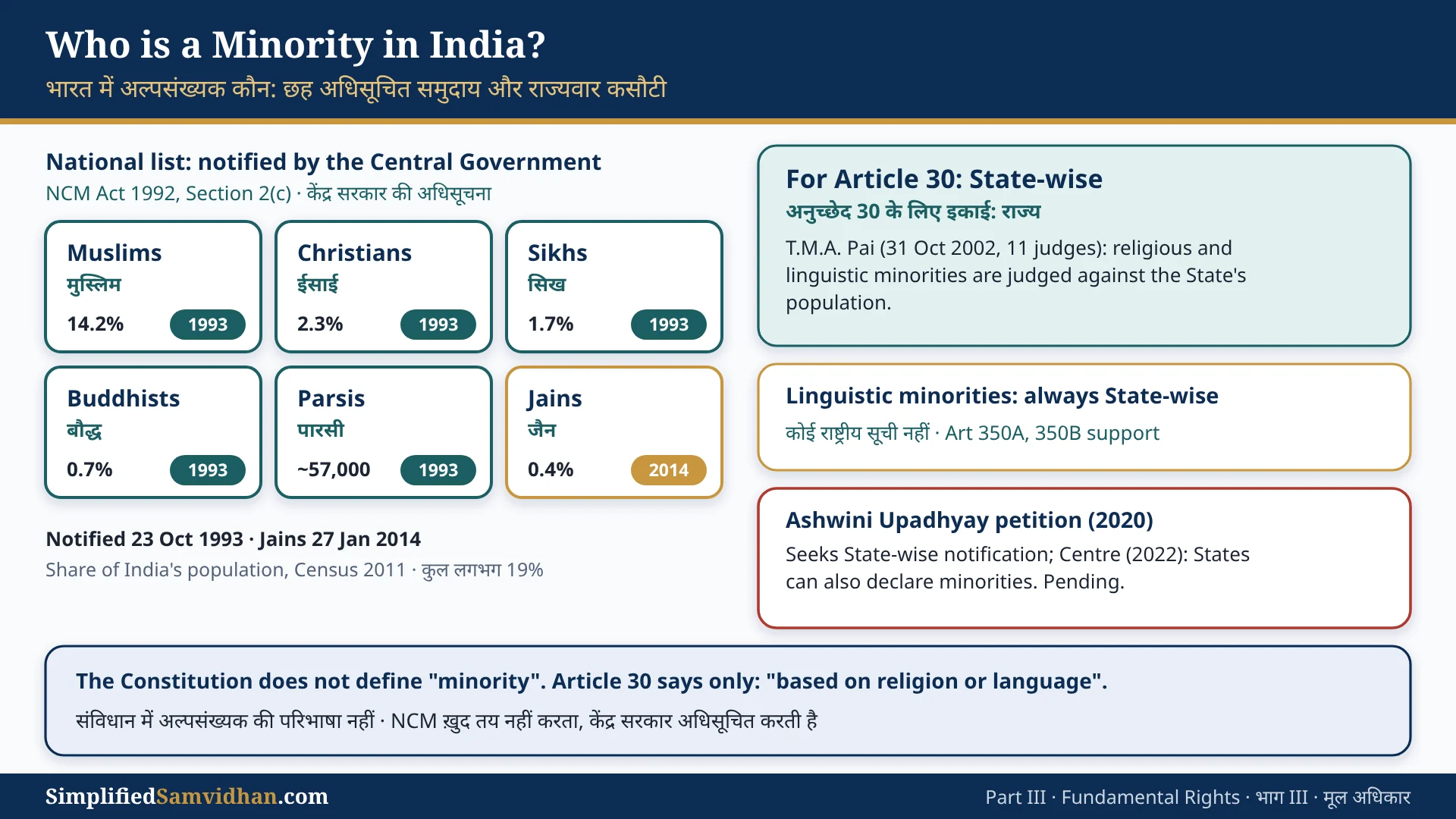
- Religious minorities (national list): Section 2(c) of the National Commission for Minorities Act, 1992 says a minority is a community notified by the Central Government. The NCM itself does not decide; it monitors safeguards and hears complaints.
- Notified so far, on the basis of their share in India's population: Muslims, Christians, Sikhs, Buddhists and Parsis (23 October 1993) and Jains (27 January 2014). Together they are about 19% of India's population (Census 2011).
| Community | Notified | Share of India's population (Census 2011) |
|---|---|---|
| Muslims | 23 October 1993 | 14.2% |
| Christians | 23 October 1993 | 2.3% |
| Sikhs | 23 October 1993 | 1.7% |
| Buddhists | 23 October 1993 | 0.7% |
| Parsis (Zoroastrians) | 23 October 1993 | about 57,000 people |
| Jains | 27 January 2014 | 0.4% |
Linguistic minorities
- There is no national list of linguistic minorities. Since States were reorganised on linguistic lines (1956), a linguistic minority is a group whose mother tongue differs from the main language of that State, e.g. Urdu, Tamil or Marathi speakers in Karnataka.
- Articles 350A (instruction in the mother tongue at primary stage) and 350B (Special Officer for Linguistic Minorities, now the Commissioner for Linguistic Minorities) support them.
National or State-wise? The T.M.A. Pai test
- In T.M.A. Pai Foundation v. State of Karnataka (31 October 2002) an 11-judge bench held that, for Article 30, both religious and linguistic minorities are to be determined State-wise, with the State as the unit.
- Reasons given: States were reorganised on a linguistic basis, and education is largely legislated and administered at State level by State education departments; so a group's position must be seen in the State whose law applies. Earlier, D.A.V. College v. State of Punjab (1971) had judged minority status against the State's population for a State law.
- So a community that is a majority in India can be a minority in a State, and the reverse. At the same time, the national list of six communities continues to be used for the NCM and Central schemes. The gap between the two is what the next section is about.
State-level Minority DebateArticle 30 and the Ashwini Upadhyay Petition: Should Minorities Be Identified State-wise?
- The petition: in Ashwini Kumar Upadhyay v. Union of India (filed 2020) the petitioner challenged Section 2(c) of the NCM Act and the NCMEI Act and asked for guidelines to identify minorities State-wise.
- His argument: in several States and UTs, followers of the national majority religion are fewer in number (by Census 2011, for example, Lakshadweep, Mizoram, Nagaland, Meghalaya, Jammu and Kashmir, Arunachal Pradesh, Manipur and Punjab; Ladakh is cited too), yet they cannot get minority benefits there, while a nationally notified community that is a majority in that State can.
- The Centre's response (2022): in its affidavits the Union said that States can also declare a religious or linguistic community a minority within their territory, giving examples such as Maharashtra notifying Jews (2016) and Karnataka notifying several linguistic minorities. It later said the power to notify lies with the Centre and that it was consulting States and UTs. The Court asked for a clear and final stand.
- Status: the matter was pending before the Supreme Court at the last verified hearing. Until it is decided, the national notification under the NCM Act continues, and courts apply Article 30 on the State-wise T.M.A. Pai test.
Arguments on both sides
| Points made for State-level notification | Points made for the present national system |
|---|---|
| T.M.A. Pai already says minorities for Article 30 are counted State-wise; notification should match it | Article 30 is already applied State-wise by courts; the national list mainly serves Central schemes and the NCM |
| A community that is fewer in a State may need the same protection there as notified minorities elsewhere | Central welfare schemes need one national list; many State lists could make them hard to run |
| Education is largely run by State departments, so the State is the natural unit | Going below the State (district or block) could split communities into many small categories |
| The Centre itself said States can also declare minorities (e.g. Jews in Maharashtra, 2016) | The Centre also said the power to notify lies with the Union and asked for wide consultation first |
Way forward (exam view)
- Points often made in UPSC answers: bring the notification process in line with the State-wise test already laid down in T.M.A. Pai, through consultation between the Centre and the States.
- Keep separate the two questions that often get mixed: Article 30 rights (already State-wise) and eligibility for Central welfare schemes (national list).
- Use transparent data, such as Census figures, and clear criteria, so that decisions are seen as fair by all communities.
- Whatever the final unit, the aim of Articles 29 and 30 is security and equality for every group, as the Supreme Court said in St. Xavier's (1974).
Rights and LimitsArticle 30 of Indian Constitution: Rights and Limits of Minority Educational Institutions
| Minority institutions CAN | Minority institutions MUST |
|---|---|
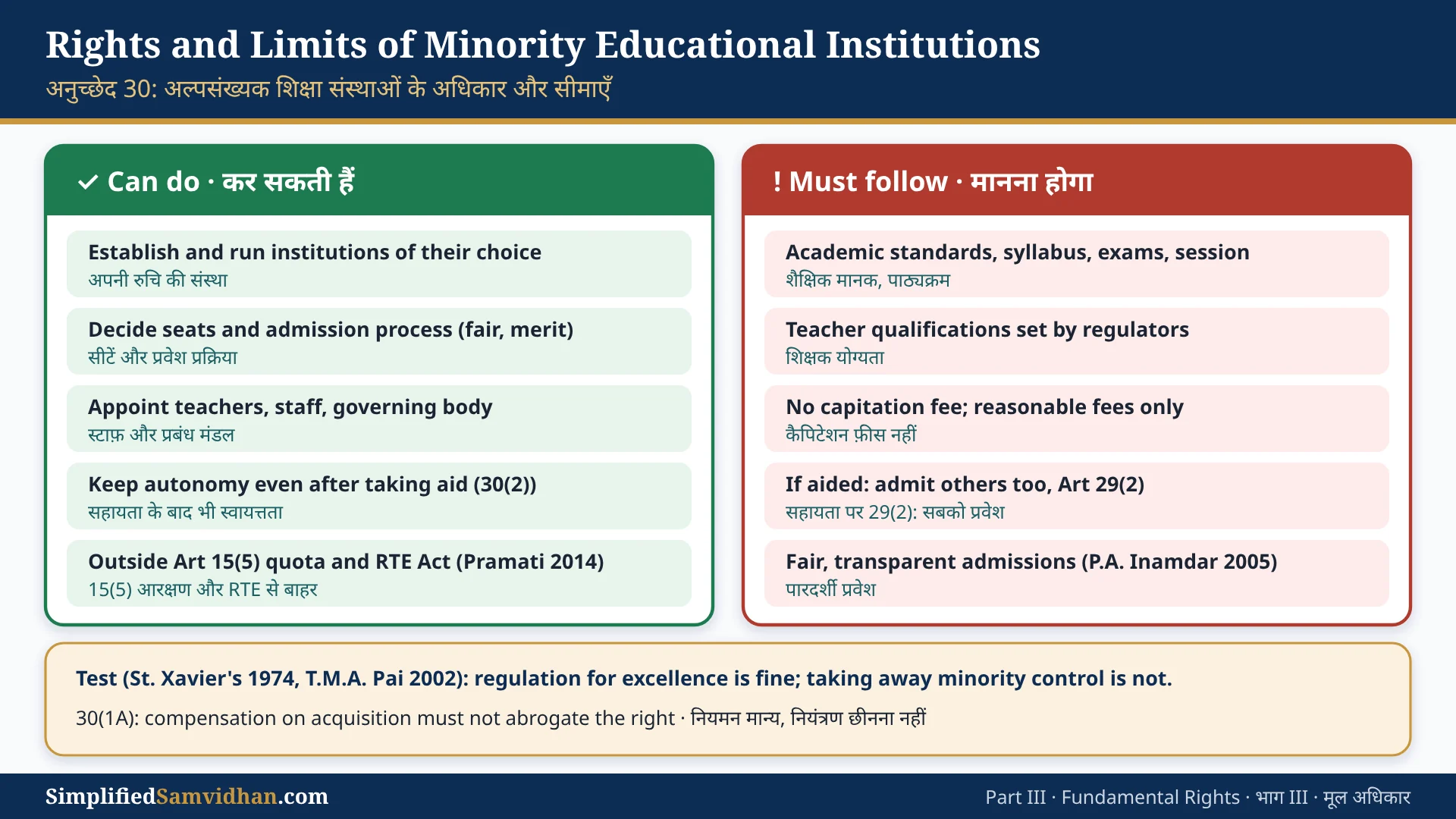
| Choose their own admission process and decide seats, including for non-minority students (fairly and on merit) | Follow regulations on academic standards, syllabus, teacher qualifications, the academic session and exams |
| Appoint teachers and staff, and set up their own governing body | Not charge a capitation fee; fees must be reasonable (a reasonable surplus is allowed) |
| Keep their autonomy even after taking government aid (Article 30(2)) | If aided, admit students of other communities too (Article 29(2)); a reasonable share for their own community is allowed |
| Stay outside SC/ST/OBC reservation under Article 15(5) and outside the RTE Act's 25% quota (Pramati 2014) | Pay staff fairly and follow service safeguards linked to aid; admission must be transparent |
Points to remember
- Admissions: a minority institution can decide its seats and admission process, also for non-minority students, but the process must be fair, transparent and merit-based (T.M.A. Pai 2002; P.A. Inamdar 2005). Unaided institutions have the most freedom.
- Own community share: it may admit a reasonable share of students of its own community: up to about 50% in St. Stephen's (1992); T.M.A. Pai said there is no rigid ratio and the State may fix a reasonable one for aided institutions.
- No profiteering: education is not for profit; capitation fees are barred, though a reasonable surplus for growth is allowed.
- Aid does not end autonomy: Article 30(2) bars discrimination in aid, and taking aid does not turn a minority institution into a State institution. But aid can carry conditions on standards, accounts and service conditions.
- Regulation for excellence: the State may prescribe syllabus standards, teacher qualifications, the academic session and exams, so long as these do not destroy the minority character (St. Xavier's 1974).
- Reservation (Article 15(5)): the 93rd Amendment 2005 lets the State reserve seats for SCs, STs and OBCs in educational institutions, including private ones, but expressly excludes minority institutions under Article 30(1). Upheld in Ashoka Kumar Thakur (2008) and Pramati (2014).
- RTE Act 2009: in Pramati Educational and Cultural Trust (6 May 2014, 5 judges) the Court held that the RTE Act, including the 25% quota, does not apply to minority schools, aided or unaided. Before that the position for aided minority schools was unclear.
- Land acquisition: Article 30(1A) requires compensation that does not restrict or abrogate the right. Separately, the RFCTLARR Act 2013 (which replaced the Land Acquisition Act 1894) gives every land owner about 2 times (urban) to up to 4 times (rural) the market value; this higher rate is not a special benefit for minorities.
Landmark CasesArticle 30 of Indian Constitution: Landmark Cases from Kerala Education Bill to AMU (2024)
- In re Kerala Education Bill (1958, advisory opinion under Article 143): Article 30 is not absolute; the State may regulate for standards, but conditions of aid or recognition cannot destroy the minority character. Minority institutions may also admit others and teach secular subjects.
- Rev. Sidhrajbhai Sabbai v. State of Gujarat (1963): regulations must be in the interest of the institution's efficiency; an order reserving 80% of seats in a minority teachers' training college for government nominees was struck down.
- Ahmedabad St. Xavier's College Society v. State of Gujarat (1974, 9 judges): university rules that took control of appointments and discipline away from the minority management were invalid; the aim of Article 30 is equality, not privilege.
- St. Stephen's College v. University of Delhi (1992): an aided minority college may give preference to its own community up to about 50%, with the rest on merit.
- T.M.A. Pai Foundation v. State of Karnataka (2002, 11 judges): minorities counted State-wise; right to admit students, fix reasonable fees, appoint staff and manage, with more freedom for unaided institutions; no capitation fee.
- Islamic Academy of Education (2003) and P.A. Inamdar v. State of Maharashtra (2005, 7 judges): the State cannot impose its reservation policy on unaided institutions; admissions through a fair, transparent, merit-based process; fee regulation to prevent profiteering.
- Pramati Educational and Cultural Trust v. Union of India (2014, 5 judges): Article 15(5) valid; RTE Act does not apply to minority schools.
The AMU case (8 November 2024)
- Background: Aligarh Muslim University grew out of the Muhammadan Anglo-Oriental College (1875) and became a university under the AMU Act 1920. In S. Azeez Basha v. Union of India (1967, 5 judges) the Court held AMU was established by the central legislature, not by the Muslim community, so it could not claim Article 30.
- Parliament amended the AMU Act in 1981. In 2006 the Allahabad High Court held that AMU was not a minority institution; appeals reached the Supreme Court and the question went to a 7-judge bench in 2019.
- Judgment (8 November 2024, 4:3): the majority (CJI D.Y. Chandrachud, with Justices Sanjiv Khanna, J.B. Pardiwala and Manoj Misra) overruled Azeez Basha. An institution does not lose minority character merely because it was incorporated by a statute. The test is who established it: courts look at its genesis, such as whose idea it was, who gave the land and money, and whether it was set up mainly for the community. Administration need not be wholly by the minority.
- Three judges (Justices Surya Kant, Dipankar Datta and Satish Chandra Sharma) dissented, for differing reasons.
- AMU's own status was left to a regular bench to decide by applying these tests; that was pending at the last verified hearing.
Quick RevisionKey Points to Remember
- Religious and linguistic minorities can establish and administer educational institutions of their choice.
- 30(1A) (44th Amendment 1978): compensation on acquisition must not destroy the right; 30(2): no discrimination in aid.
- "Minority" is not defined; the Central Government notifies six religious minorities under the NCM Act 1992 (Jains in 2014).
- T.M.A. Pai (2002): for Article 30, minorities are counted State-wise; the Ashwini Upadhyay petition on State-level notification is pending.
- Minority institutions are outside Article 15(5) reservation and the RTE Act (Pramati 2014); AMU case 2024 overruled Azeez Basha.
TimelineArticle 30: Key Dates, Laws and Cases
| Year | Event |
|---|---|
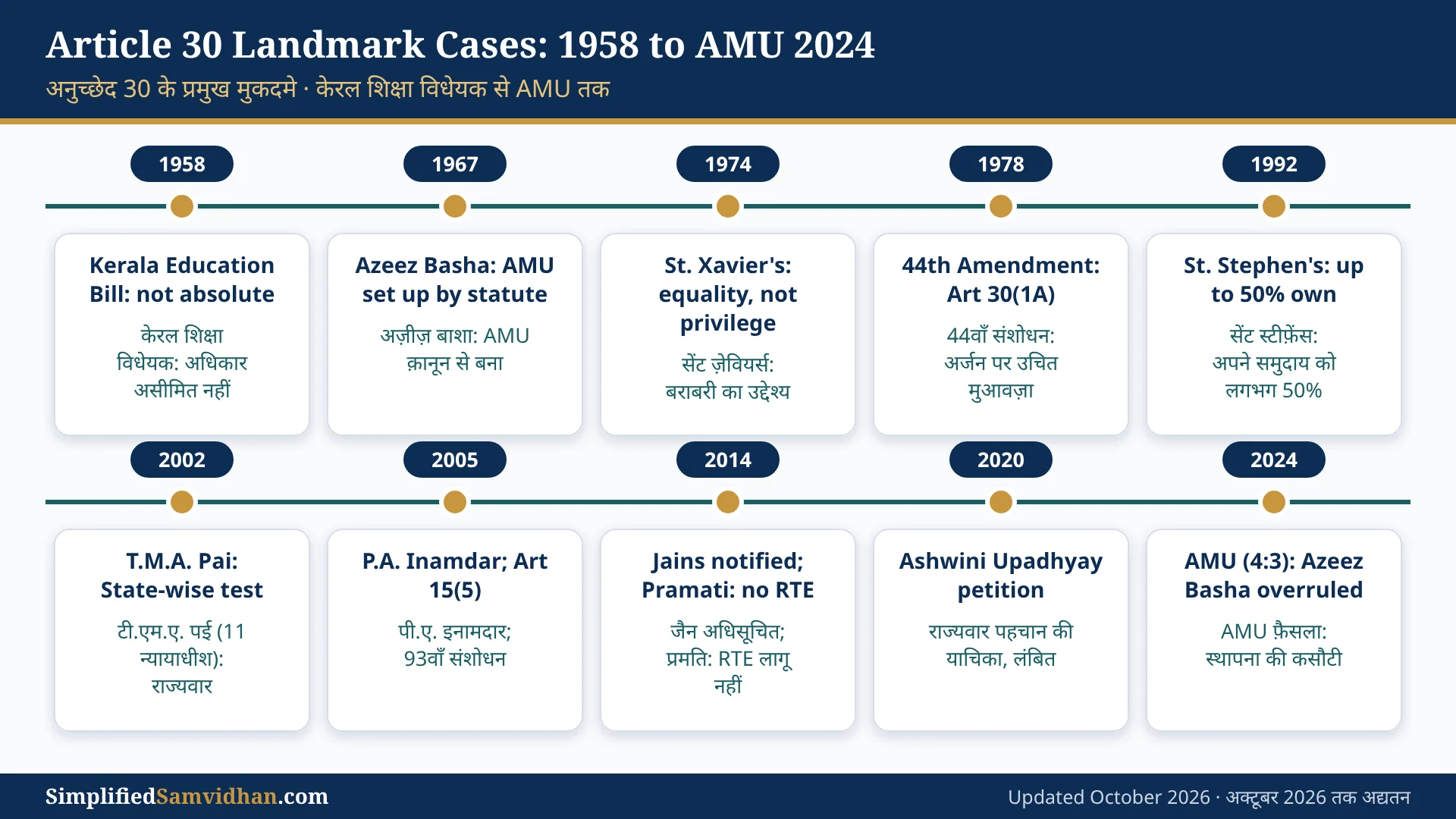
| 1958 | Kerala Education Bill: Article 30 not absolute; regulation for standards allowed. |
| 1967 | Azeez Basha: AMU established by statute, not by the minority. |
| 1974 | St. Xavier's (9 judges): equality, not privilege; control of management protected. |
| 1978 | 44th Amendment inserts Article 30(1A) (in force 20 June 1979). |
| 1992 | NCM Act; St. Stephen's: up to about 50% for own community. |
| 1993 | Five religious minorities notified (23 Oct). |
| 2002 | T.M.A. Pai (11 judges, 31 Oct): State-wise test; rights of management. |
| 2004 | NCMEI Act sets up the National Commission for Minority Educational Institutions. |
| 2005 | P.A. Inamdar (7 judges); 93rd Amendment adds Article 15(5), excluding minority institutions. |
| 2014 | Jains notified (27 Jan); Pramati (6 May): RTE not for minority schools. |
| 2020 | Ashwini Upadhyay petition for State-wise minority identification (pending). |
| 2024 | AMU case (8 Nov, 7 judges, 4:3): Azeez Basha overruled. |
UPSC · State PSC · JudiciaryArticle 30: UPSC Exam Corner
- Prelims trap: "The National Commission for Minorities notifies minority communities." False. The Central Government notifies them under Section 2(c) of the NCM Act 1992.
- Prelims trap: "Article 30 covers minorities based on religion, language and caste." False. Only religion or language.
- Prelims fact: Clause (1A) was added by the 44th Amendment 1978; Jains were notified as a minority on 27 January 2014.
- Mains (from the class notes, 250 words): Describe the constitutional and legal provisions for identifying minorities, and how far identifying minorities on the basis of national or State population is appropriate, keeping the Supreme Court's view in mind.
- Practice (150 words): "Article 30 aims at equality, not privilege." Examine with reference to the regulation of minority educational institutions.
Practice MCQTest Yourself: Article 30
Consider the following statements: 1. The Constitution of India defines the term "minority". 2. For Article 30, religious and linguistic minorities are determined State-wise (T.M.A. Pai, 2002). 3. Jains were notified as a minority community in 2014. Which of the statements given above are correct?
Doubts ClearedFrequently Asked Questions
What is Article 30 of Indian Constitution?
Article 30 gives all religious and linguistic minorities the right to establish and administer educational institutions of their choice. Clause (1A) protects them in land acquisition, and clause (2) bars discrimination against them in government aid.
Who is a minority in India?
The Constitution does not define it. Under the NCM Act 1992, the Central Government has notified six religious minorities: Muslims, Christians, Sikhs, Buddhists, Parsis (1993) and Jains (2014). For Article 30, the Supreme Court in T.M.A. Pai (2002) said religious and linguistic minorities are decided State-wise.
Can Hindus be a minority under Article 30?
Under the T.M.A. Pai test, a group that is fewer in number in a particular State can claim Article 30 there, and courts have treated groups this way (for example in D.A.V. College, 1971). Whether States or the Centre should formally notify such groups is the question in the Ashwini Upadhyay petition, pending before the Supreme Court at the last verified hearing.
What did the Supreme Court decide in the AMU case in 2024?
On 8 November 2024 a 7-judge bench, by 4:3, overruled Azeez Basha (1967). It held that an institution does not lose minority character just because a statute incorporated it; the test is who established it. Whether AMU itself is a minority institution was left to a regular bench.
Does the RTE Act apply to minority schools?
No. In Pramati Educational and Cultural Trust v. Union of India (2014) a 5-judge bench held that the RTE Act 2009, including the 25% quota for weaker sections, does not apply to minority schools, aided or unaided.